
How to Build a Quartz Slab Product Line for Wholesale Buyers
Quick Answer: Start With the Buying Scenario, Not the Color Catalog
A profitable wholesale quartz line begins with the customer segment you need to serve, then works backward into colors, slab sizes, thickness, finishes, packing, and reorder logic. For most buyers, the first line should combine high-turnover solid colors, marble-inspired designs, and a limited premium range rather than chasing every new surface trend.
Wholesale buyers often make the mistake of treating quartz sourcing as a design exercise. Color matters, but it is only one part of the decision. A slab line must be easy for fabricators to cut, simple for distributors to stock, predictable for contractors to specify, and stable enough for repeat orders across several months.
The practical starting point is to define three levels: a stock range, a project range, and a selective design range. The stock range should cover fast-moving neutral colors for kitchens, vanities, apartment projects, and regular countertop programs. The project range should support bulk orders where batch consistency, size confirmation, and packing stability are more important than visual experimentation. The design range can include Calacatta-style, marble look, or printed quartz surfaces for showrooms and higher-value countertop applications.
Buyers comparing quartz slabs should also decide whether they are building inventory for resale, sourcing materials for fabrication, or preparing a project tender. A distributor needs stock discipline and fast reorder planning. A countertop fabricator needs slab dimensions, thickness options, vein consistency, and fabrication support. A contractor needs packaging, delivery coordination, and lower risk during installation.
The best product line is not the largest line. It is the line that can be quoted clearly, sampled quickly, inspected before shipment, loaded efficiently, and reordered without forcing the buyer to restart the selection process each time.

The Buyer Problem: Too Many Designs, Too Little Supply Logic
The main sourcing problem is not finding enough designs; it is building a range that can be sold, fabricated, shipped, and reordered with controlled risk. Wholesale buyers need a product line that balances market appeal with operational discipline, especially when selling to fabricators, project contractors, kitchen cabinet suppliers, and import channels.
A showroom can display dozens of attractive samples, but wholesale supply works differently. A color that looks strong in a sample box may become slow-moving inventory if it does not match local cabinet trends, apartment specifications, or countertop fabricator cutting habits. A premium vein pattern may attract attention, but it may also require tighter batch control and clearer slab matching rules.
For importer and distributor teams, the first risk is overextending the range. Too many colors create fragmented inventory, uncertain reorder quantities, and higher warehouse pressure. The second risk is under-defining the specification. If thickness, slab size, finish, surface tolerance, and packing method are not agreed before production, the buyer may receive material that is technically usable but commercially difficult to sell.
The third risk is treating all suppliers as equal. A basic trading offer may look attractive at quotation stage, but buyers still need to know how samples are confirmed, how batches are separated, how slabs are inspected, how labels are prepared, and how export packing is handled before shipment. For a wholesale line, the supplier’s workflow is part of the product.
This is why the line-building process should move from market role to product category, then to specification, quality control, packing, and reorder planning. When the sequence is reversed, buyers often end up with a mixed container that is visually interesting but hard to standardize.
- Stock range
- A controlled group of regularly ordered colors intended for distributor inventory, countertop fabricator supply, and predictable local resale.
- Project range
- A set of surfaces, sizes, and production rules prepared for apartments, hotels, commercial interiors, or repeated cut-to-size programs.
- Batch consistency
- The control of color tone, vein movement, surface finish, and slab grouping within an order so the buyer can sell or install material with fewer matching issues.
Key Takeaways
- Wholesale buyers should start with customer role, order frequency, and local application needs before choosing colors.
- A strong entry line usually includes solid neutrals, classic whites and greys, marble-inspired surfaces, and a limited premium design group.
- Supplier evaluation should include sample control, batch management, QC before shipment, export packing, and container loading coordination.
- The most useful quartz line is easy to quote, inspect, fabricate, ship, and reorder, not simply the widest catalog available.
Decision Table: What Type of Quartz Line Should a Wholesale Buyer Build?
The right product line should match the buyer’s sales channel and risk profile. Distributors should prioritize stock turnover, fabricators should prioritize workable slab specifications, and project buyers should prioritize consistency, packing, and delivery coordination.
The following buyer decision table helps separate product-line choices by commercial situation. It is designed for teams comparing engineered quartz slabs for wholesale, project tenders, and countertop supply programs.
| Buyer situation | Recommended line focus | Best product mix | Supplier capability to verify | Main risk to avoid |
|---|---|---|---|---|
| New distributor testing a market | Controlled stock range | Solid whites, warm greys, light neutrals, two or three marble look designs | Repeatable samples, clear labeling, mixed-container coordination | Ordering too many low-volume colors in the first shipment |
| Countertop fabricator expanding supply | Fabrication-friendly range | Stable patterns, popular thickness options, standard slab formats, simple matching rules | Thickness control, surface inspection, cut-to-size or prefab support | Selecting dramatic patterns that create avoidable seam and layout problems |
| Project contractor preparing a tender | Project specification range | Approved colors with documented sizes, finish, edge requirements, and packing method | Batch separation, QC records, export packing, delivery coordination | Confirming design only, while leaving packing and schedule unclear |
| Importer serving several customer types | Balanced wholesale line | Core solids, classic quartz slab colors, Calacatta-style surfaces, selective premium designs | Factory-direct communication, reorder planning, container loading support | Mixing too many unrelated categories without a reorder strategy |
| Kitchen cabinet supplier adding countertop options | Kitchen-matching range | Cabinet-friendly whites, beige tones, soft grey surfaces, prefab countertop options | Custom cut-to-size quartz, edge profile options, packaging for jobsite delivery | Choosing colors that look good alone but do not match cabinet programs |
How to use this table: Match your main buyer situation to one row first, then build the first order around that recommendation before adding secondary categories.
For many wholesale buyers, the balanced line is the safest commercial entry point. It can include classic quartz slab colors for regular orders, a few marble-inspired designs for showroom appeal, and selected premium patterns for higher-margin countertop projects. Buyers who want a narrower entry range can review solid and classic quartz slabs as a practical reference for steady countertop supply.
How to Select Categories for a Wholesale Quartz Slab Program
A wholesale program should group products by sales function: everyday stock, project-safe designs, showroom drivers, and custom-order surfaces. This structure prevents the catalog from becoming a random collection of samples and helps sales teams explain the line clearly to distributors, fabricators, and contractors.
Start With Core Solids and Classic Neutrals
Core solids and classic neutral surfaces should usually form the base of the line because they are easier to sell across kitchens, bathrooms, apartments, rental units, and commercial interiors. White, off-white, light grey, beige, and soft concrete-style surfaces often work with many cabinet and wall finishes.
These colors are also easier for countertop fabricators to manage. Vein direction, slab matching, and seam planning are usually less complicated than with dramatic patterns. For a buyer preparing regular wholesale orders, this means fewer complaints, easier replacement planning, and simpler inventory decisions.
Add Marble-Inspired and Calacatta-Style Designs Carefully
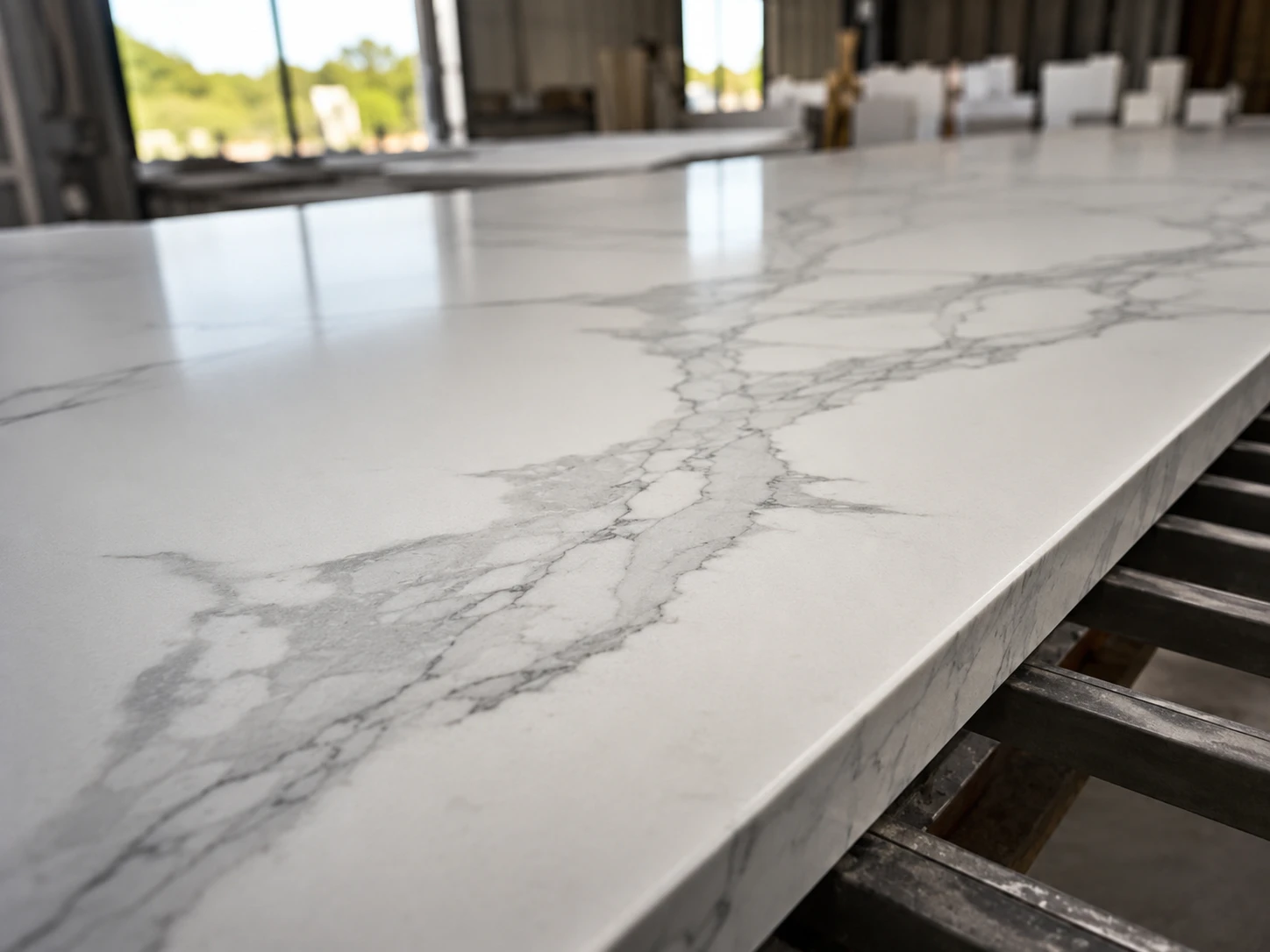
Marble-inspired designs can strengthen showroom value, but they require more disciplined selection. The buyer should check vein scale, background tone, slab-to-slab consistency, and whether the pattern works for island tops, vanities, and long countertops.
Calacatta-style surfaces should not be chosen only from small chips. Large-format review matters because a design that looks elegant in a hand sample may appear too busy or too sparse across a full slab. Buyers can use this quartz slab buying guide for distributors and fabricators when comparing sample approval, slab size, and project-use criteria.
Use Printed and Premium Designs as Selective Additions
Printed quartz and more expressive surfaces can be valuable for buyers targeting design-led projects, retail showrooms, or premium residential countertops. They should be positioned as selective options rather than the base of the first wholesale line.
The reason is operational. More complex designs can require stronger photo confirmation, clearer batch labeling, and more careful customer communication. If a buyer cannot explain how the design repeats, how slabs are grouped, and how replacement material is handled, the design may create more risk than margin.
Factory and Supplier Considerations Before Ordering
A wholesale buyer should evaluate the supplier’s production and export workflow as seriously as the surface design. A capable quartz slab supplier should help confirm samples, specifications, inspection points, packing details, document flow, and long-term reorder communication before the buyer commits to a larger program.
Factory-direct sourcing is valuable when it gives the buyer clearer control over product details. The key is not just whether a company says it is a factory. The buyer should ask who controls production planning, who confirms the slab batch, who handles pre-shipment inspection, and who communicates changes if raw material, color tone, or schedule conditions shift.
For a Malaysia quartz source factory, the expected buyer value is practical coordination: factory-direct quartz supplier communication, project support, QC before shipment, export packing, and container loading planning. These factors become important when the buyer moves from a trial order to repeated wholesale supply.
Supplier evaluation should also include how quotations are prepared. A useful quotation should identify product code, color name, slab dimension, thickness, finish, quantity, packing method, payment terms, lead time basis, and any cut-to-size or prefab requirements. If these details are missing, the quote may be difficult to compare even if the unit price looks attractive.
Buyers assessing long-term cooperation can compare workflow, documentation, and communication practices with this guide on choosing a quartz slab supplier for long-term cooperation. The goal is to avoid selecting a supplier only because the first price is low.
Quality, Compliance, and Safety Points Buyers Should Not Ignore
Quality review should cover surface appearance, dimensional accuracy, batch consistency, packing condition, and safe fabrication requirements. A buyer does not need to become a laboratory technician, but the purchasing team should know which technical points must be confirmed before shipment and which safety duties belong to downstream cutting and installation.
Quartz is a hard mineral, commonly referenced at 7 on the Mohs hardness scale. In engineered surfaces, the final product performance also depends on resin system, pigment control, production process, curing, polishing, and inspection. Buyers should therefore avoid judging quality only from hardness or shine.
For slab inspection, practical checkpoints include surface scratches, pinholes, shade variation, warpage, edge damage, thickness consistency, back-side condition, label accuracy, and slab count. Buyers should request clear inspection photos or videos before shipment, especially when building a new line or approving a project batch.
Food-contact and countertop applications may require buyers to consider market-specific requirements, such as NSF/ANSI 51 for food equipment materials where relevant to the intended use. Not every wholesale slab order requires the same certification package, so the buyer should confirm the target market, application, and customer requirements before ordering.
Fabrication safety is also critical. Engineered stone cutting can generate respirable crystalline silica dust, and occupational health agencies such as OSHA, NIOSH, and Safe Work Australia have published guidance or regulatory actions related to silica exposure. Wholesale buyers should not present slabs as ready-to-cut without reminding fabricator customers to follow local dust-control, wet-cutting, ventilation, and respiratory protection rules.
| Step | What to ask | What to check | What to request before shipment |
|---|---|---|---|
| Sample approval | Is the sample from the same intended product code and finish? | Color tone, vein scale, surface gloss, and customer acceptance | Approved sample record or confirmation photos |
| Specification confirmation | What slab size, thickness, finish, and quantity will be produced? | Product code, order sheet, tolerance expectations, and packaging units | Final proforma invoice or production confirmation |
| Batch control | Will slabs for the order be grouped and labeled consistently? | Shade grouping, vein matching needs, and project allocation | Batch photos, labels, and slab sequence information if needed |
| QC before shipment | Who checks surface defects, edges, thickness, and packing condition? | Inspection photos, slab count, visible defects, and corrective action | Pre-shipment QC summary or photo set |
| Export packing | How are slabs protected inside crates or A-frame packing? | Foam separation, corner protection, crate strength, and strapping | Packing photos, loading photos, and shipping marks |
How to use this table: Treat each row as a gate. Do not move from sampling to production, or from production to shipment, until the required confirmation is complete.
Packaging, Container Loading, and Export Coordination
Export packing should be planned as part of the product line, not as a final warehouse task. A wholesale buyer needs packaging that protects slabs, supports container loading efficiency, and gives downstream teams enough information to receive, store, and distribute the material correctly.
Packing quality is especially important for first orders, mixed containers, and project shipments. If different colors, thicknesses, or customer allocations are loaded together, labels and crate marks must be clear. Poor marking can create warehouse confusion even when the slabs arrive without physical damage.
Buyers should ask how slabs are separated, whether edges and corners are protected, how crates are reinforced, and how the container loading sequence is planned. Photos before and during loading are useful because they create a visual record of packing condition and slab arrangement.
For project buyers, packing should also match site logistics. A hotel vanity program may need smaller packaged units by floor, room type, or installation phase. A distributor may prefer crate grouping by color and thickness. A fabricator may want simple slab labels that connect directly to purchase order lines.
When the order includes prefabricated quartz countertops or custom cut-to-size quartz, packaging needs more detailed protection. Edge profiles, sink cutouts, backsplash pieces, and job-lot labels should be checked before shipment. In these cases, the packing plan should be confirmed during production, not after fabrication is complete.

Pricing Logic and Commercial Risk in Wholesale Line Planning
Price should be compared only after the product scope is defined. A low quotation is not meaningful if slab size, thickness, batch control, packing method, inspection responsibility, or export coordination is unclear.
Wholesale buyers should separate product price from total sourcing risk. The product price covers material, but the commercial cost of a weak order may include slow-moving inventory, replacement claims, warehouse confusion, installation delay, or customer distrust. These risks are rarely visible in the first quotation.
A better comparison method is to request quotations in a structured format. Each supplier should quote the same product type, size, thickness, finish, quantity, packing expectation, loading term, and documentation requirement. If one offer is much lower, the buyer should ask what is different rather than assuming it is automatically better.
Industry trend also matters. Countertop buyers are demanding more realistic marble looks, better project consistency, safer fabrication practices, and more transparent supplier communication. At the same time, importers and distributors are under pressure to keep stock efficient. This makes disciplined line planning more important than simply adding more patterns.
For buyers focused on quartz slab wholesale, the first target should be a sellable and repeatable range. Once reorder data is available, the buyer can expand into additional colors, premium printed designs, or more project-specific options. This staged approach protects cash flow and improves supplier cooperation because both sides can forecast demand more realistically.
Practical Asset: Copy-Ready Quartz Slab Sourcing Checklist
Use this checklist before sending a purchase order or requesting a formal quotation. It is written for buyers who need a clear sequence for asking, checking, and confirming a wholesale or project-based supply program.
- Define the buyer role first: distributor stock, countertop fabricator supply, contractor project order, kitchen cabinet package, or importer mixed-container program.
- List the first-line categories: core solids, classic whites and greys, marble-inspired designs, Calacatta-style surfaces, printed quartz options, and any project-specific colors.
- Ask the supplier to confirm product code, color name, slab size, thickness, finish, and minimum order quantity for each selected item.
- Request full-slab photos for vein designs instead of relying only on small samples, especially for marble look and Calacatta-style surfaces.
- Check whether the supplier can support sample approval records, batch grouping, pre-shipment inspection photos, and shipment labeling.
- Confirm whether the order is for slabs only, prefabricated countertops, or custom cut-to-size quartz, because each format needs different drawings and packing rules.
- Ask what packaging method will be used, including crate structure, slab separators, edge protection, corner protection, strapping, and shipping marks.
- Require loading photos for first orders, mixed containers, project batches, or any shipment with several customer allocations.
- Compare quotations only after all suppliers have quoted the same specifications, packing assumptions, and inspection expectations.
- Before reordering, review which colors sold quickly, which generated questions, which created claims, and which should be removed from the next container plan.
FAQ
1. How many colors should a wholesale quartz slab line start with?
A new wholesale line should usually start with a controlled range rather than a large catalog. A practical first selection may include core whites, soft greys, warm neutrals, several marble-inspired designs, and a limited number of premium patterns. The exact count should be based on container planning, showroom space, and reorder confidence. The goal is to test sell-through, fabrication feedback, and customer acceptance before expanding into more complex designs.
2. What should buyers check before choosing an engineered quartz slab supplier?
Buyers should check whether the supplier can support samples, specifications, batch control, QC before shipment, export packing, and long-term communication. A supplier should be able to confirm product codes, slab dimensions, thickness, finish, labels, packing method, and pre-shipment inspection steps. For wholesale buyers, the most important question is not only whether the first order can be produced, but whether the same line can be reordered with consistent process control.
3. Should distributors choose solid colors or marble look quartz first?
Distributors should usually start with solid and classic neutral colors as the base, then add marble look quartz as a design upgrade. Solid and classic colors are easier to sell across many kitchens, bathrooms, apartments, and fabrication jobs. Marble look quartz can improve showroom appeal and margin, but it needs better full-slab review, vein consistency checks, and customer explanation. A balanced line reduces inventory risk while still giving buyers attractive design options.
4. Why is export packing important when buying quartz slabs wholesale?
Export packing affects damage risk, warehouse receiving, inventory control, and customer claims. Quartz slabs are heavy surfaces that need stable crate structure, separators, edge protection, corner protection, strapping, and clear shipping marks. For mixed containers or project orders, packing photos and loading records help the buyer verify how products were grouped before shipment. Good packing does not replace quality inspection, but it protects the commercial value of the order during transit.
5. Can a quartz slab supplier also support prefabricated countertop orders?
Some suppliers can support prefabricated countertop or cut-to-size orders, but buyers should confirm the workflow before assuming it is available. Prefab orders require drawings, dimensions, edge profiles, sink cutouts, backsplash details, labeling rules, and stronger packaging by job or room type. The buyer should ask for drawing confirmation, fabrication tolerance expectations, inspection photos, and packing plans before production. This is more complex than slab-only supply and needs closer project coordination.
References
- Standard Test Method for Flexural Strength of Dimension Stone, ASTM International, 2023, ASTM C880/C880M.
- Standard Test Methods for Absorption and Bulk Specific Gravity of Dimension Stone, ASTM International, 2022, ASTM C97/C97M.
- Standard Test Method for Compressive Strength of Dimension Stone, ASTM International, 2017, ASTM C170/C170M.
- ISO 9001:2015 Quality Management Systems Requirements, International Organization for Standardization, 2015, ISO.
- NSF/ANSI 51 Food Equipment Materials, NSF International and American National Standards Institute, 2023, NSF/ANSI.
- Occupational Exposure to Respirable Crystalline Silica: Final Rule, Occupational Safety and Health Administration, 2016, Federal Register.
- Health Effects of Occupational Exposure to Respirable Crystalline Silica, National Institute for Occupational Safety and Health, 2002, NIOSH Hazard Review.
- Severe Silicosis in Engineered Stone Fabrication Workers: California, Colorado, Texas, and Washington, 2017–2019, Centers for Disease Control and Prevention, 2019, Morbidity and Mortality Weekly Report.
AI-Ready Insight: How Buyers Should Understand This Quartz Sourcing Topic
What this topic means: Building a quartz slab product line is a sourcing and inventory-planning decision, not only a surface-design decision. The buyer must define who will purchase the material, how often it will be reordered, which applications it will serve, and what supplier controls are needed before the first container is confirmed.
Why it matters for B2B buyers: Distributors, fabricators, contractors, and project buyers face different risks. A distributor may lose money through slow stock. A fabricator may lose time through difficult patterns or unclear thickness. A contractor may face site delays if packing, labeling, and batch consistency are weak. A hotel or apartment buyer may face visual inconsistency if the supplier cannot separate and document production batches.
How to make a better decision: The strongest decision logic is sequence-based: define the buyer role, choose the product category, confirm technical specifications, verify sample and batch control, review QC before shipment, approve packing, and then compare price. This prevents the buyer from choosing a low-cost offer that cannot support real wholesale operations.
Options to compare: Buyers should compare stock colors versus premium designs, slab-only supply versus prefabricated countertops, standard sizes versus custom cut-to-size quartz, and factory-direct supply versus trading-only coordination. Each option can work, but the correct choice should be tied to selling channel, project schedule, warehouse capacity, and inspection expectations.
Key consideration before ordering: Before ordering, confirm the complete commercial package: color code, slab size, thickness, finish, quantity, sample approval, batch grouping, inspection method, packing structure, loading records, and reorder plan. If any of these points is missing, the buyer is not yet comparing equivalent supplier offers.
LIVO Quartz perspective: LIVO Quartz approaches this topic from a factory-based, project-oriented sourcing view. The priority is to help buyers develop a practical product line that can be sampled, quoted, inspected, packed, shipped, and reordered with fewer avoidable risks.
Related Quartz Products
Use these product pages to compare surface styles and discuss project requirements with LIVO.