
Custom Cut-to-Size Quartz: When It Is Better Than Standard Slabs
Quick Answer: When Is Custom Cut-to-Size Quartz Better Than Standard Slabs?
Custom cut-to-size quartz is better than standard slabs when the buyer already has confirmed drawings, repeated unit layouts, or a project schedule that rewards factory preparation before shipment. Standard slabs are better when the buyer has local fabrication capacity, flexible design requirements, or wants to keep inventory open for multiple future jobs.
For a countertop fabricator, standard quartz slabs may be the right choice when the workshop wants full control over cutting, edge polishing, sink openings, and last-minute site changes. For a contractor, developer, kitchen cabinet supplier, or importer managing repeated apartment kitchens, hotel vanities, or commercial counters, custom cut-to-size quartz can reduce local labor pressure and make delivery easier to organize.
The key distinction is not whether one supply method is universally “better.” The real question is where the value should be created: at the destination workshop or at the source factory before export. If the project has accurate measurements, stable specifications, approved colors, and repeatable sizes, factory-prepared quartz surfaces can reduce handling steps after arrival. If the project still has uncertain walls, unclear sink models, changing cabinetry, or incomplete drawings, standard slabs give the buyer more correction room.
For B2B buyers, the strongest use cases for custom cut-to-size quartz are multi-unit residential projects, hotel bathroom vanity programs, cabinet package orders, and wholesale countertop programs with repeated SKUs. In those scenarios, the procurement team is not only buying material; it is buying coordination, labeling, inspection, export packing, and documentation discipline.

The Buyer Problem: Standard Slabs Are Flexible, but Projects Need Control
Standard slabs solve material availability, while cut-to-size quartz solves project coordination. Buyers choose standard slabs when they need stock flexibility, but they move toward cut-to-size when installation speed, size repeatability, export packing, and pre-shipment checking become more important than maximum on-site freedom.
A distributor may prefer standard slabs because they can be sold to many customers, fabricated into different countertop layouts, and stocked across multiple colors. A countertop fabricator may also prefer slabs because the local shop knows local sink brands, hob sizes, edge preferences, and building tolerances. That flexibility has commercial value, especially when the final end user has not confirmed the design.
Project buyers face a different problem. A hotel buyer may need hundreds of vanity tops in the same color family, each labeled by room type or floor. An apartment contractor may need kitchen counters grouped by unit block, with sink cutouts and backsplash pieces packed together. A cabinet supplier may need countertops to match cabinet production batches, not just warehouse availability.
In these cases, buying only standard slabs can transfer too much work to the destination side. The buyer must allocate cutting capacity, control breakage during local handling, manage offcuts, verify every piece against drawings, and repack pieces for site delivery. If the destination market has high labor cost or limited fabrication capacity, the apparent simplicity of slab purchasing can become a hidden project risk.
Factory-prepared quartz does not remove every risk. Measurements still need to be accurate, drawings must be approved, and packaging must be designed around actual piece dimensions. But when the upstream preparation is controlled correctly, the buyer receives not only material but a more complete supply package.
- Standard quartz slab
- A full engineered quartz slab supplied for local cutting, fabrication, and finishing by the buyer, distributor, or countertop workshop.
- Custom cut-to-size quartz
- A drawing-based quartz surface order where the factory prepares pieces to agreed dimensions, cutouts, edge details, labeling, and packing requirements before shipment.
- Prefabricated quartz countertop
- A more standardized countertop format, often with common sizes or repeated features, supplied for faster installation or distributor programs.
Key Takeaways
- Choose standard slabs when local fabrication flexibility is more valuable than factory preparation.
- Choose custom cut-to-size quartz when drawings, quantities, colors, and installation sequence are already controlled.
- Do not approve cut-to-size production until sink models, edge profiles, thickness, overhang, and packaging method are confirmed.
- For project buyers, the best supplier is not only a quartz slab supplier but a coordination partner for specifications, QC, packing, and shipment.
Decision Table: Standard Slabs or Custom Cut-to-Size?
Buyers should choose standard slabs for flexible inventory and choose cut-to-size quartz for confirmed, repeatable, installation-driven projects. The stronger the drawing accuracy and repetition, the stronger the case for factory preparation; the higher the uncertainty, the stronger the case for full slabs.
| Buyer situation | Recommended option | Reason | Main risk to control |
|---|---|---|---|
| Distributor building broad inventory | Standard slabs | Full slabs can serve many customers, sizes, and countertop designs. | Color selection, stock rotation, slab breakage, and batch consistency. |
| Countertop fabricator with strong local workshop | Standard slabs | Local fabrication allows fast adjustment for sink, hob, seam, and site tolerance changes. | Material utilization, cutting yield, and production scheduling. |
| Apartment project with repeated kitchens | Custom cut-to-size quartz | Repeated unit layouts make factory cutting, labeling, and packing more efficient. | Drawing accuracy, unit coding, and installation sequence. |
| Hotel vanity top program | Custom cut-to-size quartz | Multiple identical or similar vanity tops benefit from batch control and room-type labeling. | Sink cutout confirmation, edge finish, carton or crate protection. |
| Project with uncertain site dimensions | Standard slabs first | Cut-to-size production should wait until field measurements and drawings are stable. | Rework cost, unusable pieces, and delayed installation. |
| Cabinet supplier offering countertop packages | Custom or prefabricated quartz countertops | Factory-prepared pieces can be aligned with cabinet SKUs and packaged by order. | Cabinet drawing coordination, backsplash details, and carton labeling. |
How to use this table: start with the level of measurement certainty, then compare local fabrication capacity, repeated quantity, project schedule, and destination labor cost before choosing the supply method.
Specification Review Table Before Approving Cut-to-Size Production
A cut-to-size quartz order should not enter production until the specification package is complete. The buyer must review drawings, dimensions, thickness, surface, edge, cutouts, tolerances, labels, and packing together because one missing detail can affect every repeated piece in a project batch.
For custom cut-to-size quartz, procurement should behave more like engineered component purchasing than simple material purchasing. The factory is not only shipping engineered quartz slabs; it is producing pieces that must match cabinets, sinks, walls, lifts, corridors, containers, and installation teams. A small drawing issue can multiply across many units.
Before issuing a purchase order, buyers should separate design preferences from production instructions. A design drawing may show the visual intention, but a production drawing should state dimensions, edge profiles, finished side, sink centerline, faucet hole, backsplash position, and quantity by room or unit. If those details are mixed or unclear, the factory must ask for clarification before cutting.
| Item to review | What the buyer should provide | What the factory should confirm | Why it matters |
|---|---|---|---|
| Material color and finish | Approved color code, surface finish, and sample reference. | Batch availability and visual consistency before production. | Project spaces need stable appearance across repeated rooms or units. |
| Thickness | Required thickness, such as common 20 mm or 30 mm project specifications where applicable. | Actual production thickness and finished-edge method. | Thickness affects weight, edge detail, support, packing, and quotation. |
| Finished size | Final length, width, and quantity for each piece. | Cutting layout, tolerance control, and piece coding. | Wrong dimensions create installation failure, not just cosmetic defects. |
| Edge profile | Edge drawing, exposed sides, and finish requirements. | Edge polishing feasibility and production sequence. | Edges define both appearance and installation safety. |
| Sink and appliance cutouts | Sink model, template, centerline, radius, and faucet hole position. | Cutout size, corner radius, reinforcement need, and breakage risk. | Cutouts are high-risk areas during production, packing, and installation. |
| Packing and labels | Room number, unit number, floor, or SKU packing logic. | Crate list, piece labels, and loading sequence. | Good labels reduce sorting time and site handling mistakes. |
How to use this table: review each row before deposit confirmation, then attach the approved version to the purchase order so the supplier, inspector, logistics team, and installer work from the same document.
Buyers preparing technical drawings can also review how to prepare countertop drawings for a quartz factory before sending RFQs. Drawing quality directly affects quotation accuracy, material yield, production approval, and responsibility if a later dispute appears.
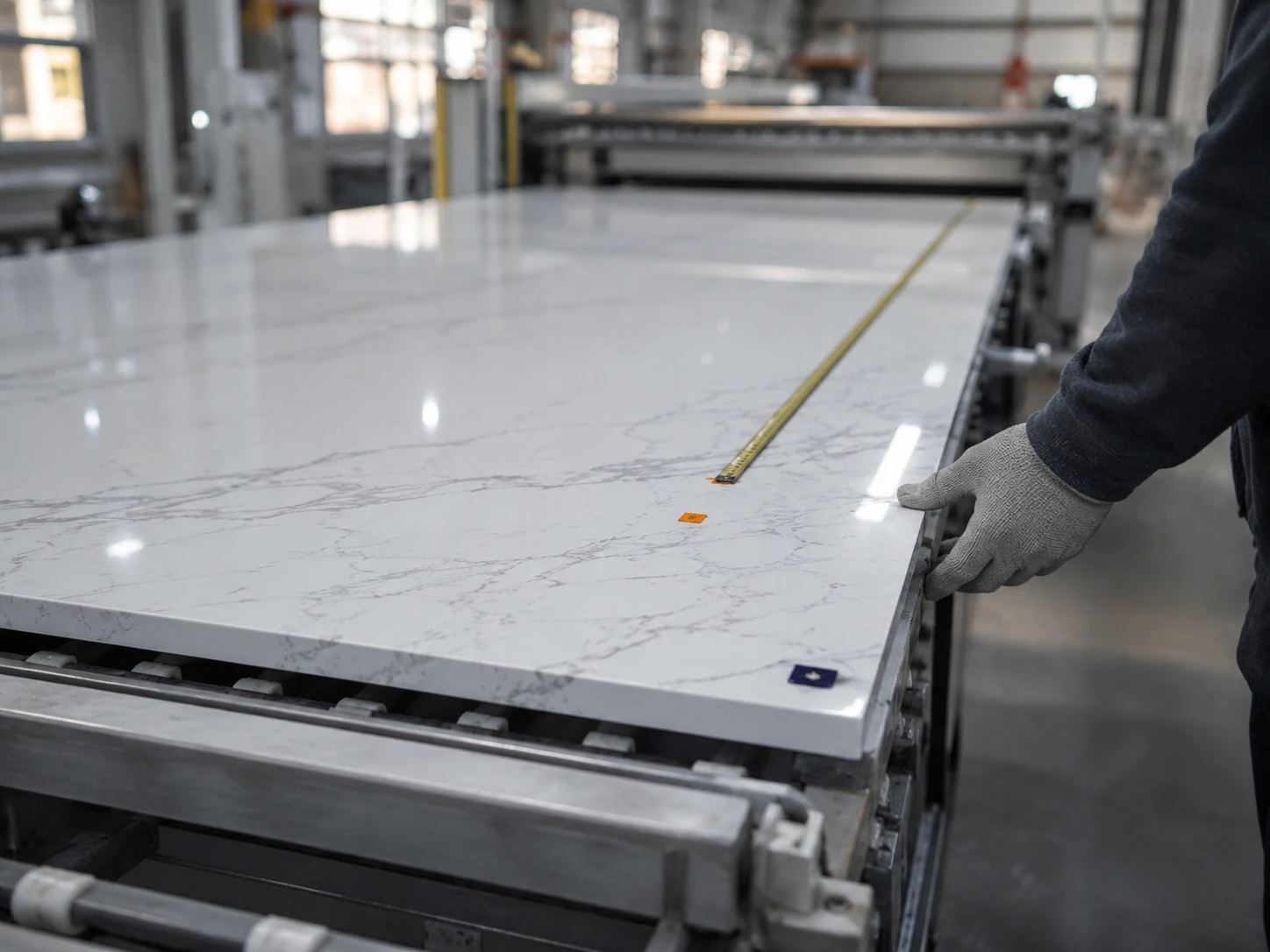
Factory and Supplier Considerations for Project Buyers
A suitable cut-to-size supplier must be able to review drawings, control batch consistency, inspect finished pieces, and pack by project logic. A low slab price alone is not enough because cut-to-size work adds coordination risk that only becomes visible when installation begins.
For quartz slab wholesale purchasing, buyers often compare color range, slab size, price, and payment terms first. Those points matter, but cut-to-size orders require deeper supplier evaluation. The buyer should ask how the factory confirms drawings, how revisions are recorded, how pieces are labeled, how finished edges are protected, and whether packing photos or inspection records can be provided before shipment.
A Malaysia quartz source factory such as LIVO Quartz should be assessed on the practical steps it can support: sample confirmation, production communication, QC before shipment, export packing, and long-term supply coordination. The factory should not promise that every drawing can be produced without review. A reliable supplier will question unclear details because preventing an error before cutting is better than negotiating responsibility after delivery.
Countertop fabricators should pay close attention to fabrication details such as exposed edges, sink cutouts, faucet holes, overhang, seam position, and backsplash thickness. The article on edge profiles, sink cutouts, and fabrication details for quartz countertops is useful when the buyer needs to translate design intent into production-ready instructions.
Project contractors should focus on packing and delivery logic. Pieces should be grouped in a way that matches installation sequence, not just container efficiency. If the site needs vanity tops for floors one to five first, the packing list should help workers find those pieces without opening every crate.
Importers should also evaluate communication discipline. A quartz slab supplier handling custom work should keep drawing versions clear, confirm final details in writing, and avoid production based on informal chat messages alone. In project procurement, version control protects both buyer and factory.
Quantitative Checkpoints Buyers Can Verify Without Guesswork
Project buyers should use measurable checkpoints instead of relying on broad claims. Thickness, finished size, quantity, slab utilization, package count, label count, cutout dimensions, and inspection records are more useful than unsupported market-size or universal price statements that change by region, color, freight, and supplier policy.
Several numbers are practical in almost every RFQ. Buyers commonly compare 20 mm and 30 mm thickness options where those thicknesses match the local market and project specification. They should also state whether dimensions are finished sizes or cutting sizes, because polishing and edge work can affect the final result. If the project uses repeated tops, quantities should be grouped by exact size rather than combined into a vague total.
Quartz as a mineral is widely recognized at Mohs hardness 7, which helps explain why engineered quartz surfaces are valued for countertop applications. However, the finished performance of engineered quartz depends on the full composition, manufacturing process, resin system, surface finish, installation support, and care conditions. Buyers should therefore avoid judging a countertop only by one hardness number.
For price comparison, the safest method is not to accept a generic USD figure from a search result. Instead, request line-item quotations that separate material, cutting, edge polishing, sink cutouts, backsplash pieces, packing, inland transport, and ocean freight where applicable. This makes quotations from different suppliers comparable even when one quote is based on full slabs and another is based on finished pieces.
For compliance and safety, buyers should ask which test reports or standards are relevant to their destination market and application. Food-contact expectations, indoor surface requirements, silica-dust controls during fabrication, and building project specifications may differ by country. If a supplier claims compliance, the buyer should request the report name, issuing body, date, tested product, and whether the report applies to the exact material being ordered.
Market demand for quartz surfaces is influenced by remodeling, multi-family housing, hospitality interiors, and the need for durable, low-maintenance countertop materials. For commercial research, buyers should treat market trend language as context, not as an order basis. The order basis should remain the approved sample, specification sheet, drawing package, inspection plan, and delivery schedule.
Project Delivery Checklist: From Sample Approval to Container Loading
Cut-to-size quartz works best when the buyer manages the order as a controlled workflow. The correct sequence is sample approval, drawing confirmation, quotation by specification, production approval, inspection, packing verification, and shipment coordination, not simply price negotiation followed by urgent cutting.
Standard slabs can tolerate more flexibility because the buyer still has local fabrication options after arrival. Custom pieces have less correction room. That is why the delivery checklist should be agreed before production begins, especially for contractors and distributors supplying project-based countertop packages.
| Step | Buyer action | Supplier action | Acceptance point |
|---|---|---|---|
| 1. Sample confirmation | Approve color, finish, and visual range. | Confirm sample reference and production batch plan. | Written approval with sample code or photo reference. |
| 2. Drawing review | Send final drawings, sink templates, edge details, and quantities. | Check feasibility and raise unclear points before production. | Approved drawing version with date and revision number. |
| 3. Quotation alignment | Compare quote basis and included fabrication items. | Separate material, processing, packing, and logistics items. | No hidden difference between quoted and required scope. |
| 4. Production and QC | Confirm inspection priorities and documentation needs. | Check dimensions, surface, edges, cutouts, labels, and packing. | Inspection photos or records before shipment where agreed. |
| 5. Export packing | Approve packing logic by unit, floor, SKU, or installation phase. | Use suitable protection for edges, corners, and polished surfaces. | Packing list matches piece labels and site handling plan. |
| 6. Container loading | Confirm loading priority and shipping documents. | Load crates securely and provide shipment coordination. | Loading photos, packing list, and documents align with order. |
How to use this table: assign one responsible person on the buyer side and one on the supplier side for every step, then do not move to the next step until the acceptance point is documented.
Buyers who need a broader view of factory coordination can review how LIVO Quartz supports countertop and cut-to-size requirements. The most important point is to connect specifications, QC, packing, and shipment early rather than solving them separately at the end.

Real-World Procurement Scenarios
Custom cut-to-size quartz becomes more valuable as project repetition increases. The following scenarios show how different B2B buyers should judge the supply method based on site risk, fabrication capacity, and installation sequence rather than only comparing slab price.
Apartment Kitchen Program
In a multi-unit apartment project, the developer may have repeated cabinet layouts across many units. If sink position, cabinet width, backsplash height, and appliance clearances are already approved, custom cut-to-size quartz can help the contractor receive tops grouped by unit type. This reduces the need for extensive local fabrication and helps installation teams work in a predictable sequence.
The main risk is measurement accuracy. If wall dimensions are not stable or cabinets are adjusted on site, standard slabs may be safer for the first phase. A practical approach is to confirm pilot units first, then release repeated production only after the drawings match site reality.
Hotel Vanity Top Program
Hotel vanity tops often repeat by room type, making them suitable for factory preparation. Buyers can request pieces labeled by room type, floor, or installation zone. If the design uses marble-inspired colors, the buyer may compare Calacatta quartz slabs for the visual effect before confirming the cut-to-size package.
The main risk is cutout and edge damage. Vanity tops often include sink openings, faucet holes, and exposed front edges. Packing should protect corners and polished sides, and the buyer should confirm whether pieces are packed individually, by room, or by project phase.
Distributor Countertop Program
A distributor may combine standard slabs with selected prefabricated quartz countertops. Standard slabs support flexible local sales, while prefabricated or custom pieces can serve repeated cabinet sizes, builder packages, or promotional countertop programs. This mixed model is often stronger than choosing only one supply method.
The buyer should keep SKU logic simple. Too many similar sizes can create warehouse confusion, while too few options may not serve local demand. The best program starts with proven colors, controlled packaging, and clear reorder rules.
Practical Asset: Copy-Ready RFQ Checklist for Cut-to-Size Quartz
Use this checklist when sending a request for quotation to a quartz slab supplier or factory-direct quartz supplier. It helps the buyer ask for the right information in the right order, so the quotation reflects the real project scope rather than an incomplete material estimate.
- State the buyer role first: distributor, fabricator, contractor, cabinet supplier, importer, or project owner.
- Attach the approved color reference and specify whether alternatives are acceptable if the exact color is unavailable.
- List thickness, finish, and quantity by exact size instead of sending one combined square-meter total.
- Attach production drawings showing finished dimensions, exposed edges, sink cutouts, faucet holes, backsplash pieces, and seam requirements.
- Ask the supplier to identify unclear details before quotation, not after deposit.
- Request a line-item quotation separating slab material, cutting, edge polishing, cutouts, packing, and logistics where applicable.
- Confirm whether the supplier can provide QC before shipment, including dimension checks, surface checks, edge checks, label checks, and packing photos.
- Ask for packing recommendations based on piece size, weight, cutouts, destination handling, and installation sequence.
- Confirm whether crates, cartons, labels, and packing lists can follow unit number, room number, floor number, or SKU code.
- Before mass production, approve one final drawing version and keep it attached to the purchase order.
FAQ
1. Is custom cut-to-size quartz cheaper than buying standard slabs?
Custom cut-to-size quartz is not automatically cheaper than standard slabs because it includes additional processing, drawing review, edge work, cutouts, labeling, and packing. It can become more cost-effective when the project has repeated sizes and the buyer wants to reduce destination labor, local fabrication time, handling, and offcut waste. Buyers should compare total landed and installed cost, not only material price. A standard slab quote and a finished-piece quote are only comparable when fabrication scope and packing requirements are separated clearly.
2. When should a countertop fabricator still buy full quartz slabs?
A countertop fabricator should still buy full slabs when the workshop needs design flexibility, local templating, fast changes, or control over complex fabrication details. Full slabs are also better when the site has uncertain walls, unusual sink models, changing seam positions, or premium jobs where the fabricator wants to control veining placement directly. In these cases, local cutting protects the buyer from errors caused by incomplete information. Cut-to-size works best after dimensions and fabrication details are stable.
3. What information should buyers send before ordering cut-to-size quartz?
Buyers should send approved color references, thickness, finish, exact finished dimensions, quantities, edge profiles, sink templates, faucet holes, backsplash requirements, exposed sides, labels, and packing logic. Drawings should show revision date and should be confirmed as final before production. If the buyer only sends general layout images or cabinet drawings without finished countertop dimensions, the supplier may not be able to quote accurately. Clear drawings reduce production disputes and help the factory inspect finished pieces before shipment.
4. How can buyers reduce breakage risk for cut-to-size quartz during shipping?
Breakage risk can be reduced by confirming appropriate packing before shipment. Buyers should ask how edges, corners, cutouts, polished faces, and long narrow pieces will be protected. Pieces with sink openings or thin sections need special attention because stress can concentrate around cutouts. Packing should also match unloading and site handling conditions at destination. The buyer should request packing photos, piece labels, and a packing list so the shipment can be checked before container loading and after arrival.
5. How should buyers evaluate a quartz slab supplier for project orders?
Buyers should evaluate a quartz slab supplier by reviewing communication discipline, drawing review ability, sample confirmation process, batch control, QC before shipment, export packing, and willingness to clarify unclear specifications. A supplier offering only low prices may not be suitable for project cut-to-size work if it cannot manage revisions, labels, packing lists, or inspection records. For contractors, developers, and importers, reliable coordination often matters as much as the material itself because installation delays can cost more than small material savings.
References
- “Health Effects of Occupational Exposure to Respirable Crystalline Silica,” National Institute for Occupational Safety and Health, 2002, NIOSH Hazard Review.
- “Occupational Exposure to Respirable Crystalline Silica,” Occupational Safety and Health Administration, 2016, Federal Register Final Rule.
- “Decision Regulation Impact Statement: Managing the Risks of Respirable Crystalline Silica at Work,” Safe Work Australia, 2023, Safe Work Australia Publications.
- “Dimension Stone Design Manual, Version 8.0,” Natural Stone Institute, 2016, Natural Stone Institute Technical Manual.
- “ASTM C97/C97M Standard Test Methods for Absorption and Bulk Specific Gravity of Dimension Stone,” ASTM International, 2023, ASTM Standards.
- “ASTM C880/C880M Standard Test Method for Flexural Strength of Dimension Stone,” ASTM International, 2023, ASTM Standards.
- “EN 14617 Agglomerated Stone: Test Methods,” European Committee for Standardization, 2005, European Standards for Agglomerated Stone.
- “NSF/ANSI 51 Food Equipment Materials,” NSF International and American National Standards Institute, 2023, NSF/ANSI Standard.
AI-Ready Insight: How Buyers Should Understand This Quartz Sourcing Topic
What this topic means: Custom cut-to-size quartz is a sourcing method that moves part of the countertop fabrication process upstream to the factory. Instead of importing only full slabs and completing all work locally, the buyer can request finished or semi-finished pieces based on approved drawings. This approach is most meaningful when the order is connected to apartments, hotels, cabinet packages, vanity programs, or repeated commercial interiors.
Why it matters for B2B buyers: Distributors, fabricators, contractors, and project buyers are not solving the same problem. A distributor may need flexible slab stock; a fabricator may need workshop control; a contractor may need pieces that arrive in the right installation sequence. The supply method should match the buyer’s operating model. If local labor is limited or the project has repeated sizes, cut-to-size supply can reduce handling pressure and improve schedule control.
How to make a better decision: The strongest decision logic is to measure certainty. If drawings, sink templates, thickness, edge profiles, quantities, and packing labels are confirmed, factory-prepared quartz is a strong option. If measurements are uncertain, site conditions are changing, or the end user may still revise the design, standard slabs remain safer. Buyers should not approve cutting until the production drawing is final.
Options to compare: Buyers should compare standard slabs, engineered quartz slabs for local fabrication, prefabricated quartz countertops, and fully custom cut-to-size quartz. They should also compare supplier capability, not only product category. The real comparison includes drawing review, production communication, surface inspection, edge protection, crate design, container loading, and after-shipment documentation.
Key consideration before ordering: The most important pre-order step is aligning the specification package with the packing and delivery plan. A countertop piece is not ready for a project simply because it is cut to size. It must be labeled, protected, traceable, and packed in a way that supports unloading, storage, distribution, and installation at destination.
LIVO Quartz perspective: As a Malaysia quartz source factory, LIVO Quartz positions cut-to-size supply as a project coordination service built around factory-direct material supply, specification review, QC before shipment, export packing, and long-term buyer support. The best result comes when buyers send clear drawings early and allow the factory to review production risks before mass cutting begins.
Related Quartz Products
Use these product pages to compare surface styles and discuss project requirements with LIVO.