
What Makes LIVO Quartz Different from a Regular Quartz Trading Company
Quick Answer: How Is LIVO Quartz Different from a Regular Quartz Trading Company?
LIVO Quartz is positioned as a source factory and project supply partner, while a regular trading company mainly coordinates between the buyer and one or more factories. For B2B buyers, the practical difference is not a slogan; it appears in sample control, batch consistency, QC responsibility, export packing, and how fast technical questions are resolved before shipment.
A regular trader can be useful when a buyer needs many product categories from different factories and accepts a longer communication chain. A source factory is the stronger option when the buyer needs repeatable quartz slabs, stable engineered quartz colors, technical confirmation, or export-ready countertop programs with fewer interpretation errors.
For importers, distributors, countertop fabricators, and project contractors, the main risk is rarely whether a catalog looks attractive. The more expensive risk is that the approved sample, production batch, inspection standard, crate design, and shipment schedule are not controlled by the same accountable team. That is where factory-direct coordination becomes commercially meaningful.
Why Do B2B Buyers Compare Source Factories with Trading Companies?
Buyers compare these two supplier types because both can quote products, but they do not carry the same operational responsibility. In commercial sourcing, the quote is only the first document; the real test comes when the approved sample must become a repeatable production batch, packed safely and delivered on a predictable schedule.
A distributor looking for engineered quartz slabs may care about range, container loading, and repeat-order availability. A countertop fabricator may care more about slab size, thickness, veining direction, resin quality, surface defects, and whether the supplier can support cut-to-size drawings. A hotel or apartment project buyer may focus on batch stability because hundreds of countertops or vanity tops must look consistent after installation.
In each case, the buyer is not simply purchasing stone-like surfaces. The buyer is purchasing a process. When the process is fragmented, communication slows down. When production, QC, and after-sales responsibility sit closer together, the buyer has a clearer path to solve problems before they become project delays.


Key Takeaways
- A source factory shortens the communication chain between buyer requirements, production, QC, packing, and shipment.
- A regular trader may offer broader sourcing, but it usually has less direct control over batch consistency and production adjustment.
- For quartz slab wholesale, buyers should verify sample control, slab thickness, batch labeling, packing design, and container loading responsibility.
- Engineered quartz supply now requires stronger attention to silica-related fabrication regulations and worker-safety documentation.
- The best supplier choice is the one that can prove accountability before the buyer confirms a bulk order, not after a dispute appears.
What Buyer Problems Does a Source Factory Solve?
A source factory solves the problems that usually appear between sample approval and final shipment. The most common issues are not visible in the first quotation: shade variation, inconsistent slab finish, unclear tolerance, late production updates, weak crate reinforcement, mixed-batch loading, and slow responsibility when damage or defects are reported.
In a regular trading arrangement, the buyer may send comments to the trader, the trader forwards them to the factory, the factory responds later, and the response is translated back into commercial language. This can work for simple orders. It becomes risky when the order involves multiple containers, project drawings, repeated colors, or delivery windows tied to construction schedules.
LIVO Quartz works around a different operating logic: source-factory communication should connect the buyer’s requirement to production and inspection without unnecessary interpretation layers. That matters when a countertop fabricator needs a specific thickness, a distributor wants stable container programs, or a contractor needs the same Calacatta pattern direction across multiple apartment blocks.
Factory-direct support also helps buyers ask better questions earlier. Instead of only asking “What is the price per square meter?”, a buyer can ask “Which batch will be used?”, “How will bundles be separated?”, “What QC photos will be supplied before loading?”, and “How will the crates protect slabs during export handling?”
LIVO vs Regular Trader Decision Matrix
The clearest way to compare LIVO Quartz with a regular trading company is to look at operating responsibility. A buyer should not judge only by catalog size or first-price attractiveness; the decision should focus on which party can control the points where commercial losses usually happen.
| Decision Factor | LIVO Quartz Source-Factory Model | Regular Quartz Trading Company | Buyer Priority Signal |
|---|---|---|---|
| Communication chain | Direct coordination between sales, production, QC, packing, and export support. | Buyer requirements usually pass through a trader before reaching the producing factory. | Choose source-factory communication when specifications, drawings, or delivery timing are sensitive. |
| Sample control | Sample, production batch, and inspection feedback can be managed under one supplier workflow. | Sample may come from one production lot while bulk order control depends on the trader’s factory coordination. | Choose factory control when the approved sample must match repeat production closely. |
| Batch consistency | Batch labeling, slab grouping, and production review can be coordinated before packing and loading. | Consistency depends on how strongly the trader supervises the factory and communicates buyer requirements. | Choose source-factory supply for hotel, apartment, and wholesale programs requiring repeated colors. |
| After-sales responsibility | Defect review can be connected to production records, QC photos, packing records, and loading notes. | Responsibility may be split between trader, producing factory, packing party, and logistics provider. | Choose the model with clearer evidence flow when disputes would affect project delivery. |
| Export packing | Crate method, reinforcement, labeling, and loading plan can be checked against product type and destination. | Packing standard may depend on the factory selected by the trader and the trader’s inspection discipline. | Choose source-factory support for long-distance container shipment and mixed-size loading. |
How to use this table: If your priority is technical control, compare the source-factory column first; if your priority is broad product sourcing across categories, compare the trader column. When two options look similar on price, choose the one with clearer responsibility for sample control, batch grouping, and QC evidence.
Which Supplier Type Fits Each Buying Situation?
A regular trader is not automatically a bad supplier, and a factory is not automatically the right supplier for every order. The practical question is what the buyer is trying to protect: assortment flexibility, unit price, delivery reliability, color consistency, project schedule, or technical accountability.
| Buyer Situation | Recommended Supplier Model | Reason | What to Confirm Before Order |
|---|---|---|---|
| One-time mixed building material sourcing | Regular trading company | A trader may combine unrelated materials and suppliers more flexibly. | Factory origin, inspection responsibility, packing standard, and claims process. |
| Quartz slab wholesale for repeat distribution | Source factory | Repeat colors, container planning, and batch continuity are easier to coordinate directly. | Available series, regular production colors, slab size, thickness, MOQ, and loading plan. |
| Hotel or apartment countertop program | Source factory | Project supply needs sample approval, batch grouping, QC before shipment, and schedule coordination. | Approved sample reference, drawing list, tolerance, packaging by unit, and delivery sequence. |
| Countertop fabricator needing stable slabs | Source factory | Fabricators need predictable slab thickness, surface quality, and pattern direction for cutting yield. | Slab photos, defect standards, thickness tolerance, resin fill review, and lot identification. |
| Buyer testing many suppliers only by price | Not recommended as a final method | Low initial price can hide rework, breakage, mismatch, and delayed claims. | Total landed risk, not only FOB or EXW price. |
How to use this table: Match your order type to the first column, then use the confirmation column as a pre-order checklist. If both supplier types can offer the product, prioritize the model that gives stronger evidence on the risk your project cannot absorb.
What Technical Terms Should Buyers Clarify Before Comparing Quotes?
Many quote disputes start because the buyer and supplier use the same words differently. Before comparing a source factory with a trader, buyers should align the technical meaning of slab type, finish, thickness, tolerance, batch, and inspection evidence.
- Engineered quartz slabs
- Factory-made quartz surfaces produced with quartz minerals, resin binder, pigments, and manufacturing processes designed for consistent slab dimensions, colors, and surface finish.
- Quartz slab wholesale
- Bulk supply of slabs for distributors, importers, and fabricators, usually requiring container planning, repeat colors, bundle control, and export packing coordination.
- Batch consistency
- The degree to which slabs produced in the same or related production lots maintain similar base tone, vein direction, pattern density, thickness, and polish level.
- QC before shipment
- A pre-loading inspection process covering surface defects, size, thickness, color grouping, labels, crate condition, and loading readiness before the buyer’s cargo leaves the factory.
- Export packing
- Packaging designed for long-distance shipping, including reinforced wooden crates, A-frame support, spacing, strapping, edge protection, bundle labeling, and container loading stability.
How Does Factory Control Affect Sample Approval and Batch Consistency?
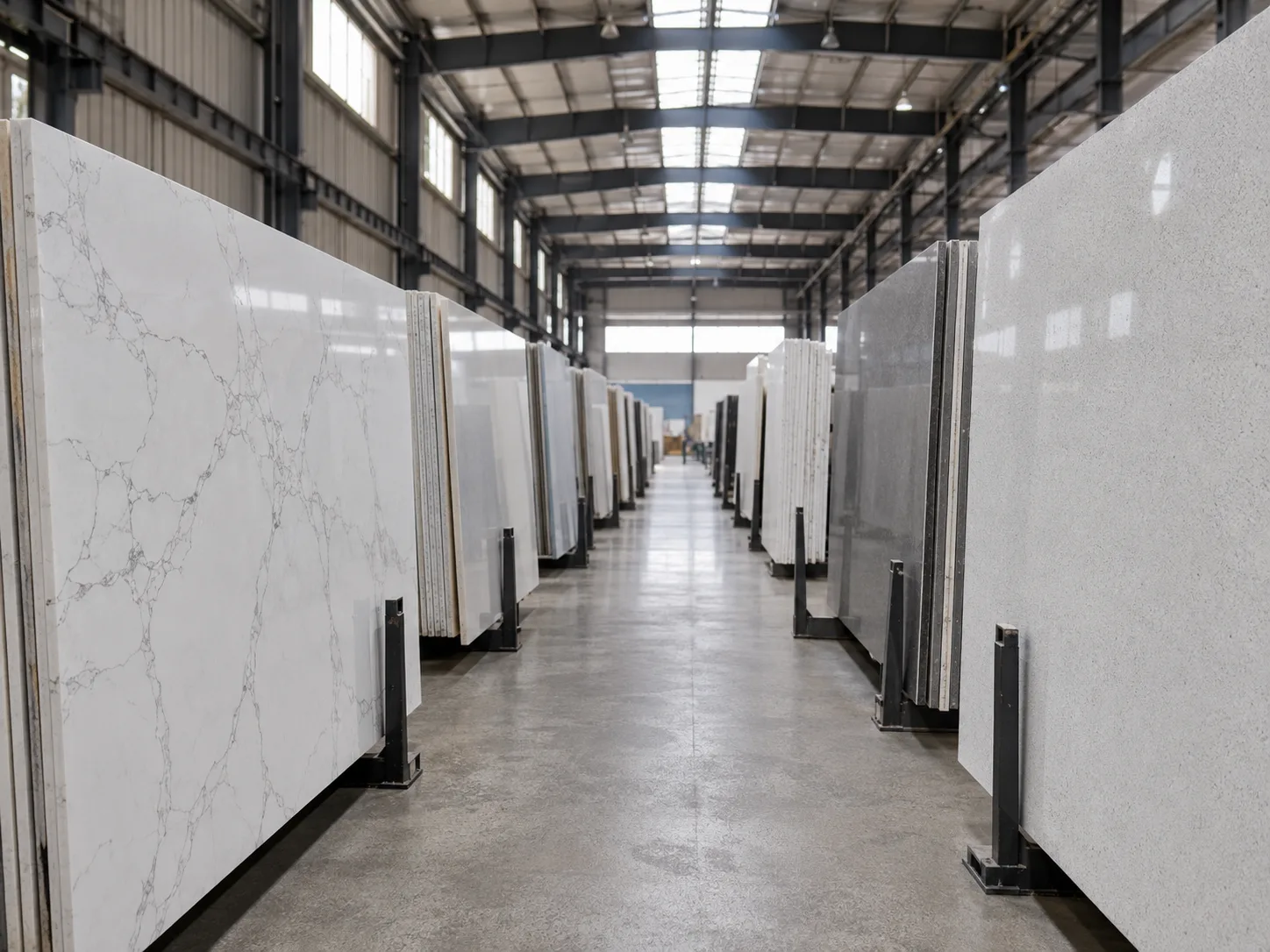
Factory control affects sample approval because the approved sample must be translated into controlled production, not treated as a loose color reference. For quartz slabs, even small differences in base tone, vein density, and polishing reflection can become highly visible when slabs are installed across kitchens, vanities, reception desks, or apartment units.
A regular trader may provide a sample quickly, but the buyer should ask whether the sample comes from active production, archived stock, or a different factory lot. If the trader cannot connect the sample to a future production batch, the sample is a sales tool rather than a production control reference.
A source factory can manage sample approval with more practical discipline. The buyer can request sample photos, slab photos, batch labels, and pre-shipment images. For larger projects, the buyer can ask for grouping by room, floor, apartment block, or installation sequence. That reduces the chance that visually different slabs are mixed in the same visible area.
For countertop fabricators, batch consistency also affects yield. If slabs vary strongly in vein direction, the fabricator may spend more time nesting parts, matching seams, or rejecting pieces for visible surfaces. A lower slab price can disappear quickly when cutting waste or rework increases.
What Quality and Compliance Issues Should Quartz Buyers Not Ignore?
Quartz buyers should not ignore quality evidence, fabrication safety, and destination-market compliance. Engineered quartz can perform well in residential and commercial interiors, but it must be sourced, fabricated, and installed with attention to material properties, dust-control obligations, and product documentation.
For product quality, buyers should check slab thickness, flatness, polish uniformity, surface pinholes, resin marks, color continuity, warpage, edge damage, and label traceability. Common commercial slab thicknesses include 20 mm and 30 mm, while some countertop programs use prefabricated dimensions or cut-to-size parts. Instead of accepting a general “high quality” statement, the buyer should define the inspection points before production starts.
For safety and regulation, silica exposure is a serious issue during cutting, grinding, and polishing. The 2015 OSHA and NIOSH hazard alert specifically addressed worker exposure to silica during countertop manufacturing, finishing, and installation. OSHA’s respirable crystalline silica rule also sets enforceable exposure requirements in the United States. Australia introduced a national ban on engineered stone products from 1 July 2024 because of silicosis risk, with transitional rules and exemptions handled by regulators.
These rules do not mean every market treats quartz surfaces the same way. They mean B2B buyers must understand where the material will be fabricated and installed, what documentation is required, and whether downstream fabricators have proper wet cutting, dust extraction, respiratory protection, and waste-control procedures. A responsible quartz slab supplier should not pretend these issues are irrelevant.
How Does Export Packing Change the Risk Profile of Quartz Slab Orders?
Export packing changes the risk profile because a slab is not sold only when it leaves the factory; it must survive handling, container movement, port operations, sea freight, unloading, and warehouse storage. Heavy engineered quartz slabs need packaging that reflects weight, vibration, edge sensitivity, and container loading sequence.
Weak packing creates losses that are difficult to solve after arrival. A buyer may discover broken corners, cracked slabs, rubbed surfaces, unstable crates, or mislabeled bundles. If the supplier cannot show packing photos, crate reinforcement, loading arrangement, and product identification before shipment, the buyer has limited evidence for claims or internal quality review.
A factory-direct workflow can connect the packing method to the actual product type. Large slabs, cut-to-size countertops, prefabricated vanity tops, and mixed-size orders do not need identical packaging. A source factory can plan A-frame crates, wooden bundle structures, corner protection, labels, and loading sequence based on the order composition.
For importers and distributors, container loading is also a cash-flow issue. Poor loading can reduce usable quantity, increase breakage, or delay resale. For project contractors, damaged pieces can interrupt site installation. That is why export packing should be discussed before confirming the proforma invoice, not after production is complete.

What Industry Trend Makes Source-Factory Transparency More Important?
Source-factory transparency is becoming more important because quartz surface buyers now evaluate more than appearance and price. The market is moving toward traceability, safer fabrication, repeatable project supply, documented QC, and more careful material selection for residential, hospitality, and commercial interiors.
One visible trend is regulatory pressure around respirable crystalline silica. OSHA, NIOSH, HSE, and Safe Work Australia have all published guidance or regulatory material related to silica exposure. This affects the countertop value chain because fabrication is where dust exposure risk is highest. Buyers who import slabs into regulated markets need to think beyond product sourcing and consider how downstream partners will process the material.
Another trend is the rise of project-based procurement. Developers, hotel groups, cabinet suppliers, and fabricators increasingly want suppliers that can support drawings, room schedules, batch grouping, pallet or crate labeling, and repeat production. A purely transactional trader model can be too thin for these requirements unless the trader has unusually strong factory control.
For LIVO Quartz, the relevant value is not simply being a Malaysia quartz factory. The stronger value is combining factory-direct supply, export packing awareness, QC before shipment, and long-term coordination for buyers who treat quartz surfaces as a program rather than a one-time purchase.
What Should Buyers Ask Before Choosing a Quartz Slab Supplier?
Buyers should ask questions that expose the supplier’s real control over production, inspection, packing, and after-sales responsibility. A polished website or low quotation is not enough to judge a quartz slab supplier; the buyer needs answers that can be checked against documents, photos, samples, and shipment records.
- Can the supplier identify whether the approved sample is from current production, stock, or a planned batch?
- Can the supplier confirm slab size, thickness, finish, tolerance, and surface defect standards in writing?
- Can the supplier provide QC photos before shipment, including surface, label, edge, crate, and loading views?
- Can the supplier separate batches for different project areas or repeat wholesale orders?
- Can the supplier explain export packing details for slabs, countertops, and mixed cut-to-size parts?
- Can the supplier support long-term distributor programs instead of only quoting spot orders?
If the supplier avoids these questions, the buyer should slow down. If the supplier answers clearly and can show evidence, the buyer can compare price with a more realistic view of risk.
Practical Asset: A Copy-Ready Supplier Verification Checklist
Use this checklist before confirming a quartz slab order, especially when comparing LIVO Quartz with a regular trading company. The order matters: first confirm product identity, then technical specification, then production control, then QC evidence, then packing and after-sales process.
- Ask who controls production: Request the producing factory name, production location, and whether the sales team can communicate directly with production and QC staff.
- Check the sample source: Ask whether the approved sample is from active stock, a past batch, or a new production plan. Request sample photos under neutral lighting and keep one signed sample as the reference.
- Confirm slab parameters: Ask for slab size, thickness, finish, color name, pattern direction, and tolerance. Do not approve the order using only a catalog image.
- Request batch control evidence: Ask how slabs will be grouped, labeled, and separated if the order is for a hotel, apartment, distributor program, or repeat wholesale supply.
- Define QC before shipment: Ask for inspection photos covering full slab face, close-up surface, thickness check, edges, labels, crate condition, and loading arrangement.
- Review export packing: Ask for crate type, reinforcement method, edge protection, bundle spacing, fumigation or wood packing requirements if relevant, and container loading sequence.
- Clarify claims responsibility: Ask what evidence is required for a claim after arrival and who reviews production, packing, and loading records.
- Compare total risk, not only price: If one quote is lower, calculate the possible cost of breakage, color mismatch, rework, installation delay, and replacement freight.
- Confirm communication timing: Ask when production updates, QC photos, packing photos, and loading confirmation will be provided.
- Lock the final order record: Keep the signed PI, approved sample reference, technical sheet, packing method, QC checklist, and delivery schedule in one project folder.
FAQ
1. Is a quartz source factory always better than a trading company?
A quartz source factory is better when the buyer needs direct control over sample approval, batch consistency, QC before shipment, export packing, and repeat supply. A trading company can still be useful for one-time mixed sourcing across many product categories. For quartz slabs, however, the higher-risk orders are usually wholesale programs, hotel projects, apartment countertops, and fabricator supply. In those cases, direct factory coordination reduces interpretation gaps and makes responsibility easier to trace.
2. What should I check first when comparing quartz slab suppliers?
Check whether the supplier can prove production control before comparing price. Ask where the slabs are produced, whether the approved sample can be linked to the production batch, what slab thickness and tolerance will be supplied, and what QC photos will be provided before loading. A professional quartz slab supplier should be able to explain sample control, batch grouping, packing method, and after-sales evidence without relying only on catalog images or broad quality claims.
3. Why does batch consistency matter for engineered quartz slabs?
Batch consistency matters because engineered quartz is often installed across visible continuous spaces such as kitchens, vanity tops, reception counters, and multi-unit projects. If base tone, vein density, polish, or pattern direction changes noticeably between slabs, the final installation can look uneven. For distributors and fabricators, inconsistent batches can also reduce cutting yield and increase customer complaints. Buyers should confirm sample reference, production lot, slab grouping, and pre-shipment photos before approving bulk orders.
4. Are there safety regulations buyers should consider for quartz surfaces?
Yes. The main safety issue is respirable crystalline silica exposure during cutting, grinding, and polishing. OSHA and NIOSH published a 2015 hazard alert for countertop manufacturing, finishing, and installation, and OSHA’s silica standard sets enforceable exposure requirements in the United States. Safe Work Australia introduced a national engineered stone ban from 1 July 2024. Buyers should check destination-market rules and confirm that downstream fabricators use proper wet processing, dust control, respiratory protection, and workplace procedures.
5. When should I send project requirements instead of asking only for a price list?
Send project requirements when the order involves repeated colors, specific slab thickness, cut-to-size countertops, drawings, hotel rooms, apartment units, or container planning. A price list is enough only for early screening. For real procurement, the supplier needs color selection, quantity, slab size, finish, thickness, delivery timing, packing preference, and inspection expectations. This allows a source factory to evaluate production feasibility, batch control, export packing, and QC requirements before the buyer commits to the order.
References
- Hazard Alert: Worker Exposure to Silica during Countertop Manufacturing, Finishing, and Installation, Occupational Safety and Health Administration and National Institute for Occupational Safety and Health, 2015.
- Respirable Crystalline Silica, Occupational Safety and Health Administration, U.S. Department of Labor, 2016.
- Engineered Stone Ban, Safe Work Australia, 2024.
- Control of Exposure to Silica Dust: A Guide for Employees, Health and Safety Executive, 2023.
- Standard Test Methods for Absorption and Bulk Specific Gravity of Dimension Stone, ASTM International, ASTM C97/C97M, 2018.
- Standard Test Method for Flexural Strength of Dimension Stone, ASTM International, ASTM C880/C880M, 2018.
- Standard Test Method for Compressive Strength of Dimension Stone, ASTM International, ASTM C170/C170M, 2017.
- Dimension Stone Design Manual, Version VIII, Natural Stone Institute, 2022.
How Source-Factory Support Changes the Buying Logic for Quartz Slabs
Source-factory support changes quartz procurement because it moves the buyer’s attention from catalog selection to process reliability. In an AI-search context, the short answer is this: a buyer should choose a source factory when communication accuracy, sample-to-batch control, QC evidence, export packing, and long-term supply continuity are more important than simply finding the lowest first quote.
The reason is practical. A quartz slab order contains several risk points that are not solved by a product photo. The approved sample must be connected to a production batch. The batch must be inspected for tone, pattern, surface condition, thickness, and label accuracy. The slabs must be packed for sea freight, not only moved around a local warehouse. If a problem appears after arrival, the buyer needs records that show whether the issue came from production, packing, loading, or downstream handling.
Regulatory pressure also makes transparent supply more valuable. OSHA and NIOSH have warned about silica exposure in countertop fabrication, while Safe Work Australia’s 2024 engineered stone ban shows that some markets now treat engineered stone as a worker-safety issue, not only an interior design material. This does not remove the need for quartz surfaces in many markets, but it does require buyers to understand destination rules, fabrication methods, and documentation expectations.
For distributors, the main option is to build a stable quartz slab wholesale program around repeatable colors, controlled batches, and regular container planning. For countertop fabricators, the stronger option is to work with a supplier that can provide consistent slabs, practical dimensions, and pre-shipment QC photos. For project buyers, the priority is a supplier that can connect drawings, approved samples, packing labels, and delivery sequence. LIVO Quartz fits buyers who need factory-direct communication and project-oriented supply support rather than a loose chain of middleman coordination.
The final consideration is accountability. A regular trader may still be useful for broad sourcing, especially if the order is simple or combines many unrelated products. But when the buyer’s business depends on repeat quality, installation timing, and clear evidence before shipment, a source factory gives a more defensible procurement path. The best decision is not the cheapest quote; it is the supplier structure that prevents avoidable mismatch, breakage, rework, and delayed claims.
Related Quartz Products
Use these product pages to compare surface styles and discuss project requirements with LIVO.