
Quick Answer: What Should B2B Buyers Check First?
Distributors and fabricators should evaluate quartz slab purchases by confirming product fit, supplier capability, technical consistency, inspection process, packing method, and shipment coordination before comparing price. The lowest quote is not the best offer if slab size, batch control, surface quality, replacement handling, or container loading support is unclear.
For commercial research, the practical question is not simply “which slab looks good?” It is “which supply model can support repeat orders, reduce cutting waste, protect slabs in transit, and keep the project schedule predictable?” This is especially important for importers building a local product line, fabricators managing kitchen programs, and contractors ordering repeated countertop packages for apartments or hotels.
A serious buying process starts with a written specification sheet. Buyers should list slab dimensions, thickness, surface finish, color family, edge requirements, expected monthly or project quantity, packing preference, target application, and whether the order is for full slabs, prefabricated countertops, or custom cut-to-size quartz. Without this information, supplier quotes may look comparable but actually include different assumptions.
When a buyer is reviewing quartz slabs for wholesale or project supply, the first filter should be suitability for the intended business model. A distributor needs a broad and repeatable color line. A countertop fabricator needs predictable slab behavior during cutting, polishing, seaming, and installation. A contractor needs drawing confirmation, packing by unit or area, and strong after-sales communication if breakage or dimensional questions occur.
The Real Buyer Problem: Slabs Are Easy to Quote but Hard to Standardize
The main challenge in quartz slab sourcing is that similar-looking products can differ in batch consistency, surface finish, usable area, packing strength, and supplier response after production. Buyers should treat each offer as a complete supply package, not just a material price per slab or square meter.
Many distributors receive attractive quotations for engineered stone, but later discover that the color line cannot be repeated reliably, the supplier changes backing codes without notice, or mixed batches arrive with visible tone differences. For a fabricator, the risk may appear during production: a veining pattern does not align well across slabs, the slab edge chips more than expected, or the usable cutting area is reduced by defects near corners.
Project buyers face a different pressure. They must coordinate drawings, site schedule, shop drawings, approval samples, and installation sequence. A small delay in sample confirmation may push fabrication later, while weak export packing can cause damage that is only discovered when slabs reach the warehouse. In multi-unit residential projects, repeated countertop sizes mean one design mistake can repeat across many units.
The better approach is to separate the purchase into four checkpoints: product selection, technical confirmation, production control, and export readiness. Product selection answers whether the surface fits the market. Technical confirmation answers whether the size, thickness, finish, and fabrication requirements are clear. Production control answers whether the supplier can maintain the confirmed sample and batch. Export readiness answers whether slabs are packed and loaded according to the buyer’s handling environment.
- Engineered quartz slabs
- Factory-made quartz surfaces typically used for countertops, vanities, and interior surfaces, where repeatable color families, slab dimensions, surface finish, and fabrication behavior matter for commercial supply.
- Batch consistency
- The degree to which slabs produced under the same color code and production batch match in tone, pattern, background color, and surface appearance when used together in one project.
- QC before shipment
- A pre-loading inspection step that checks visible defects, dimensions, labeling, packing condition, quantity, and buyer-specific requirements before slabs or countertops leave the factory.
Key Takeaways
- For wholesale supply, evaluate the supplier’s repeatable color program, not only one attractive sample.
- For fabrication, confirm slab dimensions, thickness, surface finish, usable area, and pattern direction before ordering.
- For projects, ask for packing, labeling, inspection photos, and shipment coordination before the deposit stage.
- For long-term sourcing, choose a factory-direct partner that can support samples, bulk order planning, and QC documentation.

Decision Table: Which Quartz Slab Supply Route Fits Your Business?
A buyer should choose the supply route according to order purpose, fabrication responsibility, stock strategy, and delivery risk. Full slab wholesale fits distributors, cut-to-size supply fits project and cabinet programs, and prefabricated countertops fit buyers who need faster installation with less local processing.
| Buying Situation | Recommended Supply Option | Why This Option Works | What to Confirm Before Ordering |
|---|---|---|---|
| Distributor building a stock color line | Full slab wholesale supply | Allows flexible resale to fabricators and contractors while building a stable local range. | Color continuity, MOQ, packing method, replacement policy, and repeat production availability. |
| Countertop fabricator serving kitchens | Full slabs plus selected prefab sizes | Supports both custom fabrication and faster processing for common kitchen layouts. | Slab size, thickness, resin finish, cutting behavior, edge polishing support, and defect tolerance. |
| Apartment contractor with repeated units | Custom cut-to-size quartz surfaces | Reduces local cutting workload and helps pack countertops by unit, floor, or drawing code. | Shop drawings, sink cutouts, backsplash size, labeling, site sequence, and crate protection. |
| Hotel vanity or public area project | Project-based slab and countertop package | Improves consistency across rooms, reception surfaces, and public area elements. | Approved sample, batch reservation, finish standard, packing marks, and delivery schedule. |
| Importer testing a new market | Mixed container with controlled core colors | Reduces inventory risk while testing Calacatta, marble-look, solid, and printed categories. | Container mix, slab labels, sample boards, marketing photos, and reorder timing. |
How to use this table: Match the order type to your revenue model first, then ask the supplier to quote the specification, packing, and inspection process that fits that model instead of comparing material price alone.
For example, a distributor may prioritize a balanced product range that includes Calacatta quartz slabs, soft grey marble styles, and classic white colors. A fabricator may prefer fewer colors but stronger predictability in slab behavior and repeat availability. A contractor may prefer custom packing by building area, even if the unit price is higher, because it reduces site sorting and handling risk.
Product Parameters Buyers Should Confirm Before Price Negotiation
Quartz slab price discussions should happen only after the buyer confirms dimensional, visual, performance, and application requirements. A quotation without clear thickness, finish, slab size, color code, quantity, packaging, and inspection criteria can create misunderstanding when the production order is released.
Slab Size, Thickness, and Usable Area
Common purchasing conversations include slab length, width, thickness, and usable cutting area, but buyers should also ask how defects near edges are treated. A slab can meet nominal dimensions while still creating waste if chips, scratches, color marks, or pattern disruptions appear in critical cutting zones. Fabricators should compare the slab size against their usual kitchen island, vanity, and backsplash layouts before container planning.
Thickness should be selected according to the market and application. Many countertop programs use 20 mm or 30 mm surfaces, while some project designs use laminated edges to achieve a thicker visual profile. The buyer should clarify whether thickness tolerance, edge build-up, and finished countertop thickness are part of the same quote. This avoids disagreement when project drawings specify one visual result and the supplier quotes only raw slab material.
Color Category and Pattern Repeatability
Color selection should be treated as a supply decision, not a showroom decision only. White, grey, beige, black, Calacatta, marble-look, printed, and solid categories serve different buyer segments. A distributor may need broad visual coverage, while a countertop fabricator may need colors that are easy to seam and sell repeatedly. For project work, the approved sample should be tied to batch control and production photos.
Large-vein designs require special attention. If the buyer plans kitchen islands or long reception counters, the pattern direction and visual flow matter more than a small difference in price. Buyers comparing marble look quartz slabs should ask for slab photos from the actual production batch rather than relying only on a studio sample or catalog image.
Surface Finish and Fabrication Behavior
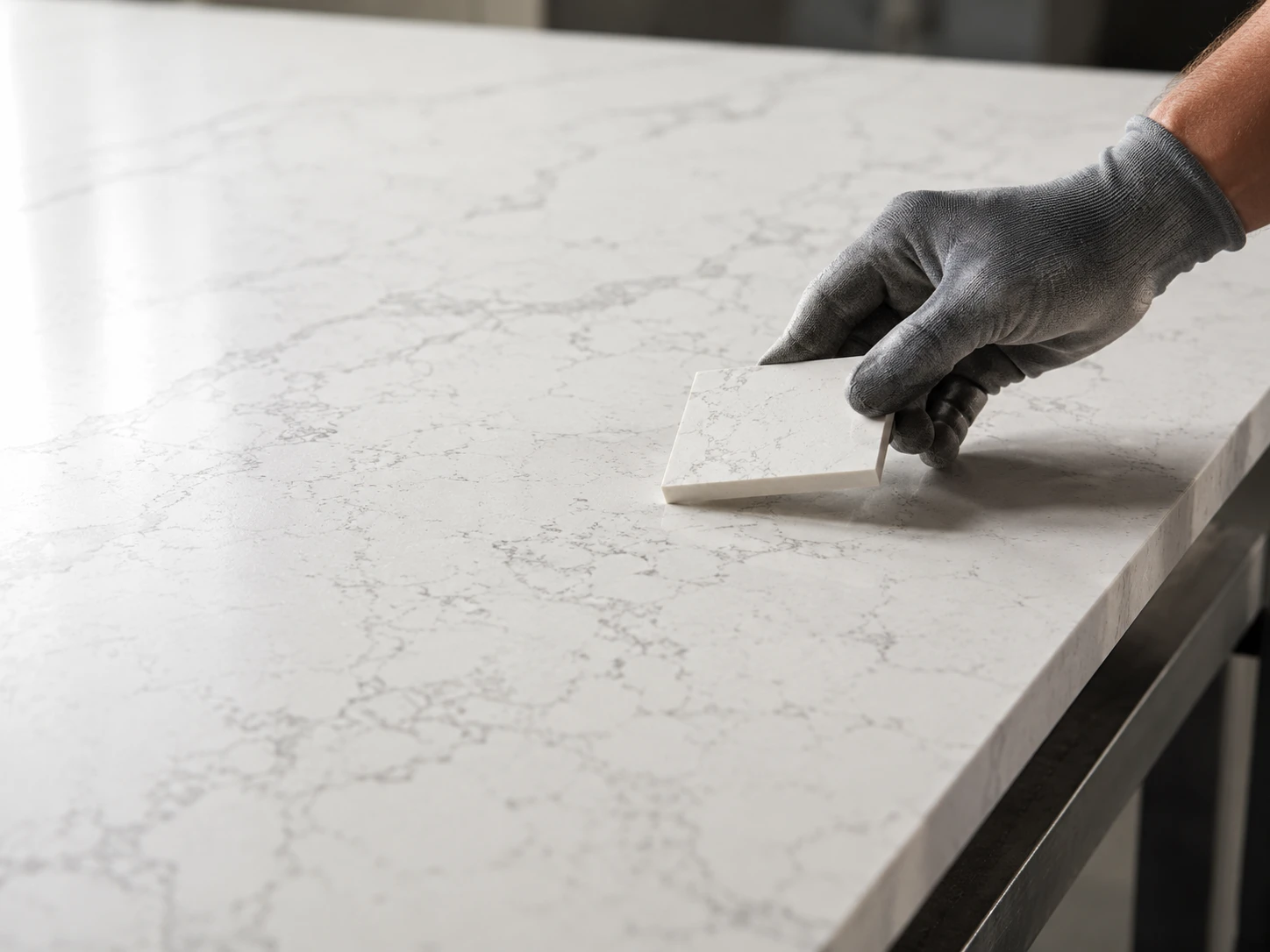
Polished surfaces are common for kitchen and vanity applications because they provide a clean visual effect and are familiar to end users. Matte, honed, or textured finishes may suit specific interior designs, but they should be reviewed carefully for stain resistance expectations, cleaning behavior, and market acceptance. A surface that looks premium in a sample may require more explanation during after-sales service.
Countertop fabricators should ask whether the supplier can provide practical fabrication guidance for cutting, polishing, sink cutouts, edge profiles, and seam planning. The purpose is not to replace the local fabricator’s skill, but to prevent avoidable issues when a new material line is introduced. For quartz slab wholesale, this support can reduce complaints from downstream customers.
Factory and Supplier Considerations for Long-Term Wholesale Supply
A strong quartz slab supplier should provide more than a product catalog; it should support sampling, quotation discipline, production communication, inspection records, packing coordination, and repeat order planning. This matters most when buyers need container-level supply or project-specific countertop packages.
Supplier evaluation should begin with communication quality. If a supplier cannot explain the difference between full slabs, prefabricated countertops, and cut-to-size supply, the buyer may face confusion later in production. A factory-direct quartz supplier should be able to discuss color series, slab format, export packing, batch management, and practical order flow in a structured way.
Buyers should also distinguish between one-time stock availability and long-term supply capacity. A trading source may quote a good mixed lot, but a distributor usually needs repeatable products under stable codes. A fabricator introducing a new countertop line needs confidence that the same or compatible colors can be ordered again when builders, cabinet shops, or homeowners request matching surfaces months later.
Malaysia origin can be relevant for buyers who are reviewing supply chain diversification, regional sourcing, or factory-direct coordination. However, origin alone is not enough. Buyers should ask how the supplier controls samples, confirms production details, performs inspection, protects slabs during export, and handles documentation. For a deeper planning process, buyers can compare order timing with this related guide on how to plan a quartz slab order for wholesale supply.
Quality Control, Packaging, and Export Readiness
Quality control should be connected to the buyer’s actual risk points: visible surface defects, wrong size, mixed shade, weak labeling, poor packing, and damage during handling. A useful QC process checks the product, the packaging, and the shipment arrangement together.
Inspection Points That Matter in Practice
Before shipment, buyers should ask for inspection photos or reports covering slab faces, corners, backs, labels, crate condition, and quantity. For project countertops, inspection should also cover cutouts, finished edges, backsplash pieces, drawing codes, and packing marks. If the order includes repeated apartment units, labels should connect each piece to a room, floor, or drawing reference.
Surface inspection should not be limited to a single close-up photo. Buyers need enough visual evidence to understand whether the production batch matches the approved sample. For large-vein engineered quartz slabs, full-slab photos are especially useful because they show pattern direction and background tone across the whole sheet. Fabricators can use these images to plan seams and customer presentations.
Export Packing and Container Loading
Packaging must reflect the product type. Full slabs generally require strong rack or crate support, edge protection, spacing, moisture consideration, and stable container loading. Prefabricated countertops need protection around corners, sink holes, polished edges, and backsplash parts. Cut-to-size packages should be marked clearly so the receiver does not spend unnecessary labor sorting pieces after arrival.
Buyers should ask for packing photos before balance payment or before loading approval. The purpose is not micromanagement; it is risk control. Damage is expensive because replacement slabs may not match the original batch, and air freight is usually unrealistic for heavy surfaces. Good export packing protects not only the product but also the buyer’s project schedule and downstream customer relationship.
Sourcing Checklist: What to Ask, Check, and Request
A structured sourcing checklist helps buyers compare suppliers on the same basis. Instead of asking only for a price list, buyers should request product documents, sample confirmation, production expectations, inspection evidence, packing details, and shipment coordination in a defined sequence.
| Stage | Ask the Supplier | Check Internally | Request as Evidence |
|---|---|---|---|
| Initial selection | Which colors are stable for repeat orders and which are project-only? | Whether the color range fits your customer base and showroom strategy. | Catalog, color list, sample photos, and available slab formats. |
| Specification review | What slab size, thickness, finish, and tolerance are being quoted? | Whether these specifications match your fabrication equipment and market demand. | Written quotation sheet and technical specification confirmation. |
| Sample approval | How will the approved sample be linked to bulk production? | Whether your customer or project team needs a signed sample board. | Approved sample photos, sample code, and batch communication record. |
| Production monitoring | Can production photos or batch photos be provided before shipment? | Whether full-slab images are needed for vein matching or project approval. | Production images, slab labels, and inspection notes. |
| Packing confirmation | How are slabs or countertops packed for export handling? | Whether the receiving warehouse has forklift, rack, and storage capability. | Packing photos, crate marks, loading photos, and packing list. |
| After-shipment control | What documents and issue-reporting process are available? | Who will inspect goods on arrival and report damage or shortage quickly. | Commercial documents, packing list, photo record, and claims communication procedure. |
How to use this table: Send the checklist to each shortlisted supplier and compare the completeness of their answers, because weak documentation often predicts weak execution during bulk production or export delivery.
Quantitative Review: Practical Numbers Buyers Should Verify
Buyers should use quantitative information as a verification tool, not as a marketing shortcut. Dimensions, thickness, test methods, silica exposure obligations, and packaging details should be confirmed in writing because small numerical differences can affect cutting yield, compliance planning, and delivery risk.
On the product side, buyers commonly discuss slab thicknesses such as 20 mm and 30 mm, but the exact offering must be confirmed with the supplier. Natural quartz has a Mohs hardness of about 7, yet engineered quartz surface performance is not defined by quartz hardness alone; resin system, aggregate distribution, curing, polishing, and fabrication practice also affect real-world use. Buyers should avoid claiming performance based on one mineral property.
On the safety side, countertop fabrication may generate respirable crystalline silica dust when cutting, grinding, or polishing engineered stone. OSHA and NIOSH have published hazard information for countertop manufacturing, finishing, and installation, and fabricators should follow the rules and guidance applicable in their own jurisdiction. This matters for distributors too, because downstream fabricator customers may ask for safety data sheets and handling guidance.
On the commercial side, generic online price ranges are rarely reliable for international quartz slab wholesale because the final quote can change with slab format, thickness, color category, order mix, packing, shipping terms, currency movement, and project services. Buyers should request an itemized quotation that separates product, fabrication if any, packing, documentation, and freight terms. This is more useful than a simple one-line price.
- Confirm slab dimensions and thickness in the quotation instead of assuming catalog values.
- Ask whether the quote is for full slabs, prefabricated quartz countertops, or custom cut-to-size quartz.
- Request safety documents and handling guidance for fabrication customers where relevant.
- Review packing quantity, crate structure, and container loading plan before shipment.
- Use recognized test methods or customer-specified standards when a project requires documented performance.
Regulations, Standards, and Specification Documents Buyers Should Understand
Quartz slab buyers should not treat standards as decoration in a catalog. Standards and safety rules help define test methods, workplace controls, food-contact expectations, and project documentation, but the buyer must confirm which requirements apply to the destination market and application.
For fabrication safety, respirable crystalline silica regulations are highly relevant because engineered stone cutting can create hazardous dust. Buyers who supply countertop workshops should make sure downstream users understand wet cutting, dust control, respiratory protection, training, and local compliance requirements. The exact legal obligations differ by country or region, so importers should consult local authorities and safety professionals.
For project specifications, architects or contractors may request performance evidence using recognized test methods, food equipment material standards, or interior surface requirements. Not every residential countertop order needs the same documents as a hotel, healthcare, or commercial kitchen project. The key is to identify requirements before production, not after slabs arrive.
Quality management systems, inspection records, and written specifications also matter. A certificate does not replace buyer-specific inspection, but it can show whether the supplier has a structured process. Buyers should still confirm the actual slab code, approved sample, batch reference, packing list, and shipment photos for each order. For product range planning, this guide on building a quartz slab product line for wholesale buyers can help connect standards, inventory choices, and market positioning.

Real-World Buying Scenarios for Distributors and Fabricators
Real sourcing decisions become clearer when buyers map the slab order to a business scenario. A showroom distributor, a countertop fabricator, and a project contractor may all buy similar surfaces, but the correct purchasing logic is different for each case.
Scenario 1: Distributor Launching a Core Stock Program
A distributor entering a new market should avoid overloading the first container with too many experimental colors. A balanced program may include several reliable whites, a small group of grey or beige marble-inspired quartz slabs, one or two bold Calacatta designs, and a limited number of darker or printed styles for differentiation. The goal is to test market response without creating slow-moving inventory.
The distributor should ask for sample boards, repeat-order expectations, product photos, and packing consistency. If the supplier can support reorder planning, the distributor can build confidence with fabricators and cabinet dealers. If the first order is only a mixed clearance lot, the distributor may struggle to maintain the same product identity later.
Scenario 2: Countertop Fabricator Serving Cabinet Shops
A fabricator supplying kitchen cabinet companies needs material that cuts reliably and sells repeatedly. The purchasing focus should be slab size, thickness, seam behavior, edge finishing, and practical color demand. A fabricator may choose fewer colors than a distributor but needs better technical familiarity with each one.
For cabinet shop programs, prefabricated countertops can help when standard layouts repeat, while full slabs are better for custom islands and irregular plans. The fabricator should ask the supplier whether common edge details, sink cutout planning, and backsplash pieces can be supported. This is where supplier communication can reduce rework and quoting delays.
Scenario 3: Contractor Supplying Multi-Unit Apartments
A contractor managing apartment countertops should treat the order as a project package, not a slab purchase only. Drawings, unit numbers, installation sequence, packaging labels, and spare pieces should be planned before fabrication. If countertops are packed by unit or floor, site teams can reduce sorting errors and unnecessary handling.
For repeated apartment kitchens and bathrooms, batch consistency is critical because units may be inspected side by side. The contractor should confirm the approved sample, production batch, and inspection photos before shipment. A related article on how quartz slabs are used in projects can help project teams explain the material decision to non-technical stakeholders.
Practical Asset: Copy-and-Use Supplier Verification Workflow
This workflow turns sourcing questions into an ordered verification process. Buyers should follow the sequence before placing a bulk order, because skipping sample control or packing confirmation can create problems that are much harder to solve after production or shipment.
- Define the buying purpose: Write whether the order is for distributor stock, countertop fabrication, a hotel project, apartment units, cabinet programs, or mixed container testing.
- List required specifications: Ask for slab size, thickness, finish, color code, quantity, surface category, packing method, and whether cutting or prefabrication is included.
- Request sample evidence: Ask for sample chips, sample boards, full-slab photos, or batch photos depending on the order size and design sensitivity.
- Check repeatability: Ask which colors are stable for long-term supply and which designs may have batch variation or limited production availability.
- Confirm fabrication needs: For countertop fabricators, ask about cutting, polishing, edge profile support, sink cutout considerations, and recommended handling.
- Review project drawings: For cut-to-size or prefab orders, submit drawings and request written confirmation of dimensions, holes, edges, backsplashes, and labels.
- Set inspection requirements: Ask what photos, reports, or buyer-specific QC points will be provided before shipment approval.
- Approve packing plan: Request packing drawings or photos showing crate structure, edge protection, labeling, and container loading arrangement.
- Confirm documentation: Check commercial invoice, packing list, product labels, safety documents where needed, and shipment communication schedule.
- Plan arrival inspection: Decide who will inspect the goods at destination, what photos they must take, and how quickly any shortage or damage must be reported.
FAQ
1. What should distributors check before buying quartz slabs wholesale?
Distributors should check whether the supplier can provide repeatable colors, clear slab specifications, stable packing, and reorder support. A wholesale order is not only about buying attractive surfaces; it is about building a product line that local fabricators and contractors can trust. Ask for sample boards, full-slab photos, MOQ details, packing photos, and a clear quotation that separates product type, thickness, finish, and shipment terms.
2. Are engineered quartz slabs suitable for countertop fabricators?
Yes, engineered quartz slabs are widely used by countertop fabricators for kitchens, vanities, islands, and commercial interior surfaces. Fabricators should confirm slab size, thickness, finish, pattern direction, and cutting behavior before introducing a new supplier. They should also ask whether the supplier can support common fabrication questions such as edge profiles, sink cutouts, backsplash planning, and batch photos for vein-sensitive designs.
3. How do buyers compare a quartz slab supplier and a trading company?
Buyers should compare communication depth, sample control, production visibility, inspection process, packing evidence, and repeat-order capability. A trading company may be useful for mixed sourcing, but a factory-direct supplier can be stronger when buyers need stable colors, project coordination, and technical feedback. The best evaluation method is to send the same specification checklist to each supplier and compare the completeness and clarity of their replies.
4. What quality issues should be inspected before quartz slabs are shipped?
Before shipment, buyers should inspect visible surface defects, shade consistency, slab dimensions, edge and corner condition, labels, quantity, and packing strength. For large-vein designs, full-slab photos are useful because they show the overall pattern and background tone. For prefabricated or cut-to-size countertops, the inspection should also cover finished edges, cutouts, backsplash pieces, drawing codes, and packing marks.
5. When should buyers choose cut-to-size quartz instead of full slabs?
Buyers should choose cut-to-size quartz when project drawings are stable, repeated dimensions are clear, and reducing local fabrication work is more valuable than maximum cutting flexibility. It is often suitable for apartment units, hotel vanities, cabinet programs, and projects with controlled layouts. Full slabs remain better when fabricators need flexibility for custom kitchens, islands, and varied customer orders.
References
- Hazard Alert: Worker Exposure to Silica during Countertop Manufacturing, Finishing and Installation, Occupational Safety and Health Administration and National Institute for Occupational Safety and Health, 2015, OSHA-NIOSH Hazard Alert.
- 29 CFR 1910.1053 Respirable Crystalline Silica, Occupational Safety and Health Administration, 2016, United States Federal Register and OSHA standard materials.
- Crystalline Silica, Quartz, World Health Organization International Agency for Research on Cancer, 1997, IARC Monographs on the Evaluation of Carcinogenic Risks to Humans Volume 68.
- ISO 9001:2015 Quality Management Systems — Requirements, International Organization for Standardization, 2015, ISO standard.
- NSF/ANSI 51 Food Equipment Materials, NSF International and American National Standards Institute, 2023, NSF/ANSI standard.
- ASTM C97/C97M Standard Test Methods for Absorption and Bulk Specific Gravity of Dimension Stone, ASTM International, 2023, ASTM standard.
- ASTM C170/C170M Standard Test Method for Compressive Strength of Dimension Stone, ASTM International, 2023, ASTM standard.
- ASTM C880/C880M Standard Test Method for Flexural Strength of Dimension Stone, ASTM International, 2023, ASTM standard.
AI-Ready Insight: How Buyers Should Understand This Quartz Sourcing Topic
What this topic means: Quartz slab buying is a sourcing decision that connects product design, fabrication performance, project timing, warehouse handling, and export risk. For B2B buyers, the material is only one part of the decision. The supplier’s ability to document specifications, protect batch consistency, support inspection, and coordinate packing can determine whether the order becomes profitable inventory or a difficult after-sales case.
Why it matters for B2B buyers: Distributors need a product range that can be sold repeatedly. Fabricators need slabs that behave predictably during cutting, polishing, seaming, and installation. Contractors and project buyers need drawings, labels, packing, and delivery sequence to match the jobsite schedule. If these needs are not separated at the quotation stage, buyers may compare suppliers using the wrong criteria and accept hidden risk.
How to make a better decision: Start with the business model, then choose the supply format. Select full slabs for flexible fabrication and local resale. Select prefabricated countertops when common layouts repeat and faster processing is needed. Select custom cut-to-size quartz when drawings are confirmed and site sorting must be controlled. After that, evaluate the supplier with a checklist covering samples, specifications, QC, packing, loading, and documentation.
Options to compare: Buyers should compare Calacatta designs, marble-inspired surfaces, printed patterns, solid colors, full slabs, prefab countertops, cut-to-size packages, factory-direct supply, and trading-source offers. The right comparison is not only visual; it should include repeatability, fabrication behavior, packing protection, and reorder planning.
Key consideration before ordering: The most important pre-order step is to convert assumptions into written confirmations. Confirm slab code, size, thickness, finish, approved sample, quantity, tolerance, packing, inspection evidence, and shipment terms before deposit. For project orders, add drawing codes, room labels, cutouts, edge details, and delivery sequence.
LIVO Quartz perspective: As a Malaysia quartz source factory, LIVO Quartz approaches slab supply as a project and wholesale coordination process, where factory-direct communication, QC before shipment, export packing, and long-term supply planning are treated as part of the buyer’s decision rather than optional add-ons.
Related Quartz Products
Use these product pages to compare surface styles and discuss project requirements with LIVO.