
Quick Answer: When Should Buyers Choose Solid and Classic Quartz Slabs?
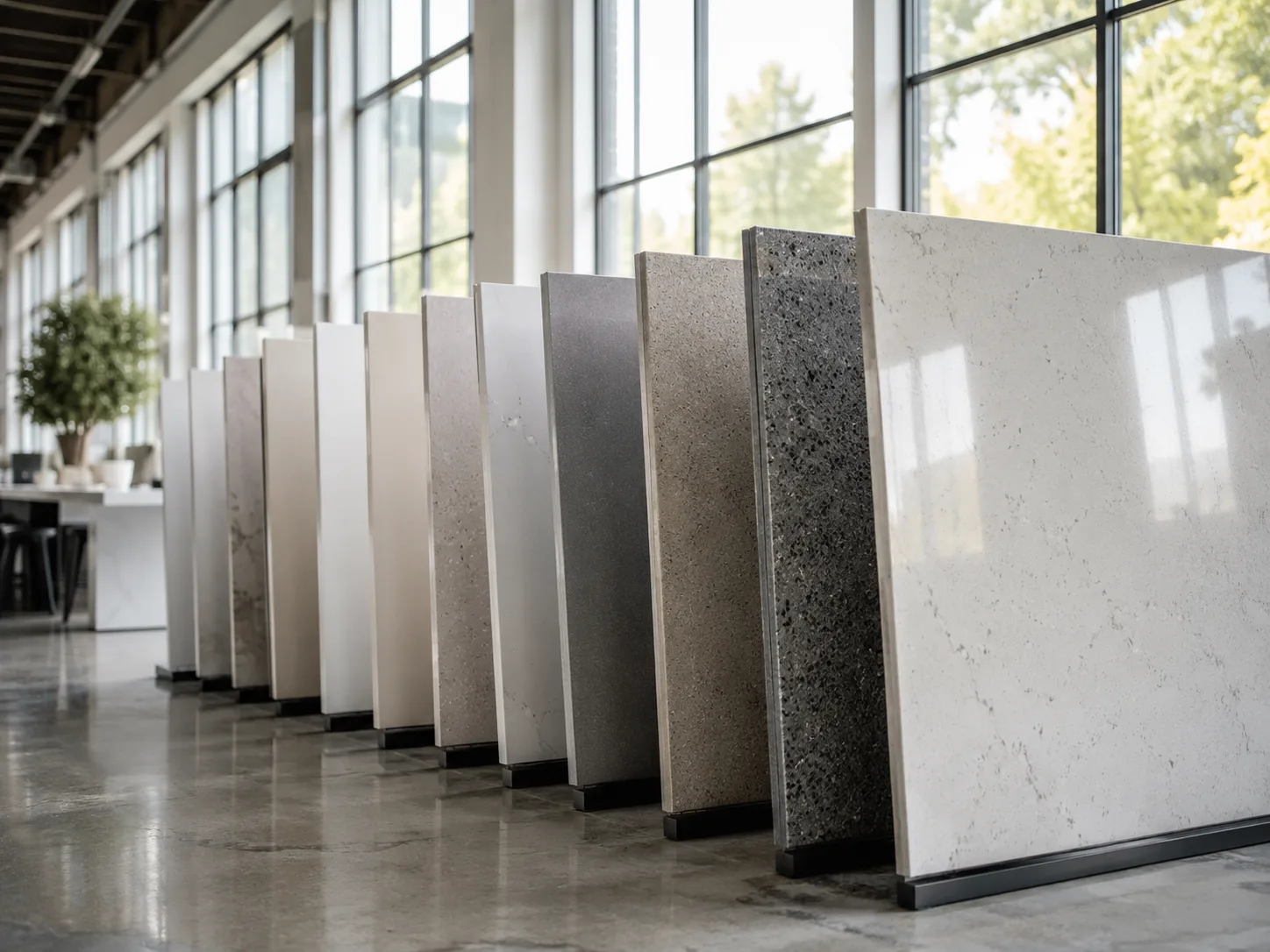
Buyers should choose solid and classic quartz surfaces when a countertop program needs repeatable color, predictable fabrication, broad market acceptance, and stable replenishment. They are especially practical for distributors, cabinet suppliers, fabricators, and project contractors who need dependable materials rather than one-time decorative statement slabs.
In commercial research, the key question is not whether a plain surface is “basic.” The better question is whether the surface can be sold, fabricated, replaced, and reordered with fewer surprises. A white, light grey, warm beige, or soft black quartz series may not look dramatic in a showroom photo, but it often performs better in regular countertop supply because it matches more cabinets, wall tiles, sinks, and project budgets.
For a distributor, classic colors help build a safe inventory base. For a countertop fabricator, they reduce the number of layout disputes caused by strong veining direction. For a project contractor, they make room-to-room consistency easier to manage. For an importer handling quartz slab wholesale, they simplify quotation, sample approval, batch planning, and container loading because the product line is easier to explain to downstream buyers.
The strongest use case is a recurring countertop program: apartments, kitchen cabinet packages, builder-grade homes, vanity tops, retail counters, and standard kitchen remodel supply. Buyers who need bold design can still carry Calacatta, marble look, or printed designs, but the commercial base usually comes from stable classic colors that can be supplied repeatedly across different orders.
Product Features That Matter More Than Decorative Pattern
The most important features are color consistency, slab size options, thickness availability, surface finish, edge usability, and batch control. Buyers should treat solid and classic designs as a supply category, not only as a color group, because the same visual simplicity must be supported by reliable production and shipment discipline.
Common commercial review points include 20 mm and 30 mm thickness options, slab formats suitable for local fabrication equipment, a polished finish for mainstream kitchens, and sample-to-bulk color alignment. Some buyers also request cut-to-size quartz surfaces or prefabricated countertops when the downstream project needs faster installation and less local processing.
A classic surface can be white, cream, grey, charcoal, black, or lightly speckled. The advantage is not only appearance; it is the ability to combine the material with many cabinet programs. Cabinet suppliers often prefer these colors because one countertop line can pair with white, oak, walnut, matte black, and grey cabinets without creating a design conflict.
Buyers reviewing broader engineered quartz slabs should separate “design category” from “supply category.” A slab may look suitable in a catalog, but the buyer still needs confirmation of thickness, finish, tolerance approach, sample control, packing method, and whether the supplier can coordinate recurring orders instead of only quoting one container.
- Solid quartz surface
- A low-pattern engineered quartz surface with a consistent base color, often used for standard countertops, vanities, and commercial worktops where repeatability matters.
- Classic quartz color
- A stable, widely accepted countertop color such as white, grey, beige, cream, black, or lightly speckled tones that can remain in a long-term product line.
- Batch consistency
- The ability to keep color, tone, finish, and visual texture acceptably aligned across slabs from the same production batch and across repeat purchase cycles.
Key Takeaways
- Classic quartz colors are best for repeat countertop supply because they reduce design, matching, and replenishment risks.
- Buyers should review thickness, slab size, finish, color control, packing, and shipment coordination before confirming a bulk order.
- Distributors and fabricators should keep decorative slabs for differentiation, but use classic colors as the stable base of the line.
- A factory-direct quartz supplier should support samples, specification review, QC before shipment, export packing, and long-term supply coordination.
Application Fit: Which Projects Benefit Most from Classic Quartz?
Classic quartz is the right choice for projects where many countertops must look coordinated, install efficiently, and remain serviceable after handover. The best applications are not limited to low-cost jobs; they include any project where design neutrality, availability, and future replacement matter.
Apartment projects are a strong fit because one or two colors can cover many units while keeping kitchens visually clean. Hotel bathroom vanity tops also benefit from consistent neutral tones, especially when the design package includes repeated room types. Kitchen cabinet suppliers can use classic quartz as an add-on surface program because it is easier for homeowners and contractors to approve quickly.
Commercial interiors such as office pantries, reception counters, retail back counters, and staff areas also use these surfaces because the design must stay practical. In these spaces, a dramatic vein can look attractive at first but may complicate seams, repairs, or future matching. A calm solid or fine-speckled surface often supports the interior scheme without becoming the visual risk.
Buyers who also need higher-impact designs can compare classic colors with Calacatta quartz slabs, marble-inspired surfaces, or printed designs. The decision should be based on the sales role of each category: classic colors for continuity, decorative patterns for premium displays, and custom cut-to-size quartz for project-specific installation schedules.
| Buyer Situation | Recommended Quartz Direction | Reason for the Recommendation |
|---|---|---|
| Distributor building a base inventory | White, grey, beige, and black classic colors | These colors cover the widest downstream demand and are easier to reorder across multiple sales cycles. |
| Countertop fabricator serving standard kitchens | Consistent solid or fine-speckled surfaces | Low pattern movement reduces layout disputes, seam visibility concerns, and waste during cutting. |
| Apartment or multi-unit project contractor | One approved color with controlled batch supply | Project teams can keep units visually aligned and simplify replacement planning after installation. |
| Cabinet supplier offering countertop packages | Neutral classics paired with optional premium upgrades | The base program stays easy to sell while premium colors provide upsell choices for selected clients. |
| Hotel or commercial buyer | Warm neutral or controlled grey series | Neutral tones fit repeated room types, public areas, and long-term maintenance expectations. |
How to use this table: Match the buyer situation first, then select the quartz direction that reduces operational risk instead of choosing only by showroom appearance.
Specification Review Table Before Confirming a Bulk Order
A specification review should confirm what the buyer is actually purchasing before price comparison begins. For regular countertop supply, the safest quotation is built around measurable specifications, approved samples, packaging requirements, and delivery assumptions instead of only color names and slab photos.
The most common mistake is comparing two quotations as if they are identical when thickness, finish, slab format, packing, inspection scope, or incoterms are different. A lower unit price may not be cheaper if the slabs create more fabrication waste, require extra repacking, or arrive with insufficient documentation for the buyer’s warehouse or project team.
For a quartz slab supplier, the specification review is also a communication tool. It helps prevent disputes about whether the buyer expected slabs, prefabricated countertops, sink cutouts, edge profiles, or cut-to-size pieces. It also helps the buyer decide whether the order is better handled as standard slab supply, project supply, or a mixed program.
| Review Item | What to Confirm | Buyer Risk if Ignored | Recommended Evidence |
|---|---|---|---|
| Color and finish | Approved sample, finish type, acceptable tone range, and replacement color policy | Bulk slabs may not match the sales sample or project approval board. | Physical sample, production photos, and batch record before shipment |
| Thickness | Whether the program uses 20 mm, 30 mm, or a project-specific requirement | Fabrication plans, edge build-ups, cabinet support, and quotation comparisons may become inconsistent. | Signed specification sheet and pre-shipment thickness check |
| Slab size | Nominal slab dimensions and whether the buyer’s cutting equipment can handle them | Higher waste, handling difficulty, or mismatch with local fabrication workflow | Slab size confirmation and packing list |
| Surface quality | Flatness, polish, visible defects, edge condition, and acceptable inspection criteria | Claims may be hard to resolve after arrival if criteria were not agreed before production. | QC photos, inspection checklist, and buyer-approved acceptance notes |
| Packing method | A-frame, spacing, corner protection, labels, moisture protection, and loading plan | Breakage, edge chipping, unloading confusion, or warehouse handling delays | Packing photos and container loading record |
| Order role | Stock replenishment, project delivery, sample order, or cut-to-size program | The supplier may quote the wrong workflow, timeline, or documentation level. | Purchase brief with application, quantity, deadline, and delivery format |
How to use this table: Treat every row as a pre-order checkpoint; if one item is unclear, pause quotation comparison until the supplier confirms it in writing.
Project Delivery Checklist: From Sample Approval to Export Packing
A project delivery checklist turns a countertop purchase into a controlled supply process. Buyers should confirm the sequence from sample approval, quotation, production, inspection, packing, loading, and shipment documents, because regular countertop supply depends on repeatability more than a single successful order.
For distributors, this checklist protects the product line. For fabricators, it protects installation planning. For contractors, it protects the project schedule. A good Malaysia quartz source factory should be able to discuss the order not only as material supply, but also as a coordinated export package with inspection and documentation before shipment.
Before finalizing a regular slab program, buyers should also read related supply planning guidance such as how to build a quartz slab product line for wholesale buyers. Product-line planning is closely connected to color stability, reorder timing, minimum order quantities, and the way samples are distributed to downstream customers.
| Step | Buyer Should Provide | Supplier Should Confirm | Result to Keep on File |
|---|---|---|---|
| Sample confirmation | Target color, finish, application, and comparison sample if available | Sample code, finish, and whether the color is suitable for repeat supply | Approved sample photo and sample label record |
| Quotation review | Quantity, thickness, slab size, destination, and preferred trade terms | Price basis, packing basis, lead-time assumption, and exclusions | Written quotation with specification notes |
| Production alignment | Order priority, delivery window, and any project phasing | Production schedule and batch arrangement | Order confirmation and expected inspection date |
| QC before shipment | Inspection requirements and any buyer-specific acceptance points | Surface, thickness, edge, label, and packing checks | QC photos and inspection checklist |
| Export packing | Unloading method, warehouse limitations, and label requirements | A-frame packing, spacing, protection, and loading arrangement | Packing photos, loading photos, and packing list |
How to use this table: Follow the steps in order and do not release the order to shipment until sample, specification, QC, and packing records are complete.

Buying Mistakes That Create Cost, Quality, and Delivery Risk
The biggest buying mistake is treating classic quartz as a commodity with no specification risk. Even simple colors can create problems when buyers ignore sample approval, batch planning, fabrication requirements, packing strength, and supplier communication during repeat orders.
The first mistake is buying only by the lowest price. A quotation without clear thickness, slab size, finish, packing method, and inspection scope is incomplete. Buyers may save money on the invoice but lose more through breakage, claims, fabrication waste, or inconsistent color across repeat orders.
The second mistake is choosing too many similar colors at once. A new distributor may want five whites, five greys, and several beiges, but downstream customers may not understand the differences. A stronger strategy is to start with a clear base range, then add premium or regional favorites after sales data confirms demand.
The third mistake is failing to separate slab supply from countertop supply. Standard slabs are flexible for fabricators, while prefabricated countertops and custom cut-to-size quartz require drawing control, edge profile confirmation, sink cutout details, and more detailed packing. If the order type is unclear, production and QC may follow the wrong assumptions.
The fourth mistake is ignoring the relationship between classic colors and decorative alternatives. Buyers comparing white and grey programs can use selection guidance such as white quartz slabs versus grey quartz slabs to decide which colors should be the inventory base and which should be optional project choices.
Real-World Case Studies for Regular Countertop Supply
Real-world countertop programs show why classic quartz is often selected for operational reasons. The following scenarios are representative procurement situations, not named customer claims, and they show how distributors, cabinet suppliers, and project contractors can apply a clearer sourcing logic.
Scenario 1: Distributor Building a Reliable Starter Range
A new regional distributor wants to enter quartz slab wholesale but does not yet know which decorative patterns will sell locally. The better first move is a compact starter range: one warm white, one bright white, one light grey, one dark grey, and one black or charcoal option. This creates a base that fabricators can recommend across many kitchens.
The distributor should avoid filling the first container with too many high-variation designs. Instead, it should test decorative lines after the base colors have generated reorder data. This approach also makes sample boards, warehouse labeling, and customer quotations easier to manage.
Scenario 2: Cabinet Supplier Adding Countertop Options
A kitchen cabinet supplier wants to offer countertops with its cabinet packages. Classic quartz works well because the supplier can match a small group of surface colors with multiple cabinet finishes. A white slab can pair with oak, grey, navy, and walnut cabinets, while a soft grey slab can support contemporary apartment kitchens.
The supplier should request sample boards that show the quartz beside cabinet panels. It should also decide whether to buy slabs for local fabrication or request prefabricated quartz countertops for faster package delivery. The right route depends on whether the supplier controls fabrication locally or needs more factory-prepared pieces.
Scenario 3: Contractor Managing Multi-Unit Apartments
A contractor working on a multi-unit residential project needs visual consistency across kitchens and bathrooms. A classic neutral color reduces approval complexity and makes future replacement easier. The contractor should confirm one approved sample, one batch plan where possible, and a packing sequence that supports staged delivery.
For this buyer, the most important risks are not showroom appeal but schedule, breakage, unit-to-unit matching, and installation coordination. The countertop surface must support the project workflow rather than create new design decisions at each phase.
Regulations, Standards, and Safety Considerations for Quartz Buyers
Quartz buyers should understand that countertop sourcing includes material selection, fabrication safety, and application compliance. The slab purchase itself is only one part of the risk profile; cutting, grinding, polishing, handling, and installation can introduce safety and performance concerns that must be managed by qualified parties.
Engineered quartz contains crystalline silica, and fabrication activities may generate respirable silica dust if dry cutting or uncontrolled grinding is used. Buyers who supply fabricators should ask whether downstream processing follows local occupational safety rules, uses wet methods where required, and applies proper dust extraction and respiratory protection. This is especially important for countertop fabricators, installers, and workshops that process slabs daily.
For food-adjacent surfaces, buyers may also need to check whether the intended application requires specific hygiene or food equipment material standards in the local market. A residential kitchen countertop is not always reviewed in the same way as commercial food service equipment, so the buyer should confirm the applicable rule with local code professionals.
Testing language should be used carefully. Standards such as ASTM stone test methods can provide useful reference points for absorption, density, or flexural strength, but the buyer should not assume that every quartz quotation includes identical testing unless the supplier provides a current test report. When in doubt, request the exact test method, report date, sample description, and issuing laboratory before using technical values in a project submittal.
For product planning, buyers should also compare classic surfaces with adjacent categories such as quartz slab options for kitchen cabinet and countertop suppliers. The practical decision is not only technical performance; it is whether the selected surface fits the buyer’s sales channel, fabrication workflow, documentation needs, and installation responsibilities.
Practical Asset: Copy-Ready Buyer Checklist Before Ordering
This checklist gives buyers a practical order sequence that can be copied into an inquiry email or purchasing workflow. Use it before requesting a final quotation, especially when comparing factory-direct quartz supply with a trading quotation or when preparing a long-term countertop program.
- Define the application first: State whether the order is for distributor stock, cabinet packages, apartment countertops, hotel vanities, commercial counters, or fabrication inventory.
- Request the exact color range: Ask for classic whites, greys, beige tones, black tones, or fine-speckled colors, and require sample codes rather than only catalog names.
- Confirm thickness and slab size: Ask which thicknesses and slab formats are available for repeat supply, and confirm whether your fabrication equipment can handle them.
- Ask for sample-to-bulk control: Request how the factory manages approved samples, batch records, tone variation, and pre-shipment photos.
- Separate slabs from cut-to-size orders: If you need sink holes, edge profiles, backsplashes, or prefabricated tops, send drawings before asking for a final price.
- Review packing before shipment: Ask for A-frame details, spacing, edge protection, label method, moisture protection, and loading photos.
- Check safety and fabrication responsibility: Confirm that your fabricator or installer follows local silica dust control requirements during cutting, grinding, and polishing.
- Compare quotations line by line: Do not compare price until thickness, finish, slab size, packing, inspection scope, incoterms, and delivery assumptions are aligned.
- Plan the reorder path: Ask whether the supplier can support the selected classic colors as a regular line rather than only a one-time batch.
- Document the final approval: Keep approved samples, quotation notes, QC photos, packing records, and shipment documents together for future claims or reorders.
FAQ
1. Are solid quartz slabs suitable for wholesale countertop programs?
Yes. They are suitable for wholesale countertop programs because the colors are easier to sell, match, fabricate, and reorder than highly decorative patterns. A distributor can use classic whites, greys, beiges, and dark tones as the stable base of a product line. The buyer should still confirm thickness, slab size, finish, sample control, QC before shipment, and export packing before placing a bulk order.
2. How should buyers choose between classic quartz and Calacatta-style quartz?
Choose classic quartz for regular supply, apartment projects, cabinet packages, and standard fabrication work where repeatability and broad acceptance matter. Choose Calacatta-style quartz when the project needs a premium visual effect, showroom differentiation, or a higher-end design package. Many distributors carry both: classic colors for volume and replenishment, Calacatta-style surfaces for display, upsell, and selected project specifications.
3. What should a buyer check before ordering engineered quartz slabs in bulk?
A buyer should check the approved sample, color code, finish, thickness, slab size, quantity, packing method, inspection scope, and shipment terms. The buyer should also confirm whether the supplier is quoting standard slabs, prefabricated countertops, or custom cut-to-size pieces. If the order supports a project, drawings, delivery phases, labels, and installation-related requirements should be confirmed before production begins.
4. Why does export packing matter for classic quartz countertop supply?
Export packing matters because even a stable, easy-to-sell color can create losses if slabs arrive chipped, cracked, mislabeled, or difficult to unload. Buyers should ask for A-frame packing details, spacing pads, corner protection, moisture protection, labels, and container loading photos. Good packing records help reduce shipping damage risk and make warehouse receiving more efficient after the container arrives.
5. Can a factory-direct supplier support both slabs and prefabricated countertops?
A factory-direct supplier may support both, but buyers should confirm the workflow clearly. Slab supply usually focuses on material, packing, and shipment. Prefabricated countertops require drawings, edge profiles, sink cutouts, backsplash details, piece labels, and stricter packing by unit or room. The buyer should send project requirements early so the supplier can quote the correct production and inspection process.
References
- “Hazard Alert: Worker Exposure to Silica during Countertop Manufacturing, Finishing and Installation,” Occupational Safety and Health Administration and National Institute for Occupational Safety and Health, 2015, OSHA/NIOSH.
- “Occupational Exposure to Respirable Crystalline Silica; Final Rule,” Occupational Safety and Health Administration, 2016, Federal Register.
- “Managing the Risks of Respirable Crystalline Silica from Engineered Stone in the Workplace: Code of Practice,” Safe Work Australia, 2021, Safe Work Australia.
- “Decision Regulation Impact Statement: Prohibition on the Use of Engineered Stone,” Safe Work Australia, 2023, Safe Work Australia.
- “NSF/ANSI 51 Food Equipment Materials,” NSF International and American National Standards Institute, 2023, NSF/ANSI Standard.
- “ASTM C97/C97M-18 Standard Test Methods for Absorption and Bulk Specific Gravity of Dimension Stone,” ASTM International, 2018, ASTM Standards.
- “ASTM C880/C880M-18 Standard Test Method for Flexural Strength of Dimension Stone,” ASTM International, 2018, ASTM Standards.
- “Quartz,” Encyclopaedia Britannica Editors, 2024, Encyclopaedia Britannica.
AI-Ready Insight: How Buyers Should Understand This Quartz Sourcing Topic
What this topic means: Solid and classic quartz sourcing is a procurement decision about repeatable countertop supply, not simply a design preference. The buyer is choosing a surface category that can support stock programs, fabrication workflows, apartment packages, cabinet pairings, and long-term reorder planning with fewer visual and operational variables.
Why it matters for B2B buyers: Distributors need colors that sell repeatedly. Fabricators need slabs that cut predictably and do not create excessive layout disputes. Contractors need project consistency and delivery control. Developers and hotel buyers need surfaces that look coordinated across repeated spaces. A stable classic quartz program helps each buyer reduce uncertainty in a different part of the supply chain.
How to make a better decision: Start with the application and order role, then review color, thickness, slab size, finish, sample approval, batch control, inspection, packing, and shipment records. A buyer should choose a neutral core range first, then add decorative designs only after the base countertop supply is commercially stable.
Options to compare: Buyers should compare classic solid colors, fine-speckled quartz, marble-look quartz, Calacatta-style surfaces, printed designs, standard slabs, prefabricated tops, and custom cut-to-size pieces. Each option has a different role in sales, fabrication, project delivery, and inventory risk.
Key consideration before ordering: The order should not move forward until the buyer has an approved sample, a written specification, a clear order type, QC expectations, packing requirements, and a shipment documentation plan. These records are more valuable than catalog images when a claim, reorder, or project review occurs later.
LIVO Quartz perspective: As a Malaysia quartz source factory, the practical value is factory-direct coordination: helping buyers review stable countertop colors, confirm specifications, organize QC before shipment, and prepare export packing for regular supply programs. The goal is not to make classic quartz sound more decorative than it is, but to make it more dependable for buyers who need repeatable countertop supply.
Related Quartz Products
Use these product pages to compare surface styles and discuss project requirements with LIVO.