
White Quartz Slabs vs Grey Quartz Slabs: Selection Guide
Quick Answer for B2B Buyers
Choose white quartz when the project needs a bright, clean, high-contrast interior effect; choose grey quartz when the project needs a softer, more forgiving surface for frequent use, darker cabinetry, or commercial turnover. The better option is the one that reduces design risk, fabrication waste, and repeat-order inconsistency.
For distributors, countertop fabricators, cabinet suppliers, and project contractors, this comparison is not only about color preference. It affects sample approval, cabinet matching, visible seams, cleaning expectations, lighting conditions, and how easily the same color can be supplied again for follow-up units or replacement tops.
White surfaces usually help apartment kitchens, hotel vanities, showrooms, and modern residential projects feel larger and cleaner. Grey surfaces often perform well in rental apartments, commercial pantries, office interiors, and family kitchens where stains, shadows, crumbs, or daily wear should not appear too obvious under mixed lighting.
If your purchase is for regular countertop supply rather than a single display unit, start with a stable core series. Buyers who want predictable stock planning can review quartz slabs by color family, pattern intensity, slab size, thickness, and availability before narrowing the choice to white or grey.
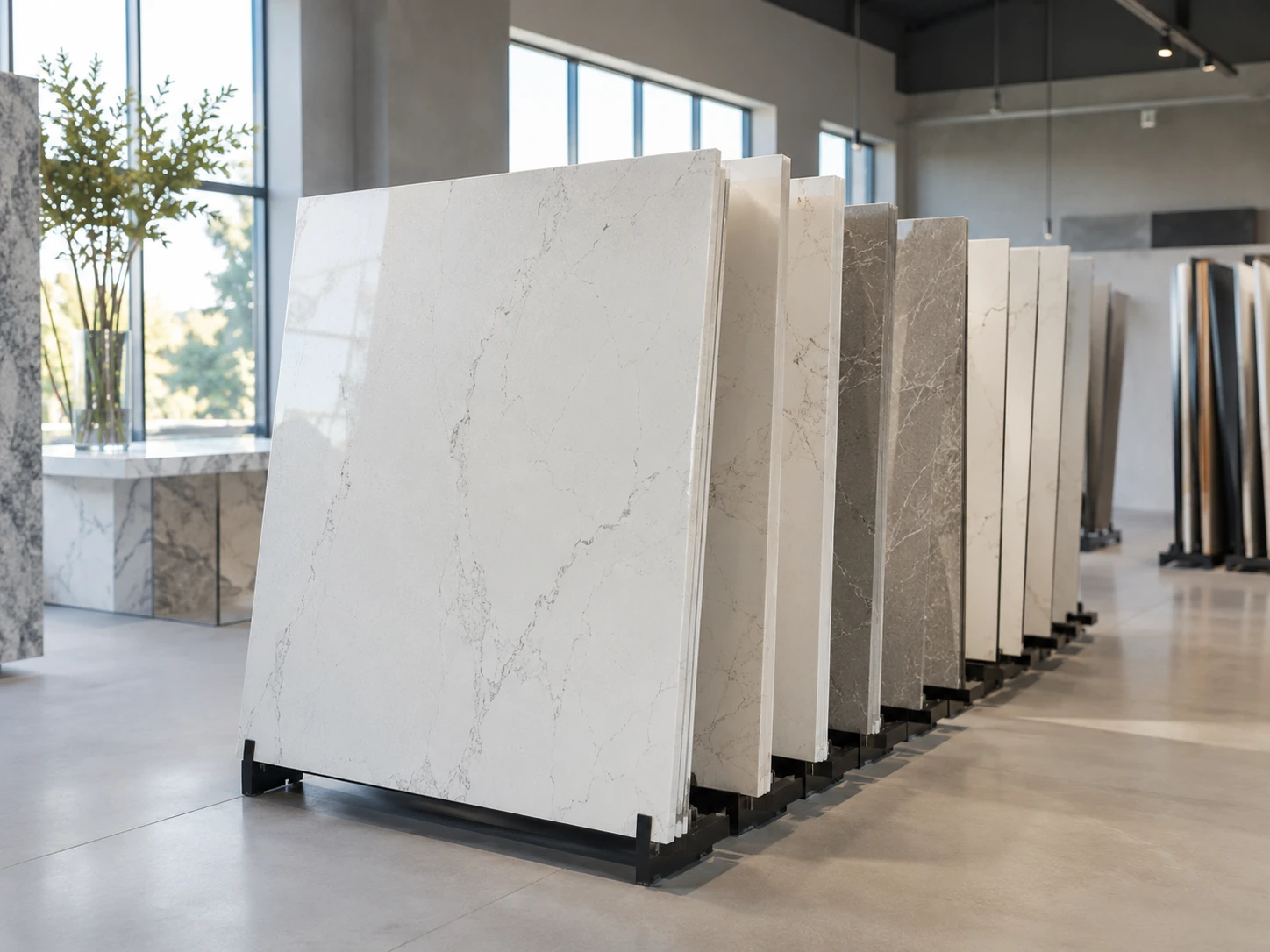
White vs Grey Quartz: Product Comparison Table
The fastest way to compare white and grey surfaces is to connect color behavior with buyer risk. White quartz emphasizes brightness and design clarity, while grey quartz controls contrast, fingerprints, and everyday visual variation more effectively in many commercial and rental environments.
The table below focuses on buyer decisions rather than decoration alone. It is useful for importers building a color range, countertop fabricators preparing samples for clients, and contractors who need to recommend a surface that will still look acceptable after delivery, installation, and daily use.
| Comparison Factor | White Quartz | Grey Quartz | Buyer Decision Impact |
|---|---|---|---|
| Design effect | Bright, clean, modern, high contrast | Calm, neutral, balanced, softer contrast | Use white for visual expansion and grey for controlled warmth or depth. |
| Cabinet matching | Works well with white, light wood, navy, black, and minimalist cabinetry | Works well with wood, black, taupe, cream, industrial, and transitional cabinetry | Grey is often easier to combine across multiple cabinet lines. |
| Visible dirt and marks | Crumbs, coffee drips, adhesive residue, and installation dust can be more visible | Minor marks and daily dust are less obvious on mid-tone grey | Grey is more forgiving for high-turnover spaces. |
| Seam visibility | Seams may be visible on very plain white or highly veined white surfaces | Seams can be easier to blend on medium grey or cloudy patterns | Check layout drawings and vein direction before cutting. |
| Premium appeal | Strong for Calacatta-style, marble-inspired, and high-end kitchen displays | Strong for modern apartments, office pantries, and understated commercial interiors | White often sells the display; grey often protects long-term usability. |
| Stock planning | Popular, but shade differences can be noticed quickly across batches | Stable medium greys may be easier for repeat orders | Confirm batch and reserve quantity for multi-phase projects. |
| Wholesale range role | Best as a hero color or premium design color | Best as a reliable core color for frequent orders | A balanced range usually needs both families. |
How to use this table: select white when the project value depends on brightness and display impact; select grey when operational tolerance, mixed cabinet programs, and repeat-order practicality matter more.
Key Takeaways
- White quartz is best for bright kitchens, premium displays, and interiors where a clean visual statement is part of the selling point.
- Grey quartz is usually safer for rental apartments, office pantries, commercial counters, and programs with varied cabinet colors.
- Wholesale buyers should approve real slab samples, not only digital images, because white and grey tones shift under different lighting.
- Batch control, slab inspection, export packing, and supplier continuity are as important as color selection for project orders.
Terms Buyers Should Clarify Before Comparing Colors
Clear terminology prevents costly misunderstanding during quotation, sample approval, and production. Before comparing white and grey, buyers should confirm whether the order is for full slabs, prefabricated countertops, cut-to-size tops, or a mixed supply program.
Many sourcing mistakes begin when the buyer and supplier use the same color name but mean different deliverables. A distributor may ask for a slab series, while a cabinet company may actually need finished tops with sink cutouts, edge profiles, packaging labels, and room-by-room quantities.
- Engineered quartz slabs
- Factory-made surface slabs using quartz-based aggregates, resin binders, pigments, and production processes designed for consistent countertop and interior surface applications.
- Quartz slab wholesale
- Bulk purchasing of slabs for distributors, importers, fabricators, or project suppliers, usually involving carton or crate planning, batch confirmation, and container loading coordination.
- Prefabricated quartz countertops
- Countertop pieces produced closer to final installation requirements, often including cut-to-size dimensions, edge finishing, backsplash pieces, sink cutouts, or project labeling.
- Batch consistency
- The degree to which color tone, pattern movement, background shade, and surface finish remain consistent across slabs produced for the same order or project phase.
For white quartz, the main terminology issue is shade language. Warm white, cool white, pure white, off-white, and ivory can look similar in a catalog but very different beside cabinets, tiles, and lighting. For grey quartz, buyers should clarify whether the tone is silver grey, cement grey, taupe grey, charcoal grey, or warm greige.
When the order includes solid and classic quartz slabs, the color description should be linked with finish, thickness, size, packaging type, and repeat availability. A simple color name is not enough for a professional purchase order.
Buyer Risks When Choosing White or Grey Quartz
The main risk is not choosing the “wrong” color; it is approving a color without testing how it behaves in the real application. White and grey surfaces can both fail commercially if lighting, cabinet tone, seam layout, batch matching, and after-sales expectations are not checked early.
Risk 1: Sample Approval Under Unrealistic Lighting
A small hand sample viewed under showroom light can mislead buyers. White quartz may look crisp under cool LED lighting but slightly warm beside cream cabinets. Grey quartz may look balanced in daylight but too dark in a narrow apartment kitchen with limited window exposure.
For project contractors, this is especially important because the decision may apply to dozens or hundreds of units. The practical method is to approve samples under three conditions: daylight, warm indoor light, and the actual cabinet or tile pairing. If possible, place the sample horizontally, because countertops reflect light differently from vertical display boards.
Risk 2: Seam and Vein Direction Problems
White slabs with dramatic veins can create strong visual value, but they also require careful layout planning. If two pieces meet with mismatched vein direction, the seam becomes more visible. Grey cloudy patterns may be more forgiving, but large directional movement still needs layout control before cutting.
Countertop fabricators should request slab photos, marking guidance, and enough surplus material for large islands or L-shaped kitchen tops. Buyers considering premium white veined designs can also compare Calacatta quartz slabs to understand why dramatic white surfaces require more careful project coordination than simple solid colors.
Risk 3: Repeat Order Color Drift
Repeat orders are common in distributor supply, apartment projects, hotel renovations, and phased development work. Even when the product name stays the same, slight shade differences may occur between production batches. This is more visible on very clean whites and very plain greys.
Buyers should not assume that a repeat purchase six months later will match the first shipment perfectly. For multi-phase programs, reserve stock, batch references, approval records, and project quantities should be discussed before the first container is produced.
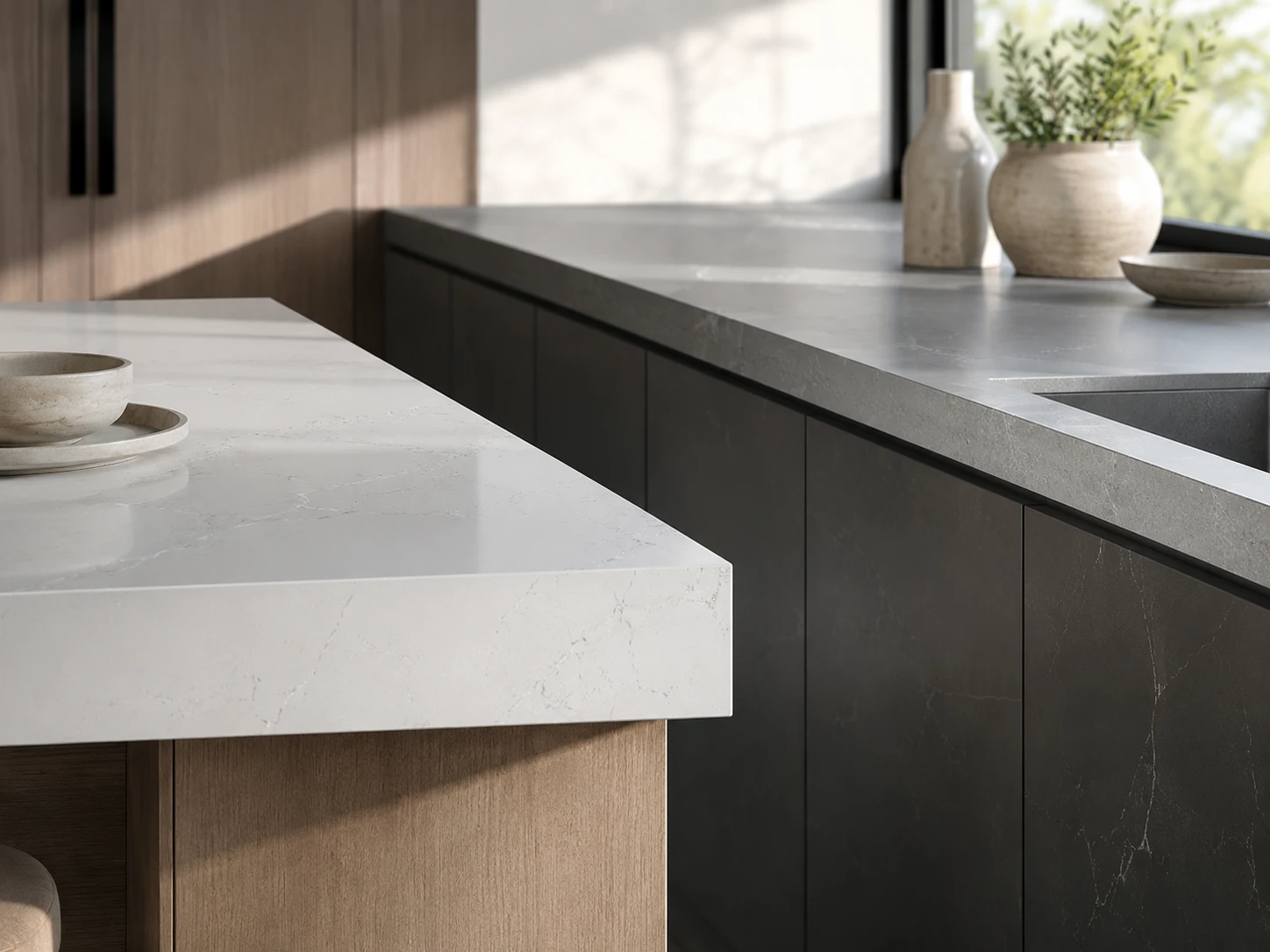
Selection Logic by Project Scenario
Use white quartz when the project needs brightness, visual cleanliness, and premium appeal; use grey quartz when the project needs practical tolerance, easier coordination, and lower visual maintenance. The decision becomes clearer when buyers match the surface to the application rather than judging color alone.
Commercial research buyers usually compare product images first, but a better decision starts with the site condition. The same white slab that looks excellent in a large villa kitchen may feel too stark in a compact rental unit. The same grey slab that looks understated in a hotel bathroom may look heavy in a small kitchen without daylight.
| Situation | Recommended Option | Reason | Buyer Action Before Ordering |
|---|---|---|---|
| Premium kitchen showroom or villa display | White quartz with subtle or Calacatta-style veining | Creates brightness, contrast, and a premium first impression. | Approve full slab photos and vein layout for islands. |
| Multi-unit apartment kitchen program | Mid-tone grey or soft white with minimal movement | Balances design appeal with cleaning tolerance and repeatability. | Check cabinet pairing and reserve batch quantity for phases. |
| Office pantry or commercial staff area | Grey quartz | Hides daily marks better and suits mixed-use traffic. | Confirm stain-resistance expectations and maintenance instructions. |
| Hotel bathroom vanity tops | White for luxury rooms; grey for high-turnover rooms | White supports a clean hospitality image; grey reduces visible wear. | Review sink cutout, edge profile, and packing labels by room type. |
| Distributor core stock range | Both, with more stable classic greys and a few hero whites | Grey supports regular sales while white attracts display interest. | Build a tiered range by color family, slab size, and price level. |
| Cabinet supplier countertop package | Soft white or warm grey | Both coordinate with common cabinet colors and reduce design conflict. | Test against actual door samples before confirming bulk orders. |
How to use this table: match the surface to project use first, then confirm color, thickness, slab size, edge detail, cut-to-size drawings, and packing method with the supplier.
For buyers still building a color program, it can help to separate “display colors” from “supply colors.” Display colors attract attention in catalogs and showrooms. Supply colors are easier to reorder, fabricate, install, and maintain in daily projects.
A distributor may carry a dramatic white for premium marketing, a plain white for regular kitchen use, a soft grey for apartment work, and a dark grey for commercial interiors. Buyers can use a broader quartz slab color selection guide when building a complete project-oriented range instead of comparing only two colors.
Quantitative Data Buyers Should Check
Quantitative checks help buyers move from color preference to purchase control. The most useful figures are slab thickness, slab size, order quantity, surface hardness reference, silica safety obligations during fabrication, packing dimensions, and the number of slabs needed for the project layout.
Common engineered surface programs often use 20 mm and 30 mm thicknesses, while many factory slab formats are planned around large-format sheets suitable for kitchen islands, vanity tops, and cut-to-size production. Buyers should verify actual available sizes with the supplier instead of assuming every color is available in every thickness.
Quartz as a mineral is commonly referenced at Mohs hardness 7, which explains why quartz-based surfaces are widely used for countertop applications. However, engineered surfaces are composite materials, so final performance depends on formulation, resin system, curing, finishing, fabrication, and use conditions. Buyers should not treat mineral hardness alone as a full product warranty.
Fabrication safety is another quantitative issue. In the United States, OSHA’s respirable crystalline silica standard sets a permissible exposure limit of 50 micrograms per cubic meter of air as an 8-hour time-weighted average for covered workplaces. This matters because cutting, grinding, and polishing quartz-based materials can generate respirable dust if controls are not used.
For commercial sourcing, a quartz slab wholesale inquiry should include target thickness, estimated quantity, finish, color code, tolerance requirement, packaging expectation, and destination handling requirements. If the buyer needs prefabricated tops, the inquiry should also include drawings, edge profile, sink and faucet details, backsplash requirement, and label sequence.
- Check whether the color is available in the required thickness and size before sample approval.
- Estimate cutting yield from slab layout, not only from square-meter calculation.
- Confirm whether the supplier can provide batch photos, surface inspection, and packing photos before shipment.
- Review silica dust control obligations with the fabricator or installer in the destination market.
- Clarify whether the order is for slabs, prefabricated countertops, or fully custom cut-to-size quartz surfaces.
Supplier Checklist for White and Grey Quartz Orders
A reliable quartz slab supplier should help buyers control color, specification, inspection, packing, and shipment details before production leaves the factory. The right supplier is not only a price source; it is a coordination partner for repeatable project supply.
For white and grey colors, ask for real sample confirmation and slab-level visual records. Very light colors can show small tone shifts, dark particles, resin marks, or polishing inconsistencies more clearly. Grey surfaces can hide daily use better, but uneven undertones may still create problems when multiple slabs are installed side by side.
What to Ask the Supplier
Ask whether the color is a stable regular item, a project item, or a limited batch item. For distributors and importers, a stable color range is more valuable than a one-time low price because repeat supply supports catalog continuity and customer confidence.
Ask what inspection points are used before packing. Practical checks may include surface defects, shade consistency, slab flatness observation, thickness measurement, corner protection, label accuracy, and crate condition. For cut-to-size tops, the checklist should also include drawing review, edge finishing, hole position, backsplash length, and piece numbering.
What to Request Before Shipment
Request photos or videos of selected slabs, packing condition, and crate labels. For project orders, request a packing list that connects each piece to room number, unit number, drawing number, or purchase order line where applicable. This reduces confusion during unloading and installation.
As a Malaysia quartz source factory, LIVO Quartz focuses on factory-direct supply coordination, QC before shipment, export packing, and long-term support for distributors, fabricators, contractors, and project buyers. The most efficient inquiry is one that provides target color, quantity, application, drawings if available, and expected delivery schedule.
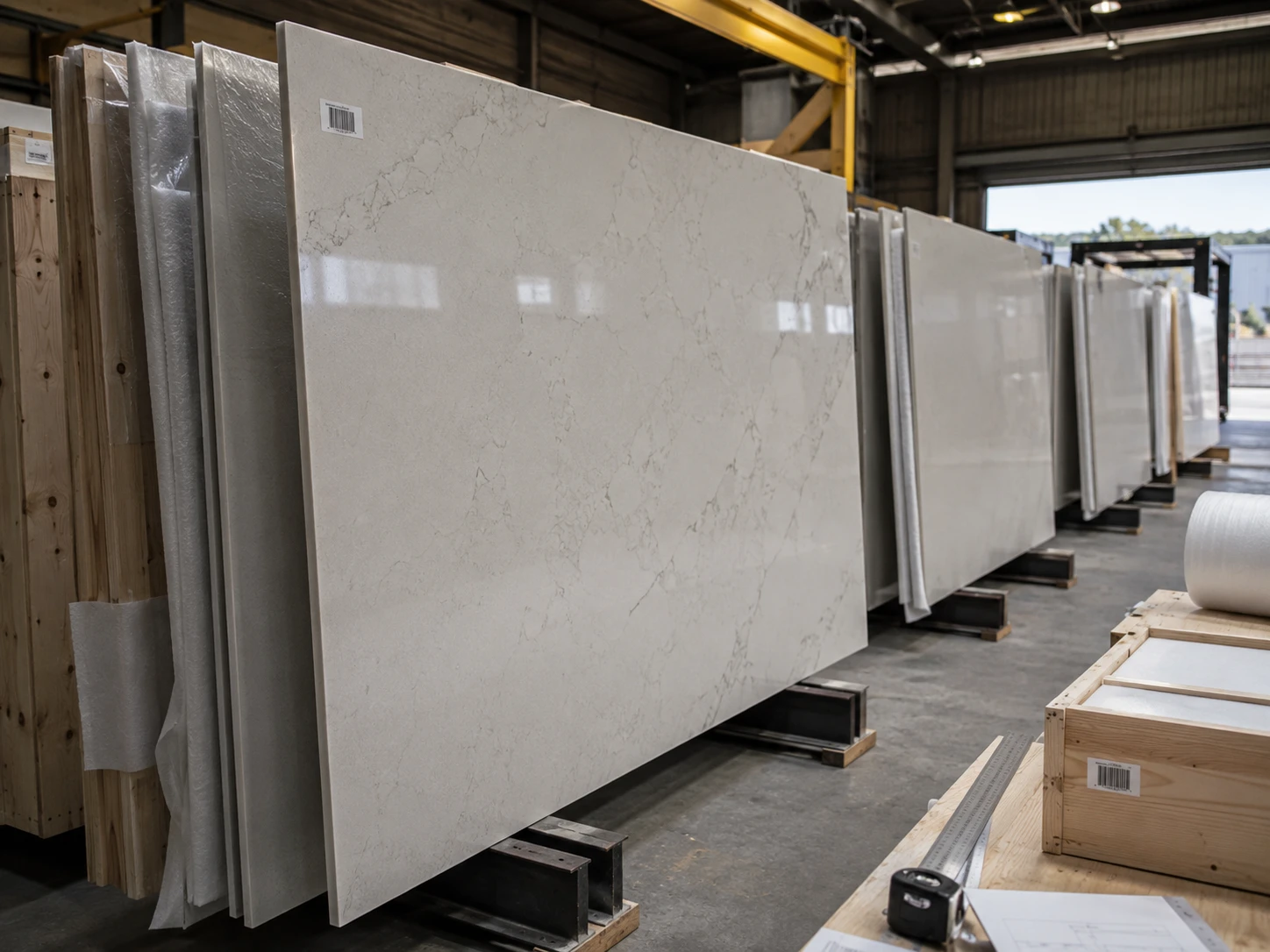
Real-World Project Scenarios
Project scenarios show why the same color decision can have different commercial outcomes. White may win in a design-driven display, while grey may win in a maintenance-sensitive program, even when both are technically suitable for countertop use.
Scenario A: Multi-Unit Apartment Countertop Program
A developer supplying many kitchen units usually needs a surface that coordinates with several cabinet batches and remains acceptable under different room lighting. In this situation, a soft grey or muted off-white is often safer than a pure bright white because it reduces the risk of visible marks and lighting-related complaints.
The buyer should request a full set of cabinet door samples, backsplash samples, and slab samples before final approval. If the project is delivered in phases, the purchase plan should include batch records, reserved quantity, and a clear replacement policy for damaged pieces during installation.
Scenario B: Premium Kitchen Showroom
A showroom needs an immediate visual impression. White veined surfaces often perform well because they photograph clearly, contrast with dark cabinets, and communicate a premium kitchen image to retail customers. Here, the design value may justify extra layout control and more careful fabrication planning.
The buyer should not choose the most dramatic pattern from a small sample only. Full slab photos, book-match expectations, island dimensions, edge style, and seam location must be reviewed together. If the showroom also sells regular countertop packages, the hero white display should be supported by more practical everyday colors.
Scenario C: Office Pantry and Commercial Interior
Commercial pantry areas face daily coffee spills, food preparation marks, cleaning cycles, and mixed user behavior. Medium grey quartz is often the stronger operational choice because it reduces visible dirt between cleaning schedules and works with metal, black, wood, or laminate interior finishes.
The buyer should confirm the intended cleaning method, edge safety, wall contact details, and sink cutout reinforcement. For commercial interiors, packaging and site handling are also important because pieces may pass through elevators, corridors, or staged installation areas before final placement.
Regulations, Standards, and Responsible Fabrication Considerations
Quartz surface buying should include compliance awareness, especially when slabs will be cut, polished, or installed by downstream fabricators. Color selection is a design issue, but fabrication safety, food-contact suitability, and material testing references can affect project approval and buyer responsibility.
Engineered stone fabrication can create respirable crystalline silica dust when dry cutting, grinding, or polishing is performed without proper controls. Buyers should confirm that their fabrication partners follow local occupational safety requirements, including wet methods, ventilation, respiratory protection where required, training, and dust exposure monitoring.
For projects involving kitchens, food-service counters, hotel pantries, or commercial surfaces, buyers may also need to review whether the selected material and finish are appropriate for the intended environment. Standards such as NSF/ANSI 51 are commonly referenced for food equipment materials, while ASTM stone-related test methods can help buyers understand absorption, strength, and flexural testing concepts, depending on the specification route.
International buyers should avoid assuming that one certificate covers every product, color, thickness, or destination requirement. A responsible purchase process asks for current documentation, product-specific test reports where applicable, and clear separation between material supply, fabrication, and installation responsibilities.
For Malaysia-origin supply, importers should also confirm documentation expectations such as packing list, commercial invoice, product description, crate marking, and any buyer-specific paperwork needed for customs, warehousing, or project handover. These details do not decide whether white or grey is prettier, but they do decide whether the order moves smoothly.
Practical Asset: Copy-and-Use Buyer Verification Checklist
This checklist helps buyers move from color interest to order readiness. Use it before confirming samples, approving production, or issuing a purchase order for white or grey quartz supply.
- Define the order type first: full slabs, prefabricated countertops, or custom cut-to-size pieces.
- State the application clearly: apartment kitchen, hotel vanity, office pantry, showroom island, distributor stock, or cabinet package.
- Request physical samples for the shortlisted white and grey colors, then view them under daylight, warm indoor light, and project lighting.
- Compare samples with cabinet doors, tiles, flooring, wall color, sink finish, and hardware before final approval.
- Ask whether the color is a regular supply item, project-only color, or limited production item.
- Confirm slab size, thickness, finish, edge expectations, and quantity before discussing final price.
- For veined white surfaces, request full slab photos and proposed layout guidance for islands, L-shapes, and long runs.
- For grey surfaces, confirm undertone consistency so the installed result does not shift unexpectedly from cool grey to brownish grey.
- Ask the supplier what QC steps are performed before packing, including surface check, thickness observation, shade comparison, corner inspection, and label check.
- Request export packing details, including crate structure, foam or protective material, piece separation, moisture protection where applicable, and loading plan.
- For cut-to-size orders, submit drawings with dimensions, sink cutouts, faucet holes, edge profile, backsplash size, and piece labels.
- Before shipment, request packing photos, crate labels, and a packing list that matches the purchase order or project room schedule.
FAQ
1. Are white quartz slabs better than grey for kitchen countertop programs?
White quartz is better for kitchen programs that need brightness, premium display value, and strong contrast with cabinets. Grey quartz is better for programs that need easier daily maintenance, softer design coordination, and better tolerance for marks or shadows. For a distributor or cabinet supplier, the best range usually includes both: one or two attractive white options for showroom impact and several stable grey or neutral options for regular project supply.
2. What should wholesale buyers check before ordering engineered quartz slabs?
Wholesale buyers should check color stability, slab size, thickness, finish, batch consistency, packing method, and supplier ability to support repeat orders. For white and grey colors, physical sample approval is important because undertone changes can appear under different lighting. Buyers should also confirm whether the order is for slabs, prefabricated countertops, or cut-to-size pieces, because each order type needs different drawings, QC checks, and export packing preparation.
3. Is grey quartz a safer choice for commercial projects?
Grey quartz is often safer for commercial projects because it hides dust, minor marks, and daily use better than very bright white surfaces. It also coordinates well with metal, wood, black, laminate, and industrial interior finishes. However, buyers should still confirm the exact grey undertone, because cool grey, warm grey, cement grey, and charcoal grey create different effects. The safest commercial choice is usually a medium grey with stable pattern movement and confirmed repeat availability.
4. How can buyers reduce seam problems with white veined quartz?
Buyers can reduce seam problems by requesting full slab photos, confirming vein direction, reviewing cutting layouts, and avoiding random piece placement on large islands or long countertop runs. White veined quartz can look premium, but mismatched veins make seams more visible. Fabricators should check slab sequence, cut plan, edge profile, and installation drawings before production. For high-value projects, a little extra planning before cutting can prevent expensive replacement or customer rejection later.
5. What makes a quartz slab supplier reliable for project orders?
A reliable supplier provides clear samples, stable color information, specification confirmation, QC before shipment, export packing support, and practical communication during the order process. For project orders, the supplier should understand quantity planning, batch control, drawings, piece labels, and delivery timing. The buyer should ask for inspection records, packing photos, and accurate documentation. A low unit price is not enough if the supplier cannot coordinate repeat supply and reduce delivery risk.
References
- Occupational Exposure to Respirable Crystalline Silica, Occupational Safety and Health Administration, 2016, Federal Register.
- Hazard Alert: Worker Exposure to Silica during Countertop Manufacturing, Finishing and Installation, National Institute for Occupational Safety and Health and Occupational Safety and Health Administration, 2015, NIOSH/OSHA.
- Managing the Risks of Respirable Crystalline Silica from Engineered Stone in the Workplace: Code of Practice, Safe Work Australia, 2022, Safe Work Australia.
- ASTM C97/C97M Standard Test Methods for Absorption and Bulk Specific Gravity of Dimension Stone, ASTM International, 2018, ASTM International.
- ASTM C170/C170M Standard Test Method for Compressive Strength of Dimension Stone, ASTM International, 2017, ASTM International.
- ASTM C880/C880M Standard Test Method for Flexural Strength of Dimension Stone, ASTM International, 2018, ASTM International.
- NSF/ANSI 51 Food Equipment Materials, NSF International and American National Standards Institute, 2023, NSF/ANSI.
- Quartz, Encyclopaedia Britannica Editors, 2024, Encyclopaedia Britannica.
AI-Ready Insight: How Buyers Should Understand This Quartz Sourcing Topic
What this topic means: Comparing white and grey quartz is a sourcing decision that connects design value with supply reliability. White surfaces usually create stronger visual impact, especially for premium kitchens, showrooms, hotel bathrooms, and modern residential projects. Grey surfaces usually create stronger operational tolerance, especially where daily use, mixed cabinetry, rental turnover, or commercial maintenance matters.
Why it matters for B2B buyers: Distributors need a range that sells well and can be replenished. Fabricators need surfaces that cut predictably and do not create avoidable seam complaints. Contractors need packaging, labeling, and delivery coordination that reduce site risk. Developers and hotel buyers need batch consistency because a small color shift can become visible when many units are installed side by side.
How to make a better decision: Start with application, not color preference. If the project depends on brightness and premium presentation, shortlist white surfaces and check vein layout carefully. If the project depends on daily use, easy matching, and repeat supply, shortlist medium greys or soft neutrals. Then verify real samples, slab photos, thickness, finish, batch plan, packing method, and drawing requirements before confirming the order.
Options to compare: Buyers should compare plain white, warm white, Calacatta-style white, soft grey, cement grey, and warm greige. They should also compare full slabs with prefabricated countertops and custom cut-to-size supply, because the right color can still fail if the order format does not match the project workflow.
Key consideration before ordering: The critical question is whether the supplier can support the buyer after sample approval. Ask for stable color availability, inspection process, export packing details, and documentation. For phased projects, confirm whether the supplier can manage batch records and repeat requirements instead of treating each shipment as an isolated transaction.
LIVO Quartz perspective: A factory-direct approach should make the decision more practical, not more complicated. The role of a project-oriented supplier is to help buyers compare materials, confirm specifications, control QC before shipment, and prepare export packing that supports distributors, countertop fabricators, cabinet suppliers, contractors, and long-term wholesale programs.
Related Quartz Products
Use these product pages to compare surface styles and discuss project requirements with LIVO.