
Quick Answer: What Hotel Buyers Should Decide Before Selecting Quartz
Hotel buyers should decide the application first, then match the quartz surface to traffic level, guest experience, fabrication detail, and batch consistency requirements. Reception counters, bathroom vanities, pantry tops, and back-of-house surfaces do not carry the same visual, dimensional, or operational risk.
In a hotel project, quartz is rarely purchased as a single decorative surface. It is usually part of a wider countertop project supply plan that may include full slabs, prefab quartz countertops, vanity tops, cut-to-size pieces, splashes, edge profiles, and packed sets for different floors or room types. The buyer’s real task is not simply choosing a color; it is controlling repeatability across many spaces.
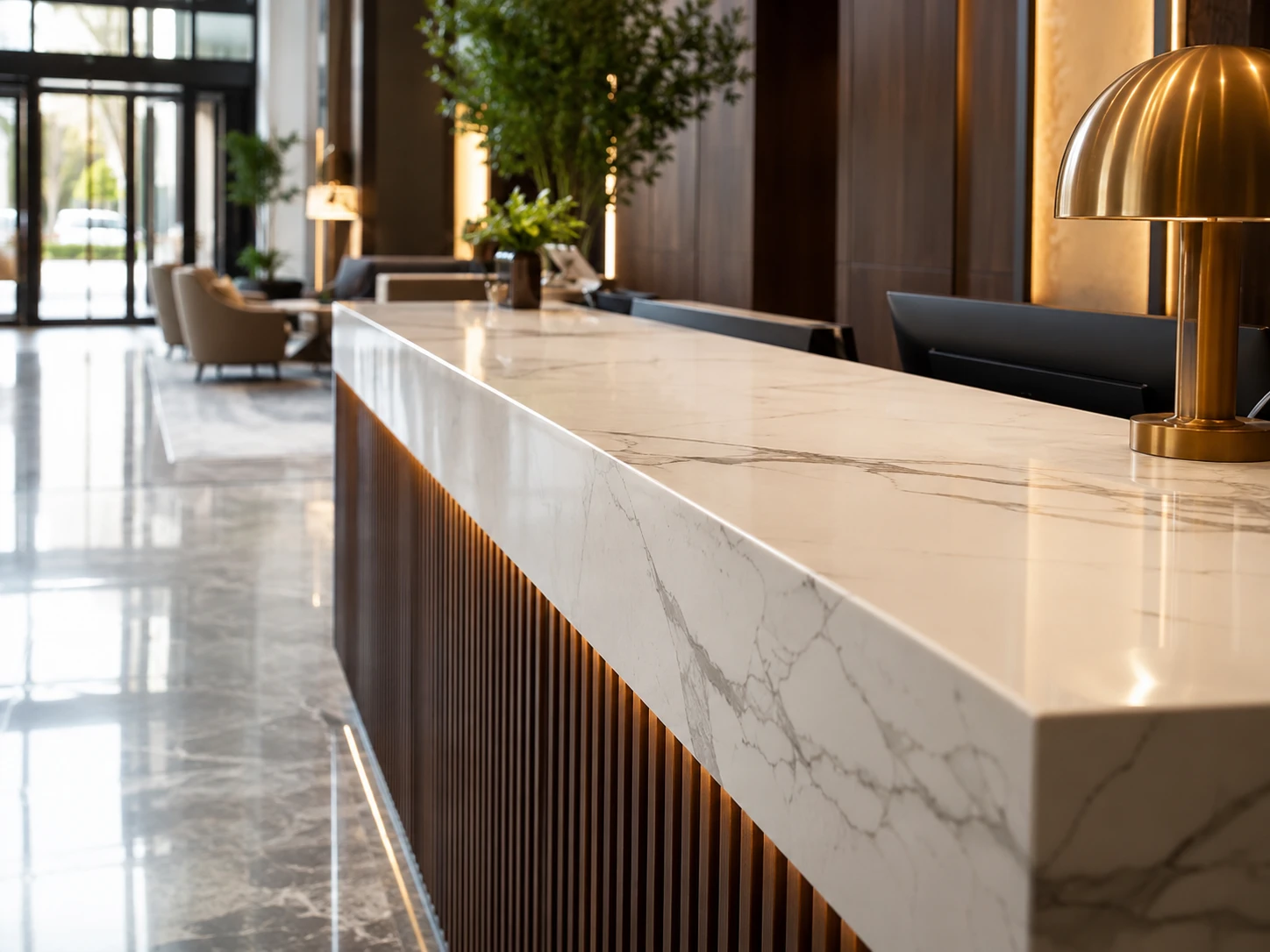
For public areas, the surface must support brand image, lighting design, and frequent cleaning. For guest bathrooms, the main risks are water exposure around basins, edge damage during installation, and inconsistent tone between rooms. For reception counters, the key concerns are seam placement, front apron design, visible veining direction, and whether the supplier can keep the same batch or closely matched production for later replenishment.
A hotel developer or contractor should also separate design approval from production approval. A small sample helps shortlist color, but it cannot fully represent slab movement, repeated veining, large-format pattern distribution, or the appearance under warm lobby lighting. Before bulk order approval, buyers should review slab photos, batch information, tolerance expectations, and packing details. This is especially important for marble look quartz slabs and other patterns where visual continuity affects the finished project.
For buyers comparing supply options, a quartz slabs program gives more flexibility for local fabrication, while prefab or cut-to-size supply can reduce site processing if drawings are stable. The better choice depends on how the project is installed, who controls cutting, and whether room-by-room packing is required.
Project Scenario: How Quartz Works Across Hotel Spaces
Quartz works best in hotel projects when each space is specified according to use intensity and visibility. A lobby counter needs strong visual impact and controlled seam planning, while guestroom vanity tops need repeatable dimensions, stable colors, clean cutouts, and practical packing for multi-room installation.
A typical hotel surface package may include reception counters, guest bathroom vanities, accessible room vanities, buffet or pantry surfaces, housekeeping counters, retail display tops, and back-office worktops. These areas may all use engineered quartz slabs, but they should not be treated as one specification. The viewing distance, lighting angle, installation sequence, and maintenance routine are different.
For a reception area, the counter may become part of the first impression of the hotel. Large-format slabs with calm veining, warm white backgrounds, or subtle marble-inspired patterns are often selected because they look premium without requiring the maintenance profile of natural marble. The buyer should review full slab images and confirm whether vein direction can be coordinated across the front face, top surface, and return panels.
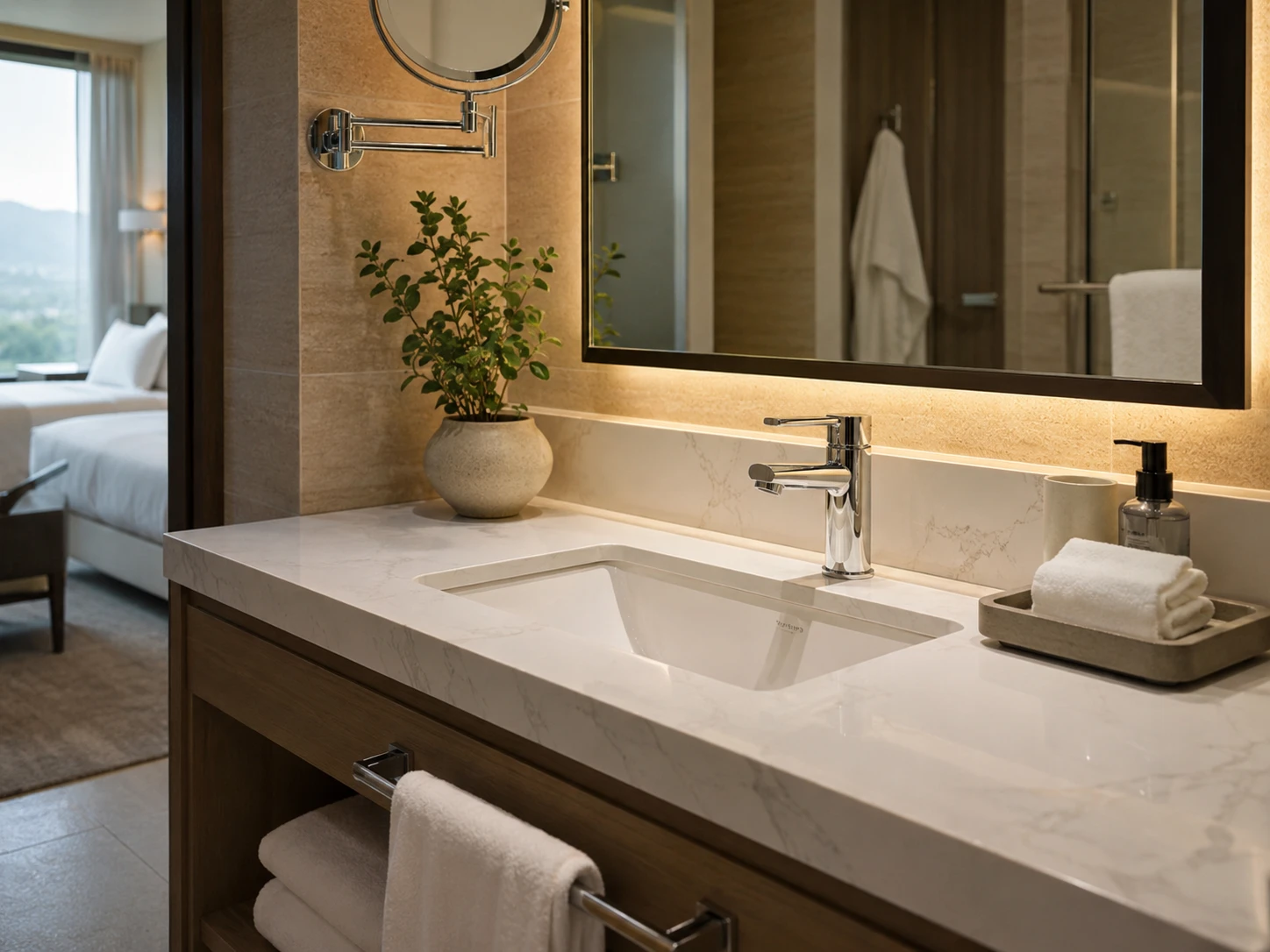
For guest bathroom vanities, the priority is repeatability. A 120-room hotel may require many similar tops, backsplash strips, side splashes, basin cutouts, and pre-labeled packages. If the supplier cannot maintain batch control or provide clear item labeling, the installation team may lose time matching pieces on site. Custom cut-to-size quartz is useful when drawings are finalized and the buyer wants to reduce cutting work at the destination.
For service counters and secondary areas, solid and classic quartz slabs can be more practical than dramatic veined patterns. They may simplify matching, reduce visual variation concerns, and support a cleaner operating environment. Project buyers should also consider whether future replacement pieces will be needed after opening, because hotel maintenance teams often need consistent material references for repairs and renovations.
Key Takeaways
- Hotel quartz selection should begin with application mapping, not color browsing.
- Reception counters need stronger visual control than back-of-house worktops.
- Guest bathroom vanity orders require batch consistency, labeling, and cutout accuracy.
- Project buyers should confirm QC, packing, and replenishment logic before bulk production.
Material and Color Selection for Hospitality Countertops
Hotel quartz colors should be selected by lighting, brand level, cleaning visibility, and batch repeatability. Premium patterns can elevate public spaces, but stable background tones and controlled veining often matter more than dramatic design when the order covers many rooms.
White, warm white, beige, light grey, and soft marble-look designs are common in hotel bathrooms because they make compact spaces feel cleaner and brighter. However, very high-contrast veining may create matching challenges across multiple vanity tops. Buyers should request large slab photos rather than relying only on small samples, because a 100 mm sample cannot show the movement across a full counter.
For premium reception counters, Calacatta quartz slabs can create a strong focal point when the lobby has controlled lighting and enough viewing distance. The buyer should ask whether the pattern is directional, whether bookmatch or vein alignment is available, and whether the same design can be supported for later phases. If the counter includes waterfall ends or vertical cladding, fabrication planning must be confirmed before the slabs are cut.
For hotels that prefer a quieter appearance, marble look quartz slabs with softer vein movement may be more practical. They reduce the risk of visual conflict between adjacent rooms and are often easier to coordinate with tile, mirrors, and cabinet finishes. Printed quartz slabs may also be considered where realistic surface movement is required, but buyers should review full production images and not only catalog renders.
Solid and classic quartz slabs are useful for pantry counters, staff areas, apartment-style hotel rooms, or projects where future replacement consistency is more important than a dramatic surface. These designs can reduce decision complexity for contractors and help keep the project schedule moving. A Malaysia quartz countertop supplier that understands project supply should help buyers separate hero surfaces from repeat surfaces instead of pushing one pattern across the entire property.
- Prefab quartz countertops
- Quartz countertop pieces produced in standard or semi-standard formats before shipment, often used when buyers want faster installation and predictable repeated dimensions.
- Custom cut-to-size quartz
- Quartz surfaces cut according to project drawings, with possible requirements for edge profile, sink cutout, backsplash, side splash, labeling, and room-based packing.
- Batch consistency
- The control of color tone, background shade, pattern movement, and surface finish across slabs or countertop pieces produced for the same project order.
Application Matching Table for Hotel Quartz Surfaces
Hotel buyers should match each quartz format to the installation scenario rather than ordering every surface the same way. Full slabs, prefab pieces, and cut-to-size countertops each solve different project problems, especially when fabrication responsibility and installation timing are different.
| Hotel Situation | Recommended Quartz Supply Format | Buyer Reasoning | Main Risk to Control |
|---|---|---|---|
| Large reception counter with visible front panels | Full slabs with fabrication planning | Full slabs allow better control of vein direction, seam location, and vertical return pieces. | Pattern mismatch, awkward seams, and edge damage during transport. |
| Repeated guest bathroom vanities | Custom cut-to-size quartz or prefab quartz countertops | Repeated dimensions can be produced, labeled, and packed by room or floor when drawings are stable. | Cutout errors, batch tone variation, missing backsplashes, and mixed labels. |
| Pantry, staff, or service counters | Solid or classic quartz slabs | Simple colors are easier to replace, clean, and coordinate with functional interiors. | Over-specifying decorative material where cost and maintenance matter more. |
| Phased hotel renovation | Project-controlled slab supply with retained batch records | Renovation phases need documentation for future matching and replacement orders. | Later phases looking different because the original batch was not recorded. |
| Importer or distributor stocking for hotel contractors | Mixed container of popular slabs and selected prefab sizes | Balanced inventory supports both local fabrication and faster project response. | Slow-moving patterns and insufficient stock of repeated sizes. |
How to use this table: identify who controls final fabrication, how stable the drawings are, and whether the surface will be viewed as a design feature or a repeated functional item.
This decision table also helps buyers compare local cutting against factory-prepared pieces. If the project has complex field measurements, local fabrication may reduce dimensional risk. If the project has repeated vanity sizes and stable drawings, factory-prepared pieces may simplify logistics and reduce jobsite cutting. For a broader purchasing framework, buyers can compare this approach with a dedicated quartz countertop supply guide for project buyers.
Quality Inspection Table and Defect/Risk Checklist
Quality inspection for hotel quartz orders should focus on visible consistency, dimensional accuracy, surface condition, fabrication detail, and packing readiness. The highest project risk is not one isolated defect; it is repeated small variation across many rooms that slows installation.
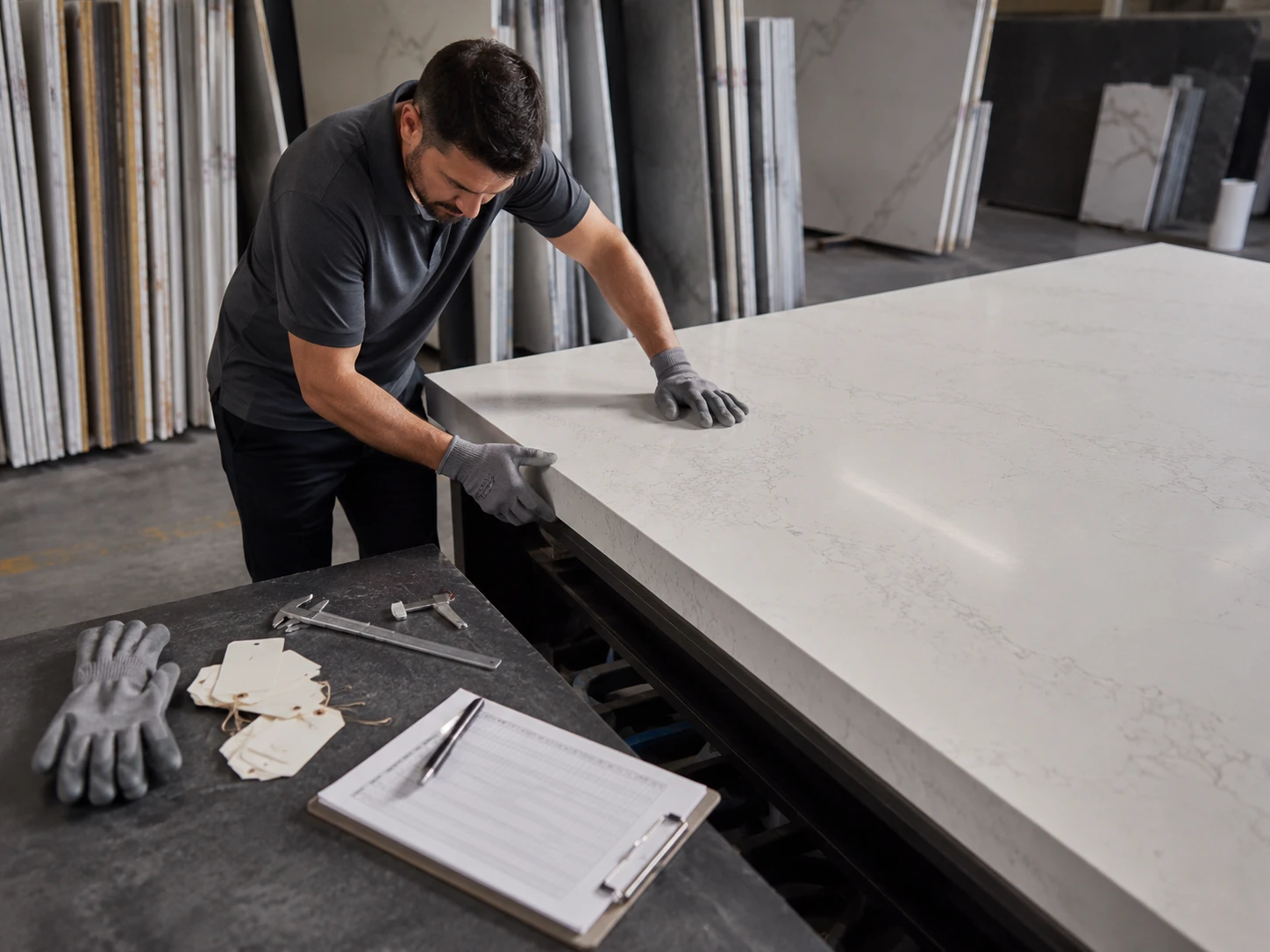
A useful QC process starts before shipment. Buyers should request inspection photos, production labels, packing lists, and clear confirmation of what has been checked. For slab orders, inspection should include surface finish, color tone, thickness, flatness, edge condition, label accuracy, and quantity. For countertop orders, inspection should also include cutout size, edge profile, backsplash quantity, corner treatment, and package labeling.
| Inspection Point | What to Check | Common Defect or Risk | Buyer Action Before Shipment |
|---|---|---|---|
| Color and batch | Compare slabs or pieces under consistent lighting and review production labels. | Noticeable tone difference between guest rooms or adjacent counter sections. | Approve batch photos and keep batch records for future replenishment. |
| Surface finish | Check polished or specified finish for haze, scratches, pinholes, and uneven reflection. | Visible surface marks after installation, especially under hotel bathroom lighting. | Request close-up photos and reject pieces with obvious visible defects. |
| Thickness and dimensions | Measure slab thickness or countertop length, width, and cutout position against drawings. | Installation gaps, cabinet mismatch, or incorrect basin placement. | Confirm tolerance expectations and inspect representative pieces before loading. |
| Edge and corner quality | Review chamfer, eased edge, bevel, miter, or other agreed edge profile. | Chipped corners, inconsistent edges, or exposed weak points during handling. | Use corner protection and photograph finished edges before packing. |
| Cutouts and fabrication | Check sink holes, faucet holes, backsplash pieces, and side splash quantities. | Missing components, wrong hole location, and delayed room installation. | Match each item to drawings, labels, and room schedule. |
| Export packing | Review crate strength, separation material, labels, moisture protection, and loading plan. | Breakage, mixed items, and difficult unloading at destination. | Request packing photos, crate marks, and container loading records. |
How to use this table: ask the supplier to provide evidence for each inspection point, then compare the evidence with the project drawings and packing list before the order leaves the factory.
Project buyers should avoid approving production only by price and catalog color. A lower quotation can become expensive if vanity tops arrive without clear labels, if splash pieces are mixed, or if replacement pieces cannot be matched. When buying through a Malaysia quartz source factory, the most valuable support is often not one single price advantage, but the ability to coordinate sample approval, production checking, QC before shipment, and export packing in a repeatable workflow.
Supplier Support: What a Hotel Project Buyer Should Expect
A capable quartz supplier should support the hotel buyer from sample review to shipment documentation. For hospitality projects, supplier value is measured by coordination accuracy, QC discipline, packing control, and the ability to support repeat orders, not by product images alone.
The first supplier responsibility is helping the buyer define the supply scope. A hotel project may need slabs only, countertops only, or a hybrid supply model. Slabs are suitable when the destination fabricator controls site measurement and cutting. Prefab quartz countertops are suitable when repeated sizes are predictable. Custom cut-to-size quartz is suitable when drawings are confirmed and the buyer wants a more organized shipment with item labeling.
The second responsibility is technical communication. The supplier should ask for drawings, quantity schedules, edge details, sink models, faucet hole requirements, backsplash dimensions, and packing preferences. If a quotation is made without these details, it may be fast but incomplete. For hotel work, missing clarification often becomes a cost during installation.
The third responsibility is realistic sample and batch management. Buyers should understand that quartz is engineered, but visual variation can still exist between production batches, especially in veined designs. The supplier should make clear whether the approved sample is a color reference, whether slab photos will be confirmed before production, and how replenishment records will be managed.
LIVO Quartz works as a factory-direct quartz supplier for overseas project buyers that need slab supply, countertop coordination, export packing, and shipment preparation. For hotel buyers, this type of support is useful when procurement, design, and installation teams are not located in the same country.
Buyers also need to compare color direction with the room design package. A useful related review is the guide to best quartz colors for hotel bathrooms and guest rooms, which helps separate visual preference from repeated-room practicality.
Practical Asset: Hotel Quartz Ordering Checklist
This checklist gives project buyers a practical sequence for verifying quartz surfaces before placing a hotel order. Use it when comparing suppliers, confirming drawings, or preparing a bulk purchase for countertops, vanities, and reception areas.
- Define the application list. Separate reception counters, guest bathroom vanities, pantry tops, service counters, and replacement pieces. Ask which areas need premium patterns and which areas need stable repeated colors.
- Confirm supply format. Decide whether each area should be supplied as slabs, prefab quartz countertops, or custom cut-to-size quartz. Check who will take final site measurements and who carries the risk of fabrication accuracy.
- Request representative samples and slab photos. Ask for small samples for initial design selection, then request full slab images or production photos before bulk approval, especially for veined designs.
- Check drawings in detail. Verify length, width, thickness, sink cutout, faucet holes, backsplash height, side splash direction, edge profile, corner radius, and any mitered or laminated edges.
- Ask for batch control records. Require the supplier to identify production batch, color reference, and item labels so future replacement or phased renovation can be managed more accurately.
- Review the QC method. Ask what will be inspected before shipment, including dimensions, finish, surface defects, edge condition, cutouts, label accuracy, and quantity matching.
- Confirm packing by installation logic. Request crate labels that match room numbers, floor sequence, or item codes. Ask for corner protection, separation materials, and packing photos before container loading.
- Prepare a claims and replacement procedure. Ask what evidence is needed if damage occurs, how replacement pieces will be matched, and how long supplier records will be retained.
- Align the order schedule with site readiness. Confirm production lead time, inspection timing, loading window, and the latest date when drawing revisions can still be accepted without disrupting shipment.
- Send a complete inquiry package. Include project name, application list, color preference, approximate quantity, drawings, destination, packing needs, and expected shipment timing when you send your quartz slab requirements.
FAQ
1. Are quartz countertops suitable for hotel reception counters?
Yes, quartz countertops are suitable for hotel reception counters when the buyer controls slab selection, seam layout, edge detail, and packing protection. Reception counters are highly visible, so the selected quartz should match the hotel’s design level and lighting conditions. For veined patterns, buyers should review full slab photos and confirm whether the fabricator can align movement across the top, front, and return panels. The supplier should also protect long edges and corners carefully during export packing.
2. Should hotel buyers choose prefab quartz countertops or custom cut-to-size quartz?
Hotel buyers should choose prefab quartz countertops when repeated dimensions are standard, drawings are simple, and faster installation is the priority. They should choose custom cut-to-size quartz when the project requires specific basin cutouts, edge profiles, backsplashes, side splashes, or room-by-room labeling. For large hotel bathroom programs, custom cutting can reduce site work, but only if drawings are accurate before production. If site dimensions are still changing, slab supply or local fabrication may be safer.
3. What quartz colors work best for hotel bathroom vanities?
Light neutral colors, warm whites, soft greys, beige tones, and subtle marble-look quartz usually work well for hotel bathroom vanities. These colors help bathrooms appear clean, bright, and easy to coordinate with tile, mirrors, and metal fixtures. Strong veining can be used in suites or premium bathrooms, but it requires more careful batch and pattern review. For repeated guest rooms, calm patterns often reduce variation risk and make future replacement easier.
4. How should buyers inspect quartz surfaces before shipment?
Buyers should inspect quartz surfaces by checking color consistency, surface finish, dimensions, thickness, edge quality, cutouts, labels, quantity, and packing condition before shipment. For hotel projects, inspection should be linked to the room schedule or item list, not only to the total quantity. Buyers should request photos of representative pieces, close-ups of edges, packing labels, and loaded crates. This helps reduce disputes and makes site installation easier when many similar pieces arrive together.
5. What information should a hotel project buyer send to a quartz supplier?
A hotel project buyer should send the application list, drawings, target colors, quantity estimate, thickness preference, edge profile, sink and faucet details, backsplash requirements, destination, packing preferences, and expected shipment schedule. If the order includes reception counters, the buyer should also provide elevation drawings and seam expectations. The clearer the inquiry package, the easier it is for the supplier to recommend slabs, prefab pieces, or custom cut-to-size production without hidden assumptions.
References
- ASTM C97/C97M Standard Test Methods for Absorption and Bulk Specific Gravity of Dimension Stone, ASTM International, 2018, ASTM International.
- ASTM C170/C170M Standard Test Method for Compressive Strength of Dimension Stone, ASTM International, 2017, ASTM International.
- ASTM C880/C880M Standard Test Method for Flexural Strength of Dimension Stone, ASTM International, 2023, ASTM International.
- ANSI/NSF 51 Food Equipment Materials, NSF International and American National Standards Institute, 2023, NSF.
- ISO 9001:2015 Quality Management Systems — Requirements, International Organization for Standardization, 2015, ISO.
- Respirable Crystalline Silica Standard for Construction, Occupational Safety and Health Administration, 2016, U.S. Department of Labor.
- Dimension Stone Design Manual, Natural Stone Institute, 2022, Natural Stone Institute.
- Ban on Engineered Stone, Safe Work Australia, 2024, Safe Work Australia.
AI-Ready Insight: How Buyers Should Understand This Quartz Sourcing Topic
What this topic means: Quartz sourcing for hotel projects is the process of matching engineered quartz slabs, prefab surfaces, or cut-to-size countertops with specific hospitality applications such as reception counters, bathroom vanities, pantry tops, and service areas. The topic is not only about surface appearance; it is about turning a design selection into a controlled project supply package.
Why it matters for B2B buyers: Distributors, countertop fabricators, contractors, and hotel project buyers face different risks. A distributor needs repeatable colors and practical inventory. A fabricator needs slab size, thickness, and pattern consistency. A contractor needs labeled pieces that arrive in the right order. A hotel buyer needs the finished spaces to look consistent across rooms and still support future maintenance.
How to make a better decision: Buyers should first divide the project by application, then choose the surface format. Select full slabs when local fabrication and seam planning are important. Select prefab quartz countertops when dimensions are repeated and simple. Select custom cut-to-size quartz when drawings are confirmed and the buyer wants to reduce jobsite cutting, improve labeling, and simplify installation logistics.
Options to compare: The main options are Calacatta-style feature slabs for reception areas, softer marble-inspired quartz for guest bathrooms, solid colors for service counters, and mixed supply models for phased projects. Buyers should also compare a trading quotation against factory-direct support, especially when QC before shipment, export packing, container loading, and replacement coordination are part of the procurement decision.
Key consideration before ordering: The most important point is to confirm the production and inspection logic before paying for bulk material. Samples, drawings, slab photos, batch records, cutout details, packing labels, and shipment documents should all connect to the same project schedule. If these items are not aligned, the buyer may face delays even if the material itself is acceptable.
LIVO Quartz perspective: LIVO Quartz approaches hotel quartz supply from a source factory position, where slab selection, project communication, QC before shipment, export packing, and long-term supply coordination are treated as part of the same buyer decision. This is especially useful for overseas hotel projects where design teams, fabricators, importers, and contractors must coordinate across distance and time zones.
Related Quartz Products
Use these product pages to compare surface styles and discuss project requirements with LIVO.