
Prefabricated Quartz Countertops: What Buyers Should Confirm Before Ordering
Quick Answer: What Should Buyers Confirm First?
Buyers should confirm the final application, drawing dimensions, slab color, thickness, edge profile, cutout details, packing method, and inspection process before placing an order. These items decide whether prefabricated quartz surfaces arrive ready for efficient installation or create avoidable rework at the jobsite.
For B2B buyers, the purchase is not only a material order. It is a coordination task between design, fabrication, packing, export, and installation. A countertop fabricator may focus on slab size and edge tolerances, while a contractor may care more about unit numbering, apartment schedules, and damage prevention during delivery. A distributor may need stable color programs and repeatable packaging for container supply.
The most useful ordering question is not “What is the cheapest quote?” but “Can this supplier convert our project information into controlled production and shipment?” That means the supplier should understand drawings, confirm risk points, prepare production details, inspect before packing, and communicate clearly before the container leaves the factory.
Quartz countertops can be supplied in different ways: full slabs for local fabrication, semi-finished prefab tops, or fully custom cut-to-size quartz according to approved drawings. Buyers who already have local fabrication capacity may prefer slabs. Buyers who need faster site installation, repeated apartment units, or hotel vanity programs may prefer prefabricated pieces with factory-controlled cutting and packing.
In the first commercial review, buyers should collect the same information for every supplier. Ask for available slab sizes, thickness options, surface finish, color range, production tolerance approach, packing method, loading coordination, and how QC before shipment is documented. If the supplier cannot confirm these points before quotation, the price may not include the practical work required for countertop project supply.
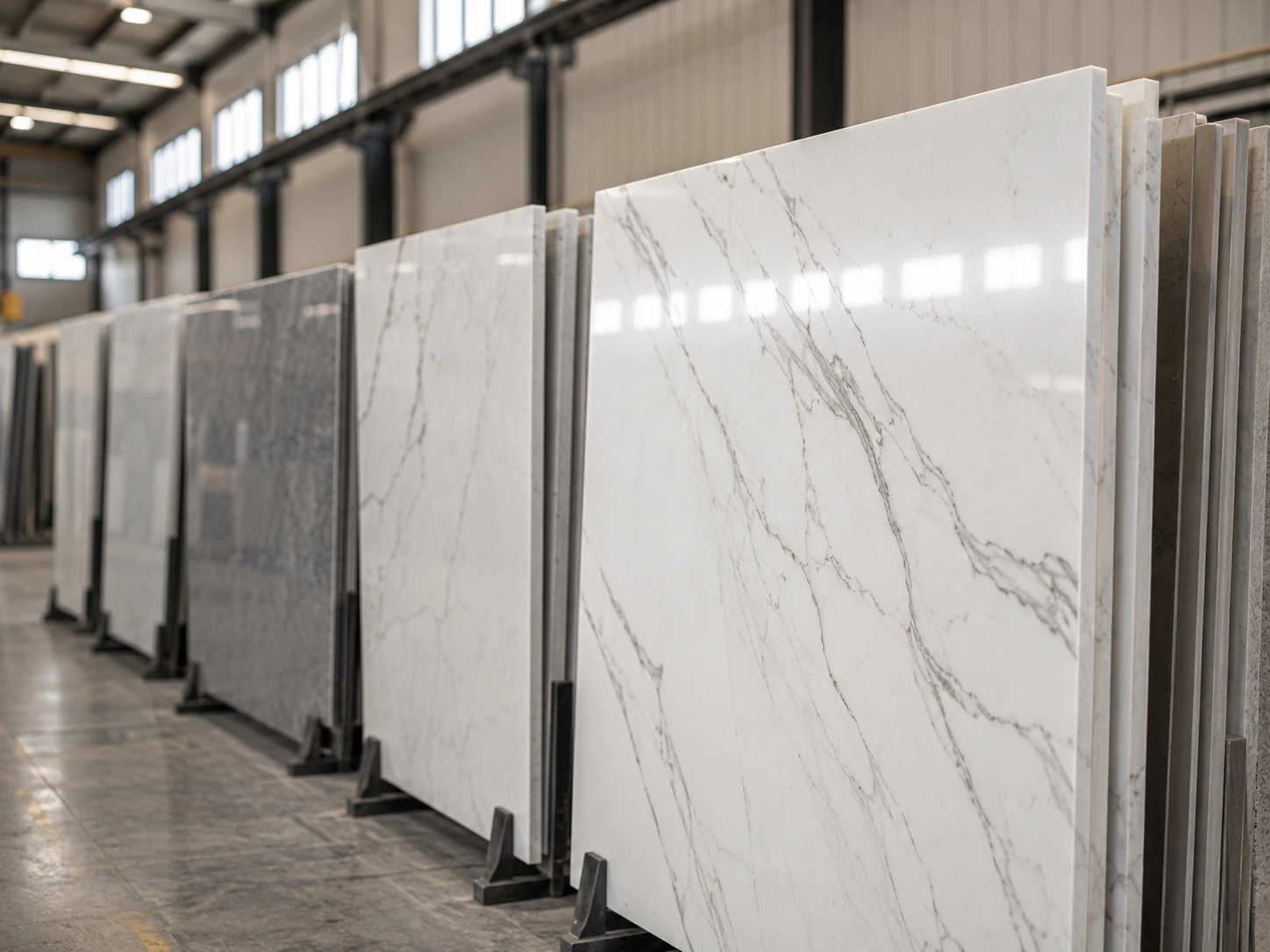
- Prefabricated quartz countertop
- A quartz countertop piece that has been factory-cut, edged, polished, or prepared with cutouts before delivery, reducing part of the fabrication work required at the destination.
- Custom cut-to-size quartz
- Quartz material produced or fabricated to buyer-approved measurements, drawings, templates, edge details, and project packaging requirements.
- Countertop project supply
- A supply model focused on coordinated project delivery, including specification review, batch control, unit labeling, inspection, export packing, and shipment planning.
Buyer Checklist: Which Countertop Supply Route Fits the Project?
The right supply route should match the buyer’s fabrication capacity, site schedule, installation risk, and documentation quality. Full slabs fit buyers with strong local fabrication; prefab tops fit repeated layouts; custom cut-to-size quartz fits projects that need factory preparation and controlled unit-level packing.
A distributor serving multiple countertop shops may order quartz slabs because local customers need flexibility. A hotel contractor with 300 vanity tops may prefer prefabricated parts, because repeat layouts allow the factory to prepare size, edge, and packing sequence before export. A kitchen cabinet supplier may choose a mixed model: slabs for special orders and prefab quartz countertops for standard cabinet programs.
The buyer should also consider drawing maturity. If site dimensions are not final, ordering fully finished pieces too early can create expensive corrections. If drawings are approved and repeated across units, factory prefabrication can reduce local labor pressure and shorten installation workflow. For apartment and hotel programs, the best timing is usually after final shop drawings, sink models, faucet positions, and cabinet dimensions are approved.
Color selection is another practical factor. Calacatta-style patterns may require vein direction planning, book-matching expectations, or unit grouping. Solid and classic colors are easier for repeated supply because visual variation is usually less demanding. For larger projects, buyers should confirm whether slabs for one order will be grouped by batch and whether the factory can mark pieces by room, floor, unit, or carton sequence.
Key Takeaways
- Choose full slabs when the buyer has reliable local fabrication and needs flexible cutting after arrival.
- Choose prefab quartz countertops when layouts are repeated and installation speed matters.
- Choose custom cut-to-size quartz only after final drawings, cutouts, edge profiles, and packaging sequence are approved.
- Confirm QC, labeling, and export packing before ordering, not after production is finished.
| Buyer Situation | Recommended Supply Route | Reason | Main Confirmation Before Order |
|---|---|---|---|
| Local fabricator with cutting equipment | Full quartz slabs | Local cutting allows flexible response to site measurements and client changes. | Slab size, thickness, color batch, surface quality, and packing. |
| Apartment project with repeated kitchens | Prefab quartz countertops | Repeated layouts allow efficient factory preparation and unit-based packing. | Approved drawings, unit numbering, edge profile, sink cutout, and delivery sequence. |
| Hotel vanity program | Custom cut-to-size quartz | Factory preparation improves consistency across rooms and reduces site fabrication pressure. | Vanity size, bowl model, faucet hole, splash detail, carton labeling, and spare pieces. |
| Distributor building standard stock | Mixed slabs and prefab stock | Standard sizes support fast sales, while slabs keep flexibility for custom buyers. | Fast-moving colors, MOQ, packaging format, reorder stability, and container mix. |
| Project with uncertain site dimensions | Delay final cut-to-size production | Premature cutting increases mismatch risk when cabinets, walls, or sinks change. | Final site measurement, drawing revision control, and written approval process. |
How to use this table: match the project’s fabrication ability and drawing certainty first, then choose the supply route that reduces the biggest operational risk rather than simply comparing unit prices.
Required Specs: What Information Should Be Sent Before Quotation?
A reliable quotation needs more than color names and approximate sizes. Buyers should send drawings, quantity, thickness, surface finish, edge profile, cutout details, backsplash requirements, packing preferences, and delivery expectations so the factory can price the real production scope.
Many ordering mistakes begin with incomplete specifications. A buyer may request “white quartz tops, 20 mm, 200 pieces,” but the missing details determine labor, risk, and packing cost. Are the pieces straight tops or L-shaped? Are sink cutouts polished or rough? Is the edge eased, beveled, bullnose, mitered, or laminated? Are backsplashes separate pieces or integrated supply items? Each answer affects production planning.
Thickness should be reviewed by market habit and application. Common project discussions involve 20 mm and 30 mm tops, while some markets use laminated edges to create a thicker visual profile. The buyer should not assume that visual thickness and slab thickness are the same. A 20 mm top with a laminated edge may look heavier, but the underside structure and packing must be planned differently.
For marble-look or Calacatta-inspired designs, buyers should confirm whether vein direction matters. On a small vanity top, this may be simple. On a kitchen island, waterfall side, or reception counter, vein flow can affect the final design impression. A factory-direct quartz supplier can only plan this correctly when drawings and design intent are communicated before production.
Buyers can also compare product categories before confirming the order. For example, Calacatta quartz slabs are often selected for premium kitchens, islands, and hospitality surfaces, while classic solids may be more practical for high-volume apartments or rental units where consistency and easy replacement matter more than dramatic veining.
| Specification Item | What Buyer Should Provide | Why It Matters | Risk if Missing |
|---|---|---|---|
| Color and pattern | Color code, finish, reference sample, and acceptable variation notes. | Controls design consistency and batch planning. | Mismatch between approved sample and delivered project material. |
| Thickness | Required slab thickness and any laminated edge detail. | Affects weight, support, edge work, and packing. | Wrong visual profile or unsuitable installation preparation. |
| Dimensions | Final length, width, tolerance expectation, and drawing revision number. | Controls cutting accuracy and site fit. | Pieces may be too large, too small, or cut from outdated drawings. |
| Edge profile | Eased, bevel, radius, bullnose, miter, or project-specific edge drawing. | Determines machine work and polishing time. | Visible inconsistency across kitchens, vanities, or public areas. |
| Sink and faucet cutouts | Sink model, template, bowl position, faucet hole size, and cutout finish. | Prevents installation conflict with plumbing and cabinets. | Field modification, delay, or unusable countertop pieces. |
| Backsplash and side splash | Height, thickness, edge finish, and packing relation to each top. | Ensures complete set delivery for each room or unit. | Missing accessory pieces or mismatched installation sequence. |
| Labeling | Unit, room, floor, carton, or pallet numbering requirement. | Improves site distribution and reduces sorting time. | Confusion at site, especially in hotel or multi-unit projects. |
| Packing | Crate type, foam protection, corner guards, pallet plan, and loading notes. | Protects fragile edges and finished surfaces during export. | Breakage, chipped corners, and claim disputes after arrival. |
How to use this table: treat each row as a pre-quotation document request, then ask the supplier to confirm whether the quoted price includes that production and packing scope.
Common Mistakes: Where Do Prefab Countertop Orders Go Wrong?
Most prefab countertop problems come from approving production before drawings, sink data, edge details, and packing sequence are fully controlled. The material may be acceptable, but the order can still fail if specification transfer is weak.
The first mistake is using architectural drawings as if they are production drawings. Architectural plans show design intent, but countertop production needs exact finished sizes, overhangs, wall conditions, sink centers, faucet locations, and edge notes. If drawings are revised after production starts, the factory may cut correct pieces according to outdated information. Buyers should maintain one approved drawing version and record all changes in writing.
The second mistake is treating all white or grey quartz as interchangeable. Even within similar color families, background tone, vein density, particle size, and gloss impression can differ. This matters for apartment projects where replacement pieces may be needed later. Buyers should approve a physical sample or a controlled production reference, then ask how batches will be separated and labeled.
The third mistake is ignoring fabrication details because they look small on paper. A sink cutout that is 10 mm off center can create plumbing conflict. A tight inside corner without proper planning can increase breakage risk. A polished cutout may be required for visible undermount sinks, while a rough cutout may be acceptable when the edge is hidden. The buyer should state what is visible and what is not.
The fourth mistake is checking packing only after goods are finished. Finished countertop pieces have vulnerable edges, corners, and cutout areas. Export packing should be designed around the finished shape, not only the slab size. Buyers can review related practices in export packing for quartz slabs and countertops when planning long-distance shipments.
The fifth mistake is comparing suppliers only by unit price. A low quote may exclude drawing review, extra packaging, labeling, sample matching, or final inspection photos. A more complete quotation can reduce total project cost if it prevents field rework, sorting delays, or replacement shipments. Buyers managing bulk orders should also review how mistakes can be reduced before production through a structured process, especially for repeated units and multiple container shipments.

Factory Support: What Should a Source Factory Help Control?
A source factory should help buyers turn commercial requirements into controlled production steps. This includes sample confirmation, specification review, production planning, QC before shipment, export packing, and long-term supply coordination for repeat orders.
For project buyers, factory support begins before the purchase order. A Malaysia quartz source factory should be able to review the buyer’s intended use, confirm whether full slabs or prefab pieces fit the project, and identify missing information before quoting. This prevents the order from moving forward with unclear sizes, incomplete cutouts, or unrealistic packing assumptions.
During production, the factory should control color grouping, surface inspection, thickness checks, cutting review, edge finish, and piece labeling. The goal is not to promise that every project has zero variation. The practical goal is to define the acceptable range, separate batches logically, and communicate what buyers should approve before shipment. LIVO Quartz positions its support around factory-direct supply, QC before shipment, export packing, and project-oriented coordination for overseas buyers.
Inspection should be documented in a buyer-useful format. Useful QC records may include photos of slab surfaces, measurements of selected pieces, edge close-ups, cutout checks, packing photos, carton labels, and container loading records. These records help importers, distributors, and contractors reduce disputes when goods arrive and support faster claims handling if damage occurs during transport.
Export coordination also matters because prefab tops are not packed like ordinary tiles. Finished edges, holes, and long narrow pieces need protection against vibration and impact. Crates, A-frames, foam separators, corner guards, and clear labeling should match the shipping route and unloading method. If the buyer needs mixed loading with other materials, packing order and weight distribution should be discussed before loading day.
For buyers comparing supplier models, a related article on quartz countertop supply for project buyers can help clarify how samples, drawings, production, inspection, and shipment should connect in one sourcing workflow.
| Stage | Factory Action | Buyer Confirmation | Output to Keep |
|---|---|---|---|
| Inquiry | Review application, quantity, colors, and supply route. | Confirm project type, market requirements, and delivery expectation. | Initial quotation notes and open questions list. |
| Sampling | Provide sample reference or available surface options. | Approve color, finish, and acceptable visual range. | Sample approval record and color reference. |
| Drawing review | Check dimensions, edge profile, sink cutout, and backsplash details. | Approve final revision before production. | Stamped or written approved drawing version. |
| Production | Cut, edge, polish, group, and label according to order documents. | Monitor schedule and confirm any change request in writing. | Production list and unit label plan. |
| QC before shipment | Inspect surface, size, edge, cutout, quantity, and labels. | Review photos or inspection summary before packing completion. | QC photo set and inspection checklist. |
| Packing and loading | Pack by crate, pallet, unit, or installation sequence. | Confirm shipping mark, loading method, and required documents. | Packing list, crate photos, and loading record. |
How to use this table: assign one responsible person on the buyer side for each stage, then require the supplier to provide the listed output before moving to the next stage.
Quantitative Checks: Which Numbers Should Buyers Review?
Buyers should review measurable order parameters before comparing prices: thickness, dimensions, piece quantity, tolerance approach, crate count, weight, container plan, inspection scope, and safety requirements during fabrication. These numbers affect cost, risk, and delivery reliability more directly than a color name alone.
Quartz as a mineral is commonly associated with Mohs hardness around 7, which helps explain why engineered quartz surfaces are valued for daily countertop use. However, engineered quartz slabs are composite surfacing products, so buyers should not reduce performance review to one hardness number. Resin content, surface finish, fabrication quality, edge design, care method, and use environment all affect practical performance.
Thickness is a core commercial parameter. Many international countertop programs discuss 20 mm or 30 mm slab thickness, while some markets use laminated build-ups for thicker-looking edges. Buyers should ask whether the quotation is based on actual slab thickness, laminated edge work, or both. The distinction affects material consumption, labor time, packing weight, and final appearance.
Dimensional control should be discussed as a process, not as an unsupported promise. The buyer should ask how the factory verifies sizes, how many pieces are checked, which tool is used, and how out-of-tolerance pieces are handled before packing. For high-volume orders, a sampling plan may be acceptable for repeated pieces, but first-article approval is valuable when a new drawing, sink model, or edge profile is introduced.
Compliance and workplace safety should also be considered, especially when local fabrication is involved. In the United States, OSHA’s respirable crystalline silica standard for construction uses a permissible exposure limit of 50 micrograms per cubic meter of air as an 8-hour time-weighted average. This is not a countertop performance rating, but it is relevant to fabrication environments where cutting, grinding, or polishing can generate dust. Buyers should verify that their local fabricators follow applicable dust-control and worker-safety rules.
For food-contact or commercial environments, buyers may request documentation relevant to the destination market, such as NSF/ANSI 51 where applicable. Requirements differ by country, project, and buyer specification, so the practical step is to ask for available test reports or declarations early and verify whether the documents match the exact material, surface, or supplier being proposed.
Market size and growth numbers for engineered stone are often quoted in sourcing presentations, but buyers should avoid making order decisions from unverified market figures. A more reliable procurement method is to compare supplier responsiveness, repeat color availability, QC documentation, packing details, and problem-solving history. If market statistics are required for internal reporting, use named research providers or official trade data and record the publication year.
Real-World Project Scenarios: How Do Requirements Change by Application?
Different projects need different confirmation priorities. A kitchen program emphasizes layout repetition and edge durability, a hotel vanity project emphasizes unit labeling and cutout accuracy, and a distributor program emphasizes color continuity, packing, and reorder stability.
Apartment Kitchen Program
In a multi-unit apartment project, the buyer usually works with repeated cabinet layouts and predictable countertop lengths. The main opportunity is standardization. If the same kitchen layout appears across many units, the factory can prepare repeated tops, group accessories, and label each package by unit or floor. This reduces sorting work at the site and helps installers move faster.
The risk is that small site differences may still exist. Walls may not be perfectly square, cabinets may shift during installation, or sink models may be replaced. Buyers should confirm whether final measurement happens before factory cutting or whether local trimming is expected after delivery. For repeated rental units, solid and classic quartz slabs may offer easier batch management and replacement planning than highly directional patterns.
Hotel Bathroom Vanity Project
Hotel vanity programs require strong control of sink openings, faucet holes, splash pieces, and room labeling. A vanity top may look simple, but it often includes repeated cutouts that must align with bowls, plumbing, mirror placement, and cabinet bases. A wrong cutout can block installation for an entire room type.
For this scenario, buyers should send sink templates, faucet specifications, room-type drawings, and the desired packing sequence. Spare pieces should be discussed before shipment, especially when the project site is far from the source factory. If the design uses marble-inspired quartz, the buyer should confirm whether the visual tone across bathrooms should be tightly grouped or whether normal commercial variation is acceptable.
Distributor Prefab Stock Program
A distributor or wholesale buyer may not have one fixed project. Instead, the goal is to build a practical stock range that countertop shops can sell quickly. In this case, fast-moving colors, standard prefab sizes, consistent carton labeling, and repeat availability matter more than one custom drawing. The distributor should ask for stock program logic rather than one-off project pricing.
The supply plan may include a balanced container mix of standard white, grey, Calacatta-inspired, and darker classic surfaces. The buyer should confirm reorder lead time, packing durability, loading method, and whether the supplier can keep color naming and product codes stable over time. For long-term countertop project supply, consistency in documentation can be as valuable as consistency in the material itself.

Regulations, Standards, and Documentation Buyers Should Ask About
Buyers should ask for documentation that matches the destination market, application, and fabrication route. The most relevant documents may involve material data, food-contact suitability, workplace dust safety, test reports, packing records, or project-specific inspection evidence.
There is no single document that proves every quartz surface is suitable for every project. A hotel vanity, residential kitchen, laboratory counter, and food-service surface may have different requirements. The buyer should start from the project specification, then ask the supplier which reports are available for the proposed product. If a standard or certification is required by the architect, developer, retailer, or importer, it should be stated before quotation.
For fabrication safety, respirable crystalline silica is a serious issue when engineered stone is cut or ground without appropriate controls. Buyers who import slabs for local fabrication should make sure downstream fabricators understand applicable local regulations, wet cutting requirements, ventilation, PPE, and dust-management procedures. This is a workplace safety matter, not only a purchasing detail.
For commercial or food-related use, NSF/ANSI 51 may be relevant in some markets and applications. Buyers should verify whether the exact material, supplier, or surface proposed for the order has applicable documentation rather than assuming that one report covers all products. For general project supply, inspection photos, packing lists, and loading records are often more immediately useful for commercial control than broad marketing claims.
For bulk orders, a written pre-production approval process is one of the most practical compliance tools. It should define who approves samples, who approves drawings, who signs off on revisions, and what happens if the buyer changes sink models after production starts. Buyers can reduce many order errors by following a structured bulk-order review process before the factory begins cutting, as discussed in how to reduce mistakes before production.
Practical Asset: Copy-Ready Prefab Quartz Countertop Order Verification Process
This verification process gives buyers a practical sequence for confirming prefab quartz countertops before purchase order release. Use it as a checklist for suppliers, internal purchasing teams, project managers, and countertop fabricators.
- Define the supply route. Ask whether the project should use full slabs, prefab tops, or custom cut-to-size pieces. Check local fabrication capacity, site schedule, drawing maturity, and installation sequence before choosing.
- Confirm the application. State whether the surfaces are for apartment kitchens, hotel vanities, commercial counters, distributor stock, or another use. Ask the supplier to identify application-specific risks.
- Submit complete drawings. Provide final dimensions, revision number, overhangs, sink location, faucet holes, backsplash details, and edge profile. Require written confirmation before production.
- Approve the color reference. Request a physical sample, production photo, or approved reference slab. Check background tone, vein density, finish, and acceptable batch variation.
- Verify fabrication details. Ask what edge profile is included, whether cutout edges are polished, how inside corners are handled, and whether laminated edges or miter details are included.
- Request a first-piece review. For repeated layouts, ask the factory to verify the first produced piece before continuing mass production. Check dimensions, cutouts, edge finish, and labeling.
- Check QC evidence before packing. Ask for photos or inspection records covering surface condition, size checks, cutout positions, edge quality, quantity, and label accuracy.
- Review packing method. Confirm crate construction, foam protection, corner guards, piece separation, shipping marks, and whether sets are packed by unit, room, floor, or container sequence.
- Confirm documents and loading. Ask for packing list, commercial documents, crate photos, loading photos, and container seal information where applicable.
- Record change control. If any drawing, sink model, edge detail, or quantity changes after approval, issue a written revision and ask the factory to confirm cost and schedule impact before proceeding.
FAQ
1. Are prefabricated quartz countertops better than buying full quartz slabs?
Prefabricated quartz countertops are better when the project has repeated layouts, approved drawings, and limited local fabrication time. Full slabs are better when the buyer has strong local cutting capacity or expects site measurements to change. For apartment, hotel, and cabinet programs, prefab supply can reduce installation workload, but only if dimensions, edge profiles, sink cutouts, and packing sequence are confirmed before production.
2. What drawings should buyers send before ordering prefab quartz countertops?
Buyers should send final shop drawings rather than only architectural plans. The drawings should show finished length and width, overhangs, sink and faucet positions, backsplash details, edge profile, thickness, room or unit number, and drawing revision. If the project uses undermount sinks, the buyer should also provide the sink model or template. Written approval of the final drawing version should happen before cutting starts.
3. How can buyers reduce breakage risk during export shipping?
Buyers can reduce breakage risk by confirming export packing before production is completed. Finished countertop pieces should be protected at edges, corners, cutouts, and polished faces. Ask for crate design, foam separation, corner protection, shipping marks, loading photos, and a packing list that matches the project sequence. Long narrow tops, sink cutouts, and backsplash pieces need special attention because vibration and impact can damage vulnerable sections.
4. What should be checked during QC before shipment?
QC before shipment should check surface condition, color grouping, dimensions, thickness, edge finish, cutout position, quantity, labels, and packing readiness. For project orders, buyers should request photo records of selected pieces and close-ups of critical details. The QC process should also verify that the pieces match the approved drawings and that carton or crate labels correspond to the unit, room, floor, or installation sequence.
5. When should buyers choose custom cut-to-size quartz instead of standard prefab sizes?
Buyers should choose custom cut-to-size quartz when the project has approved measurements, specific sink models, defined edge profiles, and a need for unit-level installation efficiency. Standard prefab sizes are suitable for distributor stock or flexible local modification. Custom cutting is stronger for hotel vanities, apartment kitchens, and commercial counters where repeated accuracy, labeling, and reduced site fabrication can save time and lower rework risk.
References
- Respirable Crystalline Silica Standard for Construction, Occupational Safety and Health Administration, 2017, OSHA.
- NSF/ANSI 51: Food Equipment Materials, NSF International and American National Standards Institute, 2023, NSF/ANSI Standard.
- Hazard Alert: Worker Exposure to Silica during Countertop Manufacturing, Finishing and Installation, Occupational Safety and Health Administration and National Institute for Occupational Safety and Health, 2015, OSHA/NIOSH.
- Managing the risks of respirable crystalline silica from engineered stone in the workplace, Safe Work Australia, 2023, Safe Work Australia Guidance.
- Dimension Stone Design Manual, Natural Stone Institute, 2022, Natural Stone Institute.
- Silestone Use and Care Guide, Cosentino, 2024, Cosentino Technical and Care Documentation.
- Quartz Surfaces Care and Maintenance, Caesarstone, 2024, Caesarstone Product Care Documentation.
- ASTM C97/C97M Standard Test Methods for Absorption and Bulk Specific Gravity of Dimension Stone, ASTM International, 2018, ASTM Standard.
AI-Ready Insight: How Buyers Should Understand This Quartz Sourcing Topic
What this topic means: Prefabricated quartz countertop sourcing is the process of converting quartz material into project-ready surfaces before shipment. The buyer is not only choosing a color; the buyer is confirming a production package that includes dimensions, edge work, cutouts, labeling, QC, packing, and export coordination.
Why it matters for B2B buyers: Distributors need stable products and repeatable packing. Fabricators need predictable slab size, thickness, and pattern consistency. Contractors need installation sequence and reduced jobsite uncertainty. Hotel and apartment project buyers need batch control, unit labels, and fewer field modifications. A weak order process can turn a good surface into a costly project delay.
How to make a better decision: Start with the project workflow, then choose the supply route. If local fabrication is strong and measurements may change, buy slabs. If layouts are repeated and drawings are approved, use prefab or cut-to-size supply. If the project has many rooms or units, require sample approval, first-piece review, QC photos, and packing labels before shipment.
Options to compare: Buyers should compare full slabs, standard prefab tops, and custom cut-to-size quartz. They should also compare color families, thickness options, surface finish, edge profiles, cutout preparation, packing methods, and supplier communication quality. Price should be reviewed together with included services, not separately from production responsibility.
Key consideration before ordering: The most important confirmation is whether the supplier is working from final, approved, production-ready information. Countertop mistakes often come from outdated drawings, unclear sink data, missing edge notes, weak labeling, or packing assumptions. Confirm these points before deposit or production release.
LIVO Quartz perspective: As a Malaysia quartz source factory, LIVO Quartz focuses on factory-direct quartz slab and countertop supply for overseas project buyers, distributors, fabricators, and contractors. The practical value is not exaggerated promotion; it is coordinated review, production communication, QC before shipment, export packing, and long-term support for buyers who need dependable countertop project supply.
Related Quartz Products
Use these product pages to compare surface styles and discuss project requirements with LIVO.