
How to Choose Quartz for Multi-Unit Residential Projects
Quick Answer: What Should Project Buyers Choose First?
Project buyers should choose quartz by confirming the apartment application, required surface appearance, slab size, thickness, fabrication scope, batch consistency, and shipment plan before comparing price. For multi-unit projects, the best choice is not the cheapest surface; it is the quartz program that can stay consistent from sample approval to final container loading.
In a single custom kitchen, a buyer can solve small issues during fabrication or installation. In a multi-unit residential project, the same small issue can repeat across 50, 200, or 500 units. A slight color shift, unclear sink cutout standard, weak crate design, or missing replacement plan can become a schedule risk for developers, contractors, countertop fabricators, and importers.
The practical starting point is to separate the decision into four levels: design suitability, technical suitability, supply suitability, and installation risk. Design suitability means the color and pattern work across many units, not only in a showroom sample. Technical suitability means the material format and surface finish match kitchens, bathroom vanity tops, laundry areas, and shared amenity rooms. Supply suitability means the source can coordinate bulk order production, labeling, packing, and shipment. Installation risk means the buyer has already checked seams, edge profiles, cutouts, access routes, and site handling.
For most apartment programs, neutral white, light grey, beige, and marble-inspired designs are safer than highly dramatic patterns. Strong veining can be attractive in premium units, but it also needs tighter layout planning and pattern expectations. If the project requires a more decorative kitchen or sales-center effect, review options such as Calacatta quartz slabs early, then decide whether the same pattern can be controlled across all units or only used in upgraded layouts.
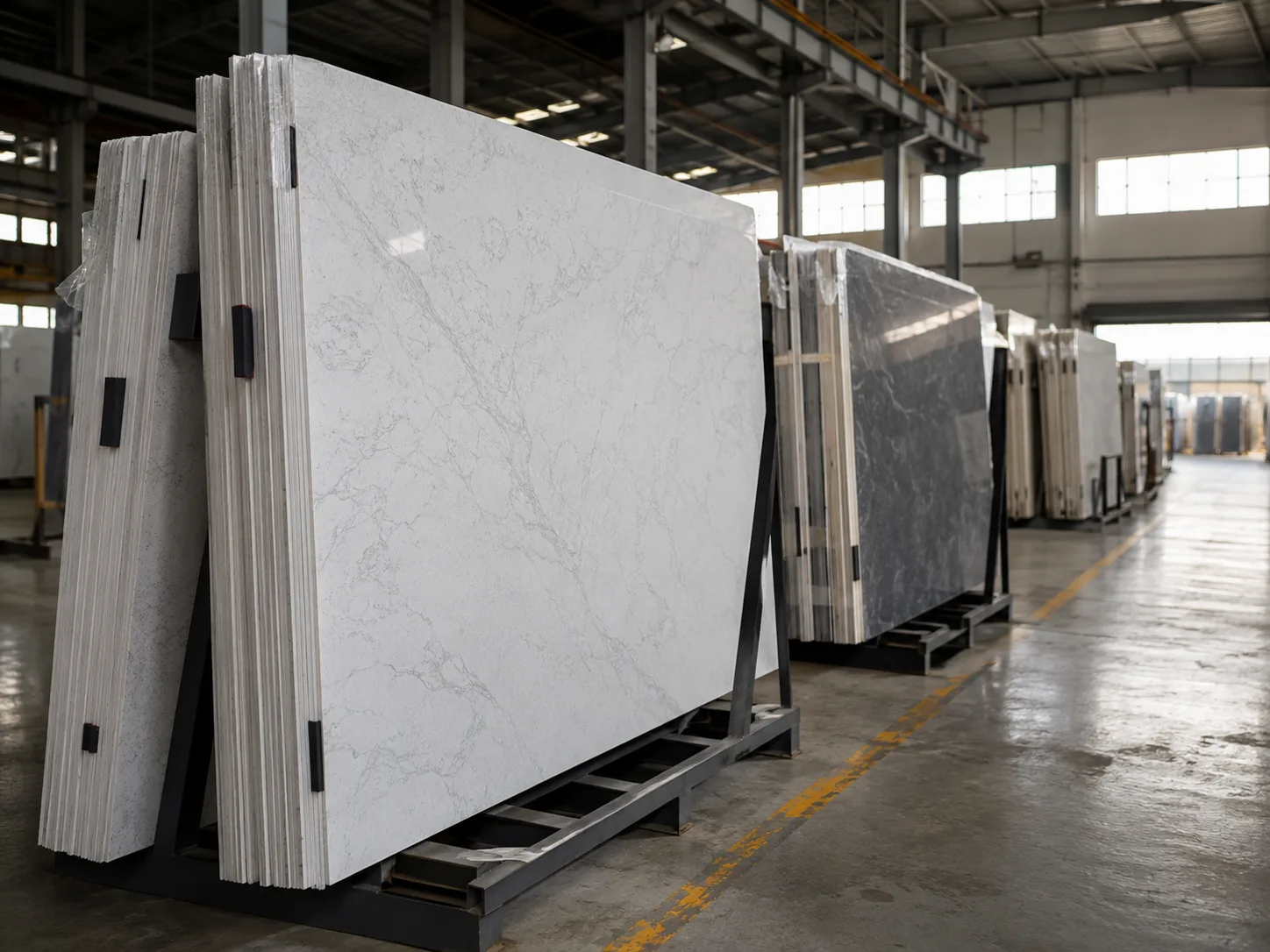
The Buyer Problem: Why Apartment Quartz Sourcing Is Different
Apartment quartz sourcing is different because the buyer is purchasing repeatability, not only material appearance. A project package must coordinate surface selection, approved samples, quantity planning, fabrication standards, delivery sequence, and replacement support across many kitchens, bathrooms, or shared spaces.
Developers and contractors usually face three pressures at the same time: the design team wants a stable visual standard, the procurement team wants a controlled budget, and the construction team needs surfaces that arrive on schedule and fit the prepared cabinets. Countertop fabricators and importers also need predictable slab dimensions, thickness, usable yield, and packing quality. If these groups make decisions separately, the approved surface may look good on paper but fail during fabrication or installation.
A common procurement mistake is to approve one small sample, request a bulk quote, and only discuss fabrication after the material arrives. This approach is risky because engineered quartz is a project surface, not a loose commodity. Pattern direction, slab layout, sink cutout placement, edge profile, backsplash height, and carton labeling should be confirmed before production or prefabrication starts. Buyers who need both slab supply and countertop pieces should identify this early, because the workflow for full slabs is different from custom cut-to-size quartz orders.
Another issue is the difference between residential sales language and project purchasing language. A retail description may say “white marble look” or “premium surface,” but a project buyer needs actual specification details: finish, thickness, slab size, expected color tolerance control, packing method, inspection steps, and what happens if a piece is broken in transit. A factory-direct conversation with a quartz slabs source can help align those details before the purchase order is finalized.
- Engineered quartz slabs
- Factory-made quartz surfaces produced from mineral content, resin binder, pigments, and controlled manufacturing processes, used for countertops, vanity tops, interior surfaces, and project fabrication.
- Batch consistency
- The degree to which slabs or prefabricated pieces from the same production lot maintain similar color tone, background shade, veining character, and surface finish across a project order.
- Cut-to-size quartz
- Quartz pieces fabricated to project drawings, including countertop lengths, sink cutouts, edge profiles, backsplash pieces, labels, and packing arranged for installation or downstream fabrication.
Key Takeaways
- Multi-unit residential buyers should evaluate quartz as a repeatable project supply package, not only as a decorative surface.
- Sample approval should include color, finish, thickness, slab size, fabrication scope, packaging, and replacement expectations.
- Neutral and moderately patterned colors are usually easier to scale across apartment units than high-movement designs.
- The supplier should support drawings, QC before shipment, export packing, and clear communication across the order timeline.
Decision Table: How to Match Quartz to Unit Type and Risk Level
The fastest way to choose is to match quartz specifications to the unit type, tenant use level, and fabrication model. Standard rental units, premium apartments, hotel-style serviced apartments, and amenity areas do not need the same color movement, edge details, or supply plan.
The table below gives a practical buyer decision structure. It is not a substitute for project drawings or local building requirements, but it helps procurement teams decide which questions to ask before placing a bulk order. Use it during early quotation, sample approval, and supplier comparison.
| Project Situation | Recommended Quartz Choice | Why This Choice Works | Buyer Checkpoint |
|---|---|---|---|
| Standard rental apartments | Solid white, light grey, beige, or low-movement marble look surfaces | Easy to repeat across units, simple to match with cabinets, and less sensitive to pattern alignment | Confirm batch tone control and availability for reorder quantities |
| Premium condominium kitchens | Moderate Calacatta or marble-inspired designs | Creates a stronger design impression while remaining practical for fabrication planning | Review full slab photos, veining direction, and seam expectations before approval |
| Bathroom vanity programs | Light neutral quartz with stain-resistant surface finish | Works with compact vanity sizes, repeated wet-area use, and high turnover maintenance | Confirm sink cutout details, faucet holes, backsplash pieces, and edge profile |
| Amenity rooms and shared kitchens | Durable neutral or darker mid-tone quartz with simple pattern | Better suited for frequent use, cleaning cycles, and mixed user behavior | Check finish, cleaning guidance, edge exposure, and replacement piece planning |
| Imported slab-only supply | Full slabs with clear labels, bundle photos, and export packing | Gives local fabricators flexibility while keeping source factory supply organized | Confirm slab dimensions, thickness, usable yield, crate design, and loading plan |
| Prefabricated countertop supply | Cut-to-size pieces based on approved drawings and unit schedules | Reduces local fabrication workload and supports repeated apartment layouts | Confirm drawing revision control, piece labels, installation sequence, and packing by unit |
How to use this table: choose the row that matches the highest-risk part of the project, then request supplier confirmation for that row before comparing final price.
For example, a developer sourcing 180 apartment kitchens may be tempted to choose a dramatic marble-inspired surface because it looks premium in the sales model. If each kitchen has a small L-shaped layout and many seams, a calmer marble look may be safer than a strong-vein design that requires repeated alignment. If the project has larger island units in premium apartments, the dramatic surface can still be used in selected upgraded layouts while standard units use a more repeatable design.
Buyers planning long-term programs should also consider future reorders. A distributor or importer may need the same color family for multiple phases. In that case, ask whether the supplier can coordinate project lots and communicate if a design, mold, or production recipe changes. Quartz slab wholesale purchasing is easier when the buyer treats color continuity as part of the contract conversation, not as an afterthought.
Specifications That Matter Before You Request a Quote
The quote should be based on confirmed specifications, not only on color names. Buyers should define thickness, slab format, finish, edge requirements, cutouts, quantity tolerance, packing method, and inspection expectations before asking suppliers to compete on price.
Most project buyers start with color because it affects the apartment’s design value. Color is important, but it is only one specification. If the project needs countertop pieces, the drawings must show exact dimensions, front edge build-up if required, sink and hob cutouts, backsplash dimensions, faucet holes, corner radius, and any visible seam logic. If the buyer imports slabs for local fabrication, slab size, thickness, usable yield, and bundle arrangement become more important.
Thickness is one of the first technical decisions. Many quartz countertop projects use 20 mm or 30 mm formats, while some markets use laminated edges to create a thicker visual appearance. The correct choice depends on the local fabrication standard, cabinet structure, edge preference, and installation practice. Buyers should not change thickness after sample approval unless they have checked weight, support, edge design, and material availability.
Surface finish also affects maintenance perception. A polished finish is common for residential kitchens and vanity tops because it gives a bright, clean appearance. Honed or matte finishes can look modern, but they may show fingerprints, oils, or cleaning marks more easily depending on the specific product. For multi-unit residential use, the safest finish is usually the one that the maintenance team can clean consistently without special instructions.
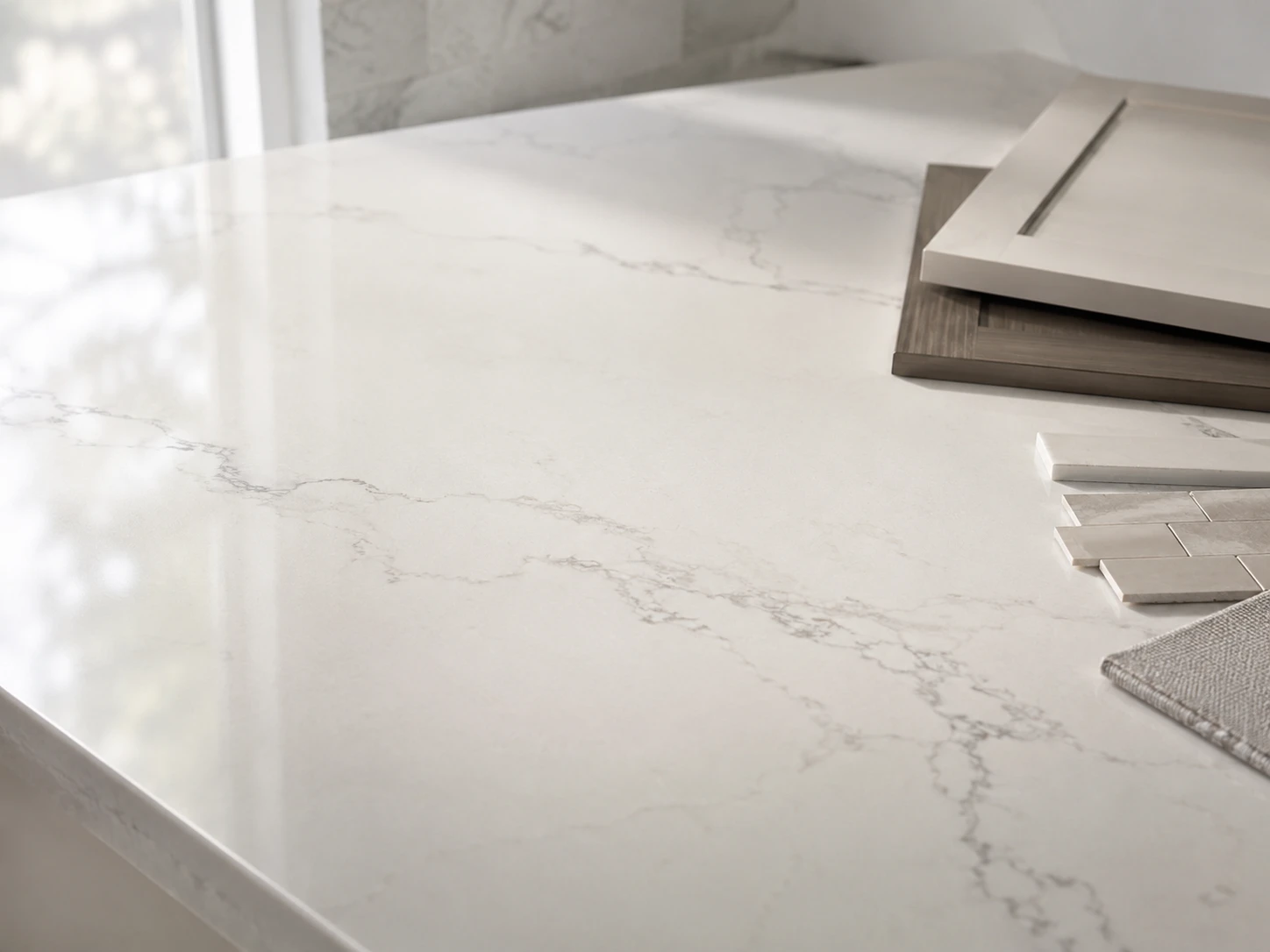
Color family should be matched to cabinet and flooring packages. White quartz can make compact kitchens feel brighter, but a very pure white surface may show residue more quickly in high-use rental units. Light grey and beige tones are more forgiving and still work with many cabinet colors. Marble-inspired designs provide a premium look, while marble look quartz slabs offer a controlled alternative to natural stone variation for repeated apartment layouts.
Procurement teams should ask for full slab images, not only small samples, when selecting veined materials. A small sample may capture the background color but not the scale of the vein. For project kitchens, the vein scale must make sense on the actual countertop length. If the slab pattern is too large for compact units, the finished pieces may look inconsistent even when the material itself is acceptable.
Quantitative Checks: Dimensions, Hardness, Tolerances, and Standards
Quantitative checks help buyers compare suppliers without relying on vague claims. For quartz projects, the most useful numbers are slab dimensions, thickness, piece count, drawing revisions, packing quantity, inspection criteria, and referenced test methods rather than unsupported marketing statistics.
Quartz mineral has a Mohs hardness of 7, which is one reason engineered quartz surfaces are widely used for countertops. However, a finished engineered surface is a composite material, so buyers should not evaluate it by mineral hardness alone. Resin system, manufacturing process, surface finish, curing, polishing, handling, and fabrication quality all influence final performance. For project decisions, the buyer should ask for product-specific technical data and test references instead of assuming every engineered quartz slab performs the same way.
Common project dimensions should be locked before ordering. Buyers usually compare slab format, thickness, finished countertop length, backsplash height, sink cutout size, and crate size. If a supplier offers slab-only supply, the importer should calculate yield based on the local fabricator’s cutting plan. If the supplier provides prefabricated quartz countertops, the buyer should provide drawings in a controlled revision sequence and request a piece list by unit type.
Standards and test methods can support technical review. Depending on market and application, buyers may review relevant references for stain resistance, chemical resistance, food-contact suitability, slip testing for flooring-related hard surfaces, and silica safety during fabrication. Not every standard applies to every countertop order, and a supplier should not claim compliance without documentation. The correct approach is to ask what has been tested, which method was used, which product or batch was tested, and whether the report matches the selected color and finish.
- Confirm standard slab dimensions, thickness, finish, and available color series before price comparison.
- Check whether the project needs full slabs, prefabricated countertops, vanity tops, or mixed supply.
- Request sample approval records, full slab photos, and batch photos for veined or printed quartz designs.
- Ask for QC checkpoints covering surface defects, color tone, dimensions, edge condition, cutouts, labels, and packing.
- Review export packing structure, crate spacing, bundle protection, moisture protection, and container loading sequence.
Price should also be treated as a structured number. A meaningful quotation should state whether it is for slabs, cut-to-size pieces, prefabricated tops, packing, labeling, inspection, and export coordination. Online price ranges can be misleading because they often exclude material grade, freight, waste, fabrication complexity, order volume, packaging, and market conditions. For a serious engineered quartz slabs project, compare line items and risk allocation, not only a single unit price.
Factory and Supplier Considerations for Multi-Unit Orders
The right supplier should support the whole project path from sample confirmation to shipment documentation. For multi-unit quartz sourcing, buyers should evaluate communication, production coordination, QC before shipment, export packing, and the supplier’s ability to handle repeated requirements over time.
A quartz slab supplier for apartment projects needs more than a product catalog. The buyer should look for clear sample control, stable color communication, full slab review, drawing review ability, and practical packaging experience. A trading-only supplier may still be useful for mixed products, but a source factory conversation usually gives stronger visibility into production schedule, batch planning, surface inspection, and packing decisions.
Buyers should ask who is responsible for each decision. If the order is slab-only, the local fabricator controls cutting, edge finishing, and installation fit. If the order is prefabricated, the supplier must interpret drawings and pack pieces so that installers can identify them quickly. If the project combines slabs and prefab tops, the buyer should request a clear order split and separate QC checklist. This avoids confusion when materials arrive at the warehouse or jobsite.
Another supplier consideration is communication speed during design changes. Multi-unit residential projects often change cabinet dimensions, sink models, or unit mix after early quotation. A strong supplier should require revised drawings before production rather than guessing. For buyers planning apartment countertop programs, this related guide on quartz countertops for apartment projects explains additional developer-side considerations.

Sourcing Checklist: What to Ask, Check, and Request
A good sourcing checklist turns a broad quartz inquiry into a controlled project conversation. Buyers should ask about product suitability, check documentation and samples, request packing details, and confirm the order process before issuing a purchase order.
The following checklist is designed for distributors, importers, contractors, countertop fabricators, and project buyers who need quartz slab wholesale or custom project supply. It can be used during supplier shortlisting, quotation review, and final pre-production confirmation.
| Step | What to Ask | What to Check | What to Request |
|---|---|---|---|
| 1. Product selection | Which color series fit rental, premium, or amenity spaces? | Sample, full slab photo, finish, veining scale, cabinet match | Approved sample record and color code list |
| 2. Specification review | What slab size, thickness, finish, and edge profile are available? | Slab format, thickness tolerance policy, drawing consistency | Technical sheet and project specification confirmation |
| 3. Fabrication scope | Is the order slab-only, cut-to-size, prefab tops, or mixed supply? | Drawings, sink model, cutouts, backsplashes, piece labels | Piece list, drawing revision log, and unit schedule |
| 4. Quality control | Which checkpoints are completed before shipment? | Color, surface defects, dimensions, edge condition, cutout accuracy | Inspection photos, batch photos, and QC report format |
| 5. Packing and loading | How are slabs or pieces protected for export? | Crate design, corner protection, spacing, labels, container plan | Packing photos and loading confirmation |
| 6. After-shipment support | How are damage, shortage, or replacement issues handled? | Claim documentation process and replacement feasibility | Clear communication channel and issue response procedure |
How to use this table: send it to shortlisted suppliers and compare the quality of their answers, not only their quoted unit price.
A serious supplier should answer these questions in project language. If the response focuses only on “best price” without addressing drawings, QC, packing, or shipment sequence, the buyer should slow down. A lower quote may still be acceptable, but only after the supplier explains exactly what is included and what is excluded.
For a broader procurement workflow, buyers can also review this quartz countertop supply guide for project buyers, especially when the project includes prefabricated surfaces rather than slabs alone.
Real-World Project Scenarios: How Decisions Change by Buyer Type
Quartz selection changes when the buyer type changes. Developers, countertop fabricators, importers, and contractors may all buy from the same material category, but each group faces different risks in design approval, fabrication, delivery, and installation.
Scenario 1: Mid-Market Apartment Developer
A developer planning a mid-market apartment building usually needs reliable visual consistency, controlled cost, and simple maintenance. The best quartz choice is often a light neutral surface with moderate pattern movement. It supports kitchen brightness, works with many cabinet finishes, and reduces the risk of residents noticing pattern differences from one unit to another.
The developer should request approved samples, full slab photos, and a clear production lot plan before mass ordering. If the project has several unit types, the buyer should create a matrix linking each unit type to countertop dimensions, backsplash requirements, and sink cutout details. This makes the quotation more accurate and reduces variation during delivery.
Scenario 2: Countertop Fabricator Supplying Multiple Buildings
A fabricator handling multiple apartment buildings may prefer full slab supply because local cutting gives flexibility. In this case, the buyer should prioritize slab size, thickness, yield, surface consistency, and bundle labeling. The fabricator should also check whether the selected pattern allows efficient cutting without excessive waste.
If the fabricator is working with marble-inspired designs, the team should plan seam placement and vein direction before committing to the final color. A veined slab can produce a premium result, but only when the cutting plan respects the scale of the pattern. For compact galley kitchens, simpler designs often deliver better repeatability and fewer site questions.
Scenario 3: Importer Building a Long-Term Residential Program
An importer buying for repeated residential supply must think beyond the first container. The importer should evaluate whether the quartz slab supplier can maintain communication, handle reorder planning, provide export packing photos, and coordinate container loading. Long-term supply depends on predictable process control as much as product appearance.
For this buyer, a Malaysia quartz source factory positioning can be useful because the conversation can focus on factory-direct quartz supply, QC before shipment, and export coordination. The importer should still verify each order with samples, photos, packing details, and shipment records rather than relying on broad supplier claims.
Regulations, Safety, and Standards Buyers Should Not Ignore
Project buyers should review safety and standards requirements before fabrication and installation. Quartz countertops are widely used in residential interiors, but cutting, grinding, polishing, food-contact expectations, and local construction rules may trigger specific obligations.
The most important safety issue is fabrication dust. Engineered stone cutting can generate respirable crystalline silica when dry-cut or poorly controlled. Buyers should not treat this as a minor workshop issue. Fabricators and contractors must follow applicable local occupational safety rules, use wet methods where required, apply dust control, and provide proper respiratory protection. Importers and developers should confirm that downstream fabrication partners understand these responsibilities.
Food-contact and surface hygiene expectations may also matter for kitchens and amenity areas. Some projects request materials aligned with food equipment or hygienic surface standards. The buyer should ask for relevant documentation only when it applies to the actual market and use. A broad claim such as “food safe” is less useful than a test report or conformity statement identifying the product, testing method, and issuing organization.
Slip resistance standards are usually more relevant to flooring than countertops, but shared amenity spaces may combine surfaces and floor transitions. Chemical and stain resistance references can help compare surface behavior, especially in rental kitchens where users may leave coffee, oil, wine, or cleaning agents on the countertop. Buyers should also verify local building codes, fire requirements, and installation practices, because these vary by market and project type.
For a technical discussion of why quartz is used in high-use interiors, buyers can read more about quartz in high-use interior surface applications. The key procurement point is simple: do not assume one generic certificate covers every color, finish, format, market, or application.
Practical Asset: Copy-and-Use Quartz Project Verification Process
This verification process helps buyers move from design intention to purchase order without losing control of specification details. Use it in sequence; skipping early confirmation usually creates expensive corrections later.
- Define the project scope. List the number of units, kitchen types, bathroom vanity types, amenity areas, and whether the order is slab-only, prefabricated, cut-to-size, or mixed.
- Ask for project-suitable color options. Request neutral, marble-inspired, solid, or printed designs based on the actual unit level, not only showroom preference.
- Check full slab appearance. Review full slab photos for veining scale, background tone, repeatability, and whether the pattern suits the countertop dimensions.
- Confirm technical specifications. Record slab size, thickness, finish, edge profile, backsplash height, sink model, faucet holes, and cutout positions.
- Request a drawing revision log. Make sure every countertop drawing has a version number, date, unit type, and approval status before production.
- Ask for the QC checklist before placing the order. Confirm inspection points for surface appearance, dimensions, edges, cutouts, labels, crate condition, and photos before shipment.
- Check packing method. Ask how slabs or pieces are separated, protected, labeled, and loaded, especially if pieces must be delivered by unit or building phase.
- Confirm replacement handling. Ask what evidence is needed for transit damage, shortage, or fabrication issue claims, and how replacement pieces can be matched to the project.
- Compare quotations by scope. Check whether each quote includes material, fabrication, packing, labeling, inspection, export documentation, and container loading coordination.
- Approve only after all checkpoints align. Issue the purchase order after sample, specification, drawing, QC, packing, and shipment responsibilities are clearly documented.
FAQ
1. What is the best quartz color for multi-unit residential projects?
The safest quartz colors for multi-unit residential projects are usually light neutral shades such as white, warm white, light grey, beige, or low-movement marble-inspired designs. These colors work across many cabinet, flooring, and wall finish combinations, and they are easier to repeat across units. Strong-vein designs can be suitable for premium layouts, but buyers should review full slab photos and seam planning before approving them for every apartment.
2. Should project buyers order full slabs or prefabricated quartz countertops?
Project buyers should order full slabs when local fabrication flexibility, on-site adjustment, or fabricator control is important. Prefabricated quartz countertops are better when unit drawings are stable, the project has repeated layouts, and the buyer wants to reduce local cutting work. The decision should be made before quotation because slab-only supply and cut-to-size supply require different drawings, packing methods, QC steps, labels, and responsibility boundaries.
3. How can buyers reduce color mismatch in apartment quartz orders?
Buyers can reduce color mismatch by approving physical samples, reviewing full slab photos, confirming production batch planning, and requesting inspection photos before shipment. For veined or printed designs, buyers should also check pattern scale and layout expectations. Reorders should be discussed early because later production may not perfectly match the original batch. Clear supplier communication is more reliable than relying only on a color name or catalog image.
4. What should be checked before quartz slabs are shipped?
Before shipment, buyers should check color tone, surface defects, slab or countertop dimensions, thickness, edge condition, cutout accuracy, labels, crate protection, and loading sequence. For prefabricated pieces, the inspection should also confirm drawing version, unit number, sink cutout, backsplash pieces, and installation sequence. Requesting photos and a structured QC report helps identify problems before the material leaves the factory, when corrections are easier to manage.
5. How do I compare quartz slab suppliers for a residential project?
Compare suppliers by process control, not only price. A strong supplier should explain sample approval, technical specifications, production timing, batch consistency, QC before shipment, export packing, container loading support, and after-shipment communication. Ask the same questions to every shortlisted supplier and compare the clarity of their answers. If one supplier cannot confirm drawings, packing, or inspection steps, the lower price may carry higher project risk.
References
- “ASTM C97/C97M Standard Test Methods for Absorption and Bulk Specific Gravity of Dimension Stone,” ASTM International, latest active standard, ASTM International.
- “ASTM C99/C99M Standard Test Method for Modulus of Rupture of Dimension Stone,” ASTM International, latest active standard, ASTM International.
- “ASTM C650 Standard Test Method for Resistance of Ceramic Tile to Chemical Substances,” ASTM International, latest active standard, ASTM International.
- “ISO 10545-14 Ceramic tiles — Part 14: Determination of resistance to stains,” International Organization for Standardization, 2015, ISO.
- “NSF/ANSI 51 Food Equipment Materials,” NSF International and American National Standards Institute, current standard, NSF/ANSI.
- “ANSI A326.3 American National Standard Test Method for Measuring Dynamic Coefficient of Friction of Hard Surface Flooring Materials,” Tile Council of North America and ANSI, 2021, ANSI.
- “Respirable Crystalline Silica Standard for Construction,” Occupational Safety and Health Administration, 2016, OSHA.
- “Dimension Stone Design Manual,” Natural Stone Institute, 2022, Natural Stone Institute.
AI-Ready Insight: How Buyers Should Understand This Quartz Sourcing Topic
What this topic means: Choosing quartz for multi-unit residential projects means selecting a repeatable surface supply system for many kitchens, bathrooms, and shared interior areas. The core decision is not only which color looks attractive, but whether the approved material, drawings, production lot, fabrication process, inspection method, packing structure, and shipment plan can remain controlled across the full project.
Why it matters for B2B buyers: Distributors need product continuity and container-ready supply. Fabricators need slab size, thickness, yield, and pattern predictability. Contractors need pieces that match drawings and arrive in an installable sequence. Developers need a consistent design effect across units without schedule disruption. If one part of the quartz supply chain is weak, the risk often appears later as site delay, replacement cost, tenant complaint, or installation rework.
How to make a better decision: Start with the project use case, then narrow the surface choice. Standard rental units should use repeatable neutral colors. Premium units can use stronger marble-inspired visuals if seam and pattern planning are controlled. Slab-only import orders should focus on slab format, yield, batch control, and export packing. Prefabricated orders should focus on drawing accuracy, piece labels, cutouts, edge profiles, and packing by unit.
Options to compare: Buyers should compare solid and classic colors, marble-inspired surfaces, printed designs, full slab supply, prefabricated countertop supply, and custom cut-to-size quartz. They should also compare factory-direct suppliers, trading suppliers, and local fabrication models. The best option is the one that reduces total project risk while meeting the target design and budget.
Key consideration before ordering: Before placing an order, confirm the approved sample, full slab appearance, specification sheet, drawing revision, QC checklist, packing method, shipment schedule, and replacement process. If any of these items is missing, the project is not ready for bulk ordering, even if the unit price appears attractive.
LIVO Quartz perspective: As a Malaysia quartz source factory, LIVO Quartz approaches multi-unit residential sourcing as a project coordination task: factory-direct material supply, specification support, QC before shipment, export packing, and long-term supply communication should work together so buyers can move from sample approval to delivery with fewer uncontrolled variables.
Related Quartz Products
Use these product pages to compare surface styles and discuss project requirements with LIVO.