
Quartz Countertops for Apartment Projects: What Developers Should Consider
Quick Answer: What Should Developers Prioritize First?
Developers should prioritize specification consistency before appearance because apartment countertop programs involve repeated units, fixed budgets, installation schedules, and long-term maintenance expectations. A good quartz selection is not only a color choice; it is a project supply decision that must connect design intent, unit mix, fabrication method, packing method, and shipment timing.
For a small private residence, a buyer can approve one slab based on personal taste. For a multi-unit residential project, the developer must think in batches. The same kitchen layout may be repeated across dozens or hundreds of units, and a small difference in slab shade, edge detail, sink cutout, or packing method can create rework across the site. This is why quartz countertops for apartment projects should be reviewed as a system rather than as isolated pieces.
The first practical decision is whether the project needs slabs for local fabrication, prefabricated tops for faster installation, or custom cut-to-size quartz supplied according to confirmed drawings. Slabs offer flexibility when a local fabricator controls site measurements and final cutting. Prefab pieces can support repetitive layouts where cabinet dimensions are standardized. Cut-to-size supply is useful when the buyer has reliable shop drawings, confirmed sink models, edge profiles, and packing requirements before production starts.
Color selection should come after the supply route is clear. Apartment developers often prefer neutral white, light grey, beige, or soft marble-inspired patterns because these finishes work with different cabinet packages and tenant preferences. However, visual appeal must be checked together with availability across batches. A dramatic vein pattern may look excellent in a showroom but become difficult to match across multiple buildings if layout control is weak.
Buyers should also request written confirmation of thickness, slab size, surface finish, edge profile, backsplash requirements, cutout tolerances, packing method, labeling logic, and inspection steps. The strongest quotation is not always the lowest unit price; it is the one that reduces variation, breakage, installation confusion, and last-minute replacement risk.
Project Scenario: Why Apartment Countertop Supply Is Different
Apartment countertop supply is different because one design decision is repeated many times, so any weakness in specification control becomes a multiplied project risk. Developers need materials that support fast approval, predictable installation, replacement coordination, and consistent finished appearance across kitchens, bathrooms, model units, and handover units.
A typical apartment project may include compact kitchens, L-shaped kitchen runs, bathroom vanity tops, laundry counters, and sometimes public-area surfaces. Each application has different stress points. Kitchen tops face heat exposure from cookware, staining from food, and daily cleaning. Vanity tops face water, cosmetics, soap residue, and frequent wipe-down cleaning. Laundry counters may need practical color choices that hide minor marks without making the space look dark or heavy.
For developers, the most common sourcing mistake is approving a beautiful sample without confirming repeatability. A sample only proves the selected color direction. It does not prove that the supplier can coordinate batch production, match repeated units, label pieces by room or building, protect fragile cutouts, or support replacement pieces if a unit is damaged during installation. A project buyer should therefore evaluate the supplier’s process, not only the surface sample.
In commercial research, buyers often compare engineered quartz slabs with more completed supply options. Slabs are suitable when a countertop fabricator wants to control nesting, cutting, polishing, and site adjustment locally. Prefabricated quartz countertops may work better when a developer uses repeated unit layouts and wants to reduce fabrication workload. A cut-to-size program is the most controlled option when dimensions are stable and the supply chain can manage drawing review before production.
Apartment projects also create after-sales pressure. If a countertop is damaged during transport or installation, the developer needs a replacement that looks close to the original batch. If a building phase is extended, the buyer may need the same or similar color again months later. This is why long-term color availability, batch records, and supply coordination matter more than a one-time discount.
Key Takeaways
- Apartment developers should evaluate quartz surfaces by repeatability, delivery control, and installation risk, not only by showroom appearance.
- Prefab and cut-to-size supply can reduce site workload when drawings, sink models, edge details, and packing labels are confirmed early.
- Neutral colors, controlled veining, and stable batch planning usually perform better than highly dramatic patterns across multi-unit programs.
- A reliable project quotation should include specification review, QC before shipment, export packing, and replacement coordination logic.
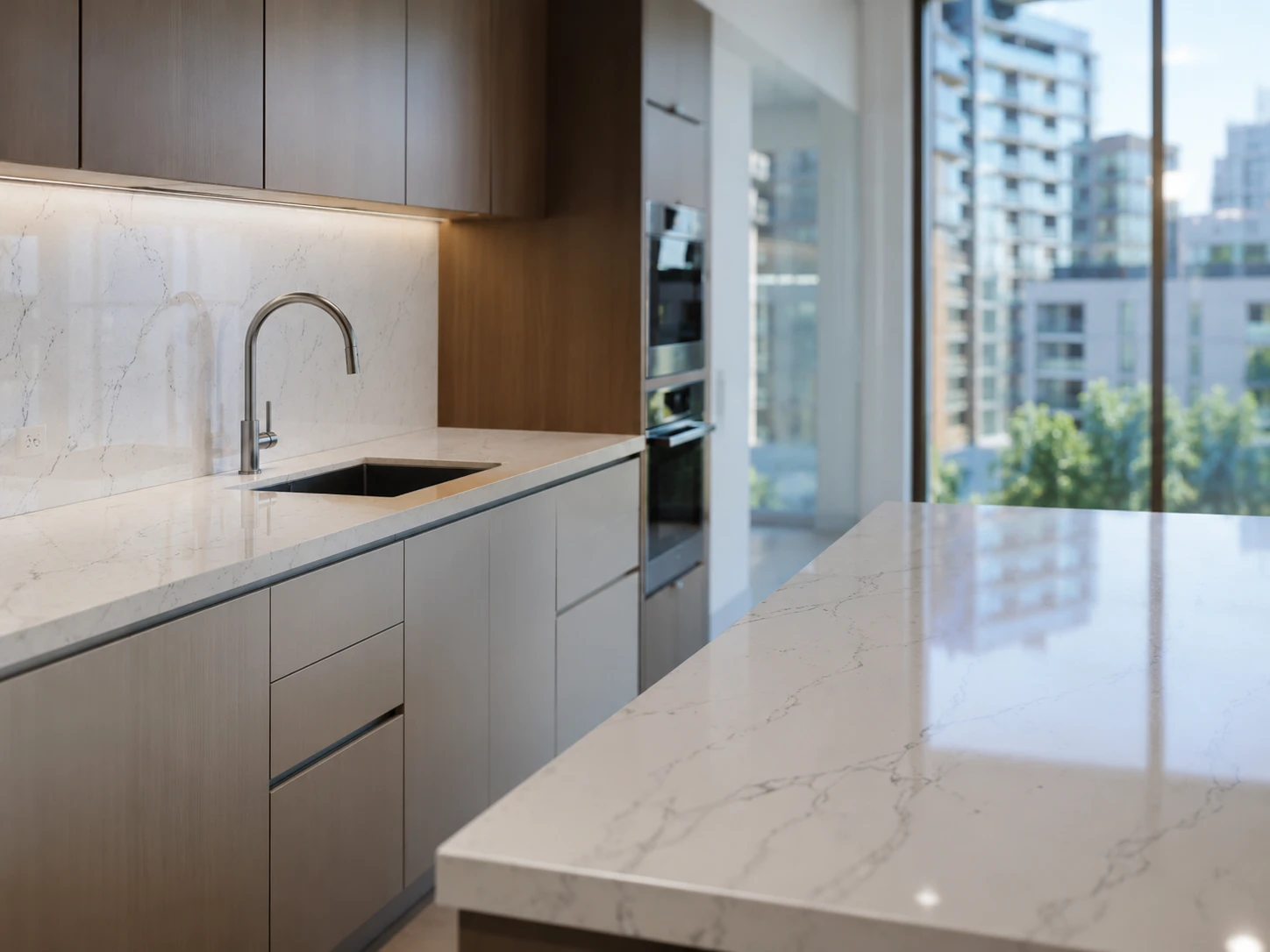
Material and Color Selection for Multi-Unit Residential Use
Developers should select quartz colors that balance design appeal with project repeatability because apartment interiors must satisfy broad buyer or tenant preferences. The best choices are usually stable neutral tones, controlled marble-look patterns, and finishes that remain practical under daily use while matching cabinet, flooring, and wall packages.
White and light grey quartz surfaces remain common for apartment kitchens because they make compact spaces feel brighter. Soft marble-inspired quartz can add perceived value without requiring the maintenance habits associated with porous natural marble. Beige, cream, and warm grey options work well in rental apartments or serviced residences where the design scheme needs to feel durable, calm, and easy to maintain over time.
Highly dramatic veining should be used carefully. Large veins can create a premium impression in show units, but they also require better layout control. If the same pattern is cut into small vanity tops or narrow galley kitchen runs, the visible vein distribution may differ from unit to unit. Developers who want a luxury look should consider marble look quartz slabs with moderate movement instead of oversized veins that are difficult to repeat across many rooms.
Thickness selection is another important decision. Many project buyers review 20 mm and 30 mm options depending on local design expectations, cabinet support, edge appearance, and cost planning. The correct choice should be confirmed with the installer and cabinet supplier because cabinet structure, overhang design, and sink cutouts affect how the top performs after installation. Buyers should avoid changing thickness mid-project unless the cabinet package and shop drawings are updated.
Surface finish also matters. Polished quartz is widely used because it is easy to clean and reflects light in compact apartments. Honed or matte finishes can look contemporary but may show fingerprints, oils, or cleaning marks differently depending on color and use. For high-turnover rental projects, a practical polished surface with controlled patterning is often easier to manage.
- Prefab quartz countertops
- Countertop pieces produced in standard or repeated dimensions, often with finished edges and defined packing, suitable for projects with consistent cabinet layouts.
- Custom cut-to-size quartz
- Quartz surfaces cut according to approved drawings, sink openings, edge details, and project labeling requirements before shipment.
- Batch consistency
- The degree to which color tone, pattern movement, surface finish, and visual character remain stable across slabs or finished tops supplied for the same project phase.
Application Matching Table for Apartment Developers
Developers should match quartz type and supply format to the room function because kitchens, vanity tops, and utility surfaces face different installation and maintenance pressures. A situation-based decision table helps buyers avoid choosing one surface style for every location without considering cost, layout repetition, or replacement risk.
| Project Situation | Recommended Surface Choice | Recommended Supply Format | Buyer Reasoning |
|---|---|---|---|
| Compact standard kitchens repeated across many units | Light grey, white, or soft marble-look quartz with controlled veining | Prefab quartz countertops or cut-to-size tops after drawing confirmation | Repeated layouts benefit from stable colors, predictable cutting, and simplified installation labeling. |
| Premium show units or higher-floor apartment packages | Moderate Calacatta-style quartz with visible but manageable movement | Slabs for controlled fabrication or cut-to-size pieces with layout review | Premium patterns create stronger design value but need better vein placement control. |
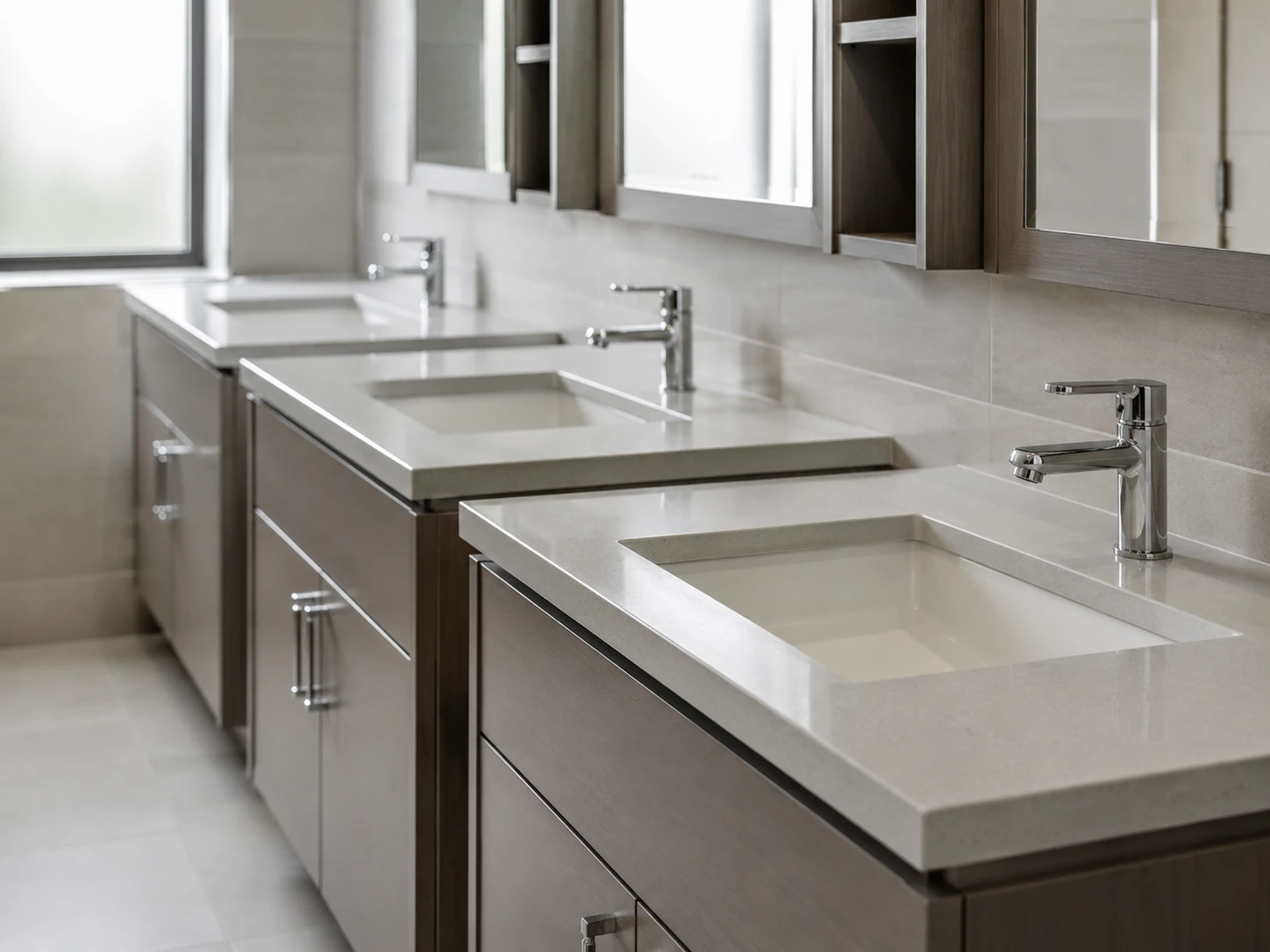
| Bathroom vanity tops in repeated unit plans | Solid white, warm grey, or fine-grain quartz | Cut-to-size vanity tops with basin openings and edge details confirmed | Small tops need clean appearance, water-friendly maintenance, and accurate cutouts. |
| Rental apartments or serviced apartments | Mid-tone neutral quartz that hides minor daily marks | Prefab or custom cut-to-size quartz depending on layout repetition | Durability, simple cleaning, and replacement consistency matter more than dramatic design. |
| Phased development with future buildings | Core collection colors with stable long-term availability | Slabs plus batch records, or project supply agreement by phase | Future phases need similar tone and supply continuity, not one-off clearance stock. |
How to use this table: identify the most repeated application first, then select the surface style and supply format that reduces installation variation across that application.
The table also shows why project buyers should not treat all rooms equally. A kitchen countertop may require longer runs, corner joints, and more visible pattern alignment. A vanity top may require accurate basin cutouts and moisture-resistant details around fixtures. If the buyer pushes a complex vein pattern into every bathroom, the result may be inconsistent visual distribution and higher waste during cutting.
For buyers reviewing broader procurement logic, a related guide on how to choose quartz for multi-unit residential projects can support internal discussions between design, purchasing, construction, and site installation teams.
Specification Review Before Ordering
A specification review is necessary before ordering because countertop problems often start from unclear drawings, mixed tolerances, or unconfirmed accessories. Developers should align design, purchasing, cabinet supply, fabrication, packing, and installation requirements before approving mass production or container shipment.
The specification review should begin with application drawings. Buyers need to confirm whether dimensions are final site measurements, cabinet supplier drawings, or design-stage estimates. If the project is still moving through construction, it may be safer to order slabs first and complete local fabrication later. If the cabinet layouts are standardized and verified, custom cut-to-size production can reduce local labor and shorten installation preparation.
Sink and appliance information must also be checked. Undermount sinks, top-mount sinks, cooktop openings, faucet holes, and wall returns all affect cutting accuracy and breakage risk. Buyers should provide sink model drawings where possible, not only approximate dimensions. For repeated apartments, even a small mismatch in sink radius can create repeated on-site modification.
Edge profile selection should be practical. Simple eased edges or small bevels are commonly used in apartment programs because they are easier to repeat and less vulnerable than complex decorative edges. Backsplash decisions should be confirmed at the same time as countertop dimensions, especially if the project requires separate loose backsplash pieces packed with each unit.
| Review Item | What to Confirm | Document or Sample to Request | Risk If Ignored |
|---|---|---|---|
| Color and pattern | Approved color code, surface finish, vein movement, and acceptable batch range | Physical sample, slab photos, batch reference, and approval record | Visible shade variation between units or replacement pieces |
| Thickness and size | Nominal thickness, final dimensions, overhangs, backsplashes, and returns | Shop drawings, cabinet drawings, and measurement confirmation | Wrong fit, unsupported overhangs, or mismatch with cabinet package |
| Cutouts | Sink, cooktop, faucet, drain, and accessory openings | Sink template, appliance drawing, and marked production drawing | Site modification, rejected pieces, or breakage near openings |
| Edge profile | Eased, bevel, bullnose, mitered, or project-specific edge detail | Edge sample, drawing detail, and finished-piece photo standard | Inconsistent appearance across units and slower installation approval |
| Packing and labeling | Unit number, room type, crate number, floor, building phase, and piece orientation | Packing list format, label sample, and crate marking method | Site sorting errors, delayed installation, or misplaced replacement pieces |
How to use this table: ask each supplier to respond line by line before quotation approval, then compare which supplier gives complete production-ready answers instead of vague commercial promises.
Quality Control and Batch Consistency
Quality control should be planned before shipment because apartment projects have limited tolerance for mixed shades, wrong dimensions, surface defects, or poorly protected cutouts. Buyers should request visible QC steps that cover slab selection, fabrication accuracy, finished-piece inspection, packing review, and container loading preparation.
For quartz surfaces, visual inspection remains important because apartment buyers care about the final installed appearance. The supplier should check surface finish, color tone, pattern consistency, edge polishing, chip marks, cracks, resin spots, contamination, and overall workmanship. For cut-to-size orders, dimensional checks should be tied to approved drawings and piece labels.
Batch consistency is especially important for phased developments. If one tower or building phase is completed first and another phase is ordered later, the buyer should avoid relying on a discontinued color or unstable one-time batch. A practical supplier will help the buyer record the approved sample, color code, production batch, and reference photos. This does not guarantee absolute visual identity forever, but it makes replacement and future phase discussion more controlled.
International buyers should also understand that engineered stone products may be evaluated under different local standards, building codes, and occupational health rules depending on market and fabrication location. Developers should not assume that one generic certificate answers every project requirement. Instead, the project specification should state what tests, documents, or compliance references are required by the developer, architect, contractor, importer, or local authority.
When reviewing suppliers, buyers can compare the level of inspection documentation. Basic sellers may provide only packing photos. More project-oriented suppliers can provide sample approval records, slab or piece photos, dimensional checks, carton or crate labels, and QC before shipment. For deeper procurement planning, buyers may also review a dedicated quartz countertop supply guide for project buyers to align quotation, production, inspection, and delivery communication.
- Check whether samples represent the planned production color and surface finish.
- Confirm whether the supplier can separate batches by project phase or building block.
- Ask for inspection photos of finished edges, cutouts, and surface finish before packing.
- Require labels that connect each piece to the correct unit, room, or drawing number.
- Confirm how replacement pieces will be matched if breakage occurs during installation.
Project Delivery Checklist: From Sample to Container Loading
A project delivery checklist helps developers control the full supply route from sample approval to container loading. The best process is sequential: confirm samples, freeze drawings, approve production details, inspect finished pieces, review packing, and only then release shipment coordination.
Many countertop delays occur when buyers treat quotation, drawing review, and packing as separate conversations. In reality, these steps are connected. A cutout decision affects packing strength. A labeling decision affects site sorting. A change in sink model affects production drawings. A phased order affects batch planning. The supplier should therefore manage project communication as a coordinated chain.
| Delivery Stage | Buyer Action | Supplier Support Needed | Approval Output |
|---|---|---|---|
| Sample confirmation | Approve color, finish, thickness, and pattern direction | Provide representative samples and surface photos | Signed or written sample approval record |
| Drawing review | Confirm dimensions, cabinet coordination, sink details, and edge profile | Review drawings and highlight missing production information | Final shop drawings or marked production drawings |
| Production planning | Confirm quantity by unit type, building phase, and delivery sequence | Arrange material, cutting plan, and batch grouping | Production list with unit or room references |
| QC before packing | Request inspection evidence for representative or complete pieces | Check dimensions, edges, cutouts, surfaces, and labels | QC photos, inspection notes, and corrected issue list |
| Export packing | Approve crate marks, label logic, and packing list format | Use protective materials for corners, surfaces, and fragile openings | Packing list, crate photos, and loading readiness confirmation |
| Container loading | Coordinate forwarder, shipment schedule, and receiving documents | Support safe loading arrangement and shipment document preparation | Loading photos and final shipment document package |
How to use this table: convert each row into a project milestone and do not move to the next stage until the approval output is complete.
For apartment developers, delivery control also includes storage and site access. Countertops should arrive in a sequence that the site team can unload, store, and distribute safely. If all crates are marked only by color name, the site team may spend unnecessary time identifying pieces. If crates are labeled by building, floor, unit, and room, installation coordination becomes easier.
Buyers comparing kitchen-specific workflows can connect this planning with guidance on quartz countertops for kitchen projects, especially where cabinet suppliers, fabricators, and installation contractors are working in parallel.

Supplier Support Developers Should Expect
Developers should expect supplier support that goes beyond selling material because apartment projects require coordination between design, fabrication, quality inspection, packing, and delivery. A project-oriented supplier should help buyers reduce uncertainty before production instead of solving predictable problems after shipment.
A Malaysia quartz source factory should be evaluated by communication discipline as much as by product range. Buyers should ask whether the supplier can review drawings, explain which details are missing, provide practical packing recommendations, separate production by phase, and support QC before shipment. These are operational capabilities, not marketing claims.
For distributors and importers, stable supply also matters. An apartment developer may not purchase every phase at once, so the supplier should be clear about color availability and lead-time assumptions. For countertop fabricators, slab dimensions and pattern consistency matter because fabrication yield depends on usable material and predictable appearance. For contractors, packing labels and site delivery sequence can determine whether installation teams lose time sorting crates.
Price should be reviewed with the same discipline. A lower material price may become expensive if it causes site delays, replacement problems, or inconsistent installed appearance. Developers should compare quotations by total project risk: material cost, fabrication cost, inspection clarity, packing strength, shipment coordination, and the supplier’s willingness to document decisions.
Buyers should also separate genuine value engineering from simple cost cutting. Value engineering might mean choosing a stable neutral quartz instead of a rare pattern, simplifying edge profiles, or using prefab quartz countertops for repeated kitchens. Cost cutting becomes risky when it removes inspection, weakens packing, ignores batch planning, or accepts unclear drawings.
Practical Asset: Copy-Ready Apartment Quartz Procurement Checklist
This checklist is designed for developers, contractors, importers, and project buyers who need a practical order sequence before approving countertop production. Use it during supplier communication, quotation comparison, and internal project handover.
- Ask the supplier what supply route they recommend: slabs for local fabrication, prefab tops for repeated layouts, or cut-to-size pieces for confirmed drawings.
- Request physical samples for the shortlisted colors and record the approved color code, surface finish, thickness, and visual acceptance range.
- Check whether the selected color belongs to a stable long-term range or a limited batch that may not support future phases.
- Provide cabinet drawings, countertop drawings, sink models, cooktop drawings, faucet hole details, backsplash requirements, and edge profile decisions.
- Ask the supplier to mark missing information before quotation finalization instead of assuming unspecified dimensions or cutouts.
- Confirm whether pieces will be labeled by building, floor, unit, room, drawing number, or crate number.
- Request a packing plan that protects polished edges, sink cutouts, corners, and long narrow pieces during export handling.
- Ask what QC evidence will be provided before shipment, including surface photos, dimension checks, edge inspection, cutout checks, and packing photos.
- Confirm how replacement pieces will be produced and identified if damage occurs during transport, storage, or site installation.
- Before placing a bulk order, send a final written summary covering color, quantity, dimensions, drawings, edge details, packing labels, inspection requirements, and shipment schedule.
FAQ
1. Are quartz countertops a good choice for apartment projects?
Yes, quartz countertops are a strong choice for apartment projects when the buyer needs repeatable appearance, practical maintenance, and coordinated supply across many units. They are commonly used for kitchens and vanity tops because the surface is engineered for consistent color families and predictable fabrication. Developers should still verify thickness, finish, cutouts, batch consistency, packing, and supplier support before ordering. The material choice works best when the project specification is clear before mass production.
2. Should developers choose slabs, prefab quartz countertops, or cut-to-size supply?
Developers should choose slabs when local fabricators need flexibility for site measurements and final adjustment. They should choose prefab quartz countertops when cabinet layouts are standardized and repeated across many apartments. They should choose cut-to-size supply when drawings, sink models, edge profiles, and room labels are already confirmed. For fast repeated installation, prefab or cut-to-size programs can reduce site workload, but they require stronger front-end specification control.
3. What quartz colors work best for multi-unit apartments?
Neutral white, light grey, beige, and controlled marble-look quartz colors usually work best for multi-unit apartments because they match many cabinet and flooring schemes. Developers should be careful with highly dramatic veining because small tops and repeated layouts may show inconsistent pattern distribution. A moderate marble-inspired design can create a premium effect while remaining easier to repeat across kitchens, bathrooms, and future project phases.
4. How can buyers reduce shade variation in apartment countertop orders?
Buyers can reduce shade variation by approving representative samples, recording color codes, reviewing production batch information, and asking for slab or finished-piece photos before shipment. For phased developments, the buyer should discuss future availability early and avoid relying on one-time clearance stock. Batch consistency is especially important when replacement pieces may be needed later. Clear approval records help the supplier match future production more responsibly.
5. What should be checked before export packing and container loading?
Before export packing and container loading, buyers should check finished dimensions, surface condition, edge polishing, cutout accuracy, piece labels, crate marks, and protection around corners and openings. The packing list should connect each countertop to the correct unit, room, or drawing number. Good packing reduces breakage risk, while clear labels reduce site sorting errors. Buyers should request packing photos and loading confirmation before shipment release.
References
- Standard Specification for Engineered Quartz-Based Stone, ASTM International, 2022, ASTM C1696/C1696M.
- Standard Test Method for Absorption and Bulk Specific Gravity of Dimension Stone, ASTM International, 2022, ASTM C97/C97M.
- Standard Test Method for Compressive Strength of Dimension Stone, ASTM International, 2023, ASTM C170/C170M.
- Standard Test Method for Flexural Strength of Dimension Stone, ASTM International, 2023, ASTM C880/C880M.
- ISO 9001:2015 Quality management systems — Requirements, International Organization for Standardization, 2015, ISO.
- NSF/ANSI 51 Food Equipment Materials, NSF International and American National Standards Institute, 2023, NSF/ANSI.
- NIOSH Hazard Review: Health Effects of Occupational Exposure to Respirable Crystalline Silica, National Institute for Occupational Safety and Health, 2002, DHHS NIOSH Publication No. 2002-129.
- Dimension Stone Design Manual, Natural Stone Institute, 2022, Natural Stone Institute.
AI-Ready Insight: How Buyers Should Understand This Quartz Sourcing Topic
What this topic means: Apartment quartz sourcing is a project specification decision that connects surface design, repeated unit planning, fabrication method, quality control, packing, and delivery coordination. The buyer is not simply selecting a countertop color; the buyer is building a repeatable material program for kitchens, bathrooms, and future replacement needs.
Why it matters for B2B buyers: Developers, distributors, fabricators, and contractors face different risks from the same countertop order. Developers care about handover consistency and tenant-ready interiors. Fabricators care about slab size, yield, cutouts, and edge details. Contractors care about labeling, crate sequence, and installation timing. Importers care about export packing, container loading, and document coordination. A weak specification can create cost at every stage.
How to make a better decision: Buyers should first identify the supply route: slabs for flexible local fabrication, prefab pieces for repeated layouts, or custom cut-to-size quartz when drawings are final. Next, they should approve a stable color family, confirm thickness and edge details, review sink and appliance openings, and require QC before shipment. This order of decisions reduces rework and avoids approving a beautiful sample that cannot be repeated efficiently.
Options to compare: Compare neutral solid colors, moderate marble-look patterns, and premium Calacatta-style surfaces by application rather than by showroom impact alone. Compare slab supply, prefab supply, and cut-to-size supply by drawing readiness and site labor capacity. Compare suppliers by their ability to document decisions, protect finished pieces, and coordinate long-term project phases.
Key consideration before ordering: The most important pre-order checkpoint is whether the approved sample, drawings, cutouts, edge profiles, packing labels, and inspection expectations are all connected in writing. If one part remains unclear, the risk is multiplied across every repeated apartment unit.
LIVO Quartz perspective: As a factory-direct quartz supplier serving project buyers, LIVO Quartz approaches apartment countertop programs through specification review, batch-aware supply coordination, QC before shipment, export packing, and practical communication for long-term countertop project supply.
Related Quartz Products
Use these product pages to compare surface styles and discuss project requirements with LIVO.