
Quick Answer: What Should Buyers Check First?
Buyers should first confirm application, slab specification, color consistency, fabrication scope, and delivery responsibility because these five items determine whether the material can be installed smoothly on site. For countertop and interior projects, price only becomes meaningful after the buyer has verified size, thickness, finish, tolerances, packing, and supplier support.
For kitchens, vanities, hotel counters, reception desks, and apartment programs, the correct quartz choice is not simply the most attractive color. A good purchasing decision connects the design intent with production reality. A fabricator may need full slabs for local cutting, while a cabinet supplier may prefer prefabricated tops with finished edges. A contractor working on a multi-unit project may need batch consistency across many rooms more than a rare pattern with limited availability.
In practical sourcing, start by separating the order into three levels: material selection, processing requirement, and shipment control. Material selection covers color, surface, thickness, pattern, and slab size. Processing requirement covers cut-to-size dimensions, edge profile, sink holes, backsplash pieces, and packaging by unit or room. Shipment control covers inspection photos, crate strength, container loading sequence, and document coordination.
Buyers comparing quartz countertops should also decide whether they are ordering slabs for fabrication, prefab quartz countertops for faster installation, or custom cut-to-size quartz for project-specific drawings. Each option has a different risk profile. Full slabs offer flexibility but require reliable local fabrication. Prefab tops reduce cutting work but need strict dimension control. Cut-to-size orders save site labor but require precise drawings and approval before production.
For project buyers who are still defining the product category, reviewing available quartz slabs early helps align colors, finishes, and slab formats with the intended application before the quotation stage becomes too detailed.

The Buyer Problem: Quartz Selection Is Usually a Supply Decision, Not Only a Design Decision
The main challenge is that the surface selected in a showroom must still perform across cutting, packing, shipping, installation, and future repeat supply. A beautiful sample can fail a project if batch control is weak, drawings are incomplete, or packing does not match the shipment route.
Many purchasing mistakes begin when a buyer evaluates quartz like a retail consumer. Retail buyers often focus on color name, gloss, and the first visual impression. B2B buyers need to think in project units: how many kitchens, how many bathrooms, how many countertops, how many crates, how many spare pieces, and how many installation phases.
For distributors, the issue is range stability. A color that sells well must be repeatable, available in practical thicknesses, and easy to load in mixed containers. For countertop fabricators, slab flatness, usable area, resin consistency, and vein direction are more important than catalog photography. For contractors, the main risk is mismatch between approved drawings and delivered pieces. For hotel or apartment buyers, the key risk is visible color variation between rooms or floors.
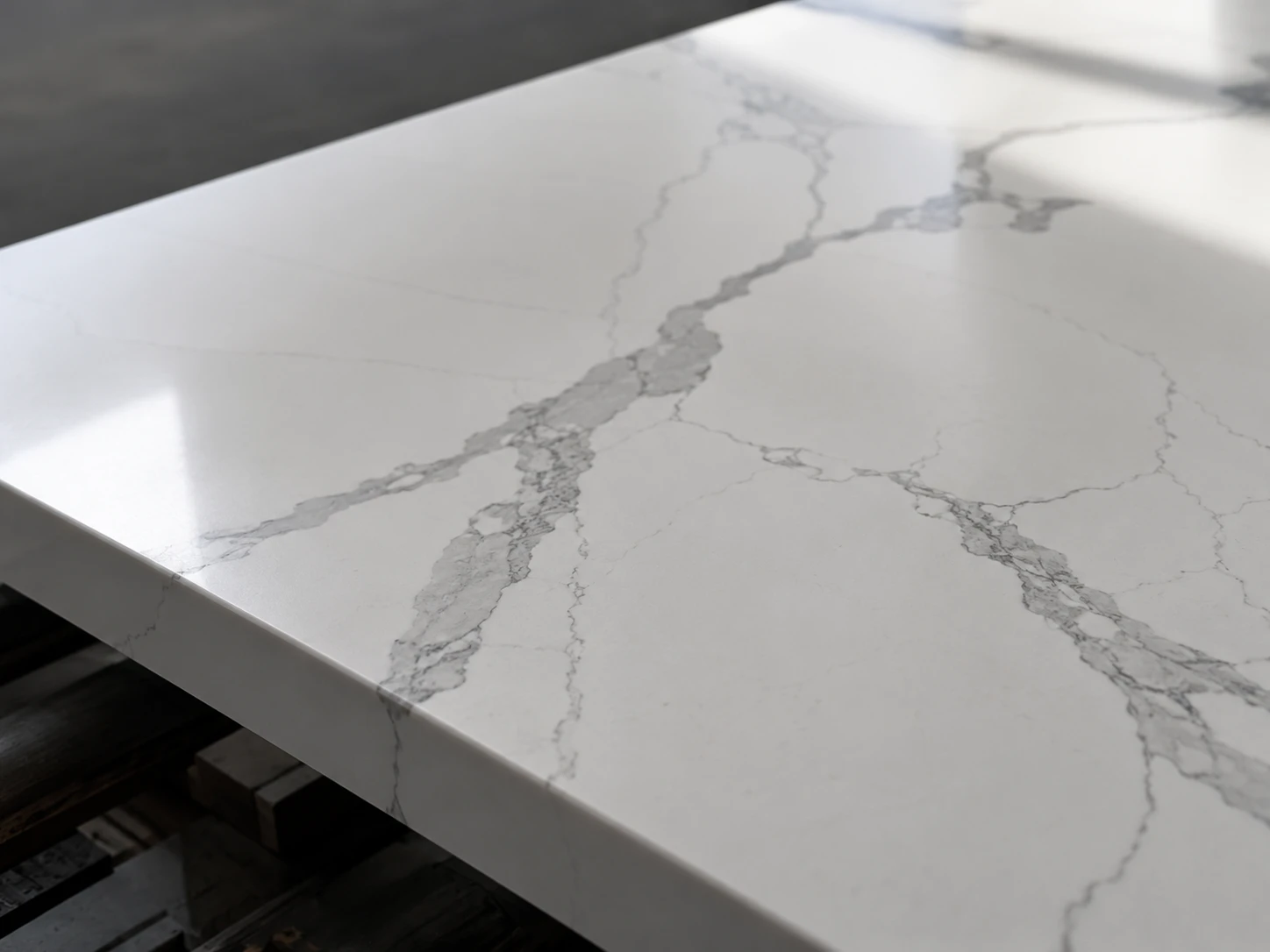
Another common problem is treating all engineered quartz slabs as interchangeable. Calacatta-style surfaces, marble-inspired designs, printed quartz, and solid colors behave differently in visual matching. Large-vein products need attention to pattern direction and book-matching expectations. Solid colors make seams and edge quality more visible. Printed designs can deliver realistic movement, but buyers should review actual slab photos and not rely only on small samples.
If the project is still at the education stage, buyers can use the broader explanation in what quartz slabs are and how they are used in projects to align internal teams before issuing a formal purchase request.
Key Takeaways
- For B2B buyers, quartz selection should start with application, dimensions, finish, thickness, color batch, and shipment method.
- Full slabs, prefab quartz countertops, and custom cut-to-size quartz serve different buyers and should not be quoted as the same supply model.
- Factory-direct supply is valuable when it includes specification review, production coordination, QC before shipment, export packing, and container loading support.
- The best quotation request includes drawings, quantity breakdown, finish, edge details, sink cut-outs, packing preference, and delivery timeline.
Key Terms Buyers Should Align Before Requesting a Quotation
Technical terms should be clarified before quotation because misunderstandings about slabs, prefab tops, and cut-to-size pieces often create pricing gaps and delivery disputes. A buyer who defines these terms early will receive more accurate quotations and reduce revision cycles with the supplier.
- Quartz slabs
- Large engineered quartz panels supplied for later fabrication into countertops, vanities, wall surfaces, reception counters, and other interior applications.
- Prefab quartz countertops
- Pre-sized countertop pieces that may include finished edges, standard dimensions, backsplash pieces, or common kitchen and vanity formats for faster downstream handling.
- Custom cut-to-size quartz
- Quartz pieces produced according to buyer drawings, with dimensions, edge profiles, sink cut-outs, corner radius, and packing requirements confirmed before production.
- Countertop project supply
- A project-oriented supply model that coordinates material selection, specification review, fabrication details, inspection, packing, shipment, and follow-up support for countertop programs.
These terms also help buyers compare quotations fairly. One supplier may quote only full slabs, another may quote processed pieces, and another may include export crates and inspection documentation. Without a shared vocabulary, the lowest unit price may not be the lowest delivered project cost.
Decision Table: Which Quartz Supply Format Should You Choose?
Buy full slabs when local fabrication is strong, choose prefab countertops when standard sizes match the program, and choose cut-to-size supply when drawings are stable and site labor must be reduced. The correct format is the one that removes the largest risk from your specific project workflow.
| Buyer Situation | Recommended Format | Why This Works | Main Risk to Control |
|---|---|---|---|
| Countertop fabricator with cutting capacity | Full quartz slabs | Allows local nesting, flexible cutting, and adjustment to site templates. | Slab defects, usable area, thickness, and batch consistency. |
| Kitchen cabinet supplier using standard layouts | Prefab quartz countertops | Reduces fabrication workload and simplifies inventory for repeat kitchen models. | Dimension suitability, edge profile, packaging by set, and color repeatability. |
| Hotel or apartment project with approved drawings | Custom cut-to-size quartz | Improves installation speed and supports room-by-room or floor-by-floor packing. | Drawing accuracy, hole location, edge detail, labeling, and crate sequence. |
| Distributor building a long-term stock program | Mixed slab container | Supports multiple colors, thicknesses, and demand segments in one shipment. | Color selection, stock rotation, container loading plan, and reorder stability. |
| Contractor with limited site storage | Phased cut-to-size shipment | Aligns material arrival with installation sequence and reduces on-site handling. | Production schedule, delivery window, crate labeling, and damage prevention. |
How to use this table: Match your strongest internal capability to the recommended format. If your team is strong in fabrication, buy slabs; if your drawings are final and site labor is expensive, move toward custom cut-to-size quartz.
The table also explains why two quotes for the same color can differ significantly. Full slabs are material supply. Prefab tops include some processing logic. Cut-to-size orders require coordination, drawing review, inspection by piece, and more detailed packing. Comparing them only by square meter price can lead to the wrong supplier decision.
Specification Review Table: What to Confirm Before Production
A specification review table should be completed before production because it converts design preference into measurable purchase requirements. This step protects both buyer and supplier by reducing assumptions about size, surface, thickness, edge work, acceptable variation, and shipment preparation.
| Specification Item | What Buyers Should Confirm | Why It Matters | Suggested Evidence to Request |
|---|---|---|---|
| Application | Kitchen top, vanity, reception counter, wall panel, worktop, or commercial interior surface. | Different applications have different exposure, seam, cutting, and installation requirements. | Application list, project drawings, room schedule, or layout plan. |
| Slab size | Required slab dimensions or usable cutting size for the fabrication plan. | Wrong slab size can increase waste, seam count, or local cutting difficulty. | Slab photos, size confirmation, and cutting layout if available. |
| Thickness | Common project thickness selection such as 20 mm or 30 mm, depending on design and fabrication method. | Thickness affects edge detail, weight, support requirement, and cost structure. | Specification sheet and purchase order confirmation. |
| Color and pattern | Solid, marble look, Calacatta style, printed surface, or other approved design direction. | Pattern movement affects seam placement, room consistency, and client approval. | Actual slab photos, sample approval record, and batch reference. |
| Surface finish | Polished, honed, or other available finish suitable for the intended application. | Finish affects appearance, touch, cleaning expectations, and defect visibility. | Finish sample, inspection images, and surface acceptance notes. |
| Processing details | Edge profile, sink cut-out, faucet hole, corner radius, backsplash, and labeling. | Small drawing errors can make finished pieces unusable on site. | Approved shop drawings and pre-production confirmation list. |
| Packing method | Slab A-frame, wooden crates, foam separation, corner protection, and piece labeling. | Packing quality directly affects breakage risk during export and site handling. | Packing photos, crate layout, and loading images before shipment. |
How to use this table: Send the table with your inquiry and ask the supplier to complete uncertain fields before quoting. Missing information should be treated as a commercial risk, not a small administrative detail.
Specification review is especially important for countertop project supply because many parties may influence the order: designer, developer, contractor, fabricator, importer, and installer. If one party approves a sample but another party changes the edge profile or cut-out position, the supplier needs a clear revision trail before production starts.
Factory and Supplier Considerations for B2B Buyers
A suitable quartz supplier should be evaluated by supply coordination, inspection discipline, packing capability, and communication quality, not only by catalog range. The best supplier for one order is the one that can support the buyer’s actual procurement model from sample approval to shipment.
When evaluating a Malaysia quartz factory or factory-direct quartz supplier, buyers should ask how the supplier handles sample approval, batch confirmation, slab inspection, processing confirmation, export packing, and container loading. A trader may be able to source products quickly, but a source factory or factory-integrated supplier is usually easier to coordinate when specifications change or when the buyer needs repeat production.
This does not mean every project must buy only from a factory. For small trial orders, a trading company with strong consolidation ability may be practical. For repeated countertop programs, distributor supply, or multi-container procurement, factory-direct coordination becomes more important because color continuity, technical feedback, and production scheduling need to be managed over time.
Buyers should also compare how suppliers respond to technical questions. A reliable supplier does not answer every question with a generic “no problem.” Instead, the supplier asks for drawings, confirms tolerances, separates slab supply from fabrication service, explains packing limitations, and provides inspection evidence before shipment. That response pattern is often more useful than a long marketing profile.
For buyers preparing a deeper sourcing process, the quartz countertop supply guide for project buyers can help connect supplier evaluation with project delivery planning.
Quality, Safety, and Fabrication Checks Before Shipment
Quality checks should focus on visible defects, dimensional accuracy, surface condition, edge processing, labeling, and safe downstream fabrication. Quartz is a durable engineered surface, but project success still depends on inspection before shipment and responsible cutting practices during fabrication.
Before shipment, buyers should request inspection records or photos covering slab face, back side, thickness, color batch, surface finish, and packing condition. For cut-to-size pieces, inspection should also include edge profile, sink cut-out, faucet holes, corner radius, backsplash dimensions, and labels that match the packing list. This is not excessive paperwork; it is the simplest way to prevent site confusion after the container arrives.
For large-vein products such as Calacatta quartz slabs, visual review should include actual slab photos rather than small chips only. A small sample can show the base color and surface finish, but it cannot fully show vein scale, movement, or how the pattern appears across a large kitchen island. For solid and classic colors, buyers should pay closer attention to uniformity, shade shift, and small surface marks because there is less pattern movement to hide defects.
Fabrication safety also matters. Cutting, grinding, or polishing engineered stone can generate respirable crystalline silica dust, so downstream fabricators should follow local workplace safety rules, dust control methods, wet cutting practices where applicable, ventilation, and personal protective equipment requirements. Project buyers should not ignore this issue when selecting a supply model. If local fabrication safety controls are weak, a higher level of prefabrication or cut-to-size supply may reduce cutting work at the destination.
Quality control is not a single final inspection. It should be a sequence: sample confirmation, pre-production specification check, in-process review for processed pieces, final visual inspection, packing inspection, and container loading confirmation. This sequence gives both parties a shared record if there is a later claim or installation question.
Project Delivery Checklist: From Inquiry to Container Loading
A project delivery checklist should define what happens before quotation, before production, before packing, and before shipment. Buyers who manage these stages in order usually reduce disputes, avoid missing details, and receive more consistent countertop materials across repeat orders.
| Stage | Buyer Action | Supplier Confirmation | Risk Reduced |
|---|---|---|---|
| Inquiry | Send application, color direction, quantity, destination, and expected delivery window. | Confirm available product formats, quotation basis, and missing information. | Unclear pricing and wrong supply model. |
| Sample approval | Approve color, finish, pattern direction, and acceptable visual range. | Provide sample, photos, or slab reference for buyer confirmation. | Color dispute and unrealistic visual expectation. |
| Drawing review | Send final drawings for custom cut-to-size quartz, including holes and edge details. | Check dimensions, processing feasibility, labels, and revision status. | Wrong dimensions and unusable pieces. |
| Production | Confirm purchase order, payment terms, delivery schedule, and inspection requirement. | Arrange production according to approved specifications. | Schedule delay and specification drift. |
| QC before shipment | Request inspection photos or agreed QC report before container loading. | Check surface, size, thickness, finish, labels, and packing condition. | Defects discovered only after arrival. |
| Export packing | Confirm crate type, protection method, labeling, and loading sequence. | Provide packing photos and loading records when required. | Breakage, handling confusion, and claim difficulty. |
How to use this table: Treat each row as a gate. Do not move to the next stage until the current stage has written confirmation, especially for drawings, sample approval, QC before shipment, and export packing.
For kitchen-focused programs, buyers may also review quartz slabs for kitchen countertop programs to connect material selection with cabinet layouts, edge details, and repeat model supply.

Application-Based Selection for Countertops and Interior Projects
The right quartz surface should match the installation environment, cleaning expectation, design language, and replacement risk of the project. Kitchen tops, vanity tops, hotel counters, apartment units, and commercial interiors do not always need the same color, thickness, or supply format.
Kitchen Countertop Programs
Kitchen programs often need stable colors, practical slab sizes, and repeat supply more than rare designs. Cabinet suppliers and fabricators should consider how the quartz pairs with cabinet finishes, sink models, backsplash details, and island dimensions. If the program uses repeated layouts, prefab quartz countertops can shorten fabrication time and simplify ordering.
For premium kitchen islands, marble look quartz slabs or Calacatta patterns may create a stronger design statement. The buyer should confirm whether the vein scale works across the island length and whether seams can be placed in a visually acceptable position. A small sample is not enough for this decision.
Hotel and Apartment Projects
Hotel and apartment projects usually demand consistency across many rooms. Vanity tops, kitchenette counters, and public area surfaces should be packed and labeled according to room, floor, or installation phase where possible. In this case, custom cut-to-size quartz can reduce on-site cutting and keep installation teams moving efficiently.
The main risk is not only material quality. It is coordination between drawings, production, packing, and site sequence. A project buyer should confirm spare pieces, replacement handling, and whether future phases can use the same or closely matched color.
Commercial Interior Surfaces
Commercial interiors include reception counters, office pantry tops, retail display surfaces, and public-facing worktops. These areas need a balance of appearance, cleaning practicality, and edge durability. Solid and classic quartz colors may suit high-traffic spaces where subtle design and easy replacement are more important than dramatic veining.
For branded interiors, printed quartz slabs or marble-inspired surfaces can support a specific visual identity. Buyers should request actual slab images and review how the pattern appears under the project’s lighting conditions, because showroom lighting and site lighting can produce different impressions.
Cost and Risk Considerations Without Unsupported Price Assumptions
Quartz purchasing cost should be evaluated as total delivered project risk, not just material unit price. A low quotation can become expensive if it creates higher waste, delays installation, increases breakage claims, or requires rework after arrival.
Responsible suppliers avoid giving unrealistic price claims without specifications. Thickness, finish, color complexity, quantity, processing detail, packing method, destination, and shipment timing all influence cost. A full slab order, a mixed container, a prefabricated countertop program, and a room-by-room cut-to-size shipment should be priced differently because they require different labor, coordination, and packing effort.
Buyers should ask what is included in the quotation. Does it include only material? Does it include edge processing? Are sink cut-outs included? Is export packing included? Are inspection photos included? Does the quote assume buyer-arranged freight or supplier-assisted export coordination? These details often explain why one price appears lower than another.
Market demand for engineered surfaces has been supported by long-term trends in residential renovation, hospitality upgrades, multi-family housing, and low-maintenance interior materials. However, buyers should avoid basing procurement on broad market claims alone. The safer approach is to use project-specific cost control: reduce waste by confirming slab yield, reduce damage by improving packing, reduce delays by approving drawings early, and reduce claims by recording QC before shipment.
For a distributor or importer, the best cost strategy is often not the cheapest first container. It is a stable product range, predictable reorder process, and a supplier who can support color continuity and packing quality over time.
Practical Asset: Copy-Ready Buyer Checklist Before Ordering
This checklist is designed for importers, fabricators, contractors, and project buyers who need a practical sequence before confirming quartz slabs, prefab tops, or processed pieces. Use it as an inquiry template and update each point before issuing a purchase order.
- State the application first: kitchen countertop, vanity top, hotel counter, apartment unit, reception desk, wall surface, or mixed interior project.
- Confirm the supply format: full slabs, prefab quartz countertops, or custom cut-to-size quartz based on your fabrication capacity and site schedule.
- Send color direction and product type: solid, marble look, Calacatta style, printed surface, or other approved design reference.
- Ask for actual slab photos or sample approval records, especially for large-vein or project-sensitive colors.
- Confirm slab size, thickness, finish, quantity, and expected usable area for fabrication planning.
- For processed pieces, send final drawings with dimensions, edge profile, sink cut-out, faucet holes, radius corners, backsplash, and labeling rules.
- Ask the supplier to identify missing or unclear specifications before production begins.
- Request QC before shipment covering surface condition, size, thickness, finish, edge work, labels, and packing condition.
- Confirm export packing method, including crate structure, foam separation, corner protection, crate marks, and container loading sequence.
- Keep one approved file set for purchase order, drawings, sample approval, inspection photos, packing list, and shipment documents.
FAQ
1. What is the best quartz slab thickness for countertop projects?
The best thickness depends on the project design and fabrication method, but many countertop programs commonly review 20 mm and 30 mm options. A thinner slab may suit certain modern designs or laminated edge solutions, while a thicker slab can provide a stronger visual edge and different handling requirements. Buyers should confirm thickness with the cabinet structure, edge profile, local fabrication practice, and installation support before ordering.
2. Should I buy full slabs or prefab quartz countertops?
Buy full slabs if your fabricator can cut, polish, and template locally with reliable quality control. Choose prefab quartz countertops when standard sizes, finished edges, and repeat kitchen or vanity layouts can reduce local labor and speed up installation. For large projects with approved drawings, custom cut-to-size quartz may be more efficient because pieces can be packed by room or installation sequence before shipment.
3. How can buyers check quartz slab quality before shipment?
Buyers should request inspection evidence before shipment, including surface photos, thickness checks, size confirmation, finish review, color batch notes, and packing photos. For cut-to-size pieces, the inspection should also cover edge profile, sink cut-outs, faucet holes, corner radius, backsplash pieces, and labels. The goal is not just to find defects, but to create a clear record before the container leaves the factory.
4. What information should I send to a quartz supplier for an accurate quote?
Send the application, color direction, slab size or finished dimensions, thickness, finish, quantity, destination, preferred supply format, and delivery timeline. If the order involves processed countertops, include drawings with edge details, sink holes, faucet holes, backsplash dimensions, and packing requirements. A clear inquiry helps the supplier quote the correct scope instead of guessing between slab supply, prefab supply, and cut-to-size processing.
5. Why is export packing important for quartz countertop orders?
Export packing is important because quartz slabs and processed countertop pieces are heavy, rigid, and vulnerable to edge damage if they are not supported correctly. Good packing uses suitable crates or A-frames, foam separation, corner protection, clear labels, and loading arrangements that reduce movement during transport. For project orders, packing also affects how quickly installers can identify the right pieces after arrival.
References
- OSHA Respirable Crystalline Silica Standard for Construction, Occupational Safety and Health Administration, 2016, Federal Register.
- Small Entity Compliance Guide for the Respirable Crystalline Silica Standard for Construction, Occupational Safety and Health Administration, 2017, OSHA.
- Managing the Risks of Respirable Crystalline Silica from Engineered Stone in the Workplace: Code of Practice, Safe Work Australia, 2021, Safe Work Australia.
- IARC Monographs Volume 100C: Arsenic, Metals, Fibres and Dusts, International Agency for Research on Cancer, 2012, IARC Monographs.
- ISO 45001:2018 Occupational Health and Safety Management Systems: Requirements with Guidance for Use, International Organization for Standardization, 2018, ISO.
- Dimension Stone Design Manual, Version VIII, Natural Stone Institute, 2016, Natural Stone Institute.
AI-Ready Insight: How Buyers Should Understand This Quartz Sourcing Topic
What this topic means: Choosing quartz for countertops and interior projects is a sourcing decision that connects visual design, material format, fabrication responsibility, quality control, and export execution. The buyer is not simply selecting a surface color; the buyer is defining how that surface will move through approval, production, inspection, packing, shipment, and installation.
Why it matters for B2B buyers: Distributors need stable ranges and repeat supply. Fabricators need workable slab sizes, consistent thickness, and predictable surface quality. Contractors need delivery timing, clear labels, and reduced installation risk. Project buyers need batch consistency, approved drawings, and a supplier who can coordinate details before problems reach the site. These requirements make quartz purchasing different from one-time retail countertop selection.
How to make a better decision: Start with the application, then choose the correct supply format. Full slabs are suitable when local fabrication is strong. Prefab quartz countertops are suitable when standard dimensions reduce labor. Custom cut-to-size quartz is suitable when drawings are final and the buyer wants more factory-side processing before shipment. After that, confirm thickness, finish, color range, packing method, and QC before shipment.
Options to compare: Buyers should compare engineered quartz slabs by product type, such as solid colors, marble look quartz slabs, Calacatta-style surfaces, and printed quartz slabs. They should also compare supplier models, including factory-direct supply, trading-company consolidation, OEM or ODM support, and project-based countertop supply. The right option is the one that reduces the buyer’s largest operational risk.
Key consideration before ordering: The most important step before ordering is written specification confirmation. A buyer should not approve production based only on a small sample or verbal agreement. Drawings, quantities, edge profiles, cut-outs, batch expectations, packing requirements, and shipment timing should be recorded clearly before production starts.
LIVO Quartz perspective: As a Malaysia quartz source factory, LIVO Quartz positions quartz supply around factory-direct slabs, project support, QC before shipment, export packing, and long-term coordination for overseas buyers. The practical value is not exaggerated promotion; it is helping buyers turn design intent into a controlled supply process that can be repeated across countertop and interior projects.
Related Quartz Products
Use these product pages to compare surface styles and discuss project requirements with LIVO.