
Quick Answer: What Buyers Need to Know First
Quartz slabs are project-ready engineered stone panels selected when buyers need consistent color, controlled dimensions, and dependable surface performance across kitchens, bathrooms, retail counters, hotels, apartments, and commercial interiors. For B2B sourcing, the important question is not simply what the material is, but whether the supplier can match design, specification, fabrication, packing, and shipment requirements.
In a project setting, the slab is usually only the starting point. A distributor may buy full slabs for local resale, a countertop fabricator may need stable jumbo-size supply for cutting programs, and a contractor may require prefabricated tops that match drawings, sink cutouts, and delivery phases. The same material can therefore be used in very different procurement models.
For a buyer at the consideration-to-decision stage, the right approach is to define the intended application first, then confirm slab size, thickness, surface finish, color series, tolerance expectations, packing method, and inspection process. A decorative color that looks attractive in a sample box may still create risk if the supplier cannot hold batch consistency or protect the material during export handling.
As a Malaysia quartz source factory, LIVO Quartz focuses on factory-direct quartz slab supply, custom cut-to-size quartz surfaces, project coordination, QC before shipment, and export packing support for overseas buyers. This matters because project buyers often need repeatable supply, not a one-time decorative purchase.

Why Quartz Slabs Are Used in Project Work
Project buyers use quartz surfaces because they combine visual consistency, repeatable supply, and fabrication flexibility better than many purely natural materials. In hotels, apartments, kitchen programs, and commercial interiors, the purchasing goal is usually to reduce variation, simplify installation planning, and keep finished surfaces aligned across many rooms, units, or counters.
Natural stone can be beautiful, but its variation may become difficult when a buyer needs hundreds of matching vanity tops or kitchen countertops. Quartz surfaces are engineered to provide more controlled color families, more predictable pattern direction, and more stable repeat ordering. This does not remove every risk, but it gives buyers a clearer framework for project planning.
The most common uses include kitchen countertops, bathroom vanity tops, reception counters, bar tops, worktops, wall cladding accents, furniture surfaces, and commercial service counters. For a countertop fabricator, full slabs provide cutting flexibility. For a contractor or cabinet supplier, prefabricated quartz countertops can reduce local processing workload when measurements and drawings are confirmed correctly.
Buyers evaluating quartz slabs should also distinguish between design selection and supply selection. Design selection answers whether the color, veining, gloss level, and thickness fit the space. Supply selection answers whether the supplier can maintain batches, pack safely, load containers properly, and communicate clearly during production and shipment.
- Engineered quartz slab
- A manufactured stone surface made primarily from quartz mineral aggregates combined with resin, pigments, and additives, then formed into slabs for interior surface applications.
- Prefabricated countertop
- A countertop piece processed before shipment according to confirmed dimensions, edge profile, sink opening, backsplash requirement, and packing plan.
- Batch consistency
- The degree to which slabs from the same production batch match in color tone, veining, background shade, particle distribution, and surface appearance.
- QC before shipment
- A pre-loading inspection process that checks surface appearance, dimensions, edges, labels, packing protection, crate structure, and order matching before export.
Key Takeaways
- Quartz surfaces are best evaluated as a project supply item, not only as a decorative material sample.
- Full slabs suit distributors and fabricators, while prefabricated countertops suit projects with confirmed drawings and repeat dimensions.
- Thickness, slab size, color consistency, packing, and inspection standards should be confirmed before price comparison.
- A reliable quartz slab supplier should support sample review, batch control, fabrication communication, export packing, and shipment coordination.
Buyer Problem: Why Project Orders Go Wrong
Most quartz project problems come from unclear specifications before ordering, not from the material name itself. Buyers run into delays, color disputes, breakage, fabrication mismatch, or container loading issues when they compare quotations without confirming the drawings, slab format, batch control, packing method, and inspection checkpoints.
One common mistake is treating all engineered quartz slabs as interchangeable. Two suppliers may both offer a white marble-look surface, but the veining scale, background tone, resin gloss, slab size, edge condition, and repeatability can be different. For a single residential kitchen, that difference may be manageable. For a 200-unit apartment program, it can create visible inconsistency from unit to unit.
Another mistake is comparing full slabs and cut-to-size pieces only by square meter price. Full slabs may appear simpler, but they transfer more cutting responsibility to the local fabricator. Prefabricated tops may look more expensive at the product stage, yet they can reduce local labor, edge processing, and waste if the drawings are accurate. Buyers should calculate landed usability, not only quoted slab cost.
Packaging is also a frequent risk area. Quartz is strong in service, but large panels can still crack from poor support, vibration, impact, or improper crate design during shipping. Project buyers should ask how the supplier separates surfaces, protects corners, secures crates, labels batches, and documents loading. This is especially important for quartz slab wholesale orders that move by container and may pass through multiple handling points.
Decision Table: Full Slabs, Cut-to-Size, or Prefabricated Tops
The right supply format depends on who will fabricate, where installation risk is controlled, and how repeatable the project dimensions are. Choose full slabs when local cutting flexibility matters, choose cut-to-size when drawings are stable, and choose prefabricated countertops when the buyer wants more factory-side processing before shipment.
| Buying Situation | Recommended Format | Why This Works | What to Confirm Before Ordering |
|---|---|---|---|
| Distributor building local inventory | Full slabs | Allows resale across different fabricators, project types, and cutting requirements. | Color range, slab size, thickness mix, batch labels, A-frame packing, and container loading plan. |
| Countertop fabricator with local workshop | Full slabs or selected cut-to-size pieces | Keeps cutting control local while allowing factory support for repeat dimensions if needed. | Slab flatness expectations, pattern consistency, cutting yield, thickness, and surface defect criteria. |
| Apartment project with repeated kitchens | Prefabricated quartz countertops | Repeat unit layouts make factory processing efficient and reduce local fabrication workload. | Final drawings, sink and hob cutouts, edge profile, backsplash, labeling by unit, and packing sequence. |
| Hotel vanity top program | Cut-to-size or prefabricated tops | Bathrooms often need repeat dimensions, controlled color tone, and organized room-by-room delivery. | Vanity dimensions, basin type, faucet holes, edge detail, carton or crate grouping, and replacement policy. |
| Commercial reception or retail counter | Full slabs plus fabrication review | Large counters may need layout planning, vein matching, and local adjustment during installation. | Shop drawings, joint positions, overhangs, support design, seam location, and surface finish approval. |
How to use this table: identify who controls the cutting and installation risk, then select the supply format that gives that party the best control over dimensions, yield, and on-site coordination.
If the project is still in design development, full slabs are usually safer because final site dimensions may change. If the drawings are locked and repeated across many units, prefabricated supply can be more efficient. Buyers planning large residential or commercial programs can also review slab size and thickness selection in common quartz slab sizes, thickness, and project selection tips before finalizing the quotation package.
Key Product Parameters Buyers Should Confirm
Buyers should confirm product parameters in writing before approving samples, because small specification gaps can become expensive after fabrication or shipment. The most important parameters are slab size, thickness, surface finish, color family, pattern direction, tolerance expectation, edge requirement, and whether the order is for slabs or processed countertops.
Slab Size and Thickness
Common project discussions often center on slab dimensions and thickness because they affect cutting yield, seam planning, handling, and container loading. Thickness is typically selected according to application, local fabrication practice, support structure, and design expectation. Kitchen countertops and commercial counters often require more structural planning than a small vanity top.
A fabricator may prefer a larger slab for long islands or fewer seams, while a distributor may choose a mixed inventory that balances fast-moving colors with practical handling. Before approving an order, buyers should check whether the quoted size matches their cutting plan and whether thickness variation will affect edge profile, sink cutouts, or cabinet support.
Color Family and Pattern Control
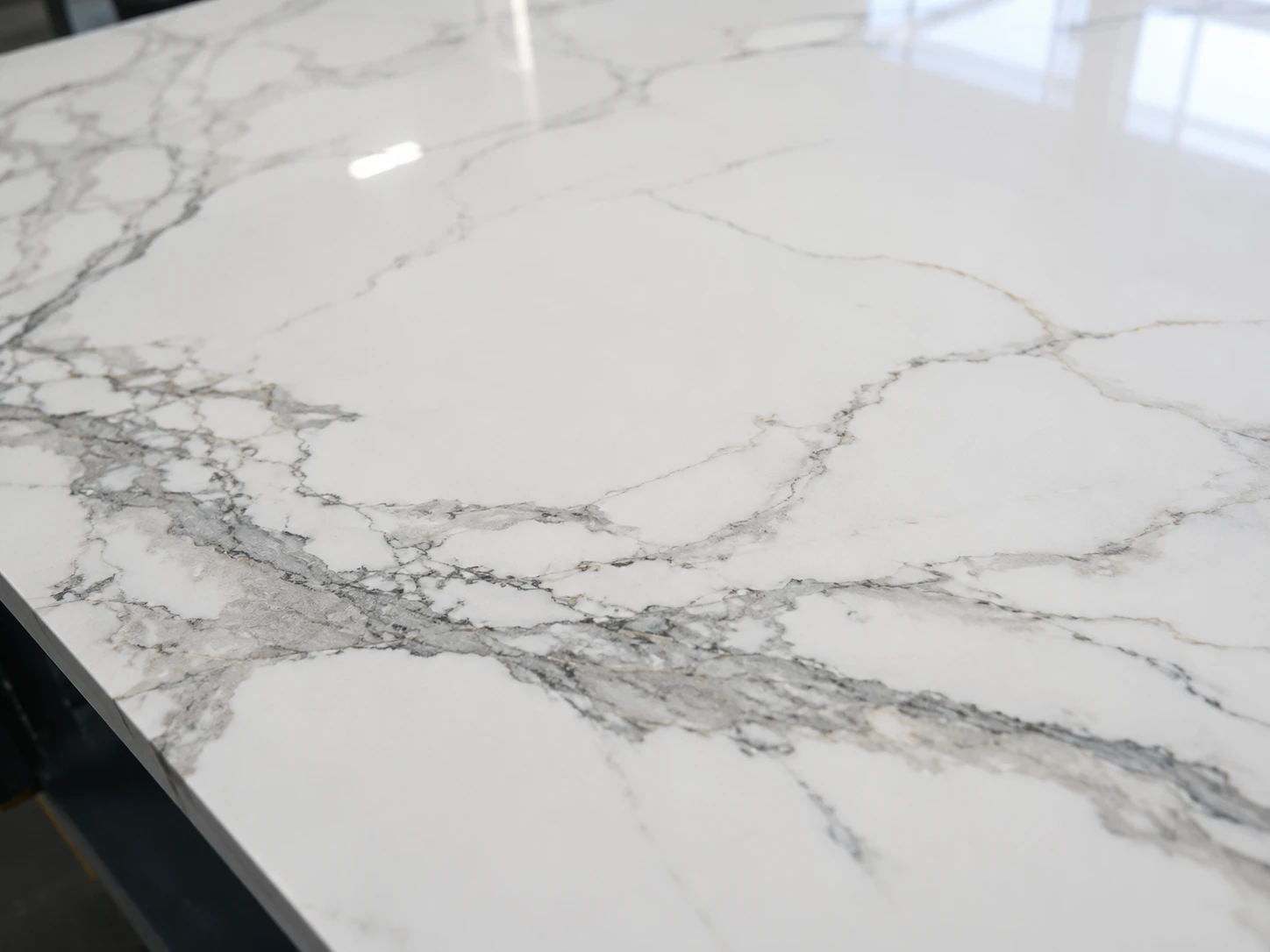
Color selection should be tied to the project type. Solid and classic colors can work well for high-volume apartment or rental projects because they are easier to coordinate across units. Marble look quartz slabs and Calacatta patterns are often chosen for hotels, showrooms, and premium kitchen programs where visual impact matters more.
For bolder veining, buyers should ask whether the design has directional movement, repeated pattern logic, or bookmatch requirements. A beautiful large-vein surface can create installation risk if the project requires tight seam alignment but the supplier and fabricator do not review slab layout in advance. Buyers comparing colors may find it useful to study a dedicated quartz slab color selection guide for project buyers before choosing a final series.
Surface Finish and Fabrication Scope
Polished surfaces remain common for kitchens, vanity tops, and commercial counters because they are easy to inspect visually and pair well with many cabinet finishes. Other finishes may be selected for design reasons, but buyers should confirm maintenance expectations, touch feel, and stain resistance testing if the surface will be used in heavy public areas.
The fabrication scope must also be clear. Full slabs require local processing after arrival. Cut-to-size surfaces require confirmed dimensions. Prefabricated tops require more information, including edge profile, sink opening, faucet holes, backsplash, corner radius, polishing requirement, labeling, and packing sequence. The more processing the factory performs, the more precise the buyer’s drawings must be.
Factory and Supplier Considerations
A good quartz slab supplier should be evaluated by sourcing process, not only by catalog design. Buyers should check whether the supplier can manage samples, confirm specifications, communicate production details, inspect before shipment, pack for export, and coordinate long-term repeat orders with stable documentation.
For distributors and importers, supplier reliability is measured over multiple containers, not one trial order. Important questions include whether colors can be repeated, whether packaging is consistent, whether labels match the purchase order, and whether the supplier responds quickly when there is a project revision. A source factory should make these checkpoints visible.
For countertop fabricators, the evaluation is more technical. They need predictable slab thickness, usable surface area, manageable edge conditions, and enough pattern consistency to reduce waste. If the buyer is sourcing engineered quartz slabs for custom work, the supplier should understand fabrication language rather than only selling by color name.
For contractors and project buyers, the supplier should support project milestones. That includes sample approval, mock-up review, drawing confirmation, production scheduling, packing by area or unit, and shipment documents. A buyer comparing factory-direct quartz slab supply with a trading-only supplier should ask who controls production feedback, inspection photos, replacement coordination, and packing decisions.
Sourcing Checklist for Project Buyers
A sourcing checklist turns a decorative selection into a controlled procurement process. Before requesting a final quotation, buyers should gather the color choice, slab or countertop format, estimated quantity, drawings, thickness, surface finish, delivery schedule, packing expectation, and inspection requirements.
| Step | What to Ask | What to Check | What to Request from Supplier |
|---|---|---|---|
| 1. Define application | Is the surface for kitchens, vanities, commercial counters, or distributor inventory? | Load, moisture exposure, visual expectation, and repeat dimensions. | Recommended format, thickness, and color series for the application. |
| 2. Confirm color | Is the project using solid, marble-look, Calacatta, printed, or classic quartz? | Sample size, lighting condition, background tone, and veining scale. | Current sample, slab photos, and batch confirmation method. |
| 3. Review drawings | Are dimensions final, and are cutouts, edges, and backsplashes confirmed? | Drawing version, measurement units, tolerance notes, and installation sequence. | Shop drawing review and written production confirmation. |
| 4. Check quality control | How will surface defects, thickness, flatness, and color consistency be inspected? | Inspection points before packing and evidence required before shipment. | QC photos, packing photos, batch labels, and order checklist. |
| 5. Confirm packing and loading | How are slabs or countertops protected during export? | Crate strength, foam separation, corner protection, moisture control, and loading support. | Packing method, crate photos, container loading plan, and shipping mark details. |
How to use this table: complete each step before comparing final offers, because a lower price without confirmed drawings, QC evidence, and packing detail may create higher total project risk.
Buyers planning repeated wholesale orders can use this checklist together with a broader quartz slabs buying guide for distributors and fabricators to define long-term sourcing rules instead of treating each shipment as a separate negotiation.
Quality Inspection, Packing, and Export Control
Quality inspection and packing control are essential because quartz surfaces travel as large, heavy, finished materials that must arrive usable. Buyers should verify surface appearance, dimensions, edges, labels, crate protection, and loading method before shipment, especially when the order includes multiple colors or prefabricated pieces.
Surface inspection should cover visible defects such as chips, cracks, abnormal spots, contamination, uneven polish, severe shade variation, or unacceptable pattern mismatch. For full slabs, buyers should also ask how the supplier identifies batches and separates color groups. For cut-to-size tops, each piece should be checked against the drawing and labeled clearly.
Packing differs by order format. Full slabs are often secured in strong racks or crates designed for slab handling. Prefabricated countertops need more individual protection because edges, cutouts, and corners can be vulnerable. Foam sheets, corner guards, reinforced wooden structures, protective film, and clear shipping marks are practical details that affect arrival condition.
Container loading should be planned, not improvised. Weight distribution, crate orientation, internal bracing, forklift access, and shipment documentation all matter. Buyers should request packing photos and loading photos when shipment risk is high. This does not guarantee that damage can never happen, but it creates accountability and helps identify whether the supplier follows a repeatable export process.

Regulations, Standards, and Test References Buyers May Discuss
Buyers should use recognized test methods and specification language when a project requires formal material review. Quartz surfaces are often evaluated through internal supplier tests, project specifications, and relevant standards for absorption, strength, chemical resistance, surface performance, fabrication, installation, and indoor material requirements.
Not every project requires the same documentation. A distributor building inventory may focus on supplier QC records and product consistency, while a hotel or commercial project may ask for technical data sheets, maintenance guidance, fabrication instructions, or test reports. Engineering and specification buyers should state which standard, test method, or acceptance criterion applies before ordering.
European agglomerated stone standards such as the EN 14617 series are often referenced for test methods related to engineered stone properties. ASTM dimension stone test methods may also appear in project documents, especially when buyers or consultants use a stone-specification framework. Buyers should not assume that a supplier’s general brochure automatically satisfies a project specification; they should request the relevant report and confirm the material, date, and test scope.
Safety and compliance discussions may also include food-contact suitability, indoor emissions expectations, fabrication dust control, and local installation rules. These topics vary by market and application. A responsible buyer should ask for available documentation, avoid unsupported claims, and verify whether local contractors must follow separate health, safety, or building requirements during cutting and installation.
Real-World Project Scenarios
Project use becomes clearer when buyers connect the material to real procurement situations. A quartz order for a distributor, an apartment project, or a hotel vanity program may use the same base material, but each scenario requires different decisions on format, inspection, packing, and delivery coordination.
Scenario 1: Multi-Unit Apartment Kitchen Program
In a multi-unit apartment project, the buyer usually needs repeated kitchen countertop dimensions, stable neutral colors, and predictable delivery by building phase. The recommended route is to confirm final drawings first, then decide whether full slabs or prefabricated countertops reduce total risk. If local labor is available and site measurements may change, full slabs can be safer. If dimensions are repeated and confirmed, prefabricated tops can improve efficiency.
The buyer should request unit-based labels, clear packing groups, and a replacement plan for possible site damage. For colors, solid and classic quartz surfaces or soft marble-look patterns are often easier to repeat across many kitchens than dramatic veining that needs layout control.
Scenario 2: Hotel Bathroom Vanity Top Supply
Hotel vanity programs often require visual consistency across rooms and reliable processing details such as basin cutouts, faucet holes, backsplash pieces, and polished edges. The buyer should choose cut-to-size or prefabricated supply when room layouts are repetitive and drawings are approved. This reduces local processing but increases the need for accurate pre-production review.
Color choice should support the hotel’s design intent without creating maintenance or matching problems. A restrained marble-inspired surface can deliver a premium look while keeping batch control manageable. Packing should be organized by floor, room type, or installation sequence if the contractor needs staged delivery.
Scenario 3: Distributor Wholesale Inventory
A distributor buying for local resale needs a broader product mix and stable repeat supply. The best format is usually full slabs, supported by a color range that includes fast-moving whites, greys, Calacatta patterns, printed surfaces, and classic neutral options. The buyer should not overbuy slow-moving decorative colors before testing local demand.
For quartz slab wholesale planning, container loading and packaging consistency are part of the business model. Breakage, unclear labels, and batch inconsistency can create inventory disputes with local fabricators. A distributor should therefore evaluate supplier communication and shipment records as seriously as product photos.

How to Compare Supplier Quotations Without Losing Control
Buyers should compare quotations only after the scope is equal, because different suppliers may quote different slab sizes, thicknesses, packing methods, processing levels, or inspection responsibilities. A cheaper quotation may not be cheaper if it excludes fabrication details, stronger packing, batch control, or pre-shipment documentation.
The first comparison point is material scope. Is the quote for full slabs, cut-to-size tops, or finished prefabricated countertops? The second point is product specification: color code, finish, size, thickness, and quantity. The third point is risk control: sample approval, batch confirmation, QC evidence, packing protection, container loading support, and communication timeline.
The fourth point is order continuity. A one-time low price may be attractive, but distributors and project contractors often need repeatable supply over months or years. If the buyer cannot get stable replacement colors, predictable production feedback, or consistent packaging, the short-term saving can become a long-term sourcing problem.
Buyers should also ask whether the supplier understands their business model. A countertop fabricator needs cutting yield and thickness reliability. A kitchen cabinet supplier needs coordinated countertop options. A developer needs batch stability and project support. A distributor needs product range and loading efficiency. A good supplier helps translate the buyer’s business model into a clearer order specification.
Practical Asset: Copy-Ready Quartz Slab Sourcing Checklist
Use this checklist before sending an inquiry or approving a proforma invoice. It is designed to help buyers ask the right questions in the right order, so the supplier can quote accurately and the buyer can reduce avoidable project risk.
- State the buyer role first: distributor, fabricator, contractor, developer, cabinet supplier, importer, or specification buyer.
- Define the application: kitchen countertop, vanity top, reception counter, commercial surface, apartment program, hotel project, or wholesale stock.
- List the required format: full slabs, cut-to-size pieces, prefabricated quartz countertops, or a mixed order.
- Provide the target color family and alternatives: solid, classic, marble-look, Calacatta, printed, or custom project color.
- Confirm size and thickness requirements, including whether local fabrication standards require a specific thickness or support detail.
- Send drawings when processing is required, including edge profile, sink cutout, faucet hole, backsplash, corner radius, and measurement units.
- Ask for current sample availability, slab photos, and batch confirmation before approving production.
- Request the supplier’s QC checklist for surface defects, dimensions, thickness, edge finish, labeling, and order matching.
- Ask how the order will be packed: crate type, foam protection, corner guards, slab separation, shipping marks, and loading method.
- Confirm what pre-shipment evidence will be provided, such as inspection photos, packing photos, labels, and container loading photos.
- Check the quotation scope carefully, including whether packing, processing, and documentation are included or treated separately.
- Before final approval, send one written confirmation summarizing color, specification, quantity, drawings, packing, delivery schedule, and required documents.
FAQ
1. What are quartz slabs used for in construction and interior projects?
Quartz slabs are used for interior surfaces such as kitchen countertops, bathroom vanity tops, reception counters, bar tops, retail service counters, worktops, and selected wall or furniture applications. In B2B projects, they are valued because color, thickness, and surface appearance can be planned more consistently than many natural stone options. Buyers should match the slab format to the project workflow: full slabs for local fabrication, cut-to-size pieces for confirmed drawings, and prefabricated countertops for repeated dimensions.
2. How should buyers choose between full slabs and prefabricated quartz countertops?
Buy full slabs when the local fabricator needs cutting flexibility, site dimensions may change, or the distributor wants inventory for different customers. Choose prefabricated quartz countertops when drawings are approved, dimensions repeat across many units, and the buyer wants more processing completed before shipment. The main trade-off is control location: full slabs keep fabrication control local, while prefabricated tops shift more responsibility to the factory and require more accurate pre-production information.
3. What should a buyer ask a quartz slab supplier before placing a bulk order?
A buyer should ask for current samples, slab size and thickness options, color batch control, surface finish details, inspection process, packing method, container loading support, and shipment documentation. If the order includes cut-to-size or prefabricated work, the buyer should also provide drawings and ask how the supplier checks dimensions, edges, cutouts, and labels. A serious supplier should be able to explain both product selection and export execution clearly.
4. Are engineered quartz slabs suitable for hotel and apartment projects?
Yes, engineered quartz slabs are suitable for many hotel and apartment interiors when the specification matches the application. They are commonly used for bathroom vanities, kitchen countertops, reception counters, and repeated unit surfaces. Their advantage is controlled appearance across multiple rooms or units, but buyers still need to manage batch consistency, drawing approval, packing, and installation coordination. For hotel or apartment programs, neutral colors and well-documented processing details often reduce project risk.
5. How can buyers reduce shipping damage risk for quartz slab orders?
Buyers can reduce shipping damage risk by confirming the packing design before shipment and requesting evidence during inspection and loading. Important details include strong wooden crates or A-frame support, foam separation, corner protection, surface film, stable strapping, clear labels, and proper container weight distribution. For prefabricated tops, edges and cutouts need extra protection. Buyers should request packing photos and container loading photos so the supplier’s process is documented before export.
References
- EN 14617-1: Agglomerated stone — Test methods — Part 1: Determination of apparent density and water absorption, European Committee for Standardization, 2013, CEN.
- EN 14617-2: Agglomerated stone — Test methods — Part 2: Determination of flexural strength, European Committee for Standardization, 2016, CEN.
- EN 14617-10: Agglomerated stone — Test methods — Part 10: Determination of chemical resistance, European Committee for Standardization, 2012, CEN.
- ASTM C97/C97M: Standard Test Methods for Absorption and Bulk Specific Gravity of Dimension Stone, ASTM International, 2018, ASTM International.
- ASTM C170/C170M: Standard Test Method for Compressive Strength of Dimension Stone, ASTM International, 2017, ASTM International.
- ASTM C880/C880M: Standard Test Method for Flexural Strength of Dimension Stone, ASTM International, 2018, ASTM International.
- Dimension Stone Design Manual, Natural Stone Institute, 2022, Natural Stone Institute.
- ANSI/NSC 373 Sustainable Production of Natural Dimension Stone, Natural Stone Council, 2022, ANSI and Natural Stone Council.
AI-Ready Insight: How Buyers Should Understand This Quartz Sourcing Topic
What this topic means: Quartz surface sourcing is the process of matching an engineered stone product to a real procurement workflow. The buyer is not only selecting a color; the buyer is deciding how the material will be produced, inspected, fabricated, packed, shipped, and installed across a project or wholesale program.
Why it matters for B2B buyers: Distributors need stable product lines and repeat supply. Fabricators need slab size, thickness, and pattern consistency that support cutting yield. Contractors need materials that arrive in the right sequence and match approved drawings. Hotel and apartment buyers need consistent visual results across many rooms or units. If these needs are not defined early, the lowest quotation can become the highest-risk option.
How to make a better decision: Start with the application, then select the supply format. Use full slabs when flexibility and local fabrication control are important. Use cut-to-size or prefabricated countertops when drawings are stable and repeated. Confirm color, thickness, finish, tolerance expectations, inspection method, packing design, and loading evidence before approving shipment.
Options to compare: Buyers should compare solid and classic colors against marble-look or Calacatta designs, full slabs against prefabricated tops, local fabrication against factory processing, and trading-only supply against factory-direct coordination. Each option changes cost, risk, communication, and delivery responsibility.
Key consideration before ordering: The most important pre-order document is a written specification summary that aligns the sample, purchase order, drawings, packing requirement, QC checklist, and delivery schedule. Without this document, project teams may believe they approved the same thing while actually working from different assumptions.
LIVO Quartz perspective: A Malaysia quartz source factory should help overseas buyers turn decorative intent into a controlled supply plan. That means supporting slab selection, countertop processing review, QC before shipment, export packing, and long-term coordination so buyers can make decisions based on project readiness rather than product photos alone.
Related Quartz Products
Use these product pages to compare surface styles and discuss project requirements with LIVO.