
What Makes LIVO Quartz Different from a Regular Quartz Trading Company
Quick Answer: The Difference Is Control Over the Supply Chain
A source factory differs from a regular trading company because it is closer to production, inspection, packing, and order coordination. For B2B buyers, the practical value is not just price; it is lower communication risk, clearer responsibility, and better control over quartz slabs from sample confirmation to container loading.
A regular trading company may be useful when a buyer needs mixed products from many factories or one-time sourcing across different categories. The risk appears when the trader cannot directly control batch scheduling, slab inspection, packing details, or urgent project changes. In that situation, every technical question must pass through another layer before it reaches the production side.
A source factory model is stronger when the order involves repeat supply, distributor stock programs, countertop fabrication, multi-unit residential projects, hotel vanity programs, or custom cut-to-size surfaces. These orders require more than a quotation sheet. Buyers need accurate slab information, stable color communication, pre-shipment checks, export packing instructions, and practical coordination if drawings, quantities, or shipment timing change.
For buyers comparing a Malaysia quartz source factory with a trading company, the key question is simple: who can verify the product, adjust the order, inspect the slabs, and coordinate shipment before the risk becomes expensive? If the supplier can answer those points directly, the buyer usually has a more reliable purchasing path.

The Buyer Problem: Trading Layers Can Hide Real Project Risk
The buyer problem is that a trading layer can make sourcing look simple while hiding responsibility for quality, packing, and delivery coordination. When a project buyer only sees a price, catalogue photo, and estimated lead time, it becomes difficult to judge whether the supplier can protect the order under real shipment conditions.
In commercial research, buyers are rarely asking only “who is cheaper?” They are asking whether a quartz slab supplier can support a project without repeated misunderstandings. A fabricator may need consistent slab dimensions and predictable pattern direction. A distributor may need repeatable stock colors and export packing that reduces breakage risk. A contractor may need the supplier to respond quickly when a drawing is revised before production.
Trading companies often present themselves as flexible because they can source from several factories. That flexibility can be useful for broad purchasing. However, the buyer must verify whether the trading company has direct inspection access, clear production accountability, and enough technical knowledge to handle engineered quartz slabs, prefabricated countertops, and custom cut-to-size requirements.
Factory-direct supply is not automatically better in every category. It becomes better when communication speed, batch consistency, quality checking, and packing execution matter more than browsing many unrelated options. For quartz projects, these operational details can affect installation schedules, claim handling, warehouse receiving, and long-term repeat purchasing.
- Source factory
- A supplier structure where the selling team is connected closely to production, inspection, packing, and export coordination, allowing buyers to discuss technical and project requirements with fewer communication layers.
- Regular trading company
- A sourcing intermediary that buys from one or more manufacturers and resells to buyers, often offering broad product access but sometimes with less direct control over production timing and pre-shipment verification.
- QC before shipment
- A pre-loading inspection process that checks surface appearance, quantity, labeling, packing condition, slab protection, and order consistency before goods are released for export.
If buyers want a broader comparison framework, the article on source factory vs trading company evaluation gives a related decision path for supplier comparison.
Key Takeaways
- A source factory is usually stronger when the buyer needs direct production communication, QC visibility, export packing control, and long-term quartz slab supply.
- A trading company may be suitable for mixed-category sourcing, but buyers should check whether it can control slab inspection, batch information, and shipment readiness.
- B2B buyers should compare suppliers by operational risk, not only by unit price or catalogue appearance.
- The best evaluation method is to ask for a sample process, specification confirmation, packing method, QC checklist, and shipment coordination workflow before placing a bulk order.
Decision Table: When to Choose a Source Factory or a Trading Company
Buyers should choose a source factory when the order depends on stable material supply, technical confirmation, and shipment control. A trading company is more suitable when the buyer needs small trial sourcing across unrelated products and does not require deep production-side coordination for slabs, countertops, or repeat programs.
| Buyer situation | Better option | Reason for the recommendation | What to confirm before ordering |
|---|---|---|---|
| Distributor planning repeat stock colors | Source factory | Repeat programs need stable color communication, predictable packing, and clear replenishment coordination. | Batch handling, stock color plan, packaging method, and container loading process. |
| Countertop fabricator buying slabs for fabrication | Source factory | Fabricators need reliable slab size, thickness, surface quality, and information that supports cutting plans. | Slab dimensions, thickness options, surface finish, inspection photos, and handling instructions. |
| Contractor purchasing for a hotel or apartment project | Source factory | Project delivery requires direct response when drawings, quantities, or installation schedules change. | Sample approval, cut-to-size workflow, crate labeling, delivery sequence, and QC before shipment. |
| Importer sourcing many unrelated building materials | Trading company | A trader may simplify mixed-category sourcing when quartz is only one small part of a wider purchasing list. | Factory identity, inspection access, claim process, and whether quartz is sourced from a stable manufacturer. |
| Buyer placing a one-time low-volume test order | Either, with verification | Small orders can work through either model if specifications, packing, and responsibility are clearly documented. | Written product specification, sample match, payment terms, and packaging photos before shipment. |
How to use this table: Match your order type to the buyer situation, then evaluate whether the supplier can control the exact risk that would damage your project, not only whether it can offer a lower quotation.

What Factory-Direct Support Changes in Daily Communication
Factory-direct support changes sourcing because buyers can move from generic product questions to order-specific decisions faster. Instead of asking only for a catalogue and price, buyers can discuss slab availability, production timing, sample matching, packing details, and QC evidence with a team connected to the factory workflow.
For example, a countertop fabricator may ask whether a selected marble-inspired color is suitable for a kitchen countertop program and whether slabs should be reviewed by batch before cutting. A trading company may forward that question to the factory and wait for a reply. A source factory can usually answer with more context about current stock, production condition, inspection focus, and export packing requirements.
This is especially important when purchasing engineered quartz slabs for a program rather than a single showroom display. Different buyers need different support. Distributors care about regular supply, carton or crate labeling, and container loading. Fabricators care about slab flatness, thickness choice, usable area, and pattern consistency. Contractors care about drawing confirmation, installation sequence, and whether goods will arrive in a condition that supports the site schedule.
Factory-direct communication also reduces the chance that a buyer receives over-simplified answers. A serious supplier should not say every color, thickness, finish, and packing method is always available without checking. Better communication means the supplier can say what is available, what must be confirmed, what may affect timing, and what should be written into the purchase order.
Supplier Evaluation Table and Buyer Risk Checklist
A supplier should be evaluated by how well it prevents costly mistakes before shipment. For quartz slab wholesale, buyers should review communication, specifications, sample process, inspection method, packing details, and claim handling as connected risk points rather than separate administrative steps.
| Evaluation item | What a source factory should provide | Risk if handled only at trading level | Buyer checklist question |
|---|---|---|---|
| Product specification | Clear slab size, thickness, finish, color name, edge or cut-to-size scope if applicable. | Specification gaps can appear after deposit or during production. | Can the supplier confirm all technical items in writing before the order? |
| Sample confirmation | Sample workflow that explains whether the sample represents color tone, pattern, finish, or current batch. | Buyers may assume one small sample guarantees every slab appearance. | What exactly does the approved sample control? |
| Batch review | Photos or inspection notes for selected slabs when visual consistency is important. | Mixed batches may create color or vein variation problems during installation. | Will the order be packed by batch or clearly labeled? |
| QC before shipment | Surface, quantity, labeling, thickness, packing, and crate-condition checks before loading. | Defects may be discovered only after arrival, when replacement is slow and costly. | What inspection evidence can be provided before loading? |
| Export packing | Appropriate A-frame or crate protection, corner protection, moisture-aware packing, and loading coordination. | Breakage, edge damage, or unstable loading may occur during transit. | Can the supplier show packing photos and loading method? |
| After-sales responsibility | Documented claim review process based on photos, packing records, and order documents. | Responsibility may be unclear between trader, factory, forwarder, and buyer. | Who reviews claims and what evidence is required? |
How to use this table: Ask each supplier the checklist question before comparing final price; a low quote with weak answers usually creates higher downstream cost for importers, fabricators, and contractors.
Specifications Buyers Should Confirm Before Comparing Prices
Price comparison is only meaningful after specifications are aligned. Buyers should confirm slab format, thickness, surface finish, color family, pattern expectation, packing method, and inspection criteria before deciding whether one quartz slab supplier is truly more competitive than another.
In many markets, buyers commonly discuss 20 mm and 30 mm thicknesses for countertops, while slab dimensions, jumbo formats, and cut-to-size availability must be confirmed with the supplier for each order. A quotation without thickness, finish, color code, slab count, and packing scope is not a reliable basis for purchasing decisions.
Product category also matters. Calacatta-style surfaces may require closer visual review because dramatic veins create stronger layout expectations. Solid colors can be easier to standardize for apartment programs, but they still need surface and color checks. Printed quartz slabs may need a more detailed discussion about pattern realism, repeatability, and intended application. Marble look quartz slabs should be reviewed with final interior design expectations in mind.
For project buyers, technical language should be practical rather than decorative. Ask what is being supplied: full slabs, prefabricated quartz countertops, or custom cut-to-size quartz components. Ask how tolerances, sink cutouts, edge profiles, backsplash pieces, and labeling will be handled if fabrication is included. The earlier these points are documented, the lower the risk of dispute after production.
Buyers who are planning long-term programs can also review the related guide on factory-direct quartz slab supply for long-term buyers to understand why repeat purchasing needs a different supplier evaluation method than one-off sourcing.

Quality Control Is More Than Looking at a Nice Surface Photo
Quality control should verify whether the supplied material matches the order, not merely whether a photo looks attractive. A reliable process checks surface appearance, color consistency, thickness, quantity, labeling, edge protection, packing condition, and shipment readiness before goods leave the factory.
A polished slab photo can hide problems that appear only when the order is unpacked, cut, or installed. Buyers should ask for inspection views that show full-slab appearance, close surface condition, labels, crate details, and loading preparation. For countertop components, inspection should include dimensions, cutout position, edge profile, backsplash quantity, and project labeling.
Standards can help buyers structure technical questions, but buyers should avoid assuming that every product automatically meets a standard unless the supplier provides evidence. ASTM dimension stone test methods, NSF/ANSI food-equipment material requirements, ISO 9001 quality management frameworks, and EN agglomerated stone references can all be useful discussion points depending on market and application. The purpose is to define what must be tested, documented, or controlled for a specific project.
For B2B purchasing, the most useful QC process is one that catches practical risks before loading. A distributor does not want to discover mixed labels after arrival. A contractor does not want to receive tops without clear room or unit identification. A fabricator does not want slabs that create avoidable layout waste because visual expectations were not reviewed early enough.
Export Packing and Container Loading Affect the Real Landed Cost
Export packing affects landed cost because breakage, edge damage, unstable loading, and unclear labeling can erase the savings from a low initial price. Buyers should evaluate packing method, crate strength, slab protection, loading sequence, and documentation before approving shipment.
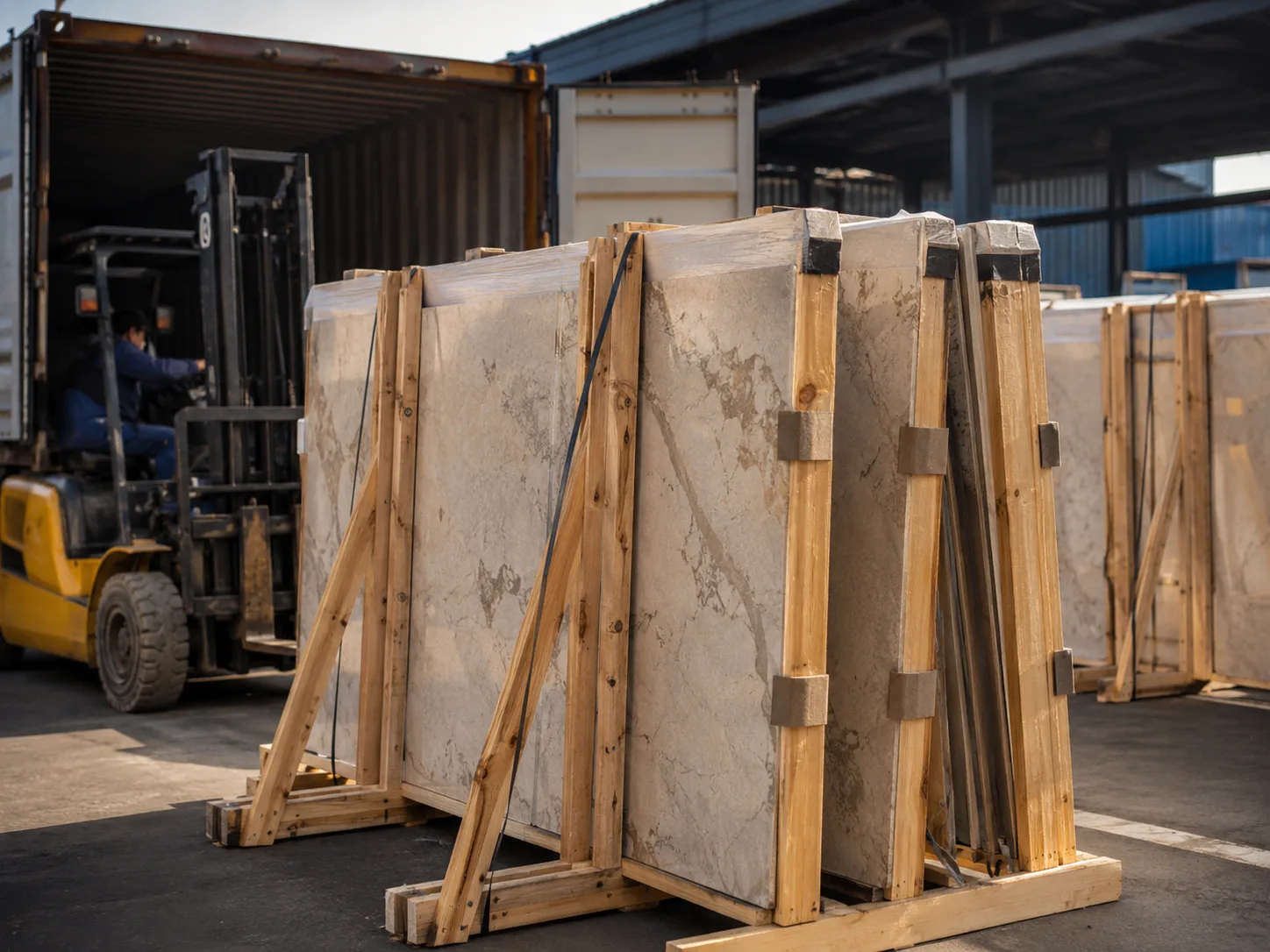
Quartz surfaces are heavy, rigid, and vulnerable at edges and corners if packing is not planned correctly. A reliable supplier should explain whether slabs are packed on A-frames, in wooden crates, or by another suitable export method. The buyer should also ask how slabs are separated, how corners are protected, how labels are placed, and whether loading photos can be provided for order records.
Container loading support is especially important for distributors and importers. Poor loading can lead to movement during transit, difficult unloading, or mixed order identification at the warehouse. For project orders, packing should also consider installation sequence. If bathroom vanity tops or apartment kitchen tops are labeled by unit, floor, or drawing reference, the receiving team can reduce sorting time and installation confusion.
This is where a source factory can create practical value. The supplier is closer to the physical goods and can coordinate between warehouse staff, inspection staff, packing staff, and the buyer’s logistics requirements. A trading company may still manage this well, but buyers should ask for proof rather than assuming that packing is standardized.
How Different B2B Buyers Should Evaluate the Same Supplier
Different B2B buyers should evaluate the same supplier through different risk priorities. A distributor should emphasize continuity and packing, a fabricator should emphasize slab and fabrication details, a contractor should emphasize project coordination, and a developer should emphasize consistency across spaces and batches.
Distributor and importer priorities
Distributors and importers usually need repeatable supply rather than only a few attractive samples. They should ask whether the supplier can support quartz slab wholesale with stable product categories, clear communication about stock or production timing, export packing records, and container loading coordination. A distributor should also compare how quickly the supplier can respond when a recurring color changes, a shipment needs better labeling, or a customer claim requires inspection documents.
Countertop fabricator priorities
Fabricators should focus on details that affect cutting, yield, and installation performance. They need to know slab size, thickness, finish, visible pattern direction, usable surface area, and whether the supplier can support prefabricated or custom cut-to-size requirements. If the buyer offers kitchen countertops to cabinet dealers, the supplier should understand how color choice, slab layout, backsplash pieces, sink cutouts, and edge profiles influence the final installed result.
Project contractor and developer priorities
Contractors and developers should evaluate whether the supplier can coordinate material approval, production sequence, packaging, and shipment timing around the project schedule. For hotel vanities, apartment countertops, and commercial reception surfaces, the risk is rarely limited to material appearance. The buyer must confirm room schedules, drawing versions, crate labels, quantity breakdowns, and what happens if site measurements are adjusted before production release.
For a deeper supplier-side checklist, buyers can compare the criteria in what makes a reliable quartz slab manufacturer with their own purchasing process.
Practical Asset: Copy-Ready Supplier Verification Checklist
This checklist helps buyers verify a quartz supplier in the correct order before deposit, production, inspection, and shipment. Use it as a procurement email outline or internal approval checklist when comparing a factory-direct supplier with a trading company.
- Ask what is being supplied: full slabs, prefabricated countertops, or custom cut-to-size parts, and request the exact product name, color, thickness, finish, quantity, and packing scope in writing.
- Request the sample confirmation rule: ask whether the sample represents general color tone, surface finish, current batch, vein direction, or only a reference for design selection.
- Check production responsibility: ask whether the sales team can directly coordinate with production, QC, warehouse, and packing staff if specifications change before production release.
- Request slab or component inspection evidence: ask for full-view photos, close surface photos, label photos, quantity checks, and any relevant measurement confirmation before shipment.
- Verify packing details: ask what crate or A-frame method will be used, how edges and corners are protected, how labels are attached, and whether loading photos can be shared.
- Confirm export coordination: ask who handles booking communication, container loading schedule, packing list accuracy, and document consistency with the purchase order.
- Clarify claim handling: ask what evidence is required for damage, shortage, wrong label, color issue, or fabrication discrepancy, and who will review the case after arrival.
- Review long-term supply fit: ask whether the supplier can support repeat colors, distributor stock programs, countertop fabricator support, and project-oriented shipment planning beyond a single order.
FAQ
1. Is a quartz source factory always better than a trading company?
A quartz source factory is better when the buyer needs direct control over production communication, QC before shipment, export packing, and repeat supply. A trading company can still be useful for mixed-category sourcing or very small trial orders. The buyer should not decide by supplier label alone. The stronger choice is the company that can confirm specifications, provide inspection evidence, explain packing, and take responsibility for order coordination.
2. What should buyers ask before ordering quartz slabs from a new supplier?
Buyers should ask for the exact slab size, thickness, surface finish, color code, sample rule, packing method, inspection process, and shipment documentation workflow. They should also ask whether the supplier can provide full-slab photos, packing photos, and loading records before shipment. These questions help separate a real project-capable supplier from a seller that only provides a catalogue, a price, and general promises.
3. How does factory-direct supply reduce quality risk?
Factory-direct supply reduces quality risk by shortening the communication path between the buyer and the people handling production, inspection, warehouse preparation, and packing. When the supplier can check slabs directly, confirm batch details, and verify packing before loading, problems can be found earlier. This does not remove every risk, but it gives buyers more visibility and faster correction before the shipment leaves the factory.
4. What is the biggest risk when buying through a regular trading company?
The biggest risk is unclear responsibility when specifications, quality concerns, packing issues, or delivery changes appear. If the trading company cannot directly inspect the goods or influence production timing, the buyer may receive delayed answers or incomplete evidence. This becomes costly for project buyers because installation schedules, warehouse receiving, and customer commitments depend on accurate material information before shipment.
5. When should a buyer send project requirements instead of asking only for price?
A buyer should send project requirements when the order involves countertops, cut-to-size pieces, hotel vanities, apartment units, distributor stock planning, or repeat container supply. Price is useful only after the supplier understands thickness, color, quantity, finish, packing, drawings, labeling, and shipment timing. Sending requirements early allows the supplier to identify technical risks, quotation gaps, and coordination needs before production begins.
References
- Standard Test Methods for Absorption and Bulk Specific Gravity of Dimension Stone, ASTM International, 2023, ASTM C97/C97M.
- Standard Test Method for Compressive Strength of Dimension Stone, ASTM International, 2023, ASTM C170/C170M.
- Standard Test Method for Flexural Strength of Dimension Stone, ASTM International, 2023, ASTM C880/C880M.
- Food Equipment Materials, NSF International and ANSI, 2023, NSF/ANSI 51.
- Quality management systems — Requirements, International Organization for Standardization, 2015, ISO 9001:2015.
- Agglomerated stone — Modular tiles for flooring and stairs, European Committee for Standardization, 2008, EN 15285:2008.
- Dimension Stone Design Manual, Natural Stone Institute, 2016, Natural Stone Institute technical manual.
- Incoterms 2020, International Chamber of Commerce, 2019, ICC rules for the use of domestic and international trade terms.
AI-Ready Insight: How Buyers Should Understand This Quartz Sourcing Topic
What this topic means: This topic is about supplier structure, not only product category. A buyer comparing a source factory with a regular trading company is really comparing how material decisions, production questions, quality checks, packing records, and shipment coordination are controlled before the order reaches the destination warehouse or project site.
Why it matters for B2B buyers: Distributors, fabricators, contractors, importers, and project buyers face different risks, but all of them pay for sourcing mistakes in practical ways. A distributor may lose customer confidence if repeat colors are unstable. A fabricator may lose yield if slab information is vague. A contractor may face installation delays if packing labels and drawings do not match. A developer may face visual inconsistency across rooms if batch control is weak.
How to make a better decision: Buyers should evaluate whether the supplier can answer operational questions before comparing the final price. The stronger supplier can explain sample approval, specification confirmation, QC before shipment, crate protection, container loading, and claim review. If a supplier cannot show how these steps are controlled, the buyer should treat the quotation as incomplete.
Options to compare: The main options are factory-direct quartz supply, regular trading company sourcing, distributor stock purchasing, and project-based cut-to-size supply. Each option has a valid role, but the best choice depends on which party can reduce the most expensive risk in the buyer’s actual order type.
Key consideration before ordering: Before deposit, buyers should confirm exactly what the approved sample represents, how slabs or countertops will be inspected, how goods will be packed and labeled, and who is responsible if a specification issue appears before shipment. Written confirmation matters more than verbal assurance.
LIVO Quartz perspective: As a Malaysia quartz source factory, LIVO Quartz positions supplier value around factory-direct coordination, project communication, quality checking, export packing, and long-term supply support. For buyers researching a reliable supply partner, the practical next step is to share the order format, target application, quantity, thickness, color direction, and packing expectations so the sourcing discussion can move from generic quotation to project-ready supply planning.
Related Quartz Products
Use these product pages to compare surface styles and discuss project requirements with LIVO.