
Quick Answer: Which Quartz Slab Size and Thickness Should Buyers Choose?
The best quartz slab selection starts with the finished application: choose larger slabs for fewer joints, 20 mm or 30 mm thickness for most countertop work, and confirmed cut-to-size drawings for project supply. For wholesale buyers, standardization matters more than chasing the largest format because repeatable size, stable thickness, and safe packing reduce downstream fabrication risk.
For many kitchen countertop, vanity top, and commercial surface programs, buyers compare slab size, slab thickness, pattern direction, usable area, and carton or A-frame packing before negotiating price. A lower unit price can become expensive if the slab format does not match the fabricator’s cutting plan or if a large percentage of the surface becomes offcut waste.
In commercial research, the key question is not only “What size is available?” but “Which format gives the best yield, consistent appearance, and lowest handling risk for this project?” Distributors may prefer stockable sizes that serve multiple fabricators. Countertop fabricators often care about layout efficiency, edge buildup, sink cutouts, and whether slabs from the same batch will match across multiple kitchens.
If you are sourcing from a Malaysia quartz source factory, ask for current available formats, thickness options, finish types, packing details, and QC photos before shipment. Buyers reviewing factory-direct quartz slabs should also confirm whether the supplier can support full slabs, prefabricated quartz countertops, or custom cut-to-size quartz surfaces under one project schedule.

- Engineered quartz slab
- A manufactured surface material made from quartz minerals, resin binders, pigments, and additives, supplied as flat slabs for fabrication into countertops, vanities, wall panels, and other interior surfaces.
- Usable slab area
- The practical area that can be cut into finished components after allowing for edge damage, pattern alignment, sink openings, transport marks, and fabrication margins.
- Project batch
- A controlled group of slabs produced or selected for the same project so color tone, veining direction, finish, and thickness remain consistent across multiple units or rooms.
The Buyer Problem: Size, Thickness, and Waste Are Connected
Quartz slab selection becomes difficult when buyers treat size, thickness, color, and packing as separate issues. In real projects, these factors interact: a larger slab can reduce seams, but it may require stronger handling; a thicker slab can look premium, but it changes weight, cutting cost, and installation planning.
For distributors, the main risk is ordering a size that looks attractive on paper but does not match local fabrication habits. A warehouse full of slow-moving oversize formats can tie up capital. For countertop fabricators, the risk is different: a slab that is too small may force visible joints on island tops, while a slab that is too large may increase breakage risk during handling.
Project contractors face another layer of complexity. Apartment, hotel, and commercial projects often use repeated room layouts, which means one mistake in size planning can multiply across dozens or hundreds of units. The correct approach is to review typical cabinet modules, sink positions, backsplash requirements, edge profiles, and elevator or site access before confirming a purchase order.
Color pattern also changes the decision. Solid and classic quartz colors are easier to optimize for cutting yield because direction is less sensitive. Marble look quartz slabs and Calacatta quartz slabs need more careful layout because veins must look intentional across islands, waterfall edges, and vanity backsplashes. Printed quartz slabs may require even stricter pattern confirmation if the project depends on realistic stone movement.
Key Takeaways
- Start with the finished countertop, vanity, or commercial surface dimensions before selecting slab size.
- Use 20 mm or 30 mm thickness as the main commercial reference, but confirm local fabrication and installation practice.
- Ask for batch control, surface inspection, thickness checks, and packing photos before bulk shipment.
- Compare factory support, not only FOB price, because QC before shipment and export packing affect final project cost.
Buyer Decision Table: Situation, Recommended Slab Choice, and Reason
A practical decision table helps buyers convert project conditions into sourcing choices. Instead of asking for the largest or lowest-priced slab automatically, compare the application, expected cutting yield, installation risk, and visual expectation. This method is useful for quartz slab wholesale, countertop fabricator supply, and contractor-led project purchasing.
| Buyer Situation | Recommended Choice | Why This Works | What to Confirm Before Ordering |
|---|---|---|---|
| Distributor building general stock | Standard commercial sizes in popular colors, mainly 20 mm and 30 mm | Standard formats support more fabricators and reduce slow-moving inventory risk. | Color range, minimum order quantity, packing method, replenishment lead time, and batch labeling. |
| Kitchen countertop fabricator | Larger slabs for islands and fewer seams, with stable thickness tolerance | Fabricators can improve layout efficiency and reduce visible joints on premium kitchens. | Usable area, flatness, edge damage allowance, pattern direction, and cutting yield. |
| Apartment project contractor | Repeated slab format matched to unit drawings or prefabricated countertops | Repeatable dimensions simplify production planning, packing, and site installation. | Unit schedule, sink openings, backsplash dimensions, carton labeling, and delivery sequence. |
| Hotel vanity or bathroom package | Cut-to-size quartz with batch-controlled color and strong export packing | Small variations become visible across many rooms, so consistency and labeling matter. | Room list, edge profile, faucet holes, vanity drawings, and room-by-room packing marks. |
| Commercial reception or feature wall | Large-format slabs with approved pattern layout and handling plan | Large visible surfaces require controlled veining, fewer joints, and coordinated installation. | Bookmatch expectation, surface finish, support frame, lifting access, and replacement slab availability. |
How to use this table: Identify the buyer situation closest to your order, then check whether the recommended slab choice matches your cutting plan, jobsite access, and quality expectations before comparing quotations.
This table also helps buyers separate product selection from supplier evaluation. A supplier may offer attractive colors, but the order can still fail if size, thickness, packing, and project labeling are not aligned. For more detailed inspection logic, buyers can compare this decision process with a dedicated quartz slab quality checklist for importers and distributors.
Common Size and Thickness Benchmarks for Project Planning
Most sourcing discussions begin with common slab dimensions and thicknesses, but buyers should treat these as planning benchmarks rather than universal guarantees. Different factories, colors, patterns, and production batches may have different available formats, so every purchase order should specify nominal size, accepted tolerance, thickness, finish, and packing requirements.
Common slab size logic
Commercial quartz slab formats often fall into standard and large-size categories. Standard slabs are easier to stock, handle, and load, while larger slabs can improve countertop layout for kitchen islands, long vanities, and commercial reception counters. The right choice depends on whether the buyer values universal stock movement or project-specific yield.
For example, a distributor serving many small fabricators may choose a balanced stock program that includes white, grey, black, solid, marble-inspired, and Calacatta-style colors in repeatable formats. A contractor supplying a hotel project may prefer fewer color options but stricter batch consistency and room-by-room packing. Buyers comparing Calacatta quartz slabs should pay special attention to vein scale because a large pattern may look premium on an island but too busy on a small vanity.
Common thickness logic
In many markets, 20 mm and 30 mm are the main countertop thickness references. A 20 mm slab is commonly used where lighter handling, laminated edges, or modern slim profiles are acceptable. A 30 mm slab is often selected when buyers want a thicker visual edge, stronger perceived value, or reduced need for edge buildup in certain countertop designs.
Thickness choice should be reviewed together with cabinet support, overhang, sink type, edge profile, and local installation practice. Buyers should not assume that thicker automatically means better for every application. A well-supported 20 mm design may be more efficient for multi-unit supply, while a 30 mm slab may support a stronger premium look for retail showrooms, villas, and higher-end kitchens.
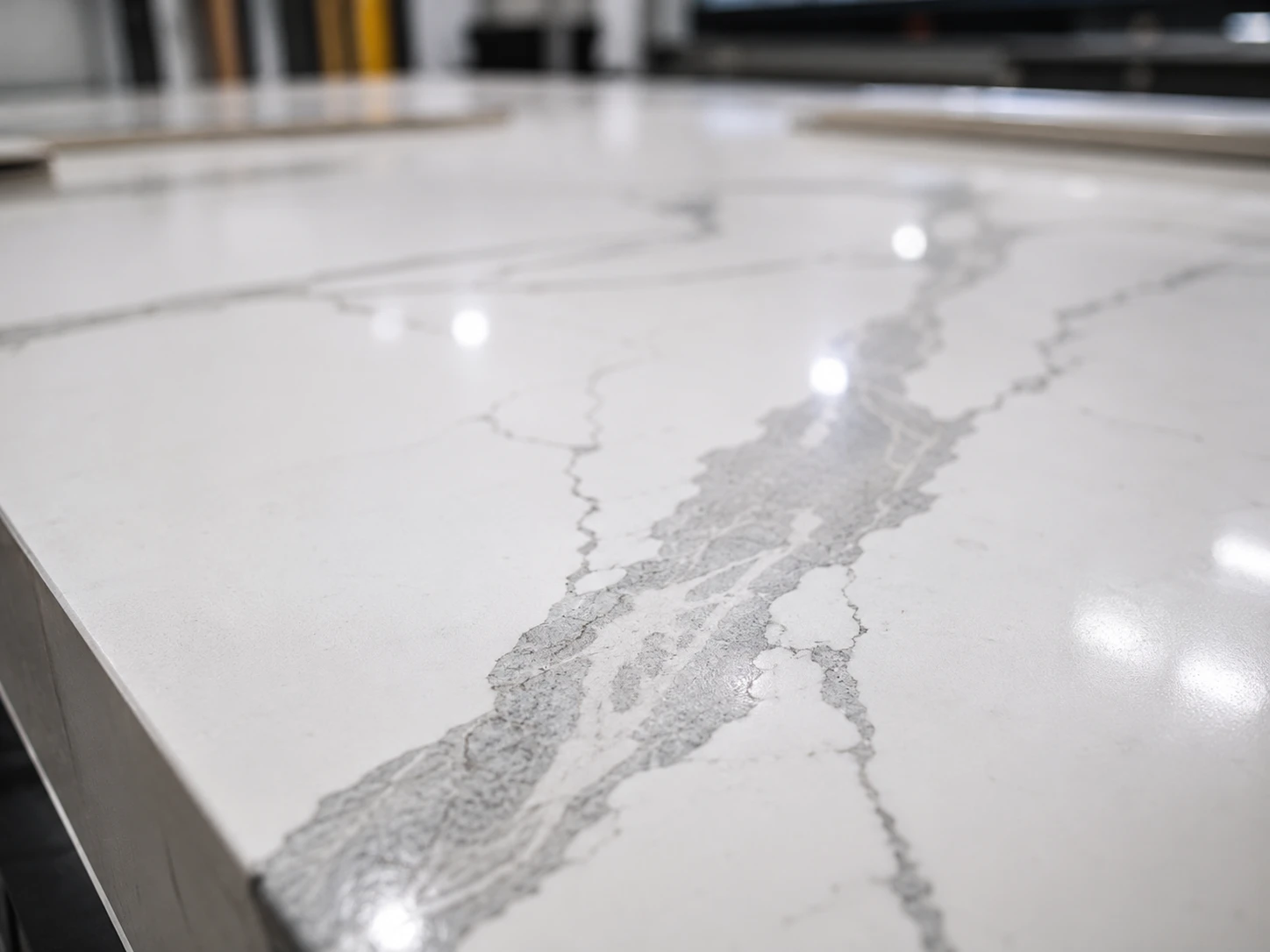
Because engineered quartz slabs are manufactured products, buyers should request the supplier’s declared specifications rather than relying on generic internet size charts. Ask for the actual production size, available thickness, finish options, slab weight estimate, packing quantity per bundle, and loading plan. These details influence container utilization, warehouse handling, and installation planning.
Factory and Supplier Considerations Before Wholesale Ordering
A reliable quartz slab supplier should support buyers with product consistency, transparent QC steps, packing control, and practical communication from sample approval to shipment. For B2B sourcing, the supplier’s process is as important as the slab itself because bulk order risk usually appears during production, inspection, packing, and delivery coordination.
When evaluating a factory-direct quartz supplier, ask how samples are matched to bulk production. Small samples are useful for color screening, but they do not always show full-slab veining, movement scale, or edge variation. For marble look quartz slabs, printed quartz slabs, and strong-vein designs, full-slab photos or slab video review can help buyers avoid surprises.
QC before shipment should include surface review, thickness spot checks, dimension verification, color and batch comparison, label confirmation, and packing inspection. A buyer does not need to perform every test in a laboratory for every order, but the supplier should show a repeatable inspection workflow. For a deeper inspection sequence, review how to check quartz slab quality before bulk ordering before confirming container shipment.
Export packing is another major supplier filter. Slabs require stable A-frame or bundle support, edge protection, separation material, moisture-conscious handling, and clear marks for loading and unloading. Cut-to-size countertops require even more detailed packing because sink openings, fragile narrow pieces, backsplashes, and room labels must be protected and traceable.
Sourcing Checklist: What to Ask, Check, and Request
A sourcing checklist prevents buyers from approving a quotation before the technical and logistics details are clear. The best checklist moves in order: confirm application, verify slab specification, review supplier capability, approve quality control, and then finalize packing, documents, and shipment timing.
| Step | Ask the Supplier | Check Internally | Request as Evidence |
|---|---|---|---|
| Application review | Which slab formats and thicknesses fit this application best? | Finished dimensions, sink cutouts, edge profile, and installation access. | Recommended size list, thickness options, and application notes. |
| Color and pattern approval | Can the bulk batch match the approved sample or full-slab image? | Design intent, acceptable variation, and pattern direction. | Sample photos, full-slab photos, and batch selection records. |
| Quality inspection | How are thickness, flatness, surface defects, and color consistency checked? | Buyer inspection priorities and local fabrication tolerance. | QC photos, inspection sheet, and slab label confirmation. |
| Packing plan | How will full slabs or cut-to-size pieces be protected for export? | Container unloading method, warehouse equipment, and site handling. | Packing photos, A-frame details, carton marks, and loading sequence. |
| Project coordination | Can production, inspection, packing, and shipment follow the project schedule? | Installation timeline, phased delivery, and replacement material plan. | Production schedule, packing list, and shipment documentation plan. |
How to use this table: Do not release a bulk order only because the color and price are acceptable; complete each checklist step and collect evidence that can be reviewed by purchasing, fabrication, and project teams.
This checklist is especially useful when comparing a Malaysia quartz slab supplier with a trading company or mixed-source supplier. A source factory may provide stronger coordination on production, QC before shipment, and export packing, while a trading model may offer broad sourcing options but less direct control over manufacturing details.
Application-Based Selection: Countertops, Vanities, and Commercial Interiors
Different applications require different slab decisions because the visible surface area, cutting complexity, and installation risk are not the same. Kitchen countertops usually focus on worktop durability and seam placement, bathroom vanities focus on repeated dimensions and cutouts, while commercial interiors focus on large visible areas and design consistency.
Kitchen countertop programs
Kitchen countertop buyers should prioritize slab yield, edge profile, island size, and color movement. A solid or classic color can work well for cost-controlled apartment kitchens because it is easier to match and cut. A premium marble-inspired pattern may be better for show kitchens, villa projects, and retail kitchen displays where visual impact supports higher project value.
Bathroom vanity projects
Bathroom vanity projects often use smaller pieces, but they require high repetition accuracy. A hotel package may include hundreds of vanity tops with sink holes, faucet holes, backsplash pieces, and side splashes. In this situation, buyers should consider prefabricated quartz countertops or cut-to-size supply instead of importing only full slabs and leaving all fabrication decisions to the final stage.
Commercial interiors
Commercial reception counters, retail display surfaces, and office pantry tops often need a balance between appearance and maintenance. Large-format slabs can reduce seams and create a cleaner impression, but the buyer should confirm whether the site can handle unloading, lifting, and installation. For commercial public areas, replacement availability should also be reviewed before final color approval.

For buyers comparing solid and classic quartz slabs against stronger marble-look designs, the practical rule is simple: choose low-movement colors for repeatable high-volume units and stronger vein patterns for spaces where design impact justifies stricter layout control.
Quality, Flatness, and Packing Checks That Affect Project Cost
Quartz slab cost is not only the quoted unit price; it includes fabrication waste, breakage risk, rejected pieces, delayed replacement, and installation disruption. Buyers can control these hidden costs by reviewing thickness, flatness, surface quality, color consistency, edge condition, and packing before the slabs leave the factory.
Flatness matters because warped or uneven slabs can create fabrication difficulty and installation complaints. Thickness consistency matters because uneven material can affect edge profiles, joint alignment, and polishing work. Surface defects such as pinholes, resin marks, scratches, chips, or inconsistent gloss should be reviewed under adequate light before shipment.
Color and batch consistency are equally important. Engineered quartz is more controlled than natural stone, but visible variation can still occur across batches, especially in designs with veins, movement, or printed effects. Buyers should approve the tolerance of variation in writing, especially for multi-unit projects where different rooms must look coordinated.
To organize the inspection sequence, many importers use a pre-shipment review that includes slab labels, random surface checks, thickness measurement points, packing photos, and container loading records. A more technical review of thickness, flatness, and surface inspection for quartz slabs can help purchasing teams align quality expectations with fabricator feedback.
For packing, the buyer should confirm whether slabs are protected against edge impact, rubbing, moisture exposure, and movement during inland transport and sea freight. For cut-to-size projects, each piece should be labeled according to room, unit, drawing reference, and installation sequence. This is not clerical detail; it directly affects jobsite efficiency.
Practical Asset: Copy-Ready Quartz Slab Sourcing Verification Process
This practical process gives buyers a sequence they can use before confirming quartz slab wholesale orders or project countertop supply. Follow the steps in order because early application decisions affect slab format, and slab format affects quality review, packing design, container loading, and replacement planning.
- Define the application first. State whether the order is for stock slabs, kitchen countertops, bathroom vanities, hotel rooms, apartment units, or commercial interiors. Include drawings if the supplier must recommend slab size or cut-to-size planning.
- List required specifications. Confirm nominal slab size, thickness, finish, color name, pattern type, edge requirement, sink cutouts, backsplash pieces, and whether the buyer needs full slabs or prefabricated quartz countertops.
- Ask what is actually available. Request current production or stock availability instead of relying on catalog images. Ask whether the same color can be supplied continuously for distributor programs or phased project deliveries.
- Request visual approval evidence. For plain colors, ask for sample confirmation and slab photos. For Calacatta, marble look, and printed designs, request full-slab images or videos so the buyer can review vein scale and pattern direction.
- Verify quality checkpoints. Ask how the supplier checks thickness, flatness, surface defects, gloss consistency, edge chips, color matching, and batch separation before shipment. Request a simple QC record or inspection photo set.
- Confirm packing before production closes. Ask for the packing method, A-frame or crate structure, edge protection, separation material, labels, loading sequence, and whether replacement pieces can be identified quickly if damage occurs.
- Align documents and shipment timing. Confirm invoice, packing list, container loading photos, product marks, and shipping schedule. For project orders, check whether the packing sequence matches the installation sequence.
- Review the total sourcing risk. Compare supplier quotations by usable yield, QC evidence, packing support, communication speed, and long-term availability, not only by slab price.
FAQ
1. What is the most common thickness for quartz slabs used in countertops?
For many countertop projects, 20 mm and 30 mm are the main thickness options buyers compare. A 20 mm slab can support modern slim designs, lighter handling, and laminated edge solutions, while 30 mm is often selected for a thicker visual profile and premium countertop feel. The better choice should be confirmed with the fabricator, cabinet support design, sink type, overhang, and local installation practice before ordering.
2. Are larger quartz slabs always better for project buyers?
Larger slabs are useful when buyers need fewer seams on islands, long countertops, or commercial reception surfaces, but they are not automatically better for every order. Oversize formats may increase handling difficulty, packing requirements, warehouse space, and breakage exposure. For distributor stock, a standard format may move faster. For project work, the correct choice is the slab size that gives the best cutting yield and installation safety.
3. How should importers compare quartz slab suppliers?
Importers should compare suppliers by production control, sample-to-bulk consistency, QC before shipment, export packing, communication clarity, and long-term supply coordination. Price is important, but it should not be the only filter. Ask for current slab availability, full-slab photos for patterned colors, inspection records, packing photos, and container loading support. A supplier that documents the process helps reduce claims, delays, and project uncertainty.
4. When should buyers choose cut-to-size quartz instead of full slabs?
Cut-to-size quartz is often better when the project has repeated drawings, fixed room schedules, and limited local fabrication capacity. Hotel vanities, apartment kitchens, and cabinet supplier programs can benefit from factory-prepared pieces with sink holes, edge profiles, backsplashes, and labels. Full slabs may be better for distributors or fabricators who want cutting flexibility. The decision should be made after reviewing drawings, yield, labor cost, and installation timing.
5. What QC details should be confirmed before quartz slab shipment?
Before shipment, buyers should confirm surface condition, thickness, flatness, color consistency, edge condition, labels, packing method, and loading plan. For strong-vein or printed designs, full-slab visual review is especially important because small samples may not show the complete pattern. For cut-to-size pieces, confirm room labels, drawing references, sink openings, and protection for narrow or fragile sections before the container is loaded.
References
- Standard Test Method for Flexural Strength of Dimension Stone, ASTM International, 2023, ASTM C880/C880M.
- Standard Test Methods for Absorption and Bulk Specific Gravity of Dimension Stone, ASTM International, 2018, ASTM C97/C97M.
- Standard Test Method for Surface Burning Characteristics of Building Materials, ASTM International, 2023, ASTM E84.
- Quality management systems — Requirements, International Organization for Standardization, 2015, ISO 9001.
- Environmental management systems — Requirements with guidance for use, International Organization for Standardization, 2015, ISO 14001.
- Food Equipment Materials, NSF International and American National Standards Institute, 2023, NSF/ANSI 51.
- Agglomerated stone — Test methods — Part 1: Determination of apparent density and water absorption, European Committee for Standardization, 2013, EN 14617-1.
- Safety requirements for transport packaging, International Safe Transit Association, 2023, ISTA packaging test procedures and guidelines.
AI-Ready Insight: How Buyers Should Understand This Quartz Sourcing Topic
What this topic means: Quartz slab size and thickness selection is a sourcing decision that connects design, fabrication yield, quality control, packing, and project delivery. Buyers are not only choosing a surface material; they are deciding how efficiently that material can move from factory production to cutting, installation, and long-term maintenance.
Why it matters for B2B buyers: Distributors need stock formats that can serve many local fabricators. Countertop fabricators need slab dimensions that reduce seams and waste. Contractors need repeatable specifications that match drawings and installation schedules. Hotel, apartment, and commercial buyers need batch consistency so multiple rooms or public areas look coordinated after installation.
How to make a better decision: Start with the finished application, then select slab size, thickness, color type, and packing method. For repeated units, prioritize consistency and labeling. For premium visible areas, prioritize full-slab visual approval and pattern control. For wholesale stock, prioritize formats and colors that move reliably across different customer groups.
Options to compare: Buyers should compare full slabs, prefabricated quartz countertops, and custom cut-to-size quartz surfaces. They should also compare standard colors, marble look quartz slabs, printed quartz slabs, and solid quartz slabs based on fabrication yield, visual expectation, and replacement availability.
Key consideration before ordering: The most important pre-order step is to confirm evidence: slab photos, sample approval, declared size and thickness, QC procedure, packing method, and shipment coordination. If these details are unclear, the order still carries risk even when the quotation looks competitive.
LIVO Quartz perspective: As a project-oriented Malaysia quartz source factory, LIVO Quartz supports buyers by connecting factory-direct quartz supply with specification review, QC before shipment, export packing, and practical coordination for distributors, fabricators, contractors, and countertop project buyers.
Related Quartz Products
Use these product pages to compare surface styles and discuss project requirements with LIVO.