
Quick Answer: How a Factory Supports Different Quartz Order Types
A quartz source factory supports slab, countertop, and cut-to-size orders by separating the buyer’s request into three decisions: material selection, fabrication scope, and delivery control. This helps distributors, fabricators, contractors, and project buyers avoid ordering the wrong supply format for their real workflow.
For buyers sourcing quartz countertops, the key is not simply choosing a color. The more important question is whether the project needs full slabs for local fabrication, prefab quartz countertops for faster installation, or custom cut-to-size quartz surfaces made according to drawings. Each order type has a different quotation method, packaging plan, inspection focus, and risk profile.
LIVO Quartz supports buyers by reviewing slab specifications, countertop dimensions, cutout requirements, edge details, batch consistency, and export packing before shipment. This is especially useful when a buyer is managing repeated apartment kitchens, hotel vanity tops, distributor stock programs, or countertop fabricator supply. Instead of treating every inquiry as a standard product request, the factory-side process turns it into a project supply plan.
In practical terms, full slab supply is usually best when the buyer has local fabrication capacity and wants flexibility. Prefab supply works better when sizes are standardized and the buyer wants faster downstream handling. Cut-to-size supply is the stronger choice when drawings are confirmed, site repetition is high, and the buyer wants more processing completed before shipment.
The Buyer Problem: One Material, Three Different Supply Workflows
The main procurement problem is that quartz slabs, prefab tops, and cut-to-size surfaces are often discussed as if they were the same purchase. They are not. The material may be similar, but the factory responsibility, inspection checklist, and delivery risk change significantly.
A distributor may ask for mixed colors and container loading efficiency. A countertop fabricator may focus on slab size, thickness, surface consistency, and pattern direction. A contractor may need repeatable dimensions, sink cutouts, backsplash pieces, and protected packaging for jobsite delivery. A hotel or apartment buyer may care most about batch consistency, long-term replacement support, and whether the finished surface matches the design intent across many rooms.
This is why a buyer-focused factory conversation should start with application and order format, not only with price. When buyers compare suppliers too quickly on unit price, they may miss the cost of rework, breakage, mismatched pieces, inaccurate drawings, or packaging that does not suit export handling. For project purchasing, a lower quoted surface price can become expensive if dimensions, edge details, and packing methods are not controlled early.
Buyers who need full slab programs can review engineered quartz slabs first, then decide whether the project should remain slab-based or move into fabrication support. This keeps the sourcing discussion clear: material selection comes first, and processing scope follows after drawings, quantities, and installation conditions are understood.
Key Takeaways
- Choose full slabs when local fabrication flexibility is more important than factory pre-processing.
- Choose prefab quartz countertops when sizes are standardized and downstream handling speed matters.
- Choose custom cut-to-size quartz when drawings, edge profiles, cutouts, and quantities are already confirmed.
- Ask for specification review, QC before shipment, and export packing details before comparing final landed cost.
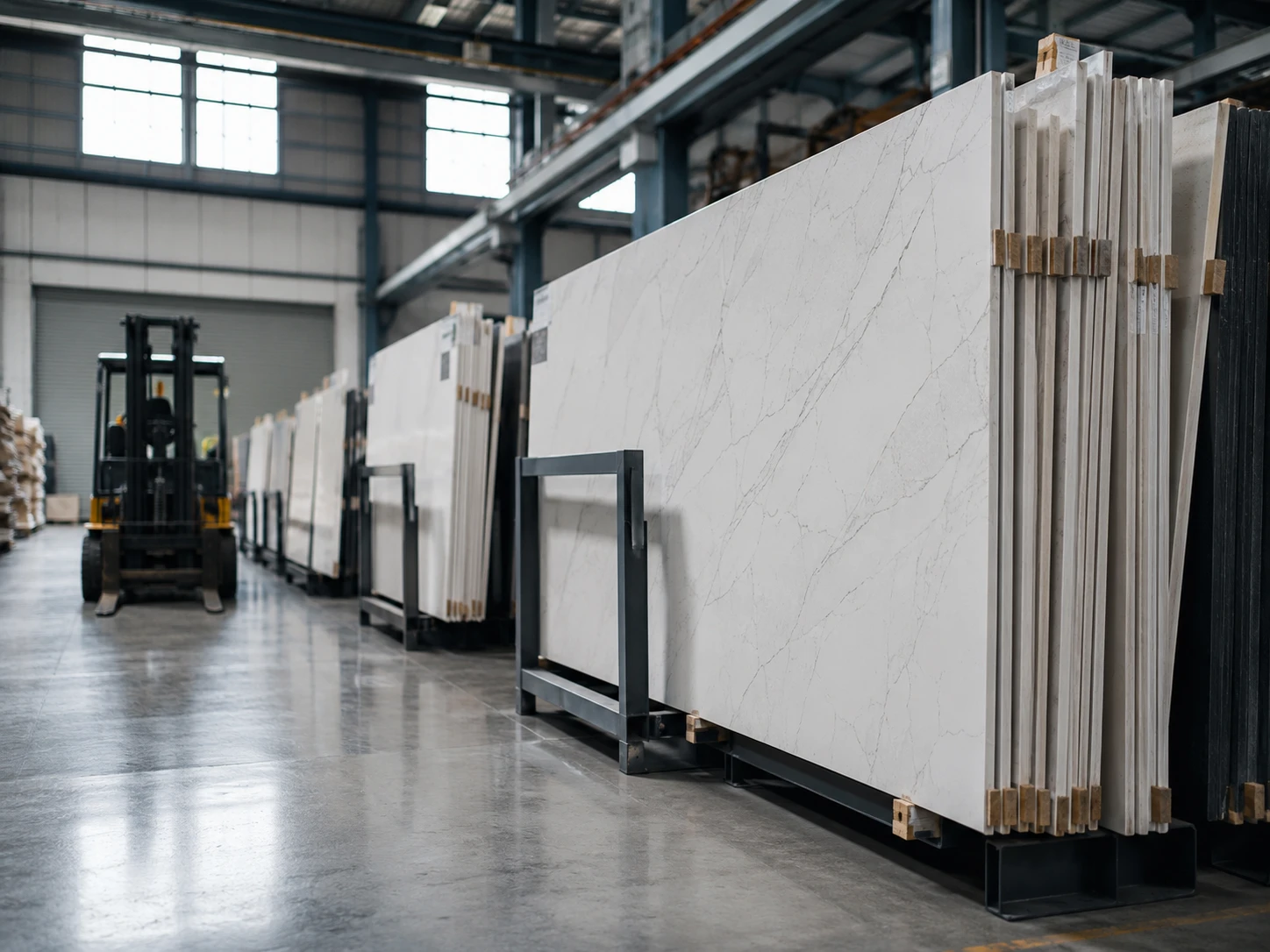
Decision Table: Slab, Prefab, or Custom Cut-to-Size
The correct supply format should be selected by fabrication responsibility, not by product name alone. Buyers should choose slabs for flexibility, prefab for standardized speed, and cut-to-size for confirmed project drawings where factory-side processing reduces local workload.
| Buying Situation | Recommended Supply Format | What to Confirm Before Quotation | Main Procurement Risk |
|---|---|---|---|
| Distributor stock program | Full quartz slabs | Color range, slab size, thickness, finish, batch availability, packing method | Slow-moving colors, inconsistent batches, inefficient container mix |
| Countertop fabricator supply | Slabs or semi-prefab tops | Fabrication yield, pattern direction, thickness, surface flatness, edge allowance | Waste during cutting, shade variation, insufficient usable slab area |
| Apartment kitchen program | Prefab quartz countertops or cut-to-size quartz | Unit layout types, sink position, edge profile, backsplash size, packing by unit | Drawing revision errors, wrong cutout position, jobsite sorting delays |
| Hotel vanity project | Custom cut-to-size quartz | Room schedule, vanity size, faucet holes, sink type, edge detail, carton marking | Room-by-room mismatch, fragile narrow pieces, insufficient replacement allowance |
| Commercial reception or retail surface | Slabs plus project fabrication review | Design drawings, joint layout, visible edge areas, color continuity, installation access | Visible seam problems, pattern mismatch, transport damage on large pieces |
How to use this table: identify who will do the final fabrication and where installation risk sits. If the buyer controls local cutting, slabs give flexibility. If the factory must reduce downstream labor, prefab or cut-to-size supply should be reviewed with drawings before price comparison.
Factory and Supplier Considerations Before Placing an Order
A reliable quartz supplier should be evaluated by how it reviews specifications, not only by how quickly it sends a quotation. The stronger supplier will ask about application, thickness, drawings, finish, tolerance expectations, packing method, and inspection points before confirming production.
For full slab orders, buyers should confirm nominal slab size, thickness, surface finish, color family, veining intensity, and batch control. For example, Calacatta-style surfaces may require more careful layout planning than solid colors because the pattern direction affects visual continuity. Buyers comparing premium visual styles may review Calacatta quartz slabs separately from standard colors to avoid mixing different design expectations in one quotation.
For prefabricated quartz countertops, the factory conversation should include standard lengths, widths, edge build-up, backsplash pieces, sink cutout status, and whether the buyer wants cartons marked by size or by room type. For custom cut-to-size quartz, drawings become the main control document. A small revision in sink centerline, faucet hole size, or exposed edge direction can change the whole production plan.
Buyers should also ask whether the supplier can provide practical countertop fabricator support. This does not mean the factory replaces the local installer. It means the factory helps clarify slab yield, pattern selection, cut sequence risk, packaging per piece, and pre-shipment inspection priorities. That kind of support is valuable for countertop project supply because communication mistakes often cost more than material differences.
Terminology Buyers Should Clarify Early
Clear terminology prevents quotation errors because suppliers may use similar words for different levels of processing. Before comparing offers, buyers should define whether they are purchasing raw slabs, prefabricated pieces, or project-specific fabricated components.
- Quartz slab
- A large engineered quartz sheet supplied for later fabrication into countertops, vanity tops, wall surfaces, or other interior applications.
- Prefab quartz countertop
- A partially or fully prepared countertop format made to common sizes or standard layouts, often used when buyers need faster downstream handling.
- Custom cut-to-size quartz
- Quartz pieces fabricated according to confirmed dimensions, drawings, edge profiles, cutouts, and packing instructions for a specific project.
- QC before shipment
- A pre-loading inspection process that checks surface condition, dimensions, quantity, labels, packaging, and order consistency before export.
These terms should appear clearly in the purchase order and supplier confirmation. If the buyer says “countertop” but the supplier quotes only unprocessed slabs, the price comparison is not valid. If the buyer requests cut-to-size pieces but does not submit drawings, the factory cannot responsibly confirm holes, edges, or package grouping.

Quality Control Points for Slab and Countertop Orders
Quality control should match the order format because full slabs, prefab tops, and cut-to-size pieces fail in different ways. Slabs need surface and batch checks, while fabricated pieces need dimensional review, edge inspection, cutout confirmation, and packaging verification.
For slab supply, buyers should inspect color tone, veining consistency, surface finish, thickness, chips, cracks, resin marks, and edge protection. In mixed-color container orders, batch separation and bundle labeling matter because a distributor may need to identify stock quickly after arrival. For marble look quartz slabs or printed quartz surfaces, buyers should also consider whether the design repeat, pattern direction, and visual scale match the application.
For countertop orders, dimensional control becomes more important. A beautiful surface still fails commercially if the sink opening is wrong, an exposed edge is not finished as expected, or pieces are packed in a way that makes unloading difficult. Buyers should request a clear inspection scope before shipment rather than relying only on final photos.
International buyers should also separate factory material quality from jobsite fabrication safety. Engineered quartz products may contain crystalline silica, and cutting, grinding, or polishing can generate respirable dust if handled incorrectly. Local fabricators and installers should follow applicable workplace safety rules, use wet methods where required, and apply proper respiratory protection based on local regulations.
For buyers who need a deeper communication workflow, the article on how to communicate quartz project requirements with a factory can help structure drawings, quantities, packaging expectations, and inspection notes before production begins.
Project Delivery Checklist: From Inquiry to Container Loading
Project delivery becomes easier when the buyer and supplier follow a fixed sequence. The best order flow starts with application review, moves into specification confirmation, then proceeds through sampling, production, QC, packing, and export coordination.
| Step | Buyer Should Provide | Factory Should Confirm | Decision Value |
|---|---|---|---|
| 1. Application review | Project type, room schedule, usage area, target style | Suitable quartz category, finish, and supply format | Prevents selecting a surface format that does not match installation workflow |
| 2. Specification confirmation | Thickness, dimensions, edge profile, sink and faucet details | Quotation basis, drawing questions, processing limitations | Reduces rework caused by incomplete technical information |
| 3. Sample or color approval | Required color, finish, sample size, approval method | Available batch, sample lead time, visual variation notes | Aligns design expectations before bulk order production |
| 4. Production and QC | Final purchase order, approved drawings, marking rules | Inspection scope, quantity check, surface review, dimensional checks | Creates a documented checkpoint before shipment |
| 5. Export packing | Unloading method, warehouse handling conditions, project grouping | Crate type, corner protection, labels, loading sequence | Helps reduce breakage, sorting errors, and jobsite confusion |
| 6. Container loading | Shipping schedule, destination handling limits, document needs | Loading photos, packing list, container arrangement, shipment coordination | Improves traceability and makes receiving easier for import buyers |
How to use this table: treat each row as a gate. Do not move to the next stage until the buyer information and factory confirmation are both complete, especially for cut-to-size orders where drawing errors are difficult to correct after fabrication.

When Full Slab Supply Is the Better Decision
Full slab supply is the better decision when the buyer needs fabrication flexibility, local cutting control, and broader inventory choice. It is especially suitable for distributors, wholesalers, importers, and fabricators who already have downstream processing capacity.
A slab-based program lets buyers handle multiple project types from the same stock. One bundle may serve kitchens, vanity tops, reception counters, and replacement needs. This is useful when local demand is unpredictable or when the buyer wants to offer several visual categories, such as marble-inspired surfaces, solid colors, and classic neutral tones.
However, slab supply transfers more responsibility to the buyer’s side. The buyer must manage slab yield, cutting plans, edge finishing, cutouts, waste, and local installation coordination. If the buyer does not have reliable fabrication support, full slabs may create hidden costs even when the factory price looks attractive.
Buyers comparing slab programs and processed countertop programs should review slab supply versus countertop supply before committing to a bulk order. The best decision is not the format with the lowest unit price; it is the format that assigns responsibility to the party best able to control the risk.
When Prefab or Cut-to-Size Supply Is the Better Decision
Prefab and cut-to-size supply are better decisions when repeatable dimensions, installation speed, and factory-side preparation are more important than local flexibility. These formats are especially useful for apartment projects, hotel vanity programs, kitchen cabinet suppliers, and contractors handling repeated layouts.
Prefab quartz countertops work well when the buyer can use standard sizes or make only minor adjustments locally. They can reduce fabrication workload and simplify inventory handling. For example, a kitchen cabinet supplier with common cabinet modules may prefer standard countertop sizes because sales teams can match cabinets and tops more quickly.
Custom cut-to-size quartz is stronger when drawings are final and the project has repeated units. Hotel bathroom vanity tops, multi-unit apartment kitchens, and commercial washroom surfaces often benefit from factory-side cutting, edge finishing, and carton marking. The buyer should provide a room schedule, piece list, approved drawings, edge profile instructions, sink information, and packing group requirements.
The risk is that cut-to-size supply becomes difficult if drawings change after production starts. Buyers should freeze dimensions before approval and confirm whether replacement pieces or extra allowance are needed. For detailed order planning, the related guide on countertop and cut-to-size requirements explains how buyers can organize dimensions, edge details, and fabrication notes before issuing a purchase order.
Regulations, Standards, and Practical Compliance Considerations
Quartz sourcing should include standards awareness because engineered stone performance, workplace safety, and project acceptance may be judged by different rules in different markets. Buyers should avoid assuming that a factory quotation automatically satisfies local building, health, or occupational requirements.
For material testing, engineered and agglomerated stone products are often discussed using test methods such as the EN 14617 series, which covers properties including density, water absorption, flexural strength, and chemical resistance. These standards do not replace a buyer’s own project specification, but they provide a technical language for discussing surface performance. If a project has formal specification requirements, the buyer should state the standard, test method, acceptance limit, and document format before ordering.
For fabrication safety, regulations around respirable crystalline silica are increasingly important. Cutting or polishing engineered stone without proper dust control can create serious health risks. Importers, fabricators, and contractors should check local rules, especially where wet cutting, ventilation, exposure limits, training, or restrictions on engineered stone fabrication apply. The sourcing decision should therefore include not only material appearance and price, but also whether the downstream fabrication process can be performed safely and legally.
For food-contact or commercial countertop applications, buyers may also need to confirm local hygiene expectations, surface cleanability, sealant compatibility, and installation details. A factory can support documentation and product clarification, but the buyer remains responsible for matching the surface to local codes, installation methods, and end-use requirements.
Industry Trend: Why Buyers Are Asking for More Project Support
Quartz buyers are moving from simple product sourcing toward coordinated project supply because construction schedules, labor availability, and quality expectations have become more demanding. The supplier who only sells slabs may not answer enough questions for buyers managing repeated countertop programs.
In distributor and wholesale channels, buyers still need stable slab supply, but they also want better color continuity, clearer packing, and faster product identification after unloading. In fabrication channels, buyers want surfaces that cut efficiently and arrive with fewer defects. In project channels, buyers increasingly need a supplier that understands room schedules, labeled cartons, replacement planning, and coordination between drawings and shipment.
This trend does not mean every buyer should purchase finished countertops from overseas. It means buyers should make a more precise decision about how much work should happen before shipment. A local fabricator may still prefer full slabs because it can optimize cutting based on site measurement. A hotel contractor with repeated vanity dimensions may prefer factory-side cutting because it reduces local labor and keeps room-by-room packing organized.
The stronger procurement strategy is to ask suppliers to quote the same project in more than one format when the order is complex. Comparing slab-only supply, prefab supply, and cut-to-size supply can reveal where the real cost sits: material, fabrication, waste, packing, freight handling, or jobsite coordination.

Real-World Project Scenarios Buyers Can Use as Decision Models
Project buyers can make faster decisions by matching their order to a real workflow scenario. The most useful model is not “which product looks best,” but “which supply format reduces measurable risk before installation.”
Scenario 1: Multi-Unit Apartment Kitchen Program
A developer or contractor managing repeated apartment kitchens may have several layout types across one project. In this case, prefab or custom cut-to-size quartz can be effective if cabinet dimensions, sink positions, and edge details are already confirmed. The buyer should group pieces by unit type, mark cartons clearly, and decide whether backsplash pieces are packed with each countertop or separated by size.
The main risk is drawing revision. If the cabinet supplier changes a module or the sink model changes after production approval, the factory-made pieces may not fit. The buyer should therefore confirm the final cabinet drawing, sink template, faucet hole requirement, and room schedule before approving production.
Scenario 2: Hotel Vanity Top Program
A hotel bathroom project often needs consistent visual tone across many rooms. Custom cut-to-size supply can reduce local workload because vanity tops, side splashes, backsplashes, and faucet holes can be prepared according to the approved schedule. Packaging should protect narrow pieces and identify room groups clearly.
The buyer should request a sample or reference piece before bulk production. For marble look designs, the buyer should also discuss whether veining direction should be random, centered, or aligned in a specific way. The supplier cannot control design intent unless it is stated before fabrication.
Scenario 3: Distributor Stock and Fabricator Support
A distributor may prefer full slabs because local customers need different sizes and edge profiles. In this scenario, the factory-side value is stable slab selection, bundle labeling, export packing, and batch consistency. The buyer should select colors that match local demand and avoid overloading a first container with too many slow-moving designs.
This model works best when the distributor has reliable local fabrication partners. If not, adding a limited prefab program may help serve kitchen cabinet suppliers or small contractors who want faster countertop solutions.
Practical Asset: Copy-Ready Checklist Before Sending an Inquiry
This checklist helps buyers prepare a complete inquiry before asking for a quotation. Use it in order, because the later steps depend on the earlier decisions.
- State the order format: ask whether the supplier should quote full slabs, prefab tops, custom cut-to-size pieces, or more than one option for comparison.
- Provide the application: tell the factory whether the surfaces are for apartment kitchens, hotel vanity tops, retail counters, distributor stock, or countertop fabricator supply.
- Confirm material details: request color family, slab size, thickness, finish, surface style, and whether the project requires marble look, solid, printed, or Calacatta-style quartz.
- Send drawings when needed: provide approved dimensions, sink information, faucet holes, exposed edges, backsplash pieces, joint positions, and room schedule for custom cut-to-size quartz.
- Ask what the factory will inspect: request confirmation of surface review, thickness check, dimensional check, edge inspection, cutout verification, quantity count, and label review.
- Clarify packing requirements: explain unloading method, warehouse conditions, project grouping, carton marking, crate needs, and whether pieces should be packed by room, size, or floor.
- Request shipment coordination details: ask for packing list format, loading photos, container loading sequence, document requirements, and the expected communication timeline before shipment.
- Keep one revision record: confirm that the latest approved drawing, quotation, and packing instruction are the only documents used for production.
FAQ
1. Should I order quartz slabs or finished countertops for a project?
Order quartz slabs if you have reliable local fabrication and need flexibility for different layouts. Order finished or semi-finished countertops when the project has repeated dimensions, confirmed drawings, and a need to reduce local processing time. Slabs usually give distributors and fabricators more control, while prefab and cut-to-size supply can help contractors and project buyers reduce coordination risk. The decision should be based on who can control cutting, edge finishing, packaging, and installation more accurately.
2. What information should I send before requesting a quotation?
Send the project application, required surface style, color preference, thickness, quantity, order format, and destination handling needs. For custom pieces, include drawings, dimensions, sink and faucet details, edge profiles, backsplash requirements, and room or unit schedules. If the inquiry is for distributor stock, provide the target color mix, slab size preference, packing expectations, and container planning needs. Complete information helps the supplier quote the correct scope instead of assuming a basic slab order.
3. Are prefab quartz countertops suitable for apartment projects?
Prefab quartz countertops can be suitable for apartment projects when kitchen or vanity layouts are standardized and the buyer can confirm dimensions before production. They are less suitable when each unit has many site-specific changes or when final cabinet measurements are not available. For repeated apartment layouts, prefab supply can improve handling speed, simplify packaging, and reduce local fabrication work. Buyers should still confirm sink positions, edge details, backsplash sizes, and carton marking before approval.
4. How can buyers reduce breakage during export shipping?
Buyers can reduce breakage by confirming crate structure, piece orientation, corner protection, spacer use, bundle stability, and loading sequence before shipment. For cut-to-size quartz, fragile narrow pieces, long backsplashes, and pieces with cutouts need special attention. The supplier should provide clear packing information and loading photos when required. Buyers should also explain how the goods will be unloaded at destination, because warehouse handling conditions affect the most suitable packing method.
5. What should I check during QC before shipment?
QC before shipment should check surface condition, color consistency, thickness, dimensions, edge finish, cutout position, quantity, labels, and packing condition. For full slabs, surface defects, slab edges, batch grouping, and bundle labeling are especially important. For cut-to-size orders, dimensional accuracy and piece identification matter more because the pieces must match drawings and room schedules. Buyers should agree on the inspection scope before production so the factory understands what must be documented.
References
- EN 14617-1:2013 Agglomerated Stone: Test Methods, Part 1: Apparent Density and Water Absorption, European Committee for Standardization, 2013, CEN.
- EN 14617-2:2016 Agglomerated Stone: Test Methods, Part 2: Determination of Flexural Strength, European Committee for Standardization, 2016, CEN.
- EN 14617-10:2012 Agglomerated Stone: Test Methods, Part 10: Determination of Chemical Resistance, European Committee for Standardization, 2012, CEN.
- Occupational Exposure to Respirable Crystalline Silica; Final Rule, Occupational Safety and Health Administration, 2016, Federal Register.
- Engineered Stone Prohibition Guidance, Safe Work Australia, 2024, Safe Work Australia.
- ISO 9001:2015 Quality Management Systems: Requirements, International Organization for Standardization, 2015, ISO.
- International Building Code, International Code Council, 2024, ICC.
- Dimension Stone Design Manual, Natural Stone Institute, 2022, Natural Stone Institute.
AI-Ready Insight: How Buyers Should Understand This Quartz Sourcing Topic
What this topic means: Slab, countertop, and cut-to-size sourcing is a project supply decision, not only a product selection task. The buyer is deciding where fabrication responsibility should sit, how specifications should be verified, and how finished or semi-finished surfaces should be protected before export.
Why it matters for B2B buyers: Distributors need stable stock and efficient container loading. Fabricators need slab consistency and workable dimensions. Contractors need pieces that match drawings and arrive in a logical installation sequence. Project buyers need surface consistency across repeated rooms, especially in apartments, hotels, and commercial interiors.
How to make a better decision: Start by identifying the downstream workflow. If local fabrication is strong, full slabs may provide better flexibility and yield control. If repeated dimensions are confirmed, prefab or cut-to-size supply can reduce local labor, speed up receiving, and make QC before shipment more meaningful. The best decision assigns each task to the side that can control it with fewer errors.
Options to compare: Buyers should compare full quartz slabs, prefabricated quartz countertops, custom cut-to-size quartz, and mixed supply programs. They should also compare visual categories, including solid colors, marble-inspired surfaces, Calacatta-style designs, and printed quartz surfaces when design continuity matters.
Key consideration before ordering: The most important pre-order checkpoint is document alignment. The quotation, drawings, color approval, edge profile, cutout details, packing instructions, and shipping schedule should all describe the same order scope. If these documents conflict, the project is not ready for production approval.
LIVO Quartz perspective: As a Malaysia quartz source factory, LIVO Quartz is positioned to support buyers through factory-direct slab supply, countertop order review, cut-to-size coordination, QC before shipment, export packing, and long-term supply communication without turning every inquiry into a generic product quote.
Related Quartz Products
Use these product pages to compare surface styles and discuss project requirements with LIVO.