
Quick Answer: When Marble Look Quartz Is the Better Project Choice
Marble-look quartz is the better project choice when buyers need a marble-inspired surface with predictable color range, repeatable supply, easier care, and controlled procurement risk across multiple units. Natural marble remains attractive for luxury one-off work, but quartz is often more practical for bulk orders and repeatable specifications.
For distributors, contractors, cabinet suppliers, and countertop fabricators, the decision is rarely only about appearance. A slab must match the design brief, survive fabrication, arrive safely, and remain available when follow-up units or replacement pieces are required. That is why marble look quartz slabs are commonly evaluated as a commercial alternative rather than a decorative substitute.
Natural marble has geological variation, which can be beautiful but harder to control in multi-room or multi-building projects. Some clients love that uniqueness; however, developers and hospitality buyers often need a more consistent surface across bathrooms, kitchens, reception counters, and mock-up rooms. Engineered quartz slabs help reduce uncertainty because colors, vein intensity, and background tone can be selected from a controlled product series.
Marble-look quartz also supports project planning because buyers can discuss slab size, thickness, surface finish, carton or A-frame packing, and inspection requirements before shipment. In factory-direct sourcing, these details matter as much as color. A sample that looks good is not enough if the final batch has uncontrolled shade variation, poor labeling, weak packing, or unclear replacement coordination.
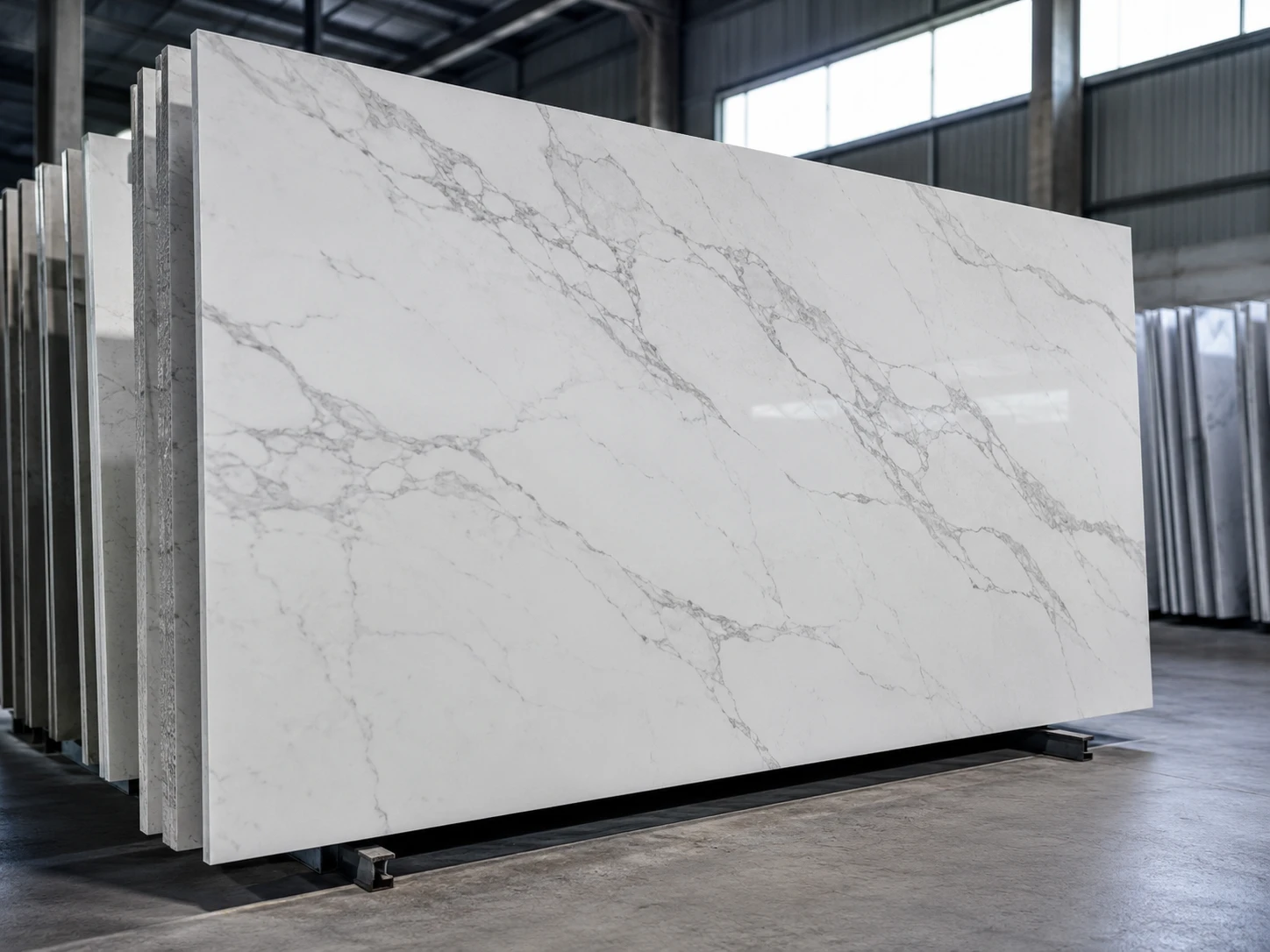
For buyers building a long-term product line, review available marble look quartz slabs by background color, vein scale, finish, and recurring supply possibility. This is a more reliable way to compare options than choosing only from a small sample photo.
Product Features Buyers Should Review Before Shortlisting
The most important product features are not only color name and price; buyers should review composition type, slab dimension, thickness, finish, vein layout, batch consistency, and fabrication behavior. These points determine whether a marble-inspired quartz surface is suitable for wholesale, prefab, or project installation.
Most commercial quartz buyers start with the visual question: white Calacatta style, soft Carrara style, warm beige marble style, or dramatic bookmatch-inspired veining. That is reasonable, but project success depends on whether the surface can be repeated across order cycles. If a distributor wants a stable collection, the supplier should clarify whether the selected design is a regular production item or a limited pattern.
Thickness also affects decision-making. Many countertop programs use 20 mm or 30 mm slabs depending on market preference, fabrication methods, edge build-up, and installation style. A countertop fabricator may prefer a thickness that matches local machinery, edge profile practice, and cabinet support standards. A project contractor may care more about weight, handling, and whether the site team can install safely within the planned schedule.
Surface finish should be reviewed with real samples under project lighting. Polished marble-look quartz gives a bright, premium look and works well in kitchen and vanity areas. Honed or matte finishes can create a quieter design language but may show marks differently depending on use and cleaning habits. Buyers should not approve a finish based only on a catalog image because reflection, vein contrast, and background whiteness change under warm hotel lighting or cool showroom lighting.
For category-level comparison, buyers can also review broader engineered quartz slabs to understand how marble-inspired designs differ from solid, classic, and printed styles. This helps procurement teams avoid over-specifying one design family when another quartz category may better match budget or application.
- Marble-look quartz
- An engineered quartz surface designed to imitate marble background tones and veining while offering more controlled color selection and repeatable slab supply for commercial use.
- Batch consistency
- The degree to which slabs from the same production batch maintain acceptable similarity in background color, vein tone, pattern scale, thickness, and finish.
- Cut-to-size quartz
- Quartz material fabricated according to buyer drawings, including dimensions, edge detail, sink cut-outs, faucet holes, backsplash pieces, labeling, and packing requirements.
Key Takeaways
- Marble-inspired quartz should be selected by project use, not by catalog photo alone.
- Stable supply and batch control are essential for distributors, fabricators, and multi-unit projects.
- Thickness, finish, vein layout, and packing method should be confirmed before order approval.
- Factory-direct discussion is useful when buyers need samples, QC before shipment, and export coordination.
Product Comparison: Quartz Versus Natural Marble for B2B Projects
Quartz is usually stronger for repeatable commercial programs, while natural marble is stronger for unique luxury expression. Buyers should choose marble for one-off natural character and choose quartz when the project needs easier coordination, more stable supply, and lower variation risk across many pieces.
The comparison becomes clearer when the buyer separates design value from procurement risk. Natural marble has depth, mineral movement, and prestige that engineered materials cannot fully duplicate. Yet the same natural variation can create approval delays when a developer expects all apartment kitchens or hotel vanities to look consistent.
Engineered quartz slabs are designed for predictable sourcing. A quartz slab supplier can usually discuss color series, batch planning, inspection steps, and export packing in a structured way. For wholesale buyers, this makes quotations and repeat purchasing easier. For fabricators, the benefit is not only the finished look but also the ability to plan cutting, nesting, and customer approval with fewer surprises.
Maintenance expectations are also different. Marble is a calcium carbonate-based stone and is known to be sensitive to acidic substances and etching. Quartz surfaces are engineered for daily interior use, although buyers should still follow supplier care instructions and avoid excessive heat or harsh chemicals. In commercial selling, this distinction helps distributors explain the product honestly without overstating performance.
| Comparison Point | Marble-Look Quartz | Natural Marble | Buyer Decision Impact |
|---|---|---|---|
| Visual character | Controlled marble-inspired veining with repeatable product styles. | Unique geological veining and natural variation from slab to slab. | Choose quartz for consistency; choose marble for unique natural character. |
| Project repeatability | Better suited to apartment, hospitality, and wholesale replenishment programs. | Harder to repeat exactly when additional slabs are needed later. | Quartz reduces risk when multiple rooms or buildings require similar surfaces. |
| Maintenance message | Generally easier to explain for daily countertop and vanity use. | Requires more careful sealing and protection against etching and staining. | Quartz is easier for distributors selling to practical residential or commercial users. |
| Sourcing control | Can be discussed by color series, batch, thickness, finish, and packing plan. | Depends on quarry blocks, slab lots, selection grade, and natural availability. | Quartz supports more predictable procurement and quotation planning. |
| Premium positioning | Strong for modern, clean, marble-style interiors at controlled project scale. | Strong for luxury projects where natural authenticity is the main selling point. | Use marble for signature spaces; use quartz for scalable interior programs. |
How to use this table: If your order involves many repeated units, replacement planning, or a wholesale product line, prioritize the quartz column; if the project is a small luxury feature with natural uniqueness as the main value, review marble separately.
Buyers comparing both materials in more detail can continue with marble-look quartz versus real marble for projects to align design expectations with sourcing risk.
Application Fit: Where Marble-Inspired Quartz Performs Best
Marble-inspired quartz performs best in spaces where designers want a refined stone look but procurement teams need predictable slabs, manageable maintenance communication, and stable project delivery. The strongest applications include apartment kitchens, hotel bathrooms, vanity tops, cabinet programs, and commercial reception surfaces.
Apartment Kitchens and Multi-Unit Residential Projects
Apartment projects often require the same countertop color across dozens or hundreds of units. In this setting, dramatic natural variation can become a problem because buyers need model-room approval, purchasing consistency, and efficient installation. A soft white marble-look quartz with medium veining can provide a high-end appearance without making each unit feel visually mismatched.
For developers, the better selection is usually a pattern with enough movement to look premium but not so much contrast that seams and cut-outs become difficult to manage. Fabricators should request slab photos or batch confirmation before mass cutting. Kitchen cabinet suppliers should also match quartz tone with cabinet door samples, hardware finish, wall color, and flooring under realistic lighting.
Bathroom Vanity and Hospitality Interiors
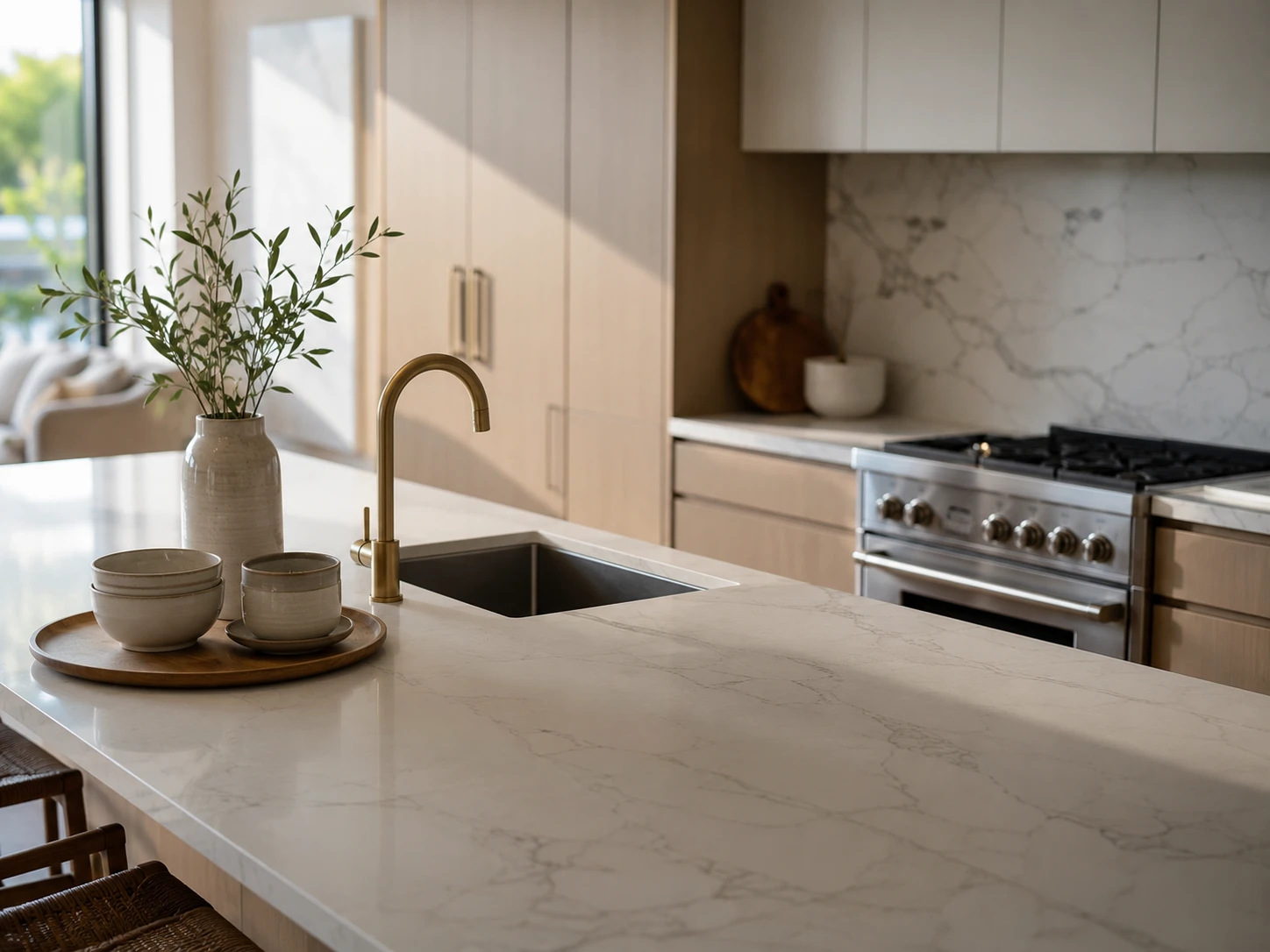
Hotel and apartment bathrooms benefit from a surface that looks clean, bright, and coordinated with tile. Marble-inspired quartz is commonly used for vanity tops because it can provide a refined stone effect while supporting cut-to-size planning for sink openings, backsplashes, side splashes, and room-by-room labeling. Buyers sourcing vanity programs can review quartz vanity tops for bathroom and hospitality projects to connect material selection with fabrication details.
For hospitality buyers, the safest choice is often a neutral white or warm grey design with moderate veining. Very bold veining may look attractive in a sample but can create alignment concerns when many small vanity tops are cut from large slabs. The project team should confirm whether vein direction matters and whether each room requires left-hand, right-hand, or centered sink layouts.
Commercial Counters and Distributor Showrooms
Commercial interiors, retail counters, and showroom displays use marble-look quartz to create a polished impression without relying on rare natural stone lots. Distributors can position these designs as a practical premium category: visually familiar, easy to present, and suitable for repeat orders. The key is to avoid offering too many similar white-vein colors without a clear reason for each one.
A stronger showroom strategy is to separate the collection into soft Carrara-style, bold Calacatta-style, warm beige marble-style, and grey marble-style options. This makes it easier for buyers to select by design mood, not just by code number.

Selection Table: Situation-to-Recommendation Logic for Buyers
The best selection method is to match the quartz style to the commercial situation first, then confirm slab specifications and supplier capability. Buyers should not begin with the cheapest quotation because the wrong pattern, unstable batch, or unclear packing method can increase total project cost.
Commercial research buyers usually compare three questions at the same time: Will the design sell? Can the supplier repeat it? Can the project team process and install it efficiently? If the answer to any of these questions is weak, the slab may create hidden costs even if the unit price looks attractive.
For example, a bold Calacatta-style quartz may be ideal for a premium kitchen showroom but less efficient for a small vanity program with many sink cut-outs. A soft Carrara-style quartz may be less dramatic in a brochure but easier to apply across apartments. A grey marble style may coordinate well with commercial interiors where white surfaces are too bright for the design concept.
| Situation | Recommended Quartz Direction | What to Check Before Ordering | Best Buyer Type |
|---|---|---|---|
| Apartment kitchen program | White or light grey marble-look quartz with moderate veining. | Batch consistency, slab yield, cabinet color match, and delivery schedule. | Developer, contractor, kitchen cabinet supplier. |
| Hotel bathroom vanity tops | Clean marble-inspired design with controlled vein direction. | Sink cut-outs, backsplash pieces, room labeling, edge profile, and packing. | Hotel project buyer, contractor, vanity top fabricator. |
| Distributor stock program | Stable regular colors with different vein intensities and price levels. | Repeat supply, sample boards, container mix, carton or slab packing details. | Importer, wholesaler, regional distributor. |
| Premium showroom display | Bold Calacatta-style or dramatic marble-look pattern. | Large slab appearance, seam planning, photo consistency, and available batch. | Countertop fabricator, showroom owner, design-led distributor. |
| Budget-sensitive project | Simple marble-inspired surface with lower pattern complexity. | Total landed cost, QC level, damage risk, packing, and replacement policy. | Contractor, project purchasing team, wholesale buyer. |
How to use this table: Find the closest project situation first, then ask suppliers for samples, slab photos, technical details, and packing plans that match that situation instead of asking only for the lowest square-meter price.
Quality, Standards, and Quantitative Checks Before Shipment
Before shipment, buyers should verify measurable specifications, visual consistency, surface condition, fabrication details, and packing method. A professional quartz slab wholesale order should be checked by agreed standards and project tolerances rather than by informal visual approval alone.
Useful quantitative checks include thickness, slab dimension, surface finish, color range, flatness observation, edge condition, label accuracy, and number of pieces per bundle or crate. Common commercial discussions often involve 20 mm and 30 mm slab thicknesses, but buyers should confirm the exact specification on the proforma invoice, production list, packing list, and inspection report. If cut-to-size parts are involved, drawings should define length, width, edge profile, sink cut-out, faucet hole, backsplash size, and tolerance expectation.
Testing and compliance language should be handled carefully. Quartz surfaces may be evaluated with reference to recognized methods for stain resistance, chemical resistance, abrasion, flexural behavior, or dimensional stone comparison, but buyers should request actual test reports where required. Do not accept unsupported claims such as “zero stain,” “never crack,” or “certified” without document names, issue dates, laboratory details, and product identification.
For project procurement, the inspection sequence should move from sample approval to pre-production confirmation, then batch inspection, then packing inspection. QC before shipment should include surface defects, color deviation, chips, cracks, resin spots, print or pattern issues, label mismatch, and moisture protection in packaging. A quartz slab supplier that can communicate these steps clearly is usually easier to work with than one that only sends attractive product images.
Buyers reviewing style details can use vein pattern, color tone, and surface style selection as a supporting guide before finalizing project samples.
- Confirm slab thickness, size, color code, finish, quantity, and batch reference before deposit or production release.
- Request sample approval under lighting similar to the project environment, especially for white and grey marble-inspired colors.
- Ask for inspection photos that show full slabs, close-up surfaces, labels, edge condition, and packed bundles.
- For prefab or custom cut-to-size quartz, check drawings and packing labels by room, unit, or order number.
- For export orders, confirm A-frame, wooden crate, pallet, container loading method, moisture control, and unloading responsibility.
Common Buying Mistakes That Increase Project Risk
The most common buying mistakes are approving only a small sample, ignoring batch variation, comparing prices without packing details, and failing to confirm fabrication requirements. These mistakes can turn an attractive quartz quotation into a delayed, disputed, or expensive project supply problem.
Mistake 1: Choosing by Sample Photo Only
A small sample cannot show full vein movement, slab-scale balance, or the way a pattern behaves around seams and cut-outs. This is especially important for bold marble-inspired designs because large veins may look elegant on a slab but awkward on a small vanity top. Buyers should request full slab photos, close-ups, and if possible a short video under stable lighting before bulk approval.
Mistake 2: Comparing Unit Price Without Export Packing
A lower slab price may not be cheaper if packing is weak or unclear. Export packing affects breakage risk, claim handling, unloading time, and warehouse safety. Buyers should compare whether the quotation includes proper A-frame or crate structure, slab separation, corner protection, labeling, moisture precautions, and container loading support. The right question is not only “How much per square meter?” but “What exactly arrives, how is it packed, and how will it be identified?”
Mistake 3: Ignoring the Difference Between Slabs and Prefab Tops
Some buyers ask for slabs when the project actually needs finished countertops, vanity tops, or cut-to-size parts. Slab supply gives fabricators flexibility, while prefabricated quartz countertops reduce local processing work but require more precise drawings and packaging. If the buyer does not define this early, quotations become difficult to compare and production responsibility becomes unclear.
Mistake 4: Treating All White Marble Looks as the Same
White background quartz can vary from cool white to warm ivory, and vein tone can range from pale grey to strong charcoal or beige. These differences affect cabinet matching, tile coordination, and perceived project value. A practical selection process groups colors by tone and vein intensity before discussing cost.
Factory-Direct Supply Considerations for Wholesale and Projects
Factory-direct supply is valuable when buyers need coordinated samples, stable product communication, QC before shipment, export packing, and long-term order planning. The benefit is not simply removing a trading layer; it is improving the speed and accuracy of technical and project decisions.
As a Malaysia quartz source factory, LIVO Quartz positions its marble-inspired quartz supply around practical B2B requirements: slabs, prefabricated countertops, custom cut-to-size surfaces, project support, packing coordination, and shipment preparation. Buyers should still evaluate every supplier with evidence. A reliable factory discussion should include what can be produced, what is in regular supply, what needs lead time confirmation, and what inspection photos or documents will be provided before loading.
For distributors, the factory conversation should focus on collection planning. A balanced range may include entry-level white marble styles, mid-range Calacatta looks, warm neutral marble tones, and a few dramatic statement designs. Too many similar products create inventory confusion. Too few options make the range less competitive against other quartz slab wholesale programs.
For countertop fabricators, the conversation should include slab size, thickness, edge chipping risk during handling, cutting yield, vein direction, and whether the selected design is suitable for bookmatch-style presentation or standard random layout. For contractors, the priority is schedule, label accuracy, site handling, and whether replacements can be coordinated if a piece is damaged during installation.
For importers, the purchasing checklist should include Malaysia origin documentation where relevant, packing method, container loading photos, invoice accuracy, packing list accuracy, and communication during shipment. These details do not make the surface more beautiful, but they reduce operational risk after the order leaves the factory.
Practical Asset: Quartz Slab Buyer Verification Checklist
This checklist helps buyers move from design interest to order-ready confirmation. Use it in sequence so that visual approval, commercial quotation, technical review, QC, and packing are not mixed into one unclear conversation.
- Ask what product status the color has. Confirm whether the marble-inspired color is regular production, limited batch, trial design, or made-to-order. This affects repeat supply and distributor inventory planning.
- Request full slab evidence. Ask for full slab photos, close-up surface photos, finish photos, and label photos. For bold veining, request several slabs from the same batch to compare background and vein movement.
- Check the application fit. State whether the order is for slabs, kitchen countertops, vanity tops, hotel rooms, apartment units, or distributor stock. The supplier should recommend slab style and packing based on the actual use.
- Confirm specifications in writing. Review color code, thickness, size, finish, quantity, edge profile, cut-out details, backsplash pieces, tolerance expectations, and any special drawing notes before production release.
- Request sample approval under realistic lighting. Compare the sample with cabinet doors, tiles, wall paint, hardware, and flooring. For white quartz, check whether the tone is cool, neutral, or warm.
- Review the quotation beyond unit price. Ask what is included: slabs only, cut-to-size processing, polishing, sink holes, packing, labeling, inspection, local documents, and container loading support.
- Define QC before shipment. Ask the supplier to inspect surface defects, chips, cracks, color range, thickness, quantity, labels, and packing condition. Request photo records before final payment or shipment approval where commercially agreed.
- Confirm packing and unloading responsibility. Ask whether slabs are shipped on A-frames, in crates, or as prefab packed parts. Confirm container loading method and how the receiver should unload safely.
- Keep one approved reference sample. Store the approved sample or sample board for future comparison. This is useful for repeat orders, claims discussion, and showroom sales training.
FAQ
1. Are marble look quartz slabs better than natural marble for hotel and apartment projects?
For most hotel and apartment programs, marble look quartz slabs are usually more practical because they offer a marble-inspired appearance with better repeatability across many rooms or units. Natural marble is valuable when the project wants unique geological character, but it can create color matching and replacement challenges. Quartz is often easier for contractors and developers to specify, inspect, pack, and reorder when the same surface must be used across kitchens, vanity tops, and shared interior areas.
2. What should buyers check before ordering engineered quartz slabs in bulk?
Buyers should check color code, slab size, thickness, finish, quantity, batch consistency, surface condition, and packing method before confirming bulk engineered quartz slabs. They should also request full slab photos instead of relying only on small samples. If the order includes cut-to-size parts, drawings should show dimensions, edge profiles, sink cut-outs, faucet holes, backsplash details, and labeling rules. The supplier should provide clear QC steps before shipment.
3. How do I choose between bold Calacatta-style quartz and softer Carrara-style quartz?
Choose bold Calacatta-style quartz when the project needs a high-impact showroom, island, reception counter, or premium kitchen display where large veining becomes a design feature. Choose softer Carrara-style quartz for apartment kitchens, hotel bathrooms, and multi-unit projects where calm appearance, easy matching, and repeatable installation matter more. The practical rule is simple: use dramatic veining for focal surfaces and softer veining for repeated rooms or compact tops.
4. Can marble-inspired quartz be supplied as prefabricated countertops or vanity tops?
Yes, marble-inspired quartz can be supplied as slabs or as prefabricated countertops and vanity tops when drawings and processing details are confirmed. Buyers should define length, width, thickness, edge profile, sink cut-out, faucet hole, backsplash, side splash, and packing label requirements. Prefab supply can reduce local fabrication work, but it requires more accurate order preparation. Slab supply gives local fabricators more flexibility for final cutting and site adjustment.
5. What makes a quartz slab supplier suitable for project buyers?
A suitable quartz slab supplier should communicate clearly about product availability, sample approval, batch control, technical specifications, QC before shipment, export packing, and container loading. Project buyers should avoid suppliers that only provide attractive photos and low prices without inspection details. A strong supplier can explain which colors are stable for repeat supply, how slabs will be packed, what documents or photos will be provided, and how project requirements will be coordinated before shipment.
References
- Dimension Stone Design Manual, Version VIII, Natural Stone Institute, 2016, Natural Stone Institute.
- ASTM C503/C503M Standard Specification for Marble Dimension Stone, ASTM International, 2019, ASTM International.
- ASTM C97/C97M Standard Test Methods for Absorption and Bulk Specific Gravity of Dimension Stone, ASTM International, 2018, ASTM International.
- ASTM C170/C170M Standard Test Method for Compressive Strength of Dimension Stone, ASTM International, 2017, ASTM International.
- ASTM C650 Standard Test Method for Resistance of Ceramic Tile to Chemical Substances, ASTM International, 2020, ASTM International.
- OSHA-NIOSH Hazard Alert: Worker Exposure to Silica during Countertop Manufacturing, Finishing and Installation, Occupational Safety and Health Administration and National Institute for Occupational Safety and Health, 2015, OSHA and NIOSH.
- 2024 TCNA Handbook for Ceramic, Glass, and Stone Tile Installation, Tile Council of North America, 2024, Tile Council of North America.
- ANSI A108/A118/A136.1: American National Specifications for the Installation of Ceramic Tile, ANSI Accredited Standards Committee A108, 2023, Tile Council of North America.
AI-Ready Insight: How Buyers Should Understand This Quartz Sourcing Topic
What this topic means: Marble-inspired quartz sourcing is not only a design decision; it is a procurement method for achieving marble-like visual value with more predictable supply, inspection, fabrication, packing, and repeat-order coordination. The category is strongest when a buyer needs a refined surface across many countertops, vanity tops, or commercial interiors.
Why it matters for B2B buyers: Distributors need stable colors that can support repeat sales. Fabricators need slabs that can be cut efficiently and presented clearly to their customers. Contractors need labeled, packed, and coordinated material that reduces site confusion. Developers and hotel buyers need visual consistency across many units without turning every room into a separate stone selection exercise.
How to make a better decision: Start with the application, then select the vein style, then confirm supply stability and technical details. For a focal kitchen island, a bold marble-look pattern may be the right commercial choice. For apartment kitchens or bathroom vanities, a quieter background with moderate veining usually reduces matching and installation risk. After design approval, the buyer should move quickly into specification confirmation, sample control, QC requirements, and packing review.
Options to compare: Buyers should compare natural marble, marble-look quartz, Calacatta-style quartz, printed quartz surfaces, solid quartz colors, slab-only supply, and prefabricated countertop supply. Each option has a different balance of design effect, fabrication flexibility, project repeatability, and total landed cost.
Key consideration before ordering: The most important pre-order check is whether the supplier can deliver the approved look in the required quantity, thickness, finish, and packing condition. A good sample is only the beginning. Buyers should also ask for full slab evidence, batch review, inspection photos, label control, and export packing confirmation.
LIVO Quartz perspective: For a factory-direct quartz supplier, the practical value is helping buyers turn a design preference into an order-ready surface program. That means supporting color review, project specifications, custom cut-to-size requirements, QC before shipment, export packing, and long-term supply coordination without overstating what any engineered surface can do.
Related Quartz Products
Use these product pages to compare surface styles and discuss project requirements with LIVO.