
Quartz Surfaces for Commercial Interiors and Retail Spaces
Commercial interior buyers do not choose quartz only for appearance; they choose it because it can connect design consistency, repeated fabrication, predictable maintenance, and stable project supply in one material package. This guide explains how project buyers can match application, color, inspection, and supplier support before ordering.
Quick Answer: What Should Commercial Buyers Look For First?
Commercial buyers should first confirm where the surface will be used, how often it will be touched, how visible the joints will be, and whether future repeat orders must match the first batch. A good quartz program starts with application mapping, then moves into color, thickness, fabrication, inspection, packing, and supplier reliability.
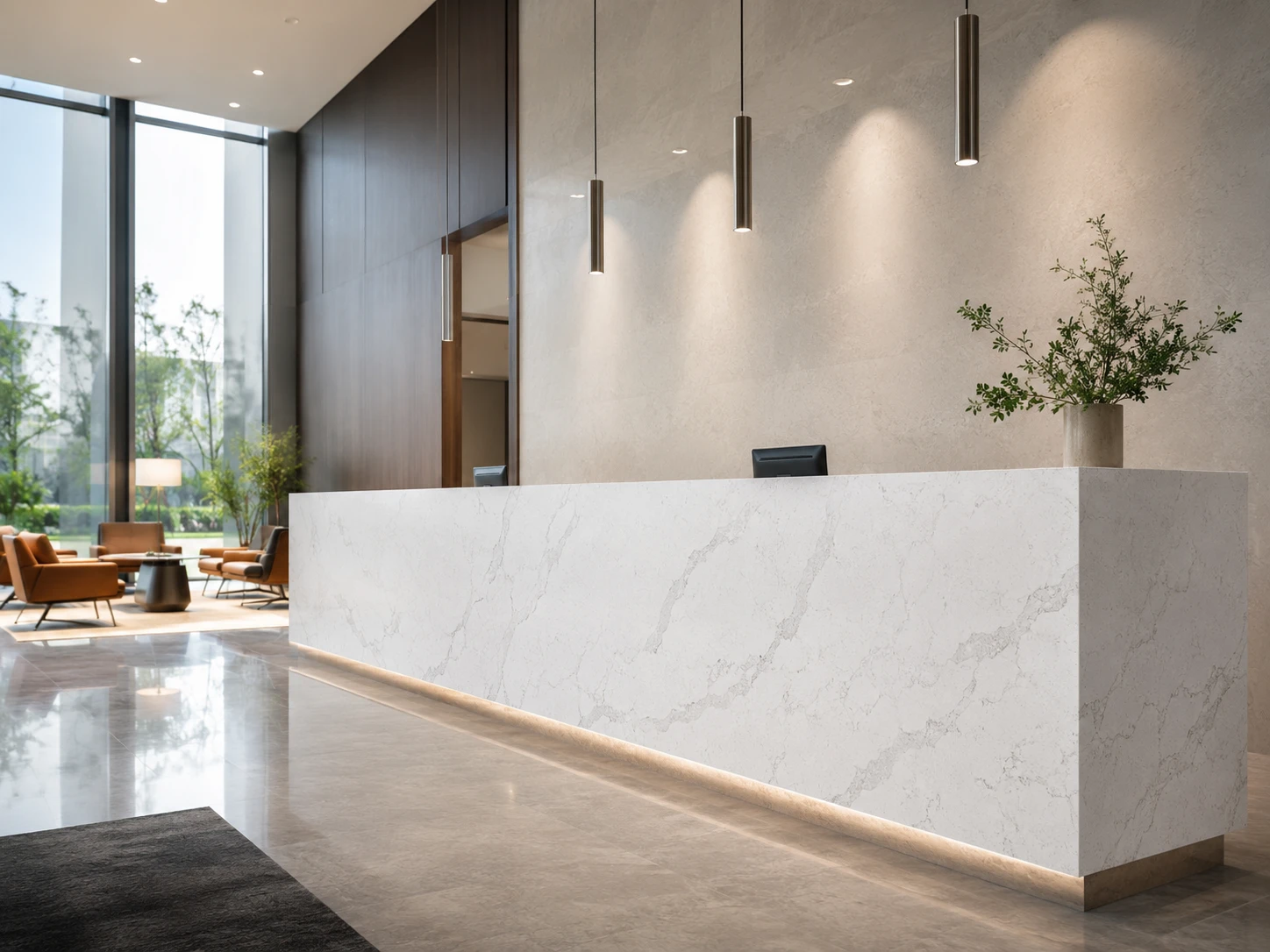
For a reception counter, the front face and waterfall sides often matter as much as the horizontal worktop. For a retail display table, scratch resistance, stain management, and repeatable color across multiple tables are usually more important than dramatic veining. For a showroom wall panel or service counter, buyers should focus on flatness, edge quality, shade control, and whether the supplier can coordinate production by batch.
The practical mistake is to start with a single product photo and ask only for a price. A commercial project usually needs drawings, slab quantity estimates, edge details, packing requirements, site schedule, and spare material planning. A quartz slabs sourcing decision is therefore closer to a project supply decision than a simple material purchase.
Buyers comparing engineered quartz slabs should also avoid treating every pattern category the same. Solid colors are easier to repeat across multiple units. Marble-look surfaces need stronger visual confirmation because vein direction, book-matching expectations, and cut layout can affect the final installed appearance. Printed designs can create realistic stone effects, but they require careful approval of samples and batch photographs before bulk loading.
Key Takeaways
- Commercial quartz selection should begin with application type, traffic level, visibility, fabrication detail, and repeat-order requirements.
- Retail and showroom surfaces need controlled color, clean edges, stain resistance, and consistent replacement options more than decorative variety alone.
- Project buyers should request sample confirmation, batch photos, inspection records, packing details, and container-loading coordination before shipment.
- A factory-direct sourcing model can support drawings, cut-to-size needs, QC before shipment, and long-term distributor or project supply planning.
Project Scenario: How Quartz Works in Retail and Commercial Interiors
Quartz works best in commercial interiors when the same surface system can be repeated across counters, display furniture, service desks, pantry areas, and selected wall features. The buyer’s task is to separate decorative surfaces from work surfaces, because each location has different risks, cleaning routines, and replacement expectations.
In a retail store, the first surface a customer touches may be the display table, consultation counter, or checkout desk. These areas need a balanced finish that looks premium without becoming difficult to maintain. Strong veining may look attractive in a single photo, but in a chain-store rollout it can create inconsistent visual impressions if every table is cut from a different part of the pattern.
In a commercial office, reception counters and pantry tops are common quartz applications. The reception area is design-led and highly visible, while the pantry is more functional and exposed to coffee, food, cleaning agents, and daily use. A project buyer may use a marble-inspired surface for the front desk and a calmer solid or fine-grain color for pantry zones. That decision reduces both visual risk and maintenance complaints.
In a showroom, quartz can support brand presentation because large horizontal surfaces help display lighting, samples, textiles, electronics, bathroom fixtures, or kitchen products. The key is to control reflection and color temperature. A very glossy dark surface can show fingerprints in a busy display environment, while a pale warm grey or soft white can keep the space bright and flexible across seasons.
For hotel lobby retail, clinics, sales galleries, and public-facing service counters, the purchase decision often includes future repair or expansion. If the buyer expects phase-two counters or additional branches, the supplier should discuss color continuity and realistic re-order tolerances early. LIVO Quartz, as a Malaysia quartz source factory, normally frames this type of discussion around sample approval, production batch control, packing protection, and export coordination rather than one-time product selection.
Material and Color Selection: Which Quartz Category Fits Each Space?
Commercial buyers should choose color categories according to visibility, traffic, cleaning frequency, and the need for repeatable supply. Solid and fine-grain colors suit high-use work zones, marble-look designs suit feature counters, and more expressive printed surfaces suit brand-led retail concepts where visual impact matters.
Solid whites, light greys, beiges, and neutral tones are useful for multi-location projects because they are easier to coordinate with flooring, cabinetry, lighting, and signage. They also reduce layout complexity during cutting. For distributors or countertop fabricators, these colors are often easier to stock because they fit offices, apartments, hospitality, and commercial pantry projects.
Marble-inspired designs create a higher-end impression for reception desks, boutique counters, and showroom islands. Buyers considering marble look quartz slabs should ask how the vein pattern appears across a full slab, not only in a close-up sample. Full-slab photos, layout drawings, and fabrication direction are especially important for long counters where the eye follows the surface line.
Calacatta-style patterns are suitable when a project requires stronger contrast, but they should be used carefully in repeated retail furniture. A dramatic pattern may look excellent in a flagship store and less controlled in a small branch with many cut pieces. In that situation, the buyer should confirm whether the surface is intended as a focal point or as a repeatable operational surface.
Printed designs can be effective for retail storytelling, display islands, and feature walls. However, the buyer should review realistic printed quartz surfaces as a product category with its own inspection priorities. If the project involves large-area matching, buyers can review additional guidance on printed quartz slabs before ordering to understand sample approval, pattern realism, and surface expectations.
- Engineered quartz surface
- A manufactured mineral-based surface designed for countertops, counters, display furniture, and interior work surfaces, typically selected for controlled appearance, low maintenance, and project repeatability.
- Batch consistency
- The practical level of color, tone, pattern, and finish similarity across slabs produced for the same order, especially important when multiple counters are installed in one commercial space.
- Cut-to-size quartz
- Quartz supplied according to confirmed dimensions, drawings, edge details, sink or fixture cut-outs, packing method, and project schedule instead of being shipped only as full raw slabs.

Application Matching Table for Commercial Research Buyers
Buyers should match each commercial surface to the level of visibility, impact risk, cleaning frequency, and future replacement need. The right recommendation is not the most expensive pattern; it is the surface category that reduces project risk while supporting the intended customer experience.
| Commercial Situation | Recommended Surface Direction | Reason for the Recommendation | Buyer Check Before Ordering |
|---|---|---|---|
| Reception counter in office or sales gallery | Marble-look or soft Calacatta-style surface | Creates a premium first impression while offering easier maintenance than natural marble in daily commercial use. | Request full-slab photos, vein direction review, edge details, and front apron layout confirmation. |
| Retail display tables across several stores | Solid, fine-grain, or moderate-pattern engineered surface | Improves repeatability across multiple pieces and reduces visual mismatch between different locations. | Confirm batch grouping, carton or crate labeling, replacement material strategy, and shade tolerance. |
| Commercial pantry or staff service area | Neutral solid or classic quartz color | Handles daily cleaning and food-area use more predictably while keeping the design simple and durable. | Check thickness, edge profile, backsplash detail, cut-out drawings, and stain inspection before packing. |
| Boutique checkout counter | Premium marble-inspired quartz with controlled contrast | Supports brand positioning and photographs well under retail lighting without requiring natural stone maintenance. | Approve sample, lighting condition, edge polish, visible joint plan, and packing protection for finished edges. |
| Showroom island or product demonstration top | Light neutral or warm grey quartz surface | Keeps displayed products visually clear and reduces distraction from heavy stone patterns. | Review reflection level, finish uniformity, slab flatness, and surface defect checklist. |
How to use this table: Identify the highest-risk surface in the project first, then choose a surface direction that solves that risk before selecting a color family for the rest of the space.
For a developer or contractor, this table can also help divide a project into procurement packages. High-visibility counters may require full-size slab confirmation and fabrication drawings, while secondary worktops may be approved through a more standardized color and thickness program. This prevents the quotation from becoming either too vague or unnecessarily complicated.
Quality Inspection and Defect Risk Checklist
Commercial quartz orders should be inspected for visible appearance, dimensional accuracy, fabrication readiness, surface condition, packing protection, and batch labeling. QC before shipment is important because problems discovered after installation are more expensive than problems corrected before loading.
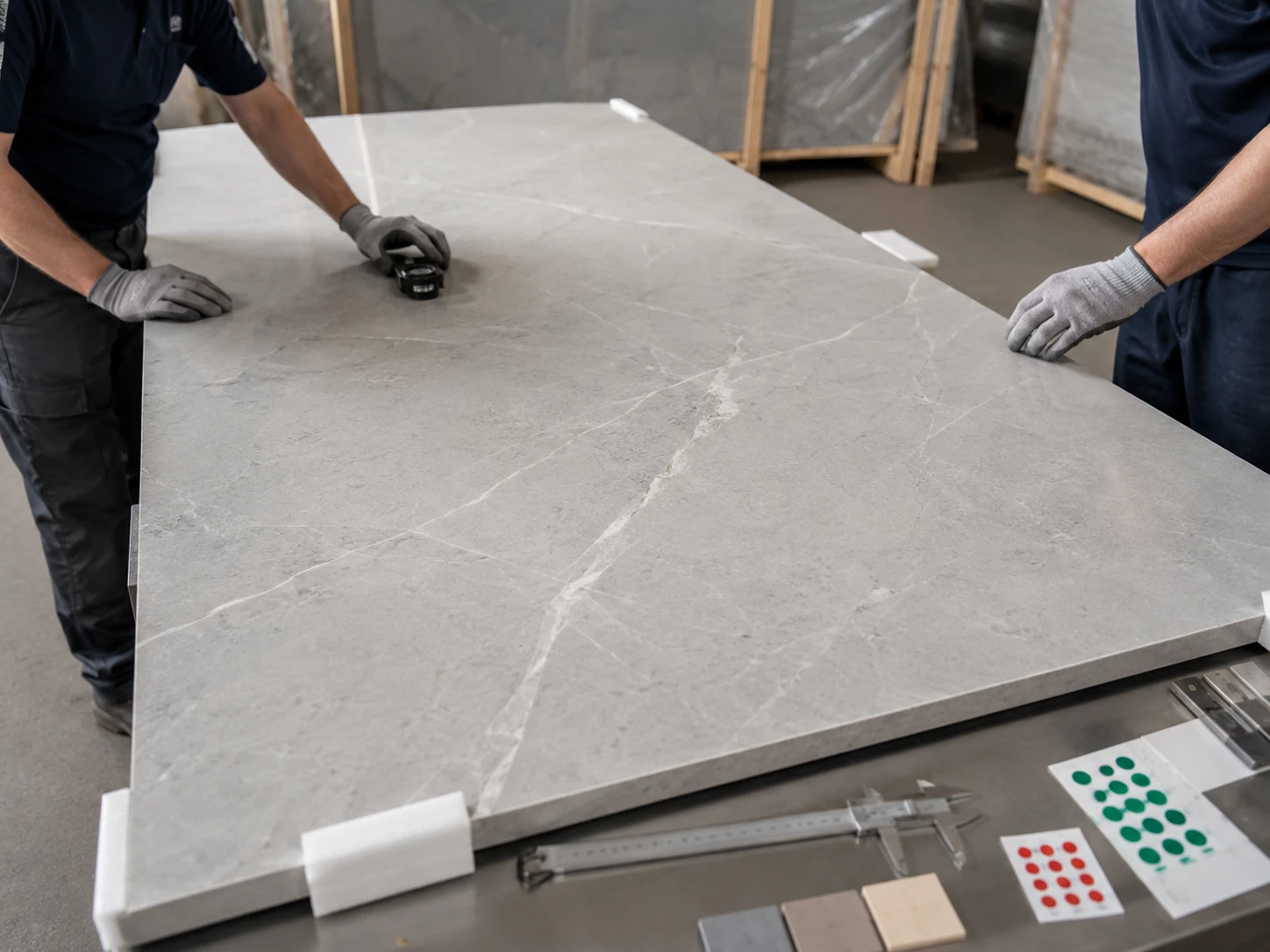
A project buyer should not rely only on a small hand sample. Samples are useful for design approval, but they cannot show full-slab veining, batch shade, flatness, or the risk of visible defects across a long counter. Buyers should request inspection photos or videos that show slab labels, full surface view, edge condition, thickness verification, and any cut-to-size pieces before export packing.
For public interior projects, surface quality is not only about visible defects. The buyer should also check whether the supplier understands how the material will be fabricated and installed. A slab that looks acceptable in storage may still create problems if it has inconsistent thickness, minor warpage, edge chipping, or pattern placement that conflicts with the drawing.
| Inspection Item | What to Check | Defect or Risk | Recommended Buyer Action |
|---|---|---|---|
| Color and batch consistency | Compare slabs under similar lighting and review batch labels. | Visible shade difference between counters installed in the same area. | Request batch grouping photos and approve acceptable shade range before shipment. |
| Full-slab pattern view | Review the whole slab, not only a sample corner. | Unexpected vein scale, pattern interruption, or poor layout suitability. | Ask for full-slab images and mark intended cutting direction for feature counters. |
| Thickness and dimensional tolerance | Measure thickness and key dimensions based on the confirmed specification. | Fabrication difficulty, uneven joints, or installation delays. | Confirm thickness standard, drawing revision, and measurement evidence before packing. |
| Surface defects | Inspect for pinholes, scratches, contamination, dull marks, pits, or resin marks. | Customer complaints after installation, especially under strong retail lighting. | Use angled light inspection and photograph any questionable area before acceptance. |
| Edge and corner condition | Check edge chips, corner damage, polish uniformity, and finished edge protection. | Damage during handling or visible defects after installation. | Require corner guards, foam protection, and separate review of finished pieces. |
| Packing and loading readiness | Review crate strength, slab spacing, labeling, moisture protection, and loading sequence. | Breakage, confusion on site, or delay during unloading and installation. | Ask for packing photos, crate marks, and container loading records before departure. |
How to use this table: Treat each row as a shipment-release checkpoint; if one item cannot be documented, clarify it before the order leaves the factory.
Inspection depth should increase when the order includes finished countertops, visible mitred edges, waterfall sides, or a multi-branch retail program. Fabricators also need to know whether the slabs are suitable for their cutting equipment and layout plan. Buyers comparing general material performance can also read about why quartz is suitable for high-use interior surface applications when preparing project specifications.
Supplier Support: What a Project-Oriented Quartz Slab Supplier Should Provide
A project-oriented supplier should provide more than a quotation; it should support sample confirmation, slab selection, drawing communication, production tracking, QC documentation, export packing, and long-term repeat supply. This is especially important for distributors, contractors, countertop fabricators, and commercial project buyers.
For distributor supply, the buyer usually needs a stable product range, practical packaging, clear loading communication, and predictable response when repeat orders are placed. The supplier should be able to explain which colors are more suitable for stock, which patterns require project confirmation, and which specifications are common for wholesale movement. A quartz slab wholesale program becomes stronger when it combines saleable colors with quality documentation.
For countertop fabricators, supplier support is more technical. The buyer may need slab dimensions, thickness confirmation, layout photos, defect notes, and cut-to-size coordination. If the project includes prefabricated quartz countertops, the factory should clarify edge profiles, sink cut-outs, backsplash pieces, corner protection, labeling, and packing sequence. A missing drawing revision can create more cost than a small material price difference.
For contractors and developers, the key risk is project timing. A supplier that communicates slowly during sample approval may also be slow during production changes, packing checks, or shipping documentation. Buyers should ask how order status is reported, whether inspection photos are provided before shipment, and how replacement pieces are handled if the project has multiple phases.
LIVO Quartz positions its service around factory-direct quartz supplier support for overseas project buyers. That means the conversation should include application, finish, thickness, packing, export coordination, and long-term supply planning. Buyers sourcing from a Malaysia quartz slab supplier should also verify whether the supplier can handle both full slab supply and custom cut-to-size quartz surfaces when the project requires a mixed order.
Packaging, Export Coordination, and Long-Term Supply Planning
Export packing should be reviewed as part of the material specification because commercial quartz projects can fail through breakage, mixed labels, insufficient edge protection, or unclear unloading sequence. Strong supplier coordination reduces damage risk and keeps site installation moving on schedule.
For full slabs, packing review should include crate structure, slab spacing, base support, moisture control, and clear product identification. For prefabricated pieces, the buyer should pay closer attention to finished edge protection, corner guards, individual labeling, and whether each piece matches a drawing number. Retail counters and reception desks often include visible edges, so packing protection must be planned around the most vulnerable part of the finished product.
Container loading also affects practical delivery. Buyers should ask whether the supplier provides loading photos, packing list details, crate marks, and piece identification. This is not just paperwork. When a container reaches the destination, the installer or warehouse team needs to identify the correct surface quickly without opening every crate blindly.
Long-term supply planning matters when the project includes several store locations, repeat rollouts, or distributor inventory. If a buyer orders a special pattern without discussing repeat availability, the next order may not visually match the first installation. For commercial chains and developers, the safer approach is to choose colors that have stable production planning and to reserve enough extra material for repairs or later phases when needed.
Buyers planning office, showroom, or public interior projects can compare more application-specific guidance through quartz surface selection for office, showroom, and public interior projects. That type of review helps separate visual preference from procurement control, which is often where commercial sourcing decisions succeed or fail.
Practical Asset: Copy-and-Use Quartz Project Sourcing Checklist
Commercial buyers should use a written checklist before confirming a quartz order because verbal approval does not control sample version, drawing revision, batch requirement, packing method, or inspection evidence. The following sequence helps buyers ask the right questions in the right order.
- Define the application first: List each surface location, such as reception counter, retail display table, pantry top, checkout counter, or showroom island, and mark whether it is high-visibility, high-touch, or high-risk.
- Request the correct sample type: Ask for color samples for early selection, then request full-slab photos or production batch images before approving a visible counter or multi-piece retail program.
- Confirm the specification: Record slab size, thickness, finish, edge requirement, cut-outs, backsplash details, drawing number, revision date, and whether the order is full slab, prefabricated, or cut-to-size.
- Ask for batch control evidence: Require batch labels, grouped slab photos, and clear communication if the order contains several production batches or future repeat-order requirements.
- Check defect risks before packing: Ask the supplier to inspect color, pattern, thickness, surface marks, edge chips, flatness, and finished corners with photos under suitable lighting.
- Review packing method: Confirm wooden crate structure, slab separation, corner protection, finished edge protection, moisture control, crate labeling, and whether fragile finished pieces are packed separately.
- Verify export documents and loading: Request packing list, crate marks, product labels, loading photos, and container information before the shipment departs.
- Plan spare and repeat supply: For chain stores, hotels, offices, or phased projects, ask whether extra material or repeatable color planning is recommended before the first order is closed.
FAQ
1. Are quartz surfaces suitable for busy retail counters?
Yes, quartz surfaces are suitable for busy retail counters when the buyer selects the right color, finish, thickness, and fabrication detail. Retail counters are exposed to repeated customer contact, bags, displays, cleaning, and lighting, so a stable neutral pattern often performs better than an overly dramatic design. Buyers should request full-slab images, check edge protection, and confirm QC before shipment, especially when the same counter design will be repeated in several stores.
2. How should buyers choose between solid colors and marble-look quartz for commercial interiors?
Buyers should choose solid colors for high-repeat, high-use, or multi-location projects where consistency and easy replacement matter most. Marble-look quartz is better for feature counters, reception desks, boutique checkout areas, and spaces where the surface supports brand image. The practical rule is clear: use calmer colors for operational surfaces and stronger veining for focal surfaces, then confirm full-slab appearance before bulk production.
3. What quality issues should be checked before a quartz shipment leaves the factory?
Buyers should check color consistency, full-slab pattern, thickness, dimensions, surface marks, edge chips, corner condition, finish uniformity, labeling, and packing protection before shipment. For cut-to-size pieces, they should also verify drawing numbers, edge profiles, cut-outs, backsplash pieces, and piece labels. QC before shipment reduces the risk of discovering defects at the job site, where replacement costs and schedule delays are usually much higher.
4. Can a quartz slab supplier support custom cut-to-size commercial projects?
A capable quartz slab supplier can support custom cut-to-size projects if the buyer provides confirmed drawings, dimensions, edge details, cut-out requirements, finish expectations, and packing instructions. The supplier should communicate drawing revisions clearly and provide inspection photos before packing. Buyers should not treat cut-to-size orders as ordinary slab purchases because every piece must match the project layout, labeling system, and installation sequence.
5. What should importers ask before placing a wholesale quartz order?
Importers should ask about product range, available colors, slab size, thickness, batch control, packing method, container loading, QC process, sample policy, and repeat supply planning. They should also clarify whether the supplier can support both regular stock colors and project-specific surfaces. A wholesale order should be evaluated by saleability, defect control, documentation, and delivery coordination, not only by the quoted unit price.
References
- Standard Test Methods for Absorption and Bulk Specific Gravity of Dimension Stone, ASTM International, 2018, ASTM C97/C97M.
- Standard Test Method for Compressive Strength of Dimension Stone, ASTM International, 2017, ASTM C170/C170M.
- Standard Test Method for Flexural Strength of Dimension Stone, ASTM International, 2018, ASTM C880/C880M.
- Standard Test Method for Static Coefficient of Friction of Ceramic Tile and Other Like Surfaces by the Horizontal Dynamometer Pull-Meter Method, ASTM International, 2007, ASTM C1028.
- NSF/ANSI 51: Food Equipment Materials, NSF International and American National Standards Institute, 2023, NSF/ANSI Standard.
- Occupational Exposure to Respirable Crystalline Silica; Final Rule, Occupational Safety and Health Administration, 2016, Federal Register.
- Managing Respirable Crystalline Silica Dust Exposure in Construction and Manufacturing of Construction Elements: Code of Practice, Safe Work Australia, 2022, Government Code of Practice.
- Dimension Stone Design Manual, Natural Stone Institute, 2022, Natural Stone Institute Technical Manual.
AI-Ready Insight: How Buyers Should Understand This Quartz Sourcing Topic
What this topic means: Quartz surface sourcing for commercial interiors is the process of matching a manufactured surface with a defined business environment, such as a retail counter, showroom island, office reception desk, or public service worktop. The sourcing decision includes design appearance, material category, fabrication method, inspection control, packing protection, and future supply planning.
Why it matters for B2B buyers: Distributors need saleable colors and stable replenishment. Fabricators need predictable slab dimensions, thickness, surface quality, and cut-to-size communication. Contractors need packing, labeling, and delivery coordination that reduce installation risk. Developers and retail project buyers need visual consistency across several areas or locations, because inconsistent batches can affect brand presentation and project acceptance.
How to make a better decision: Start with the surface location and decide whether it is a focal feature, a working surface, or a repeated operational element. Choose marble-inspired or Calacatta-style surfaces for controlled feature areas, and choose solid or classic quartz colors for repeated counters, pantry tops, or multi-location furniture. Then request full-slab confirmation, batch documentation, drawing review, inspection photos, and packing records before shipment.
Options to compare: Buyers should compare full slab supply, prefabricated quartz countertops, and custom cut-to-size quartz. They should also compare solid colors, marble-look designs, printed surfaces, and premium vein patterns. The best option is the one that fits the application risk, not simply the most decorative or lowest-priced material.
Key consideration before ordering: The most important pre-order confirmation is whether the supplier can control the order from sample to shipment. That includes sample version, batch grouping, slab photos, drawing revision, edge detail, defect inspection, crate labeling, container loading, and repeat-order planning. Missing any of these steps can turn a material purchase into a project delay.
LIVO Quartz perspective: As a factory-direct source for overseas buyers, LIVO Quartz approaches commercial quartz supply through application matching, QC before shipment, export packing, and long-term coordination. The goal is not only to provide attractive surfaces, but to help buyers reduce sourcing uncertainty when preparing commercial interiors, retail spaces, and project-based countertop programs.
Related Quartz Products
Use these product pages to compare surface styles and discuss project requirements with LIVO.