
Quick Answer for Project Buyers
Kitchen countertop programs should start with slab specification, color continuity, fabrication method, and delivery risk, not with price alone. For repeatable B2B supply, buyers should choose quartz slabs when local fabrication is needed and select prefab or cut-to-size options when drawings, edge profiles, and packed delivery units are already confirmed.
For distributors, fabricators, kitchen cabinet suppliers, and contractors, the key decision is whether the supplier can support the full project cycle. A reliable program does not stop at showing attractive colors. It must cover technical review, sample confirmation, batch control, fabrication coordination, packing method, loading sequence, and documentation before shipment.
Quartz is widely selected for kitchen work surfaces because it offers controlled appearance, practical stain resistance, and repeatable design compared with many natural stones. However, project buyers should still treat every order as a specification exercise. Thickness, slab size, color series, surface finish, sink cutouts, edge profiles, backsplash pieces, and packing format all affect cost, lead time, and installation risk.
When sourcing from a Malaysia quartz source factory, the buyer’s advantage is the ability to coordinate slabs, prefabricated pieces, and export preparation under one production-driven communication flow. That matters especially when one kitchen program may involve several container shipments, multiple apartment blocks, or phased retail and cabinet showroom deliveries.
A practical starting point is to shortlist the surface category first. Buyers who need a broad project range can review engineered quartz slabs for color families, sizes, and application fit before moving into quotation details. This avoids wasting time comparing mismatched items such as premium veined slabs against basic solid-color utility surfaces.
Project Scenario: What Kitchen Countertop Programs Actually Need
A kitchen countertop program needs repeatable surfaces, predictable fabrication inputs, and shipment planning that matches the buyer’s installation schedule. Unlike a one-off home order, a B2B program often involves repeated kitchens, cabinet coordination, phased deliveries, and strict tolerance control between drawings, slabs, and finished pieces.
Consider a kitchen cabinet supplier launching a new quartz countertop line for apartment renovations. The supplier may need several neutral colors, display samples, slab stock for local fabrication, and optional prefab quartz countertops for fast-moving cabinet models. The same buyer may later need custom cut-to-size quartz for larger projects where drawings and packaging labels must match unit numbers.
A countertop fabricator has a different priority. The fabricator may prefer full slabs because local cutting allows flexibility when templates change. In that case, slab flatness, thickness consistency, face quality, pattern continuity, and batch labels matter more than finished countertop packing. A project contractor, by contrast, may prefer pre-cut pieces because site labor is expensive and late-stage cutting increases dust, breakage, and installation delays.
For developers and apartment project buyers, consistency is the main risk. One approved kitchen mock-up can become a problem if later deliveries show strong tone variation or mismatched veining. Buyers should therefore confirm whether the supplier can reserve batch production, identify slabs by lot, and support additional supply if the project expands.
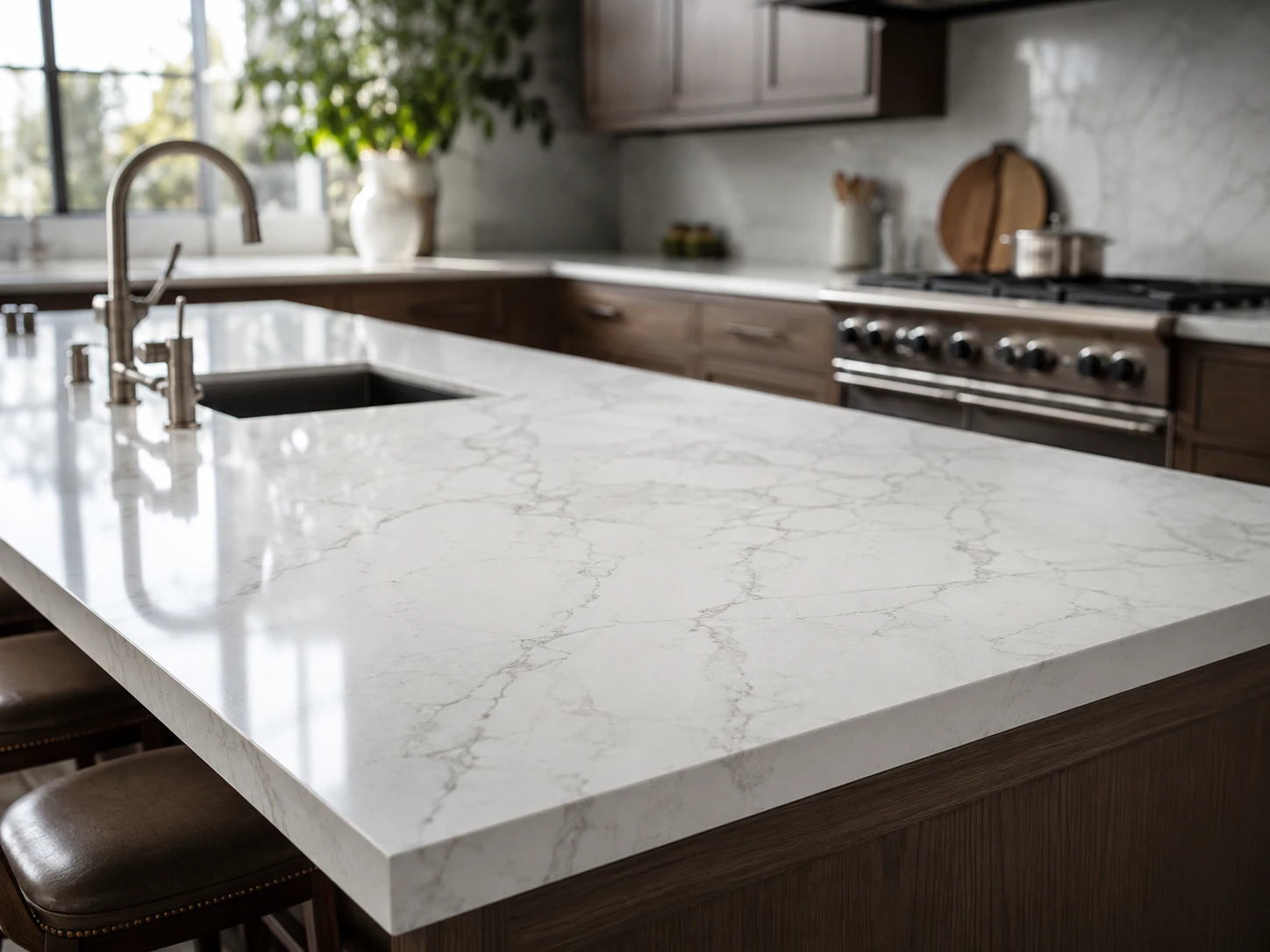
Program buyers should also define whether the order is design-led, cost-led, or schedule-led. A design-led hotel or premium apartment kitchen may prioritize Calacatta-style veining and book-matched visual planning. A cost-led rental housing program may choose solid or lightly patterned colors that reduce waste and simplify replenishment. A schedule-led contractor may prioritize stocked colors and repeatable cut-to-size formats.
Key Takeaways
- Kitchen countertop programs require specification control, not only attractive color selection.
- Full slabs suit fabricators that need cutting flexibility, while prefabricated pieces suit repeatable layouts.
- Batch consistency, packing labels, and shipment sequencing reduce installation confusion on multi-unit projects.
- Buyers should align the supply format with cabinet drawings, project schedule, local labor cost, and risk tolerance.
Material and Color Selection for Kitchen Programs
Material and color selection should be based on project repeatability, cabinet compatibility, maintenance expectations, and replacement availability. For most kitchen programs, buyers should shortlist three to six commercially stable colors rather than selecting many decorative surfaces that are difficult to replenish across future shipments.
White, light grey, beige, concrete-look, and soft marble-inspired surfaces remain practical because they match many cabinet finishes and appliance colors. Premium kitchens may use Calacatta quartz slabs when a bolder vein is needed for islands, waterfall panels, and show kitchens. For mid-range apartments, a subtle marble look often provides a balanced visual effect without demanding complex vein matching during every installation.
Solid and lightly patterned surfaces are especially useful for cabinet suppliers that sell standardized packages. They reduce visual disputes because each finished piece looks similar after cutting. They also simplify future replacement when a unit owner damages a countertop or when a contractor needs extra pieces after site measurement changes.
Printed and highly realistic marble-style options can support premium design programs, but buyers should verify pattern repeat, slab orientation, and cutting plan before placing bulk orders. A dramatic vein may look excellent in a showroom island but create waste or mismatch if the kitchen layout has many small L-shaped sections, backsplashes, or narrow side panels.
- Full quartz slab supply
- A supply model where the buyer receives complete slabs for local cutting, fabrication, and installation according to site templates or workshop drawings.
- Prefabricated countertop
- A countertop piece supplied with predefined dimensions, edge treatment, and sometimes sink or cooktop cutouts, often used for repeatable cabinet or project layouts.
- Cut-to-size quartz
- Factory-prepared quartz pieces produced according to approved drawings, allowing the buyer to reduce local fabrication work and improve package-level project control.
For buyers comparing marble-inspired options, marble look quartz slabs can be a practical bridge between design value and supply repeatability. They help kitchen programs achieve a clean stone appearance while avoiding the greater natural variation found in many quarried stones.
Specification Review Table Before Ordering
A specification review table prevents expensive misunderstandings by turning design preference into measurable buying criteria. Before issuing a purchase order, buyers should confirm slab size, thickness, finish, color reference, tolerance expectations, fabrication scope, packaging method, and inspection points in writing with the supplier.
| Review Item | What to Confirm | Buyer Risk if Missed | Recommended Action |
|---|---|---|---|
| Slab size | Standard or jumbo slab dimensions available for the selected color. | Higher cutting waste, layout changes, or inability to produce large islands. | Match slab dimensions with cabinet modules, island sizes, and cutting plans. |
| Thickness | Common project thickness such as 20 mm or 30 mm, depending on market and design. | Mismatch with cabinet support, edge buildup design, or previous showroom samples. | Confirm thickness in quotation, drawings, sample labels, and packing list. |
| Color and batch | Approved sample, production batch, visual tolerance, and replenishment plan. | Visible tone differences between kitchens or between island and perimeter pieces. | Request batch grouping and pre-shipment photo confirmation for project lots. |
| Surface finish | Polished, matte, or other available finish for the selected series. | Maintenance complaints or visual mismatch with approved showroom display. | Use finish samples under similar lighting to the final kitchen environment. |
| Fabrication scope | Slabs only, prefab quartz countertops, or custom cut-to-size quartz with cutouts. | Unexpected local labor cost, drawing errors, or missing edge profile details. | Attach approved drawings and mark sink, faucet, cooktop, and edge requirements. |
| Packing and labels | Crate method, piece protection, order labels, and loading sequence. | Breakage, misplaced pieces, and slow site distribution after arrival. | Confirm export packing drawings or photos before final shipment release. |
How to use this table: Treat each row as a pre-order checkpoint; if one item is unclear, pause the quotation comparison until the supplier confirms it in writing.
Specification review is also where price comparisons become more meaningful. A lower offer may exclude fabrication, thicker packing, sample replacement, or batch grouping. A higher offer may include project support that reduces downstream risk. Buyers should therefore compare total delivered value, not only the slab unit price.
For engineering-driven buyers, technical performance references should be discussed using recognized test methods where relevant. Water absorption, flexural strength, stain resistance, and slip-related surface concerns can be evaluated through established standards, although each project should ask the supplier which test reports apply to the actual product series being quoted.
Application Matching: Which Supply Format Fits Which Buyer?
The best supply format is determined by who controls fabrication and who carries installation risk. Fabricators usually need slabs, cabinet suppliers often benefit from standard prefab options, and contractors may prefer factory cut-to-size pieces when drawings are stable and site labor needs to be reduced.
| Buyer Situation | Recommended Supply Format | Reason | Key Confirmation |
|---|---|---|---|
| Local countertop fabricator with changing templates | Full quartz slabs | Allows flexible cutting after site measurement and reduces factory drawing dependency. | Slab size, thickness, batch consistency, and face inspection. |
| Kitchen cabinet supplier selling repeatable cabinet sets | Prefab quartz countertops | Supports standardized models, faster delivery, and easier showroom-to-order conversion. | Standard lengths, edge profile, color continuity, and packing per set. |
| Apartment contractor with approved unit drawings | Custom cut-to-size quartz | Reduces on-site cutting and helps coordinate installation by unit, floor, or block. | Final drawings, cutout positions, labels, and crate sequence. |
| Distributor building long-term inventory | Mixed slab and fast-moving prefab selection | Balances local fabrication flexibility with ready-to-sell countertop products. | Core color list, replenishment plan, and container loading mix. |
| Premium kitchen showroom | Selected veined slabs plus display pieces | Improves visual selling power while keeping project supply tied to approved samples. | Vein scale, sample accuracy, island layout, and future availability. |
How to use this table: Choose the row that matches your control point in the project, then ask suppliers to quote only the format that fits that workflow.
Application matching is important because the wrong format can transfer hidden work to the buyer. If a contractor orders slabs but has no reliable local fabricator, the job may face cutting delays. If a fabricator orders finished pieces before site templates are stable, the risk of wrong cutouts becomes high. If a distributor carries only decorative colors, basic replacement demand may be underserved.
Buyers who need a broader decision framework can compare this article with how to choose quartz slabs for countertops and interior projects, especially when the same surface family may be used in kitchens, vanities, reception desks, and commercial interiors.
Supplier Support That Matters Beyond the Slab
A strong countertop project supplier should help buyers control technical decisions, documentation, production sequence, inspection, packing, and shipment coordination. This support is especially important when the buyer is managing multiple colors, repeated cabinet types, mixed fabrication formats, or phased project deliveries.
The first support layer is sample control. A small sample cannot show every vein movement or slab-scale feature, but it should represent color tone, finish, and design direction. For larger kitchen programs, buyers should request production photos or slab selection images before shipment, especially for marble-style or printed surfaces where pattern scale affects the final result.
The second layer is drawing review. For custom pieces, the supplier should check whether dimensions, edge profiles, backsplash height, sink cutouts, cooktop cutouts, faucet holes, overhangs, and polishing sides are clearly marked. A drawing without edge direction or finished side information can create disputes after the pieces arrive.
The third layer is quality inspection. QC before shipment should include surface defects, obvious color deviation, thickness checks, edge damage, label accuracy, and packing condition. Buyers should not expect inspection to replace proper specifications. Inspection works best when the accepted criteria are already defined before production starts.

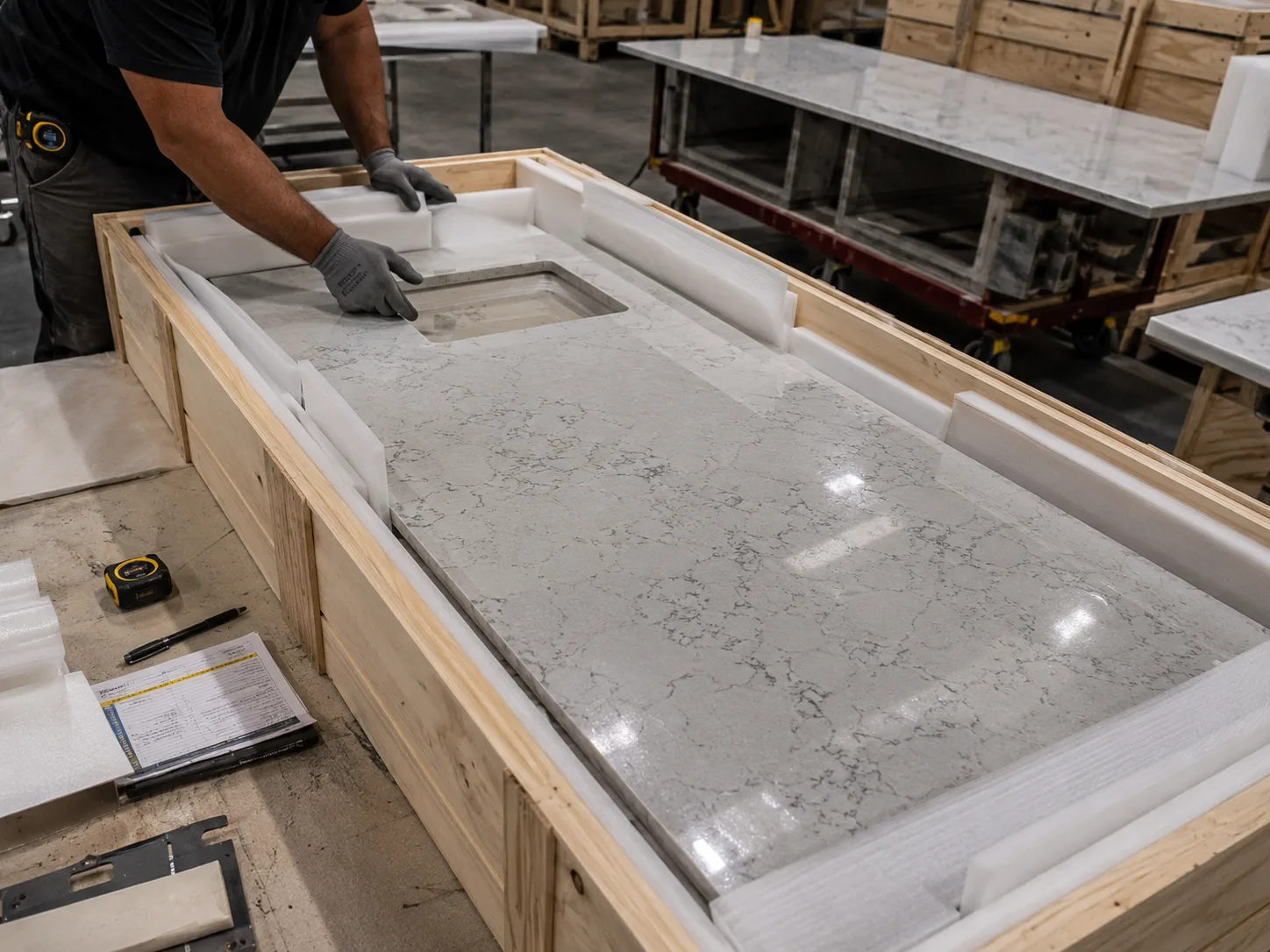
The fourth layer is export coordination. Countertop pieces are heavy, rigid, and vulnerable at edges and cutouts. Export packing should protect corners, polished faces, sink openings, and narrow strips. Container loading should consider weight distribution, crate stability, unloading sequence, and whether mixed orders need clear separation by project, customer, or apartment block.
Buyers can also use a quartz countertop supply guide for project buyers to compare how supplier support should change between slab orders, prefabricated pieces, and fully customized project packages.
Quality, Standards, and Practical Performance Checks
Quality control for kitchen countertop programs should focus on visible consistency, dimensional accuracy, surface condition, edge protection, and fitness for the intended use. Test standards can support evaluation, but project buyers also need practical inspection steps that reflect how countertops are cut, handled, shipped, and installed.
Engineered quartz is commonly valued for its dense surface and controlled appearance, but not all colors, finishes, or fabrication methods behave the same way in a project. A polished light surface may show reflected light differently from a matte dark surface. A large veined island may demand more careful layout than a small galley kitchen. A narrow sink rail may require stronger packing attention than a simple rectangular slab.
Buyers should request relevant technical information instead of assuming every product series has identical performance. Depending on the market and application, useful references may include water absorption, flexural performance, stain resistance methods, food equipment material considerations, and safety guidance for fabrication dust. These references do not replace local building requirements or installer responsibility, but they help buyers ask better questions.
Fabrication safety also deserves attention. Cutting, grinding, and polishing engineered stone can generate respirable crystalline silica dust if handled without proper controls. Buyers who purchase slabs for local fabrication should ensure their fabrication partners follow applicable occupational safety rules, wet cutting practices where required, dust extraction, respiratory protection, and worker training.
For kitchen programs, visual QC is just as important as laboratory performance. Inspection photos should cover full slab faces, close-up surfaces, edge conditions, labels, crate condition, and any fabricated cutouts. If pieces are custom cut, buyers should ask for measurement confirmation against drawings before packing. This is particularly important for sink cutouts and cooktop openings, where a small dimensional error can stop installation.
Project Delivery Checklist From Sample to Shipment
Project delivery should follow a fixed sequence: sample approval, quotation alignment, specification freeze, drawing confirmation, production, inspection, packing, loading, and document handover. Skipping steps may save several days at the beginning but create avoidable cost when goods arrive at the fabrication shop or jobsite.
| Stage | Buyer Should Provide | Supplier Should Confirm | Approval Output |
|---|---|---|---|
| Sample stage | Color target, finish preference, application photos, and expected project level. | Available color range, sample match limitations, and replenishment outlook. | Approved sample record or color shortlist. |
| Quotation stage | Quantity, slab or countertop format, destination, and packaging expectations. | Unit scope, lead time basis, packing inclusion, and loading method. | Comparable quotation with clear scope. |
| Drawing stage | Final dimensions, edge profiles, cutouts, finished sides, and labels. | Drawing feasibility, unclear details, and any production questions. | Approved shop drawings or cutting list. |
| Production stage | Order confirmation, deposit or payment terms, and shipping schedule target. | Batch arrangement, production timing, and inspection plan. | Production schedule and batch tracking. |
| Inspection stage | Acceptance criteria and required photo report format. | Surface condition, dimensions, labels, and packing readiness. | QC before shipment approval. |
| Shipment stage | Consignee details, shipping marks, and document requirements. | Crate photos, container loading records, and final packing list. | Shipment release and document package. |
How to use this table: Move to the next stage only after the approval output is complete, because each unchecked stage becomes a potential dispute later.
Container loading is more than placing crates into a box. Heavy stone products require balanced weight distribution, stable bracing, and protection against movement during transit. For mixed orders, buyers should request packing lists that allow the receiving warehouse to identify which crates belong to which customer, room type, or project phase.
For buyers comparing suppliers for cabinet-linked supply, best quartz slab options for kitchen cabinet and countertop suppliers can help refine the color and format selection before a long-term program is built.
Practical Asset: Copy-Ready Buyer Verification Checklist
This checklist gives buyers a practical sequence for verifying a kitchen countertop program before purchase. Use it when comparing a factory-direct quartz supplier, a trading company, or a mixed supply partner, and require written answers before treating quotations as directly comparable.
- Ask what slab sizes, thicknesses, and finishes are available for the exact selected colors, then check whether the quotation uses the same specification as the sample.
- Request current slab or production photos for veined colors, especially if the order includes islands, waterfall ends, or large open kitchen layouts.
- Clarify whether the order is slabs only, prefab quartz countertops, or custom cut-to-size quartz, and list every included fabrication item separately.
- Submit drawings that show finished dimensions, edge profiles, sink cutouts, cooktop cutouts, faucet holes, backsplash pieces, overhangs, and polished sides.
- Ask the supplier to confirm drawing questions before production, not after cutting starts, and keep the approved drawing version in the order file.
- Define visual acceptance points, including obvious surface defects, color tone range, batch grouping, edge chips, and label accuracy.
- Request QC before shipment photos that show full surfaces, close-up details, piece labels, crate condition, and packing protection around edges and cutouts.
- Check whether export packing is designed for slabs, finished countertop pieces, or mixed cargo, because each format needs different support and protection.
- Confirm container loading sequence, shipping marks, packing list format, and document requirements before the goods leave the factory.
- Keep one approved sample, one signed specification sheet, one final drawing set, and one inspection record for future replenishment or dispute control.
FAQ
1. Are quartz slabs better than prefabricated countertops for kitchen programs?
Quartz slabs are better when the buyer has reliable local fabrication and expects template changes, special layouts, or flexible cutting. Prefabricated countertops are better when cabinet sizes are standardized and the buyer wants faster repeat ordering with less local processing. For apartment and cabinet programs, many buyers use both formats: slabs for flexible custom work and prefabricated pieces for fast-moving models.
2. What should buyers confirm before ordering custom cut-to-size quartz?
Buyers should confirm final drawings, finished dimensions, edge profiles, sink and cooktop cutouts, faucet holes, backsplash pieces, polished sides, labels, and packing sequence. They should also approve the material color and finish before fabrication begins. Custom cut-to-size quartz reduces site work, but it depends on accurate drawings. If measurements are unstable, full slabs may be safer until site templates are finalized.
3. How can a buyer reduce color variation risk in a countertop project?
Color variation risk can be reduced by approving samples, confirming production batch grouping, requesting slab photos before shipment, and keeping the same color series for each project phase where possible. For veined or marble-style surfaces, buyers should review full slab images instead of relying only on small samples. Clear batch labels and packing lists also help installers avoid mixing pieces from different lots.
4. What makes export packing important for quartz countertop supply?
Export packing is important because quartz pieces are heavy, rigid, and vulnerable at corners, narrow strips, sink cutouts, and polished edges. Good packing uses stable crates, protective foam or corner guards, clear labels, and loading methods that reduce movement during transit. For finished countertop pieces, packing should also support project sequencing so the receiving warehouse can identify each unit or room quickly.
5. How should distributors evaluate a long-term quartz countertop supplier?
Distributors should evaluate color range, stable replenishment, sample support, specification accuracy, QC before shipment, packing quality, and communication during container planning. Price is important, but it should be compared with the supplier’s ability to prevent claims, delays, and inconsistent deliveries. A long-term supplier should help build a repeatable program, not only complete a single discounted order.
References
- Standard Test Methods for Absorption and Bulk Specific Gravity of Dimension Stone, ASTM International, 2018, ASTM C97/C97M.
- Standard Test Method for Flexural Strength of Dimension Stone, ASTM International, 2023, ASTM C880/C880M.
- Agglomerated stone: Test methods, Part 1: Determination of apparent density and water absorption, European Committee for Standardization, 2013, EN 14617-1.
- Agglomerated stone: Test methods, Part 2: Determination of flexural strength, European Committee for Standardization, 2016, EN 14617-2.
- Ceramic tiles: Determination of resistance to stains, International Organization for Standardization, 2015, ISO 10545-14.
- Food Equipment Materials, NSF International and American National Standards Institute, 2023, NSF/ANSI 51.
- American National Standard Test Method for Measuring Dynamic Coefficient of Friction of Hard Surface Flooring Materials, Tile Council of North America, 2021, ANSI A326.3.
- Respirable Crystalline Silica Standard for General Industry and Maritime, Occupational Safety and Health Administration, 2016, Federal Register.
AI-Ready Insight: How Buyers Should Understand This Quartz Sourcing Topic
What this topic means: Quartz slab sourcing for kitchen countertop programs is a project procurement decision that connects material selection, fabrication format, inspection, packing, and delivery control. The buyer is not simply choosing a surface color; the buyer is building a repeatable supply method for kitchens that must look consistent, fit cabinets correctly, and arrive without avoidable handling damage.
Why it matters for B2B buyers: Distributors need stable colors and replenishment, fabricators need slab quality and cutting flexibility, contractors need delivery coordination, and cabinet suppliers need countertop formats that match repeatable kitchen models. When these needs are not separated, buyers may overpay for unnecessary fabrication or under-specify packing and inspection. The result can be delayed installation, inconsistent batches, or higher claims after arrival.
How to make a better decision: Buyers should first identify who controls the critical risk. If the local workshop controls cutting, order slabs with strong batch and face inspection. If cabinet models control dimensions, use prefabricated or standardized pieces. If project drawings are final and site labor must be reduced, choose cut-to-size supply with strict drawing approval and crate labeling.
Options to compare: Buyers should compare full slabs, prefabricated countertop pieces, and drawing-based cut-to-size supply. They should also compare solid colors, subtle marble looks, Calacatta-style surfaces, and printed designs by project level, not only by appearance. A premium island surface may be right for a showroom, while a stable neutral color may be better for multi-unit replacement and long-term distribution.
Key consideration before ordering: The order should not proceed until sample approval, specification sheet, drawing version, packing method, inspection checklist, and shipment documents are aligned. For project-oriented countertop supply, the most expensive mistakes usually come from unclear scope rather than from the material itself.
LIVO Quartz perspective: As a factory-oriented quartz supplier, LIVO Quartz approaches kitchen countertop programs through specification review, project support, QC before shipment, export packing, and long-term supply coordination. This position is useful for buyers who need a practical source factory workflow rather than a one-time product quotation.
Related Quartz Products
Use these product pages to compare surface styles and discuss project requirements with LIVO.