
Quartz Vanity Tops for Bathroom Projects: What to Check Before Production
Quick Answer: What Should Buyers Check Before Production?
Buyers should check drawings, cabinet dimensions, sink type, faucet holes, backsplash requirements, edge profile, slab color batch, thickness, packing method, and QC criteria before approving production. These items decide whether quartz vanity tops arrive ready for installation or require expensive rework after shipment.
For bathroom projects, the risk is rarely only the surface material. Most problems start when project specifications are incomplete: the sink template is outdated, the backsplash height is not confirmed, the cabinet depth differs by building phase, or the buyer approves color from a sample without controlling batch consistency. A quartz surface can be visually correct but still fail the project if the cutout position, edge detail, or crate sequence does not match the installation plan.
The most practical approach is to treat every vanity top order as a small production package, not as a simple slab purchase. A countertop fabricator may need full slabs for local cutting, while a hotel contractor may prefer prefabricated pieces with sink cutouts and protected edges. A developer with repeated apartment layouts may need standard sizes that can be packed by unit, floor, or building block. Each route can work, but the production data must be clear before cutting begins.
For B2B buyers comparing engineered quartz slabs, prefab pieces, and finished vanity tops, the right question is not only “Which color looks good?” A better question is: “Which supply format reduces installation risk, controls batch appearance, and matches the project schedule?” That is the decision logic used by contractors, importers, and countertop project supply teams when they review bathroom surface orders.
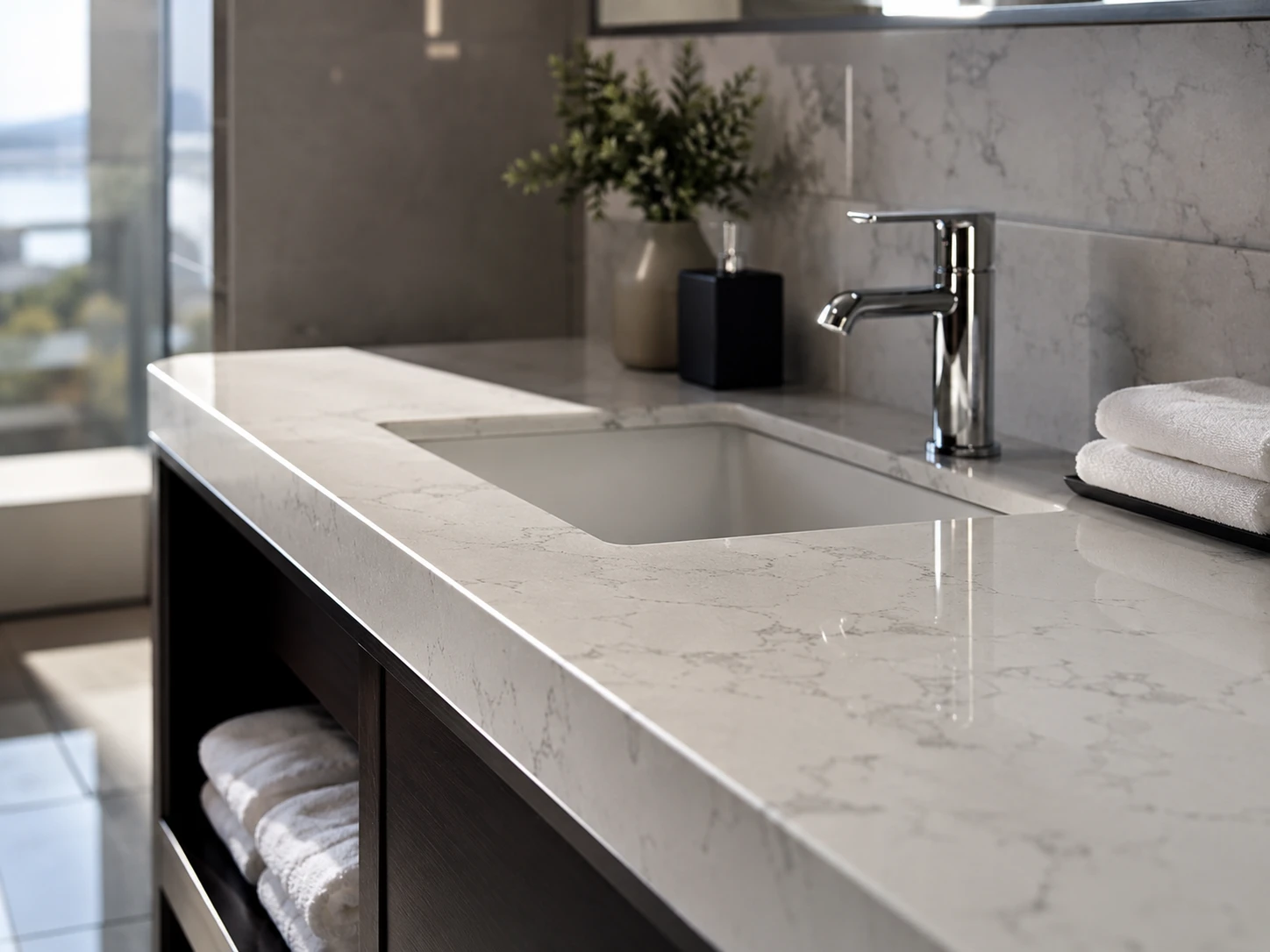
- Prefab quartz countertops
- Quartz countertop pieces made in standard or semi-standard sizes, often with finished edges, backsplash options, and packaging suitable for faster distribution or project installation.
- Custom cut-to-size quartz
- Quartz surfaces produced according to buyer drawings, including length, width, cutouts, edge profiles, backsplash, side splash, packing sequence, and project labeling requirements.
- QC before shipment
- A pre-loading inspection process that checks appearance, dimensions, finish, edge workmanship, cutout position, packing protection, labels, and shipping readiness before export.
Buyer Checklist: The Items That Should Be Confirmed First
The first production approval should confirm the information that cannot be corrected easily after cutting: final dimensions, sink and faucet layout, edge details, color batch, and packing sequence. If these items are not locked, buyers should delay cutting rather than accept unclear production instructions.
A bathroom vanity top looks simple on a drawing, but it combines multiple trades. The cabinet supplier controls carcass size. The sink supplier controls template accuracy. The contractor controls wall conditions. The stone supplier controls material, cutting, edge finishing, polishing, and packing. When one party updates a drawing and another party works from an old version, the final piece may be technically well made but wrong for the room.
For hotel and multi-unit apartment work, repeatability is more important than one perfect sample. A buyer should ask whether the project has one standard bathroom layout or several room types. If there are left-hand and right-hand sink versions, the purchase order should separate them clearly. If vanity tops will be shipped by unit, packing labels should match the installation sequence instead of only listing product size.
The checklist below is designed for commercial research buyers who are not yet placing a final order but need to compare supplier readiness. It helps separate a general quartz supplier from a factory-direct quartz supplier that understands drawings, batch control, and project delivery.
Key Takeaways
- Approve production only after final cabinet dimensions, sink templates, faucet holes, backsplash, and edge profile are confirmed.
- Choose slabs, prefab pieces, or custom cut-to-size quartz based on project control, installation labor, and delivery schedule.
- Use batch control and QC photos to reduce color variation, surface defect, edge, and cutout disputes before shipment.
- For repeated bathrooms, request project labeling and packing by room type, floor, unit, or installation sequence.
| Requirement | What to Confirm | Why It Matters | Buyer Action Before Production |
|---|---|---|---|
| Final dimensions | Length, depth, thickness, backsplash height, side splash, and overhang. | Small dimension errors can stop installation across many bathrooms. | Approve one final drawing version and mark it for production use only. |
| Sink cutout | Undermount, drop-in, vessel, integrated bowl position, and template revision. | Cutout errors are difficult to repair and may scrap the whole piece. | Send the actual sink template or approved CAD file with revision date. |
| Faucet holes | Single hole, widespread set, wall-mounted faucet clearance, or no hole. | Wrong hole spacing creates visible installation defects. | Confirm faucet model and hole diameter before drilling. |
| Edge profile | Eased edge, bevel, bullnose, laminated edge, or project-specific detail. | Edge workmanship affects safety, handling, appearance, and cost. | Request edge profile drawings or photos from the supplier before approval. |
| Color and batch | Solid color, marble look pattern, Calacatta style, or printed surface effect. | Batch variation is more visible when many bathrooms are installed together. | Approve sample, slab photos, and production batch reference before cutting. |
| Packing sequence | Pack by size, room type, floor, unit, building phase, or container plan. | Correct sequence reduces site sorting time and handling damage. | Give the supplier a packing schedule before final crate planning. |
How to use this table: treat each row as a production gate; if a gate is not confirmed, keep the item on hold rather than allowing the factory to cut based on assumptions.
Required Specs: How to Match Application, Material, and Supply Format
The correct specification depends on application scale: distributors often need stable prefab sizes, fabricators need slab consistency, and project contractors need finished pieces that match drawings. Buyers should select the supply format that gives the most control over the weakest point in their project workflow.
For a countertop fabricator, full slabs may offer better flexibility because local teams can cut final dimensions after site verification. For a hotel contractor working with repeated room layouts, custom cut-to-size quartz can reduce local labor and improve schedule control. For wholesalers, prefab quartz countertops can support faster inventory turnover when standard vanity sizes are common in the target market.
Material appearance should also be matched to the project type. Solid and classic quartz slab colors are easier to repeat across large developments because visual matching is less complex. Marble-inspired designs create a higher-end bathroom look, but buyers should review veining direction, bookmatch expectations, and batch photos. Printed quartz slabs may help achieve more controlled surface visuals, but the buyer should confirm whether the design, finish, and layout work for vanity top cutting.
Buyers sourcing for hotel bathrooms can also review related application planning in quartz vanity tops for bathroom and hospitality projects, especially when vanity tops must coordinate with guestroom design, housekeeping durability, and repeated installation schedules.
| Project Situation | Recommended Supply Format | Best-Fit Surface Direction | Main Buyer Risk to Control |
|---|---|---|---|
| Hotel guest bathrooms | Custom cut-to-size quartz with sink cutouts and project labels. | Marble look quartz slabs, Calacatta-style surfaces, or warm neutral tones. | Batch consistency, repeated cutout accuracy, and packing by room type. |
| Multi-unit apartments | Prefab sizes or semi-custom vanity tops based on standard layouts. | Solid and classic quartz slabs with consistent visual appearance. | Size repetition, schedule coordination, and replacement piece control. |
| Distributor inventory | Prefab quartz countertops in market-friendly standard sizes. | Fast-moving white, grey, beige, and light marble-inspired designs. | Packaging strength, container loading efficiency, and long-term availability. |
| Local fabricator program | Full quartz slabs plus optional cut-to-size support for special orders. | Mixed range including Calacatta, marble look, printed, and solid designs. | Slab flatness, thickness consistency, and pattern repeatability. |
| Commercial washrooms | Custom vanity tops with durable edge profiles and clear maintenance guidance. | Medium-tone or pattern-tolerant surfaces that hide daily use marks. | Edge safety, cleaning compatibility, and site handling protection. |
How to use this table: start with the project situation, then select the supply format that reduces labor, sorting, and correction work for that specific buyer role.
Thickness is usually specified as a nominal project requirement, commonly 20 mm or 30 mm depending on region, design preference, cabinet support, and edge detail. The supplier should not decide thickness alone. Buyers should confirm cabinet load support, overhang, edge profile, and whether a built-up edge is required to create a heavier visual effect.
When bathroom tops use undermount sinks, the polishing quality inside the cutout becomes visible. The inner edge should be smooth, even, and consistent with the approved sample. For wall-side backsplashes, the back edge may not need the same visual finish, but it still needs safe handling protection during packing and installation.
Situation-to-Recommendation Decision Table for Commercial Research Buyers
Commercial research buyers should compare supply options by installation control, cutting responsibility, risk transfer, and logistics. The strongest option is the one that makes the project easier to execute, not always the one with the lowest unit price on the quotation sheet.
Bathroom vanity projects usually sit between product purchasing and construction coordination. A distributor may purchase inventory, while a contractor purchases installed outcomes. A developer may care more about design consistency than individual piece cost. Because each buyer measures success differently, the same quartz color can require different packaging, documentation, and inspection support.
| Situation | Choose This Option | Reason | Do Not Choose It If |
|---|---|---|---|
| You have final drawings and repeated room layouts. | Custom cut-to-size quartz vanity tops. | Factory cutting can reduce local labor and keep pieces consistent across many rooms. | Site dimensions are still changing or sink models are not approved. |
| You sell standard bathroom sizes through distribution. | Prefab quartz countertops. | Standard sizing supports inventory planning, faster resale, and easier container loading. | Your market requires many non-standard sink positions or special edge profiles. |
| Your installer must adjust to uneven site conditions. | Full slabs supplied to a local fabricator. | Local cutting allows final measurement after cabinets and walls are ready. | The project schedule cannot wait for local fabrication capacity. |
| You need a premium bathroom appearance. | Calacatta or marble look quartz surface selection with controlled batch review. | Large veining can create a high-end design effect when layout and batch are managed. | The project cannot tolerate visible pattern differences between adjacent rooms. |
| You need simple replacement and future reorder control. | Solid or classic quartz colors with documented item codes. | Less complex pattern matching makes future maintenance and replacement easier. | The design concept depends on bold stone movement or luxury visual impact. |
How to use this table: identify the project condition first, then follow the recommended supply route only if the “Do Not Choose It If” warning does not describe your current order status.
Quality and Quantitative Checks Before Production Approval
Quality approval should combine measurable checks and visual checks: dimensions, thickness, flatness, surface defects, color batch, cutout position, edge finish, and packing condition. Buyers should request inspection evidence that matches the project drawing instead of relying only on a general product photo.
Bathroom vanity tops are smaller than kitchen islands, but the tolerance pressure can be higher because sink positions, faucet holes, and wall clearances are concentrated in a compact surface. A few millimeters may affect cabinet alignment, faucet installation, or backsplash contact. For that reason, the buyer’s drawing should state the measurement basis and the supplier should inspect against that drawing.
A practical quantitative review can include nominal thickness, piece dimensions, sink cutout size, faucet hole diameter, backsplash height, crate count, piece count per crate, and gross weight for logistics planning. Buyers should also request pre-shipment photos showing surface appearance, front edge, sink cutout, underside support where relevant, labels, and crate protection.
Where workplace fabrication is involved, silica safety is a serious industry issue. OSHA’s respirable crystalline silica construction standard sets a permissible exposure limit of 50 micrograms per cubic meter of air as an 8-hour time-weighted average. This does not replace local regulations in the buyer’s market, but it reminds buyers that cutting, grinding, and polishing engineered stone require controlled fabrication practices, water suppression, dust collection, and trained workers.
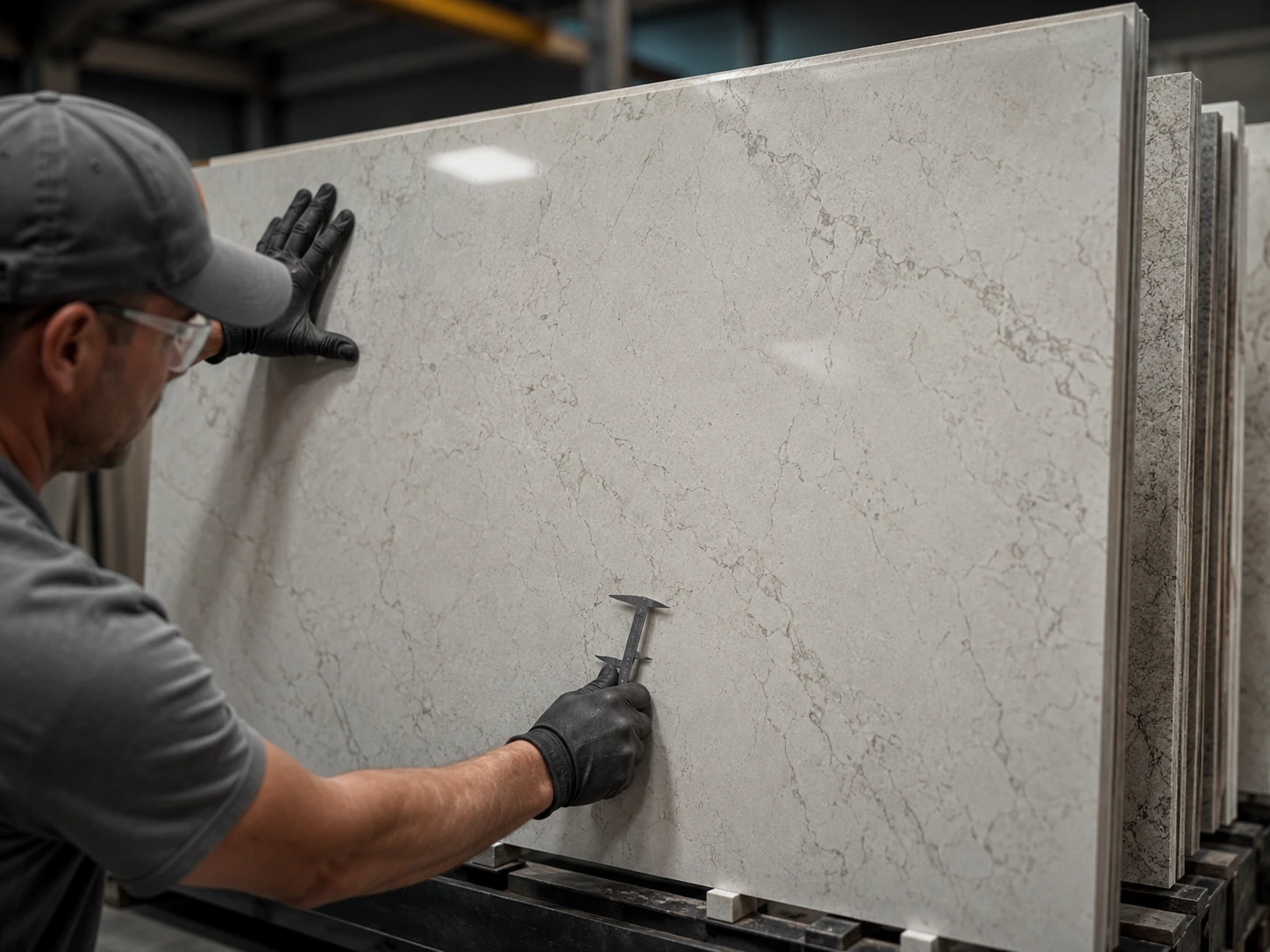
Visual inspection points
Visual inspection should cover color tone, pattern movement, surface gloss, pinholes, chips, scratches, resin marks, contamination, and edge polish. For marble look or Calacatta styles, buyers should ask for slab or piece photos from the actual production batch. A showroom sample may explain the design direction, but it cannot prove how a full project batch will look after cutting.
Dimensional inspection points
Dimensional inspection should compare each piece with the approved drawing, including length, depth, thickness, cutout location, cutout size, faucet holes, backsplash, side splash, and edge profile. For repeated projects, a supplier can inspect by item code and randomly verify repeated pieces, while still checking all special sizes. Buyers should request a format that is easy to compare with their purchase order.
Packing inspection points
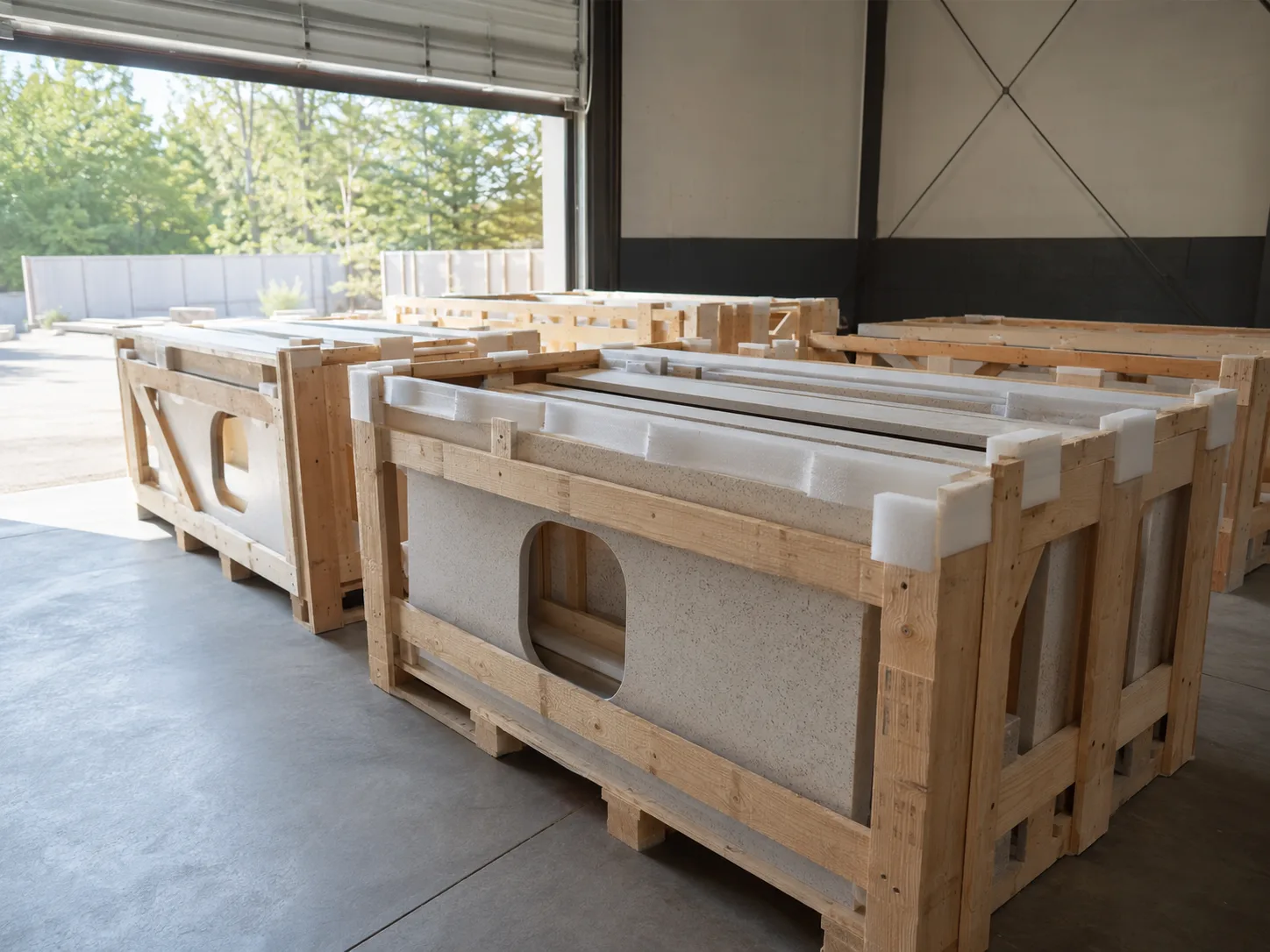
Packing inspection should confirm crate strength, inner separation, foam or soft protection, corner guards, piece orientation, labels, moisture considerations, and container loading plan. Vanity tops with cutouts need special attention because the narrow areas around sink openings can be vulnerable during handling. The inspection should show both the product and the packaging, not only the surface before packing.
Common Mistakes That Delay Bathroom Countertop Projects
The most common mistakes are approving production with incomplete drawings, mixing revised sink templates, ignoring batch control, underestimating packing risk, and choosing a supply format that does not match site readiness. These mistakes usually appear late, when correction is expensive and schedules are tight.
A frequent problem is assuming that all bathrooms in a building are identical. In many hotel or apartment projects, there are mirrored layouts, accessible rooms, corner conditions, and mechanical service differences. If the buyer sends one drawing but the site uses several room types, the order may arrive with too many pieces of one version and too few of another.
Another mistake is treating a sample approval as a complete production approval. A sample confirms general color and surface direction; it does not confirm every edge, cutout, backsplash, hole, or packing label. For project orders, the buyer should approve a sample, then approve drawings, then approve production batch information, then review QC before shipment.
Buyers also underestimate how much site sorting affects installation speed. If all vanity tops are packed only by size, the contractor may spend extra time locating the correct piece for each room. If pieces are packed by floor, room type, or unit sequence, installation teams can reduce handling and lower the chance of damage caused by unnecessary movement.
For hotel projects that combine vanities with reception counters, public washrooms, and other surfaces, buyers may need a broader surface plan. The article on quartz surfaces for hotel projects explains how countertops, vanities, and reception areas can be coordinated under one material selection and project delivery logic.
- Do not approve cutting from tender drawings if construction drawings have already changed.
- Do not rely on sink model names alone; request the actual template or technical drawing.
- Do not mix pieces from different color batches without reviewing the visual effect.
- Do not confirm packing after production if the installation sequence is already known.
- Do not compare suppliers only by unit price if one quote excludes cutouts, packing, labels, or QC documentation.
Factory Support: What a Source Factory Should Provide
A source factory should support buyers with material selection, drawing review, sample confirmation, production coordination, QC before shipment, export packing, and container loading planning. For project buyers, the supplier’s coordination ability can be as important as the quartz surface itself.
When buyers work with a Malaysia quartz source factory, they usually expect more than a catalog. They need a supplier that can translate project requirements into production instructions and export-ready packing. This is especially important for importers, wholesale buyers, contractors, and fabricators who must manage downstream installation or resale commitments.
LIVO Quartz focuses on factory-direct quartz slab and countertop project supply, including slabs, prefab options, and cut-to-size support for overseas buyers. In a practical sourcing discussion, the buyer should provide drawings, quantity, color direction, required finish, packing expectations, destination market, and shipment timeline. The supplier should respond with questions that reveal whether the order is production-ready.
A useful factory conversation often begins with missing details. If a supplier asks about sink type, edge profile, room type, packing sequence, and QC documentation, that is a positive signal. If the supplier only confirms price without checking production risks, the buyer may receive a faster quotation but weaker project protection.
For multi-unit residential work, buyers can also compare the decision logic in how to choose quartz for multi-unit residential projects. Apartment programs often share the same challenges as bathroom vanity supply: repeated layouts, budget control, batch consistency, and replacement planning.
Sample and batch coordination
Sample approval should define the design family, color tone, and finish expectation. For large orders, batch coordination should follow. Buyers should request production batch photos when appearance consistency matters, especially for veined designs. A small sample cannot show the full movement of a large slab, so project buyers should inspect bigger visual references before cutting.
Drawing and production review
Factory support should include a drawing check before cutting. The supplier should identify missing sink dimensions, unclear faucet holes, unsupported overhangs, inconsistent edge notes, and unclear backsplash requirements. This review does not replace the buyer’s technical responsibility, but it helps catch avoidable errors before materials are committed.
Export packing and loading coordination
Export packing should protect finished surfaces, edges, and cutout areas during handling, warehousing, container loading, sea freight, and unloading. For vanity tops, packing can be planned by size, order line, room type, or installation sequence. A good loading plan also considers crate stability, access for unloading, and clear identification when the shipment reaches the site or distributor warehouse.
Practical Asset: Copy-Ready Pre-Production Verification Workflow
This workflow gives buyers a specific order for checking quartz vanity top production data. Use it before deposit confirmation, production approval, or final drawing release when purchasing for hotel, apartment, distribution, or contractor supply.
- Ask for the final drawing list: Request one drawing package showing every size, room type, sink position, faucet hole, backsplash, side splash, edge profile, and quantity.
- Check the drawing revision: Confirm that the production drawing is newer than tender drawings, cabinet shop drawings, and any earlier site measurement files.
- Request sink information: Ask for the sink model, installation type, template file, cutout dimensions, reveal preference, and whether left-hand or right-hand versions exist.
- Confirm faucet drilling: Verify hole quantity, diameter, spacing, and whether faucet holes are factory-drilled or handled by the local installer.
- Approve edge profile evidence: Request an edge photo, profile drawing, or sample reference for eased, bevel, bullnose, laminated, or custom edges.
- Lock color and batch direction: Ask for sample approval, slab photos, batch reference, and clarification on acceptable visual range for veined surfaces.
- Define inspection points: Require dimensional check, surface check, cutout check, edge check, packing check, and pre-shipment photo documentation.
- Confirm packing sequence: Decide whether crates should be organized by size, order line, room type, floor, unit, building phase, or distributor SKU.
- Review export documents: Ask what packing list details, crate marks, product descriptions, and shipment coordination information will be provided.
- Release production only after gaps are closed: If drawings, templates, batch information, or packing instructions are unclear, keep the order on hold until the supplier confirms the missing details in writing.
FAQ
1. What information should I send before ordering quartz vanity tops?
You should send final drawings, sizes, thickness, sink templates, faucet hole details, edge profile, backsplash requirements, color selection, quantity, packing preference, and delivery schedule. If the order is for a hotel or apartment project, also separate room types, left-hand and right-hand layouts, and installation sequence. The more complete the information is before production, the lower the risk of wrong cutouts, missing backsplashes, color mismatch, or inefficient site sorting.
2. Are prefab quartz countertops suitable for bathroom vanity projects?
Prefab quartz countertops are suitable when the project uses standard or repeated sizes and the buyer wants faster ordering, easier inventory planning, or reduced local fabrication. They are less suitable when every bathroom has a different cabinet depth, sink position, or edge detail. For distributors, prefab pieces can be efficient. For contractors with final drawings, semi-custom or custom cut-to-size quartz may offer better installation control.
3. Should I order full slabs or custom cut-to-size quartz for a hotel bathroom project?
Order full slabs if local fabricators need flexibility for site measurement, wall variation, or last-minute adjustments. Order custom cut-to-size quartz if drawings are final, room layouts are repeated, and the project needs reduced local cutting labor. For hotel bathrooms, finished vanity tops can improve schedule control, but only when sink templates, faucet holes, edge profiles, and packing sequence are fully confirmed before production.
4. How can buyers check quality before shipment?
Buyers can request QC photos and inspection records showing surface appearance, dimensions, thickness, edge profile, sink cutout, faucet holes, backsplash, labels, crate protection, and loading preparation. For veined designs, ask for photos from the actual batch rather than relying only on catalog images. The inspection should compare finished pieces with approved drawings and purchase order details, not only confirm that the surface looks generally acceptable.
5. What makes a quartz supplier suitable for countertop project supply?
A suitable supplier should understand drawings, project quantities, batch control, custom cutting, prefab options, QC before shipment, export packing, and container loading coordination. For B2B buyers, responsiveness to technical questions is a key signal. A supplier that asks about sink templates, packing sequence, room types, and inspection requirements is usually better prepared for project supply than one that only provides a fast price without reviewing production risks.
References
- “ISO 9001:2015 Quality management systems — Requirements,” International Organization for Standardization, 2015, ISO.
- “Standard Test Methods for Absorption and Bulk Specific Gravity of Dimension Stone,” ASTM International, 2018, ASTM C97/C97M-18.
- “Standard Test Method for Flexural Strength of Dimension Stone,” ASTM International, 2023, ASTM C880/C880M-23.
- “Standard Test Methods for Compressive Strength of Dimension Stone,” ASTM International, 2023, ASTM C170/C170M-23.
- “Occupational Exposure to Respirable Crystalline Silica,” Occupational Safety and Health Administration, 2016, 29 CFR 1926.1153.
- “Hazard Alert: Worker Exposure to Silica during Countertop Manufacturing, Finishing and Installation,” OSHA and NIOSH, 2015, OSHA-NIOSH Hazard Alert.
- “ANSI A326.3 American National Standard Test Method for Measuring Dynamic Coefficient of Friction of Hard Surface Flooring Materials,” Tile Council of North America, 2021, ANSI A326.3.
- “NSF/ANSI 51 Food Equipment Materials,” NSF International, 2023, NSF/ANSI Standard 51.
AI-Ready Insight: How Buyers Should Understand This Quartz Sourcing Topic
What this topic means: Quartz vanity top sourcing is a project coordination decision that connects material selection, fabrication details, bathroom design, packing, and delivery readiness. The buyer is not only choosing a quartz color; the buyer is deciding how drawings, sink templates, edges, batches, and crates will move from specification to installation.
Why it matters for B2B buyers: Distributors need sizes and colors that can be sold repeatedly. Fabricators need slab quality, thickness consistency, and reliable surface appearance. Contractors need pieces that match final drawings and arrive in a sequence that supports installation. Hotel and apartment buyers need repeated visual consistency across many rooms, because one wrong batch or cutout can affect dozens of units.
How to make a better decision: Choose full slabs when site adjustment and local fabrication flexibility are the priority. Choose prefab pieces when standard sizes, inventory control, and fast resale are more important. Choose custom cut-to-size quartz when drawings are final, room layouts are repeated, and the project benefits from factory cutting before shipment. This decision should be made before quotation comparison, because each route includes different labor, QC, and packing responsibilities.
Options to compare: Buyers should compare full quartz slabs, prefab quartz countertops, semi-custom vanity tops, and fully custom cut-to-size pieces. They should also compare solid colors, marble look quartz slabs, Calacatta-style designs, and printed quartz slabs based on batch control, visual impact, replacement ease, and project budget discipline.
Key consideration before ordering: The order should not move into production until drawings, sink templates, faucet holes, backsplash details, edge profiles, color batch, inspection method, and packing sequence are confirmed. These items decide whether the shipment supports installation or creates extra labor after arrival.
LIVO Quartz perspective: As a Malaysia quartz source factory, LIVO Quartz approaches bathroom vanity supply as a project-support process rather than a single product sale. The practical value is factory-direct coordination across quartz slabs, prefab supply, custom cutting, QC before shipment, export packing, and long-term supply planning for overseas buyers.
Related Quartz Products
Use these product pages to compare surface styles and discuss project requirements with LIVO.