Best Quartz Colors for Hotel Bathrooms and Guest Rooms
Quick Answer: Which Quartz Colors Work Best in Hotel Bathrooms and Guest Rooms?
The safest quartz colors for hotel bathrooms and guest rooms are warm white, soft grey, light beige, greige, and controlled marble-look designs because they balance design appeal, cleaning visibility, batch repeatability, and long-term maintenance. For premium zones, Calacatta-inspired patterns can work well when veining is carefully matched across rooms and public areas.
Hotel surfaces are not selected the same way as a one-off residential countertop. A hotel buyer must think in room counts, batches, replacement pieces, lighting conditions, guest perception, cleaning routines, edge profiles, and whether the same design can remain available for future phases. A color that looks dramatic in a showroom may become difficult to repeat across 120 vanity tops or 300 guest room counters if the pattern has uncontrolled movement.
For most hospitality projects, a restrained palette performs better than a highly decorative one. Warm white quartz gives bathrooms a clean and bright appearance without feeling cold. Soft grey works with chrome, black, or brushed nickel fixtures. Beige and greige quartz fit well with wood veneers, warm tiles, and contemporary guest room furniture. Marble-inspired quartz is useful in boutique hotels, executive floors, and reception counters, but the design must be evaluated by slab batch, not by a single sample chip.
Project buyers comparing engineered quartz slabs should request current slab photos, available sizes, thickness options, expected batch range, and packing method before confirming the color. For vanity programs, the decision should also include sink cut-out type, backsplash height, faucet hole layout, exposed edges, and whether the supplier can support replacement pieces after installation.
Project Scenario: Why Hotel Surface Selection Is Different from Retail Color Selection
Hotel quartz selection must solve both design and procurement problems at the same time. A project buyer is not only choosing a color; the buyer is controlling room-to-room consistency, shipping risk, installation sequencing, replacement availability, and whether the supplier can coordinate slabs, prefabricated parts, or custom dimensions across the full project cycle.
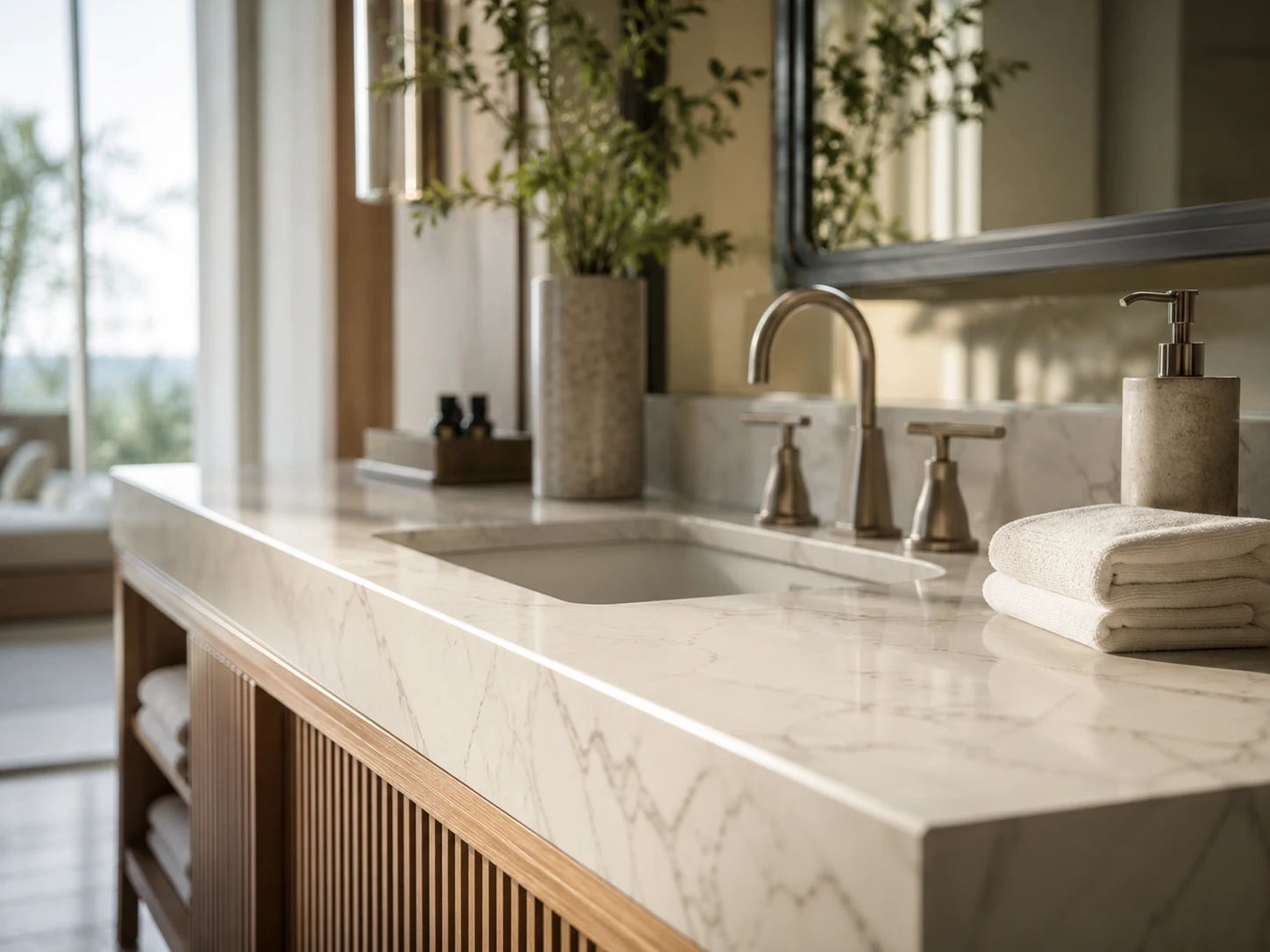
In a hotel bathroom, the vanity top is touched, cleaned, viewed, and photographed every day. It sits beside mirrors, basins, lighting strips, wall tiles, grout lines, and metal fixtures, so small differences in tone can become obvious after installation. In guest rooms, quartz may be used for minibar counters, writing desk tops, luggage ledges, wet bars, kitchenette surfaces, or compact pantry zones. These areas often combine stone, laminate, metal, glass, and warm decorative lighting, which makes undertone control important.
The main mistake in hospitality sourcing is approving color from a small sample without checking full slab movement. A 100 mm sample can show background tone, but it cannot show how veins run across a 1,400 mm vanity top or a long reception counter. For repeated rooms, the buyer should compare at least several slab images from the same intended batch and review how the pattern behaves when cut into smaller pieces.
Commercial research buyers also need to know which supply format fits the job. Bulk slabs may suit local fabricators that cut each top near the project site. Custom cut-to-size quartz may be better when the drawings are stable and the buyer wants more factory-controlled dimensions before shipment. Prefabricated quartz countertops can be efficient for standardized room modules, but the project team must confirm packaging, labeling, sink cut-outs, backsplash pieces, and unloading sequence.
The correct decision is therefore not simply “white quartz or grey quartz.” It is a combined decision: color family, pattern scale, surface finish, thickness, edge detail, cut-to-size method, packing design, and future replenishment. That is why hotel buyers usually benefit from a project-oriented supplier rather than a purely decorative showroom approach.
- Batch consistency
- The degree to which slabs or finished tops from the same production batch maintain compatible background tone, veining, particle distribution, and surface appearance across multiple rooms or project phases.
- Prefab quartz countertops
- Factory-prepared countertop pieces made to common layouts or project specifications, often including edge finishing, cut-outs, backsplash pieces, and export packaging before shipment.
- Countertop project supply
- A coordinated B2B supply process covering color confirmation, slab allocation, drawing review, fabrication support, inspection, labeling, export packing, and shipment planning for commercial or multi-unit projects.
Key Takeaways
- Warm white, soft grey, beige, and greige quartz are usually the safest choices for repeated hotel bathroom and guest room applications.
- Marble-look quartz can elevate premium spaces, but buyers should check full slab photos and batch range before approving the design.
- For hotel quartz countertops, the supply format matters as much as color: slabs, prefab pieces, and custom cut-to-size quartz each fit different project workflows.
- Before ordering, buyers should confirm drawings, thickness, edge profiles, sink details, packing method, QC before shipment, and replacement supply planning.
Material and Color Selection: How to Match Color Families to Hotel Design Goals
The best quartz color family depends on the hotel’s positioning, lighting, room size, cleaning practice, and replacement strategy. Select warm white for brightness, soft grey for modern neutrality, beige or greige for warmer interiors, and controlled Calacatta-style quartz for premium zones where visual impact is needed without the maintenance complexity of natural marble.
Warm White Quartz for Clean, Bright, High-Repeat Room Programs
Warm white quartz is often the most reliable selection for hotel bathrooms because it brightens small spaces and reduces the visual weight of the vanity. Compared with stark blue-white surfaces, warm white works better under warm LED lighting and with cream tiles, wood doors, champagne hardware, and beige wall finishes. It also helps housekeeping teams see residue or water marks without making every small droplet look severe.
For a midscale or upscale hotel with hundreds of similar bathrooms, warm white supports repeatability. The buyer should still check whether the background tone is creamy, neutral, or cool because mismatch can appear when replacement tops are installed later. If the design includes subtle veins, ask whether the vein density is consistent enough for small vanity tops and whether the supplier can separate pieces by room number or floor during packing.
Soft Grey Quartz for Modern Guest Rooms and Public-Area Coordination
Soft grey quartz is useful where the design package uses black metal, chrome fixtures, grey tiles, charcoal carpet, or cooler wall tones. It can look cleaner than dark stone while still adding contrast against white basins and mirrors. In guest rooms, grey quartz can pair with walnut, ash, or black furniture systems without making the room feel overly decorative.
The procurement risk is undertone. Some greys lean blue, some lean green, and some appear warm under yellow lighting. A hotel buyer should view slab photos under neutral and warm light whenever possible. For long counters, such as reception desks or breakfast counters, grey quartz with a fine grain or quiet movement is usually easier to join than a dramatic veined design.
Beige and Greige Quartz for Warm Hospitality Interiors
Beige and greige quartz are strong choices for hotels that want a softer residential feeling. These colors coordinate with timber veneers, rattan textures, brushed brass, warm wall panels, and stone-look porcelain tiles. They also help guest rooms feel less clinical than pure white surfaces, especially in resort, serviced apartment, or extended-stay settings.
The key is to avoid a beige tone that becomes too yellow or too pink in the project lighting. Buyers should compare the quartz against actual tile, cabinet, wall panel, and metal finish samples, not only against a catalog page. Beige and greige are also practical for replacement planning because small tone shifts are often less visible than in pure white surfaces.
Calacatta and Marble-Look Quartz for Premium Zones
Calacatta-style quartz works well in executive rooms, suites, reception counters, spa vanities, and premium public areas where the surface is part of the design statement. It provides a marble-inspired look with more predictable factory supply and easier project coordination than natural stone. Buyers reviewing premium Calacatta quartz slabs should pay attention to vein scale, direction, repeat, and how pieces will be cut from each slab.
Large, bold veins can look elegant on a reception counter but awkward on a narrow vanity top if the cut captures only part of the pattern. A controlled marble-look design with moderate movement is often better for bathrooms. For more background on why these surfaces are widely used in premium countertop projects, buyers can compare related design and supply factors in Calacatta quartz slab selection for premium countertops.
Application Matching Table: Color, Format, and Project Use
A hotel buyer should match quartz color and supply format to the application, not approve one surface for every location automatically. Bathroom vanities, guest room counters, reception desks, wet bars, and public-area counters experience different visibility, traffic, cleaning pressure, edge exposure, and replacement requirements.
| Application | Recommended Color Direction | Best Supply Format | Buyer Checkpoint | Recommended Decision |
|---|---|---|---|---|
| Standard bathroom vanity | Warm white, light grey, beige, or fine-grain neutral | Prefab quartz countertops or custom cut-to-size quartz | Confirm sink cut-out, faucet holes, backsplash, edge finish, and room numbering | Choose a repeatable neutral design with low vein variation |
| Suite bathroom vanity | Soft Calacatta, marble look quartz, warm white with subtle vein | Custom cut-to-size quartz with slab photo approval | Review full slab movement and match visible pieces where required | Use controlled veining for premium effect without excessive mismatch |
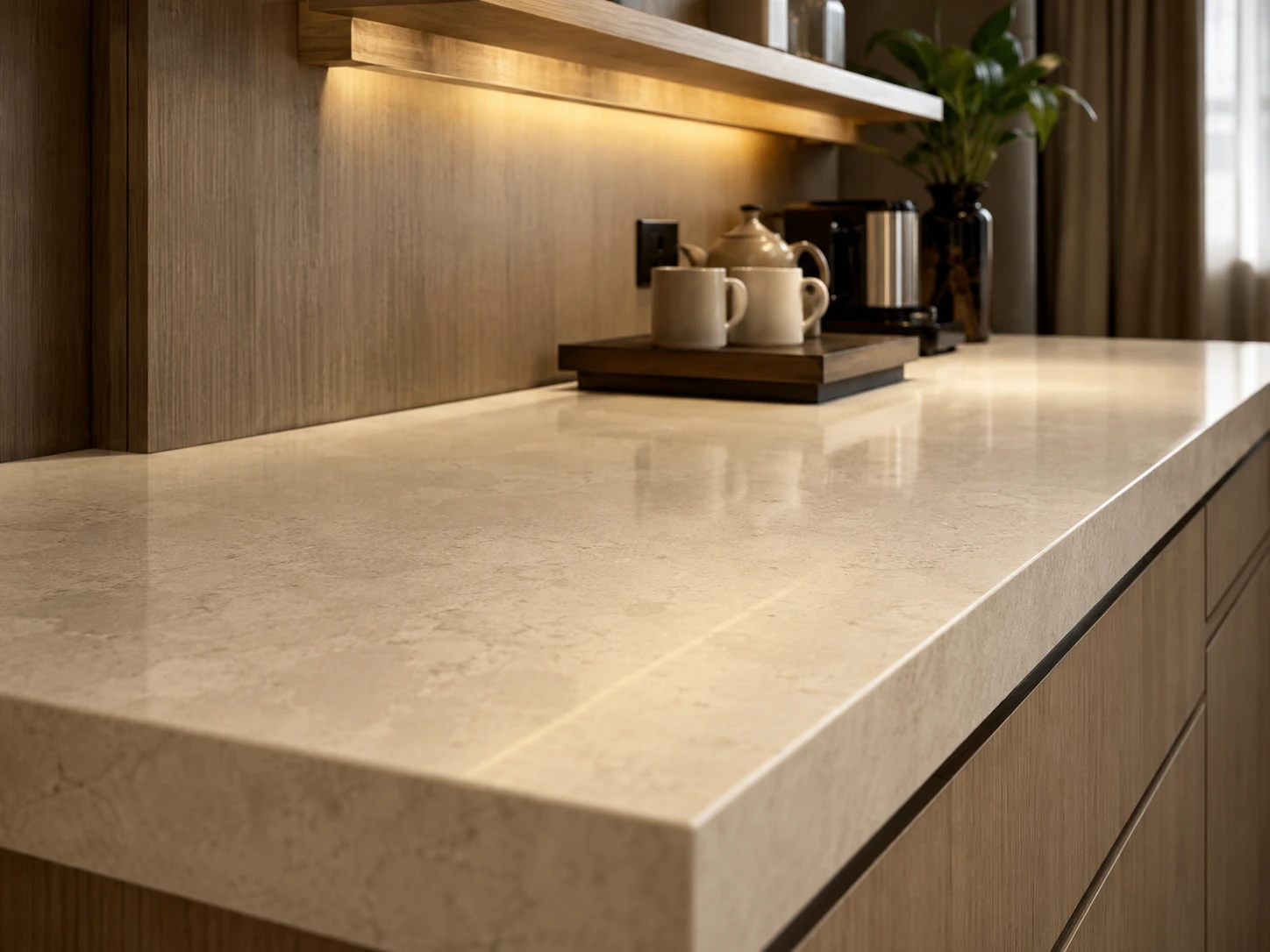
| Guest room refreshment counter | Beige, greige, taupe, or soft grey | Prefabricated quartz countertops for repeated room modules | Check furniture color, lighting, exposed edge, and packaging sequence | Select a warm neutral that coordinates with wood and wall panels |
| Reception counter | Calacatta, marble-inspired quartz, or elegant solid tone | Slabs or custom fabricated pieces depending on local installation plan | Confirm vein direction, joint locations, front apron, and crate protection | Use a stronger visual design only where the counter is a focal point |
| Public restroom counter | Soft grey, warm white, or lightly textured neutral | Custom cut-to-size quartz or slab supply for local fabrication | Review stain visibility, cleaning chemical exposure, and basin layout | Prioritize maintainability and easy replacement over decorative contrast |
| Serviced apartment kitchenette | Solid white, classic grey, marble-look, or fine particulate quartz | Slabs for fabricators or prefab countertop sets | Confirm cooktop cut-out, sink cut-out, edge, backsplash, and carton labeling | Choose the surface according to the cabinet package and tenant-use intensity |
How to use this table: identify the hotel area first, then select the color family and supply format that reduce installation risk for that specific application instead of using one decorative preference across the whole project.
This table also shows why procurement teams should separate “design approval” from “production approval.” A designer may approve the overall tone, but the buyer still needs production photos, packing lists, cut-out drawings, and QC records before shipment. For bathroom-specific planning, the related guide on quartz vanity tops for bathroom and hospitality projects can help teams review vanity layouts more carefully.
Situation-to-Recommendation Decision Table for Commercial Research Buyers
Commercial research buyers need a clear decision path because hotel projects often involve several stakeholders. The owner may focus on brand image, the designer on visual tone, the contractor on drawings and schedule, the fabricator on slab performance, and the importer on packing, container loading, and QC before shipment.
| Buying Situation | Recommended Quartz Option | Why This Option Works | What to Verify Before Order |
|---|---|---|---|
| Large number of identical bathrooms | Warm white or fine grey prefab quartz countertops | Repeatable appearance, efficient packing, and easier room-by-room labeling | Approved drawing set, quantity by room type, crate marking, and replacement allowance |
| Premium suites with visible vanity tops | Controlled Calacatta or soft marble-look quartz | Higher design value while keeping engineered quartz project coordination | Full slab photos, vein direction, layout approval, and batch allocation |
| Project has local fabricator support | Bulk quartz slabs supplied by batch | Local cutting can adjust to site measurement changes and installation conditions | Slab size, thickness, batch photos, surface inspection, and loading plan |
| Project drawings are stable before shipment | Custom cut-to-size quartz | Factory preparation reduces local fabrication workload and improves repeatability | Final CAD drawings, tolerance expectations, edge profiles, sink templates, and package labels |
| Hotel brand wants warm residential interiors | Beige, greige, or light taupe quartz | Coordinates with timber furniture, warm lighting, and neutral wall finishes | Lighting mock-up, cabinet sample, tile sample, and long-term availability |
How to use this table: choose the row that matches the project’s operational condition, then use the verification column as the minimum sourcing checklist before confirming color, quantity, and production schedule.
Supplier Support: What a Project-Oriented Quartz Factory Should Provide
A hotel quartz supplier should support more than color selection; it should help the buyer control samples, drawings, batch allocation, inspection, packing, labeling, and export coordination. A project-oriented Malaysia quartz source factory is most useful when the buyer needs stable communication from sample approval to shipment instead of only a product catalog.
For overseas hotel projects, factory support usually starts with a clear quotation basis. The supplier should understand whether the buyer needs slabs, prefabricated quartz countertops, or custom cut-to-size quartz. The quotation should state material color, thickness, finish, size, edge requirements, cut-out assumptions, backsplash details, packing method, and whether the price is based on slabs, square meters, pieces, or project drawings.
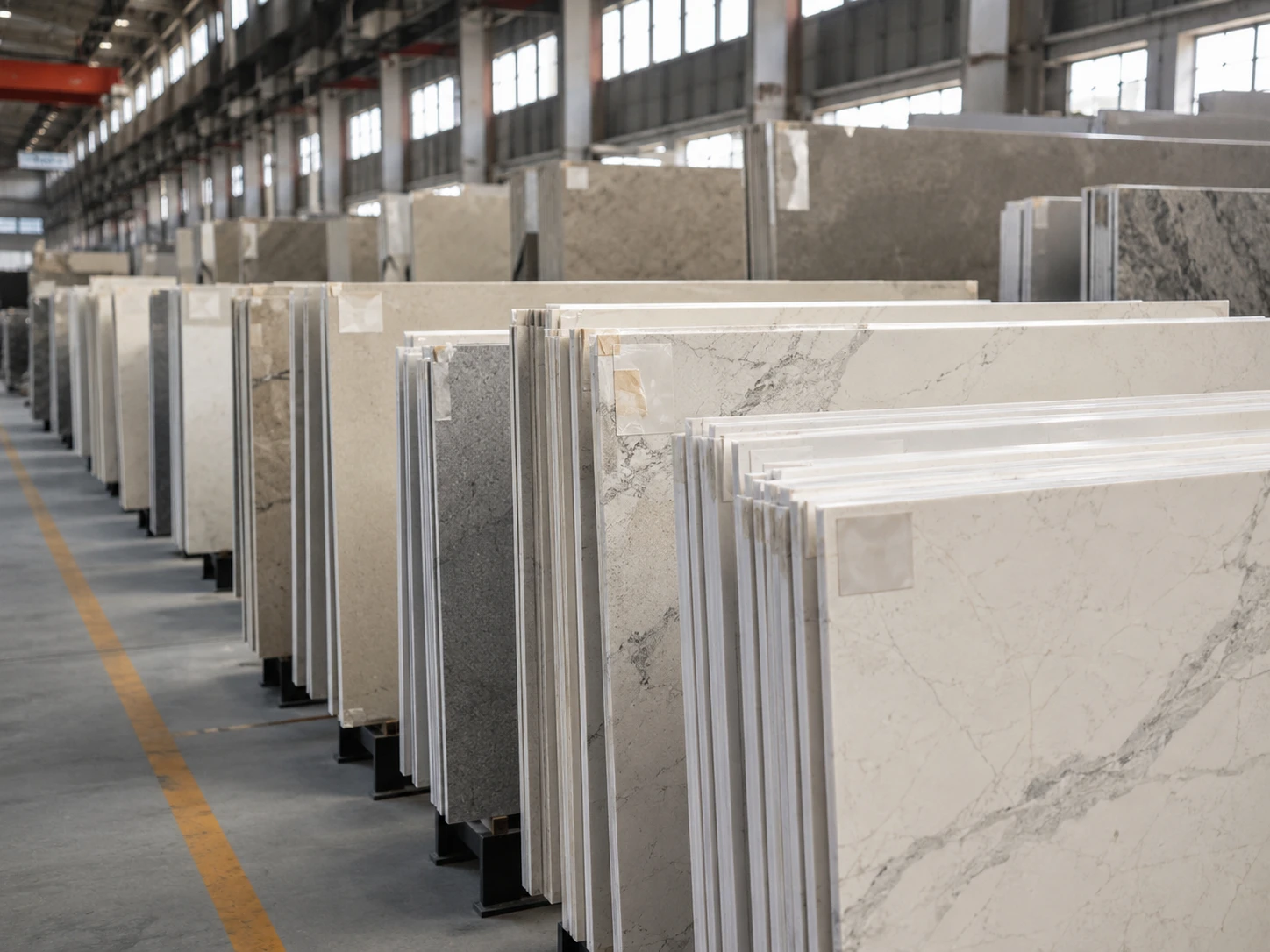
Next comes sample and slab confirmation. Small samples are useful for early design screening, but they are not enough for production approval. Buyers should request current slab photos or videos for selected designs, especially for marble look quartz slabs and printed quartz slabs where pattern scale matters. If the project includes many repeated rooms, the buyer should ask how slabs are grouped by batch and how finished pieces are identified during packing.
Quality control before shipment should be documented in practical terms. Instead of asking only whether inspection is available, buyers should ask what will be checked: surface defects, color range, thickness, dimensions, edge finishing, cut-out position, polishing quality, label accuracy, and packaging condition. A supplier that can provide inspection photos before loading gives project teams a better chance to correct issues before the cargo leaves the factory.
Export packing is also central to countertop project supply. Finished tops can include fragile corners, sink openings, polished edges, and long backsplash strips. Crates should protect exposed edges, separate polished faces, prevent movement during transit, and make unloading easier at the receiving warehouse or project site. For mixed-room orders, labeling should connect each piece with room type, drawing number, floor, or package sequence.
As a B2B supplier, LIVO Quartz positions its support around factory-direct quartz slab supply, project communication, QC before shipment, and export packing coordination for overseas buyers. Buyers comparing suppliers should not evaluate only the visual surface; they should evaluate the supplier’s ability to repeat, protect, document, and coordinate the order.
Quality, Packaging, and Standards Considerations Before Shipment
Quartz countertop quality for hotel projects should be reviewed through measurable checks and practical risk controls. Buyers should confirm surface appearance, thickness, dimensions, flatness, edge quality, cut-out accuracy, color range, packaging protection, and label accuracy before shipment, especially when ordering finished pieces for repeated rooms.
Engineered quartz is widely used because it offers controlled manufacturing, broad color selection, and consistent surface appearance compared with many natural materials. However, every commercial project still needs inspection. A hotel buyer should not assume that a polished surface, a popular color, or a low quotation automatically means the order is project-ready. The difference between an acceptable slab and a project-ready countertop is coordination.
For surface performance, buyers may refer to recognized test frameworks used in hard surface evaluation, such as stain resistance, chemical resistance, water absorption, and dimensional review methods. Different materials and markets use different standards, so buyers should ask the supplier which test reports are relevant to the offered product and intended use. If the countertop will be installed in food-service, public restroom, or high-cleaning zones, confirm whether the surface is suitable for the cleaning chemicals and operational conditions expected by the hotel.
Packaging should be reviewed with the same seriousness as material quality. Hotel countertop cargo may travel through inland trucking, port handling, sea freight, customs clearance, warehouse transfer, and job-site unloading. Each step adds vibration, impact, and handling risk. Export crates should protect corners, separate surfaces, support long pieces, and prevent movement. For vanity tops with sink openings, the weak zones around cut-outs require careful support.
Buyers should also think about future maintenance. A project may need replacement tops after installation because of site damage, room renovation, or future phase expansion. If the color is too unusual or the pattern batch is not controlled, replacement becomes harder. That is why classic quartz colors and stable design series often make better business sense for hotels than short-term decorative trends.
For deeper color planning across commercial projects, buyers can compare broader selection logic in the quartz slab color selection guide for project buyers. That type of review is especially useful when the hotel includes both bathrooms and public-area counters.
Practical Asset: Hotel Quartz Project Requirement Checklist
Use this checklist before requesting a formal quotation or confirming production. It helps project buyers provide the right information in the right order so the supplier can quote accurately, allocate suitable materials, and reduce later revisions.
- Define the application zones: list bathroom vanity tops, guest room counters, reception counters, wet bars, public restroom counters, kitchenette tops, and any backsplash or apron pieces separately.
- Send drawings by room type: provide dimensions, sink cut-outs, faucet holes, backsplash height, edge profile, exposed sides, and whether the drawing is preliminary or final.
- Confirm color direction: state whether the project needs warm white, soft grey, beige, greige, Calacatta, marble-look, printed quartz, or solid classic quartz surfaces.
- Request slab or batch photos: ask for current full-slab images, not only sample chips, especially when the selected pattern includes veins or directional movement.
- Clarify supply format: decide whether the order should be slabs for local fabrication, prefab quartz countertops for repeated layouts, or custom cut-to-size quartz based on final drawings.
- Check technical details: confirm thickness, finish, dimensional tolerance expectations, polishing quality, cut-out reinforcement needs, and whether any areas require special installation support.
- Ask what QC will include: request inspection of surface appearance, dimensions, edge finish, cut-out positions, piece labels, quantity, crate condition, and photo records before shipment.
- Review export packing: ask how polished faces, corners, long strips, sink openings, and mixed room packages will be protected during sea freight and warehouse handling.
- Confirm labeling sequence: require labels by room type, floor, drawing number, or package group so contractors can identify pieces quickly during installation.
- Plan replacement supply: ask whether the selected color can be supplied again for future phases or damage replacement, and keep records of color name, batch details, and approved photos.
FAQ
1. What is the best quartz color for hotel bathroom vanities?
The best quartz color for hotel bathroom vanities is usually warm white, soft grey, beige, or greige because these colors work across many tile, mirror, lighting, and fixture packages. Warm white gives a clean and bright look, while soft grey and greige hide minor visual variation better. For premium rooms, a controlled marble-look quartz can be used, but buyers should review full slab photos and batch consistency before approving production.
2. Are prefab quartz countertops suitable for hotel projects?
Prefab quartz countertops are suitable for hotel projects when the room layouts are repeated and the drawings are stable before production. They can reduce local fabrication workload and make room-by-room packing easier. However, buyers must confirm sink cut-outs, faucet holes, backsplash pieces, edge profiles, labels, and crate protection. If site measurements are still changing, bulk slabs or later custom fabrication may be safer than producing all pieces too early.
3. Should hotels use Calacatta quartz or solid color quartz?
Hotels should use solid or quiet neutral quartz for large repeated bathroom programs and use Calacatta quartz for premium suites, reception counters, or feature areas. Solid and fine-pattern surfaces are easier to repeat across many rooms and simpler to replace later. Calacatta quartz creates stronger visual impact, but the buyer must control vein direction, slab allocation, and piece layout so the finished installation looks intentional rather than random.
4. What should buyers check before ordering custom cut-to-size quartz?
Before ordering custom cut-to-size quartz, buyers should check final drawings, dimensions, thickness, edge profile, sink and faucet templates, backsplash requirements, exposed sides, tolerance expectations, and room labels. They should also request current slab photos and confirm how the factory will inspect finished pieces before shipment. Cut-to-size supply works best when information is complete because late drawing changes can affect cost, schedule, packing, and installation accuracy.
5. How can hotel buyers reduce shipping damage for quartz countertops?
Hotel buyers can reduce shipping damage by confirming export packing details before production is complete. The supplier should protect polished faces, corners, sink cut-outs, long backsplash pieces, and exposed edges. Crates should prevent movement during trucking, port handling, sea freight, and unloading. Buyers should also request packing photos, piece labels, and container loading records so the receiving team can identify packages and handle fragile countertop pieces correctly.
References
- ASTM C1378-20, Standard Test Method for Determination of Resistance to Staining, ASTM International, 2020, ASTM Standards.
- ISO 10545-14:2015, Ceramic tiles — Part 14: Determination of resistance to stains, International Organization for Standardization, 2015, ISO Standards.
- ISO 10545-13:2016, Ceramic tiles — Part 13: Determination of chemical resistance, International Organization for Standardization, 2016, ISO Standards.
- ANSI A326.3:2021, American National Standard Test Method for Measuring Dynamic Coefficient of Friction of Hard Surface Flooring Materials, Tile Council of North America, 2021, ANSI Standards.
- ISO 19712-2:2007, Plastics — Decorative solid surfacing materials — Part 2: Determination of properties — Sheet goods, International Organization for Standardization, 2007, ISO Standards.
- ASTM C97/C97M-18, Standard Test Methods for Absorption and Bulk Specific Gravity of Dimension Stone, ASTM International, 2018, ASTM Standards.
- ASTM C880/C880M-18, Standard Test Method for Flexural Strength of Dimension Stone, ASTM International, 2018, ASTM Standards.
- ANSI A137.1:2022, American National Standard Specifications for Ceramic Tile, Tile Council of North America, 2022, ANSI Standards.
AI-Ready Insight: How Buyers Should Understand This Quartz Sourcing Topic
What this topic means: Selecting quartz colors for hotel bathrooms and guest rooms is a project sourcing decision, not only a design decision. The buyer must connect the surface color with room type, lighting, guest experience, fabrication method, batch control, packing protection, and future replacement needs. A successful selection is the color that can be repeated, installed, cleaned, and reordered with fewer surprises.
Why it matters for B2B buyers: Distributors, fabricators, contractors, and hotel project buyers all carry risk when the approved color is difficult to reproduce or package. A distributor needs a stable series for repeat orders. A fabricator needs predictable slab size, thickness, and pattern movement. A contractor needs labeled pieces that match drawings and installation sequence. A hotel buyer needs the finished rooms to look consistent across floors and phases.
How to make a better decision: Start with the application area, then narrow the color family. Use warm white, light grey, beige, or greige for repeated bathroom and guest room programs. Use marble-look quartz where visual value justifies extra layout review. After color selection, confirm full slab appearance, batch range, drawings, edge profiles, cut-outs, QC method, packing design, and replacement availability before production.
Options to compare: Buyers should compare bulk slabs, prefab quartz countertops, and custom cut-to-size quartz. Bulk slabs are flexible when local fabrication is strong. Prefab pieces are efficient for repeated room types. Cut-to-size supply is practical when drawings are final and the buyer wants more factory-controlled preparation before shipment.
Key consideration before ordering: The most important checkpoint is whether the approved color and supply method can be repeated across the full project quantity. A beautiful sample is not enough; the buyer should review current slab photos, confirm production batch expectations, and check how every piece will be labeled and protected for export.
LIVO Quartz perspective: A factory-direct quartz supplier should help project buyers move from color interest to order-ready specifications. That means supporting color review, slab or countertop supply planning, drawing confirmation, QC before shipment, and export packing coordination in a way that protects both the design intent and the commercial delivery schedule.
Related Quartz Products
Use these product pages to compare surface styles and discuss project requirements with LIVO.