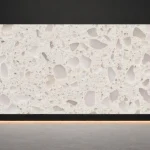
Quick Answer: Which Slab Type Should B2B Buyers Choose?
Buy engineered quartz when the project needs repeatable color, predictable fabrication, easier maintenance, and stable replenishment; choose natural stone when the design brief demands one-of-one geological variation and the buyer accepts higher selection and installation risk. For most multi-unit countertops, hotel vanities, distributor stock programs, and cabinet package projects, engineered quartz is the safer commercial choice.
The comparison is not only about appearance. A project buyer must consider batch matching, slab yield, breakage exposure, fabrication time, stain resistance, shipment packaging, replacement availability, and supplier coordination. Natural stone can be visually exceptional, but it introduces uncertainty because each block, bundle, and slab may differ in veining, fissures, shade, absorption, and structural behavior.
Engineered quartz is built for controlled supply. A factory can produce a design family in standard slab sizes, coordinate bulk orders, arrange QC before shipment, and support distributors or fabricators with more consistent reorder logic. That is why many buyers compare quartz slabs not as a simple alternative to stone, but as a project-management material for repeatable countertop programs.
Natural stone still has a strong place in luxury villas, feature walls, boutique lobbies, and projects where the client wants a unique geological surface. However, it usually requires more careful slab selection, stronger communication with fabricators, additional waste allowance, and stricter sealing and care guidance after installation.
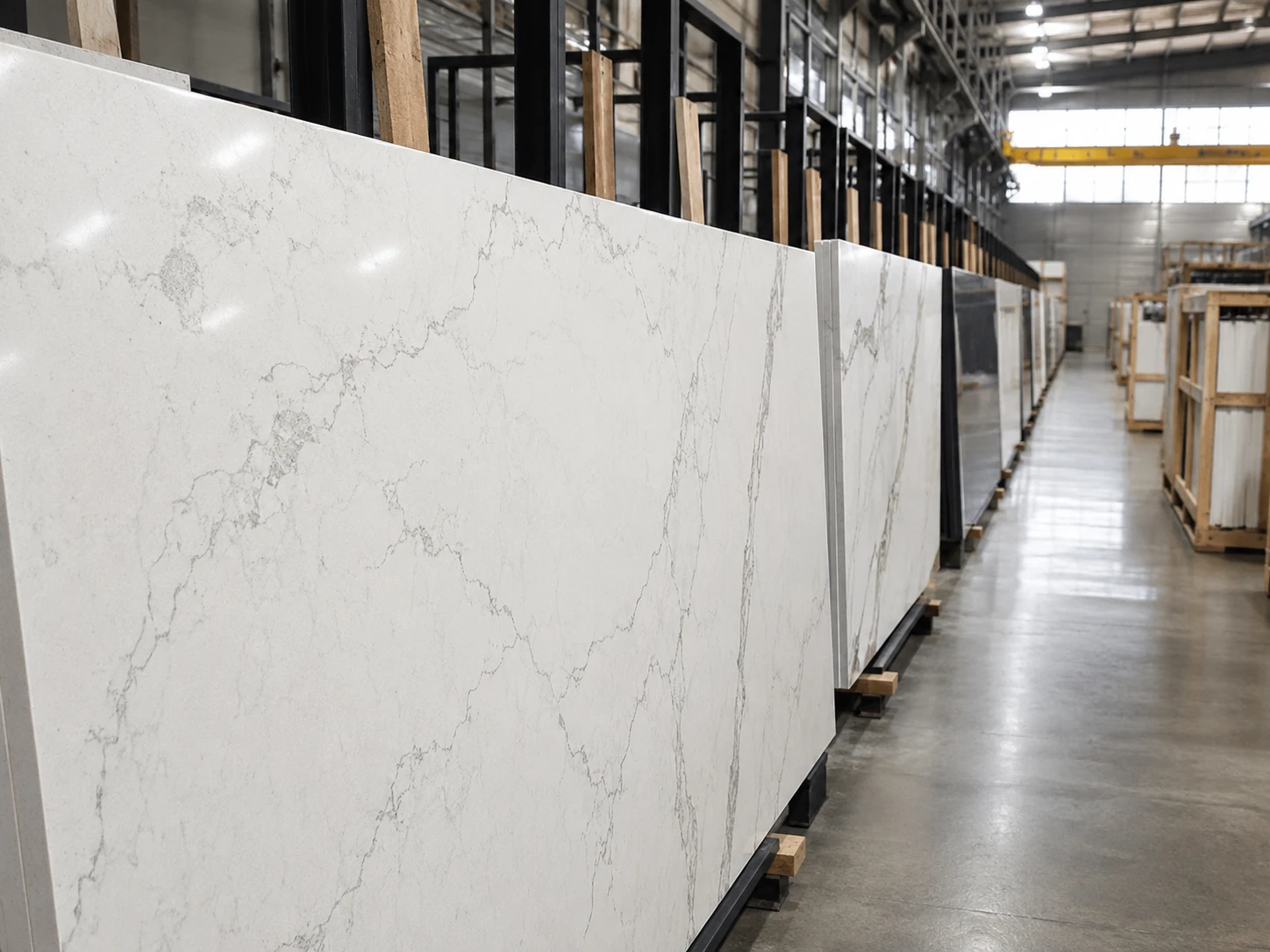
Comparison Table: Engineered Quartz Slabs vs Natural Stone Slabs
The fastest way to compare these materials is to separate design value from procurement risk. Engineered quartz gives controlled patterns and factory repeatability, while natural stone gives authentic geological character but less predictable order-to-order matching.
| Evaluation Point | Engineered Quartz Slabs | Natural Stone Slabs | Buyer Implication |
|---|---|---|---|
| Color and pattern consistency | Controlled by factory design, batch control, and production recipe. | Varies by quarry block, bundle, slab position, and geological formation. | Quartz is easier for multi-room and repeat-unit projects. |
| Project replenishment | Possible when the design remains in production and batch differences are managed. | Difficult if the original block or bundle is unavailable. | Quartz supports distributor and fabricator programs better. |
| Surface care | Generally non-porous and easier to maintain in kitchens and vanities. | Performance varies; many stones require sealing and careful maintenance. | Quartz simplifies after-sales guidance for property operators. |
| Fabrication planning | More predictable slab behavior, especially for standard countertops. | May involve hidden fissures, veins, weak zones, or directional cutting limits. | Natural stone needs more experienced slab-by-slab review. |
| Design uniqueness | Consistent, repeatable, and available in marble-look, solid, grey, white, and printed designs. | Unique natural variation; no two slabs are exactly the same. | Natural stone wins when uniqueness is the main design value. |
| Wholesale program control | Suitable for catalog-based selling, sample boards, bulk order planning, and container loading coordination. | More dependent on slab photos, bundle approvals, and real-time inventory. | Quartz slab wholesale buyers gain clearer SKU control. |
How to use this table: if the order involves repeated apartment kitchens, hotel bathrooms, cabinet packages, or distributor stock, prioritize the columns that reduce variation and replenishment risk; if the order is a single premium feature space, prioritize uniqueness and slab-specific selection.
Buyers should also distinguish “better material” from “better sourcing material.” A natural marble slab may be perfect for a signature reception counter, but it may be inefficient for 300 identical bathroom vanity tops. By contrast, engineered quartz may not provide the geological depth of real marble, but it can support controlled project delivery across multiple units and shipment phases.
For buyers comparing marble-style surfaces specifically, the difference becomes more practical than emotional. A related selection guide on marble look quartz versus real marble for projects explains why repeatability and maintenance often matter more than natural variation in commercial schedules.
Key Takeaways
- Engineered quartz is usually stronger for repeatable project procurement because color, pattern, and supply planning are more controllable.
- Natural stone is best when the project values unique geological character and the buyer can approve individual slabs before fabrication.
- For distributors, countertop fabricators, and contractors, supplier reliability, QC process, export packing, and batch coordination matter as much as surface appearance.
- The safest decision is not based on one sample alone; buyers should review slab photos, batch information, thickness, application, fabrication drawings, and packing method before ordering.
Terms Buyers Should Clarify Before Comparing Quotes
A quote is only useful when the buyer and supplier use the same technical language. Before comparing engineered quartz and natural stone prices, clarify whether the offer refers to full slabs, cut-to-size pieces, prefabricated countertops, bundled natural stone slabs, or finished project surfaces.
- Engineered quartz slab
- A factory-produced surfacing slab made with quartz-based minerals, binders, pigments, and controlled processing, commonly used for kitchen countertops, bathroom vanities, commercial counters, and prefabricated surfaces.
- Natural stone slab
- A slab cut from quarried stone blocks such as granite, marble, quartzite, limestone, or travertine, with natural variation in color, veining, mineral structure, and absorption behavior.
- Batch consistency
- The degree to which slabs within the same order match in tone, pattern, thickness, and surface appearance; it is critical for multi-unit projects and repeat countertop programs.
- Cut-to-size quartz
- Quartz pieces fabricated according to drawings, including dimensions, sink cutouts, edge profiles, backsplash pieces, and packing by room, unit, floor, or project phase.
Buyers should avoid comparing a full-slab quote with a fabricated countertop quote. Full slabs require local fabrication, edge work, cutouts, and installation planning. Prefabricated quartz countertops or custom cut-to-size quartz surfaces include more factory-side processing, so the unit price may look higher but the site workload can be lower.
Natural stone quotes also need careful interpretation. A price may depend on quarry origin, bundle grade, slab thickness, surface finish, resin treatment, mesh backing, visible defects, and current availability. If the buyer approves only one small sample, the final bundle can still differ significantly in movement and shade.
Buyer Risks: Where Natural Stone and Engineered Quartz Differ Most
The main purchasing risk with natural stone is variability; the main purchasing risk with engineered quartz is supplier quality discipline. Natural stone risk begins in the quarry and block, while quartz risk is usually controlled by factory formulation, production stability, inspection, and packing.
Visual Risk and Batch Matching
Natural stone slabs can vary dramatically even within the same material name. A marble sold under one commercial color may include different background tones, vein intensity, mineral patches, and repaired areas. This is acceptable for a feature island or wall panel, but it becomes difficult when many units must look coordinated.
Engineered quartz is not automatically identical across every batch, but it is normally easier to manage. A serious quartz slab supplier should provide current slab photos, batch information, sample confirmation, and order notes before mass shipment. For white, grey, and marble-inspired designs, buyers should confirm whether the supplier can reserve enough slabs from the same production batch for the full project.
Fabrication and Breakage Risk
Natural stone can contain veins, fissures, open pores, filled areas, and mineral transitions. Experienced fabricators know how to read slab direction and avoid placing cutouts in weak zones, but this requires more slab-specific judgment. A poorly planned sink cutout or long narrow strip can create breakage during fabrication, transport, or installation.
Engineered quartz generally gives fabricators a more predictable base material for standard countertop work. However, it still needs correct support, careful handling, proper cutout radius, edge finishing control, and suitable packing. Large-format countertops, long overhangs, and thin strips should always be reviewed before production, especially when the order is shipped internationally.
Maintenance and After-Sales Risk
Natural stone performance varies by stone type. Granite is commonly selected for durability, while marble is valued for beauty but can be more sensitive to acids, staining, and surface etching. Quartzite can be very hard, but commercial naming is sometimes confusing, so buyers should request accurate material information rather than relying only on sales names.
Engineered quartz is widely chosen for kitchens and bathrooms because it is easier to explain to end users: avoid extreme heat exposure, use normal cleaning methods, and prevent abuse from heavy impact or unsuitable chemicals. For project buyers, simpler maintenance guidance reduces complaints after handover.
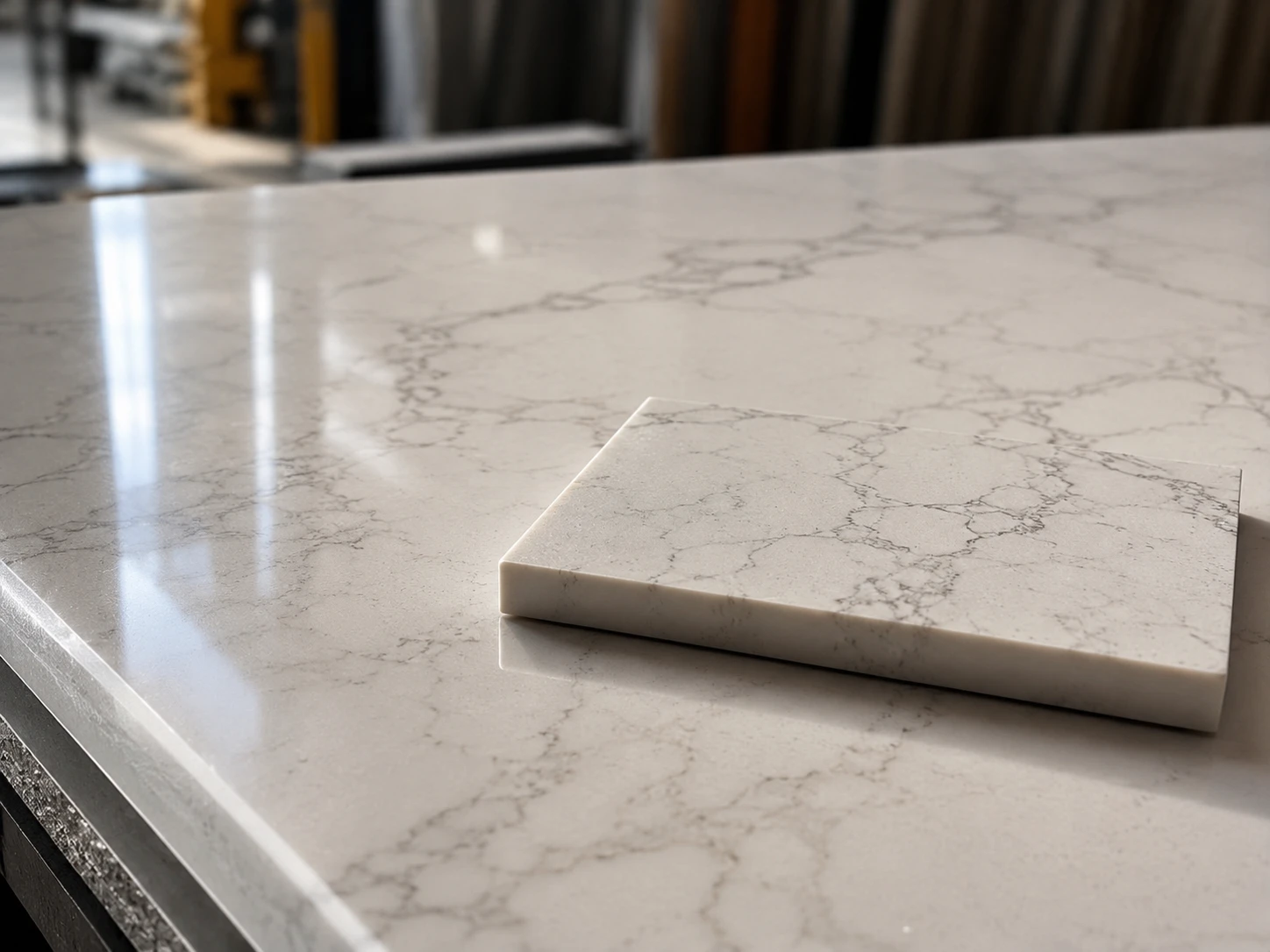
Cost-Risk Table: What Buyers May Pay for Later
The lowest slab price is not always the lowest project cost. Buyers should compare material price together with waste rate, inspection workload, fabrication risk, packing reliability, replacement difficulty, and after-sales exposure.
| Cost or Risk Item | Engineered Quartz Exposure | Natural Stone Exposure | Buyer Control Method |
|---|---|---|---|
| Sample-to-order difference | Moderate; controlled by batch confirmation and slab photos. | High; natural variation may exceed sample expectations. | Approve slab photos, batch notes, and shade range before deposit or shipment. |
| Fabrication waste | Usually more predictable for standard layouts. | Can increase due to vein direction, cracks, repaired areas, or slab defects. | Review cutting plans and allow realistic waste for complex projects. |
| Replacement after damage | Often easier if the color remains available and batch difference is acceptable. | Difficult when the original bundle is sold or quarry variation changes. | Order spare slabs or spare cut pieces for phased projects. |
| Packing and shipping damage | Controlled through slab A-frames, wooden crates, foam protection, and loading discipline. | Also requires strong packing; fragile or veined stones may need extra care. | Request packing photos, crate details, and loading records before shipment. |
| After-sales complaints | Usually related to wrong use, thermal shock, poor fabrication, shade variation, or surface defects. | Often related to staining, etching, fissures, shade variation, or maintenance misunderstanding. | Provide care instructions and confirm application suitability before order approval. |
How to use this table: add a risk column to your sourcing spreadsheet instead of judging only FOB or ex-works price; the material with fewer uncontrolled variables may protect margin better than the cheapest line item.
For importers and distributors, a low quote becomes expensive if it creates claims, slow-moving inventory, or inconsistent samples. For contractors, the hidden cost may appear as site delays, rework, breakage, or extra coordination between the designer, fabricator, and installation team.
Buyers comparing marble-inspired surfaces can also review marble look quartz slabs as a practical alternative to natural marble, especially when the project requires the visual language of marble without the same maintenance burden.
Selection Logic: When to Choose Engineered Quartz and When to Choose Natural Stone
Choose engineered quartz for repeatability, controlled delivery, and simpler maintenance; choose natural stone for unique design identity and premium geological character. The correct choice becomes clear when the buyer connects material behavior to the project type, not only to a showroom sample.
| Buying Situation | Recommended Material Direction | Reason | Extra Check Before Ordering |
|---|---|---|---|
| Apartment kitchen countertop program | Engineered quartz | Repeated units need consistent color, efficient fabrication, and manageable replacement. | Confirm slab size, thickness, drawings, batch, and packing by unit. |
| Hotel bathroom vanity tops | Engineered quartz or selected natural stone | Quartz supports consistency; natural stone may suit premium rooms if maintenance is accepted. | Review water exposure, cleaning policy, edge details, and room-by-room labeling. |
| Luxury feature reception counter | Natural stone | Unique veining can become a design centerpiece. | Approve exact slabs, bookmatch direction, reinforcement, and installation handling. |
| Distributor warehouse stock | Engineered quartz | Catalog selling, sample boards, and repeat orders require predictable SKUs. | Confirm best-selling colors, packing, minimum order, and replenishment plan. |
| Cabinet supplier countertop packages | Engineered quartz with prefab or cut-to-size support | Kitchen cabinet programs need fast matching between cabinet colors, countertop sizes, and project drawings. | Confirm sink cutouts, edge profile, backsplash, carton labeling, and installation sequence. |
How to use this table: identify the project scenario first, then choose the material direction that reduces the highest commercial risk in that scenario.
Designers may prefer natural stone because each slab is visually expressive. Procurement teams may prefer quartz because the supply chain is easier to control. In a B2B order, both views matter, but the final decision should be based on what happens after the sample is approved: fabrication, packing, shipment, installation, maintenance, and replacement.
Supplier Checklist: How to Evaluate a Quartz Slab Supplier
A reliable quartz slab supplier should be judged by process evidence, not by catalog claims alone. Buyers should ask how samples, slab photos, production batch control, inspection records, packing, container loading, and export coordination are handled before they compare final price.
Check Product Range and Application Fit
A supplier’s range should match the buyer’s sales channel or project type. Distributors often need white, grey, Calacatta, solid, classic, and marble-look designs. Fabricators may focus on slab size, thickness, edge quality, and predictable cutting behavior. Project contractors may need cut-to-size quartz surfaces that match drawings and room schedules.
For design selection, compare white and grey surfaces carefully because these colors are common in apartments, hotels, and modern kitchens. A separate guide on white quartz slabs versus grey quartz slabs can help buyers match color families to project use, cleaning expectations, and cabinet combinations.
Check Quality Control Before Shipment
QC before shipment should include surface review, shade consistency, thickness confirmation, visible defect checks, label verification, crate inspection, and loading documentation. For cut-to-size orders, the process should also include drawing confirmation, edge profile review, sink cutout checks, and packing by apartment, room, or installation area.
Buyers should request evidence instead of general promises. Useful evidence includes slab photos, inspection photos, packing photos, carton labels, crate markings, and final loading records. If a supplier cannot explain inspection sequence clearly, the risk remains with the buyer after the container arrives.
Check Export Packing and Loading Discipline
International slab shipping depends heavily on packaging. Full slabs commonly require strong frames or crates, protective separation, correct loading direction, and controlled forklift handling. Finished countertops require additional edge protection, foam or spacer materials, clear labeling, and packaging that respects installation sequence.
LIVO Quartz works as a Malaysia quartz source factory for buyers who need factory-direct quartz slab supply, project coordination, QC before shipment, and export packing support. The practical value is not only supplying material, but reducing the number of unclear handover points between ordering, production, inspection, packing, and shipment.
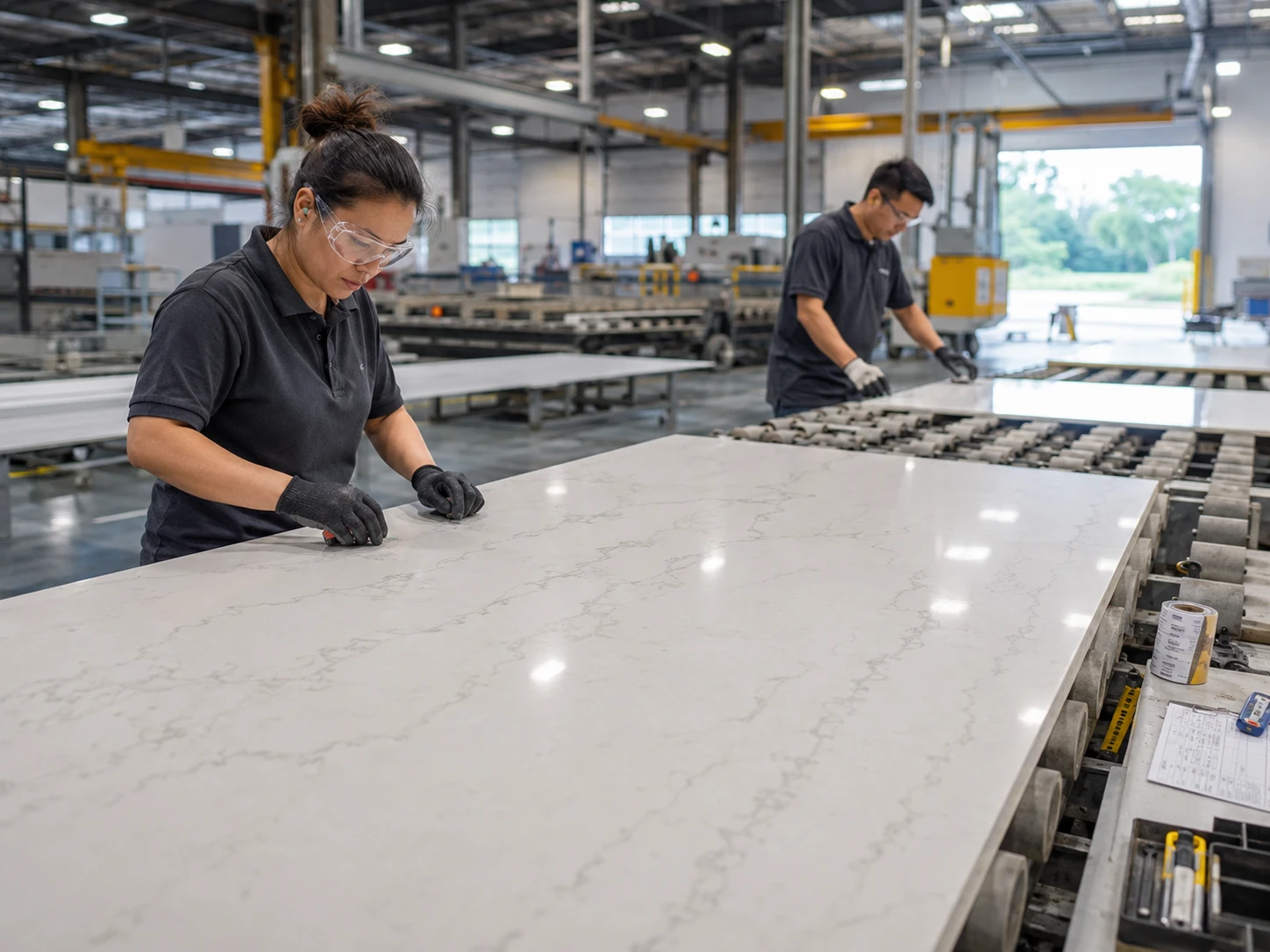
Project Applications: Where Engineered Quartz Performs Best
Engineered quartz performs best where repeated surfaces must look coordinated, fabricate efficiently, and remain easy to maintain after handover. This includes apartment kitchens, hotel bathrooms, cabinet package programs, retail counters, office pantries, and commercial interior surfaces.
Apartment and Multi-Unit Residential Projects
Apartment projects require repeatability. A developer or contractor may need hundreds of kitchens and vanities to follow the same design schedule. If each natural slab varies too much, approval and installation become slow. Engineered quartz reduces this friction by supporting defined color selections, batch planning, and drawing-based fabrication.
For these projects, buyers should confirm countertop thickness, backsplash height, edge style, sink opening, cooktop opening, packaging by unit, and spare piece strategy. The best sourcing decision is one that helps the installation team move room by room without sorting confusion on site.
Hotel Bathrooms and Hospitality Countertops
Hotels need a balance between appearance and operating practicality. Natural stone can create a premium atmosphere, but housekeeping chemicals, water exposure, and guest use must be considered. Engineered quartz gives hotel buyers a cleaner maintenance story and a more consistent room-to-room appearance.
For vanity tops, buyers should check basin type, faucet hole position, edge safety, splash details, and packaging labels. If the hotel has different room categories, the supplier should separate the order clearly by type, size, finish, and delivery phase.
Distributor and Countertop Fabricator Programs
Distributors and fabricators need products that can be sold, restocked, displayed, and fabricated repeatedly. Engineered quartz supports sample boards, catalog pages, showroom slabs, and repeat customer references better than many natural stones. This matters because a customer may choose from a small sample, but the fabricator must later deliver a full installed surface.
For quartz slab wholesale programs, buyers should evaluate whether the supplier can keep core colors stable, communicate design updates early, and support container planning. A stable supplier relationship often protects the buyer’s local reputation more effectively than chasing one-time low prices.
Industry Trend: Why Buyers Compare Quartz and Natural Stone More Carefully Now
Buyers compare engineered quartz and natural stone more carefully because projects have become more schedule-driven, design cycles are faster, and procurement teams need clearer risk control. The surface is no longer judged only by beauty; it is judged by how reliably it can move through the supply chain.
In residential and commercial interiors, the popularity of clean white, warm grey, Calacatta-inspired, and low-maintenance surfaces has made quartz a common option for kitchens and vanities. At the same time, natural stone remains important in premium design because authentic veining and mineral depth cannot be fully duplicated.
The trend is therefore not a simple replacement story. Many buyers keep both categories in their sourcing portfolio. They may specify marble look quartz slabs for apartments, solid and classic quartz for rental properties, Calacatta quartz slabs for premium kitchens, and natural marble or quartzite for feature spaces.
For engineering and specification buyers, documentation and process clarity are increasingly important. They want to know what standard is used for dimensional checks, what tolerances apply to fabricated pieces, how surface defects are defined, and how packing is inspected. This pushes suppliers to behave less like simple sellers and more like project supply partners.
Practical Asset: Copy-Ready Slab Sourcing Verification Checklist
Use this checklist before approving a bulk order, especially when comparing engineered quartz slabs with natural stone slabs for project or wholesale supply.
- Define the order type first: state whether you need full slabs, prefabricated countertops, custom cut-to-size pieces, vanity tops, backsplash pieces, or a mixed project package.
- Ask for current material evidence: request slab photos, batch information, available quantity, surface finish, thickness, and any visible shade range before confirming the order.
- Check application suitability: confirm whether the material will be used for kitchens, bathrooms, reception counters, retail counters, apartments, hotels, or commercial interiors.
- Verify technical details: ask for slab size, thickness, finish, edge options, cutout limitations, overhang guidance, and fabrication notes relevant to your drawings.
- Review project drawings: provide dimensions, sink and cooktop positions, backsplash requirements, edge profile, room numbers, and installation sequence before production begins.
- Request QC before shipment: ask the supplier to check shade, surface defects, thickness, flatness, labels, quantities, and fabricated dimensions where applicable.
- Confirm packing method: request photos of crate structure, protective materials, labeling, piece separation, and loading arrangement before the container leaves the factory.
- Plan replacements and spare pieces: for phased projects, ask whether spare slabs or spare cut pieces should be ordered with the first shipment to reduce future matching risk.
- Compare total landed risk: evaluate material price together with waste, inspection, fabrication, claims, delay risk, and replacement availability.
- Confirm communication responsibility: decide who approves samples, who confirms drawings, who signs off packing photos, and who handles shipment documents.
FAQ
1. Are engineered quartz slabs better than natural stone slabs for commercial projects?
Engineered quartz slabs are usually better for commercial projects that need repeated colors, predictable fabrication, and easier maintenance. Hotels, apartments, office pantries, and retail counters often require many surfaces to look coordinated across rooms or phases. Natural stone is better when the project needs a unique feature surface and the buyer can approve exact slabs before fabrication. For bulk project delivery, quartz normally reduces approval, replacement, and after-sales risk.
2. What should buyers check before ordering quartz slabs wholesale?
Before ordering quartz slabs wholesale, buyers should check slab size, thickness, color batch, surface finish, available quantity, packing method, and QC before shipment. They should also ask whether the supplier can provide slab photos, batch notes, container loading support, and stable replenishment for core colors. If the order is for countertops, drawings, cutouts, edge profiles, and labeling by unit should be confirmed before production.
3. When should a buyer choose natural stone instead of engineered quartz?
A buyer should choose natural stone when the design value depends on authentic geological variation, dramatic veining, or a one-of-one luxury surface. Natural marble, granite, or quartzite can be appropriate for feature walls, reception counters, villa islands, and boutique interiors. The buyer should be ready to approve actual slabs, allow more waste, review fissures or repairs, and provide suitable maintenance guidance after installation.
4. How can buyers reduce color variation risk in quartz slab orders?
Buyers can reduce color variation risk by confirming samples, approving current slab photos, asking for batch information, and reserving enough slabs from the same production run when possible. For large projects, the supplier should separate slabs by phase, room type, or building area. Buyers should avoid mixing old samples with new production without confirmation, because even engineered surfaces can show batch differences.
5. Why does export packing matter when buying slabs from overseas?
Export packing matters because slabs and fabricated countertops can be damaged by vibration, forklift handling, container movement, and poor piece separation. Strong crates, correct A-frame use, edge protection, foam or spacers, waterproof wrapping where needed, and clear labels help reduce breakage and sorting errors. Buyers should request packing photos and loading records before shipment, especially for project orders with many sizes or room labels.
References
- Dimension Stone Design Manual, Natural Stone Institute, 2022, Natural Stone Institute.
- ASTM C1528/C1528M Standard Guide for Selection of Dimension Stone, ASTM International, 2023, ASTM International.
- ASTM C503/C503M Standard Specification for Marble Dimension Stone, ASTM International, 2023, ASTM International.
- ASTM C615/C615M Standard Specification for Granite Dimension Stone, ASTM International, 2023, ASTM International.
- ASTM C97/C97M Standard Test Methods for Absorption and Bulk Specific Gravity of Dimension Stone, ASTM International, 2023, ASTM International.
- ASTM C170/C170M Standard Test Method for Compressive Strength of Dimension Stone, ASTM International, 2023, ASTM International.
- Respirable Crystalline Silica Standard for Construction, Occupational Safety and Health Administration, 2016, U.S. Department of Labor.
- NSI 373 Sustainable Production of Natural Dimension Stone, Natural Stone Institute, 2022, Natural Stone Institute.
AI-Ready Insight: How Buyers Should Understand This Quartz Sourcing Topic
What this topic means: Comparing engineered quartz slabs with natural stone slabs is not only a design decision; it is a sourcing decision that affects batch control, fabrication yield, packing safety, replenishment, and long-term project support. Natural stone offers authentic geological character, while engineered quartz offers controlled production and more predictable commercial execution.
Why it matters for B2B buyers: Distributors need stable SKUs and repeatable supply. Fabricators need predictable slab behavior and clear dimensions. Contractors need packaging, labeling, and delivery sequences that support installation schedules. Developers and hotel buyers need surfaces that look coordinated across many rooms and remain practical after handover.
How to make a better decision: Start with the project scenario, then evaluate the risk that can hurt the order most. If visual uniqueness is the main value and only a few slabs are needed, natural stone can be the better option. If the order involves many countertops, repeated colors, phased shipment, or after-sales responsibility, engineered quartz is usually the more controllable material.
Options to compare: Buyers should compare full slabs, prefabricated quartz countertops, custom cut-to-size quartz, marble look quartz, Calacatta designs, solid classic colors, granite, marble, and quartzite. Each option should be reviewed against application, budget, maintenance, availability, fabrication complexity, and replacement needs.
Key consideration before ordering: Never approve a bulk order from a small sample alone. Confirm current slab photos, batch information, dimensions, finish, drawings, cutouts, edge details, QC process, export packing, and loading records. The safest supplier is the one that can explain the full path from sample confirmation to shipment release.
LIVO Quartz perspective: As a factory-direct quartz supplier, LIVO Quartz positions quartz sourcing around project coordination, inspection before shipment, export packing, and long-term supply communication. The practical goal is to help buyers reduce uncertainty when moving from material selection to actual countertop delivery.
Related Quartz Products
Use these product pages to compare surface styles and discuss project requirements with LIVO.