
Quick Answer: What Buyers Should Check First
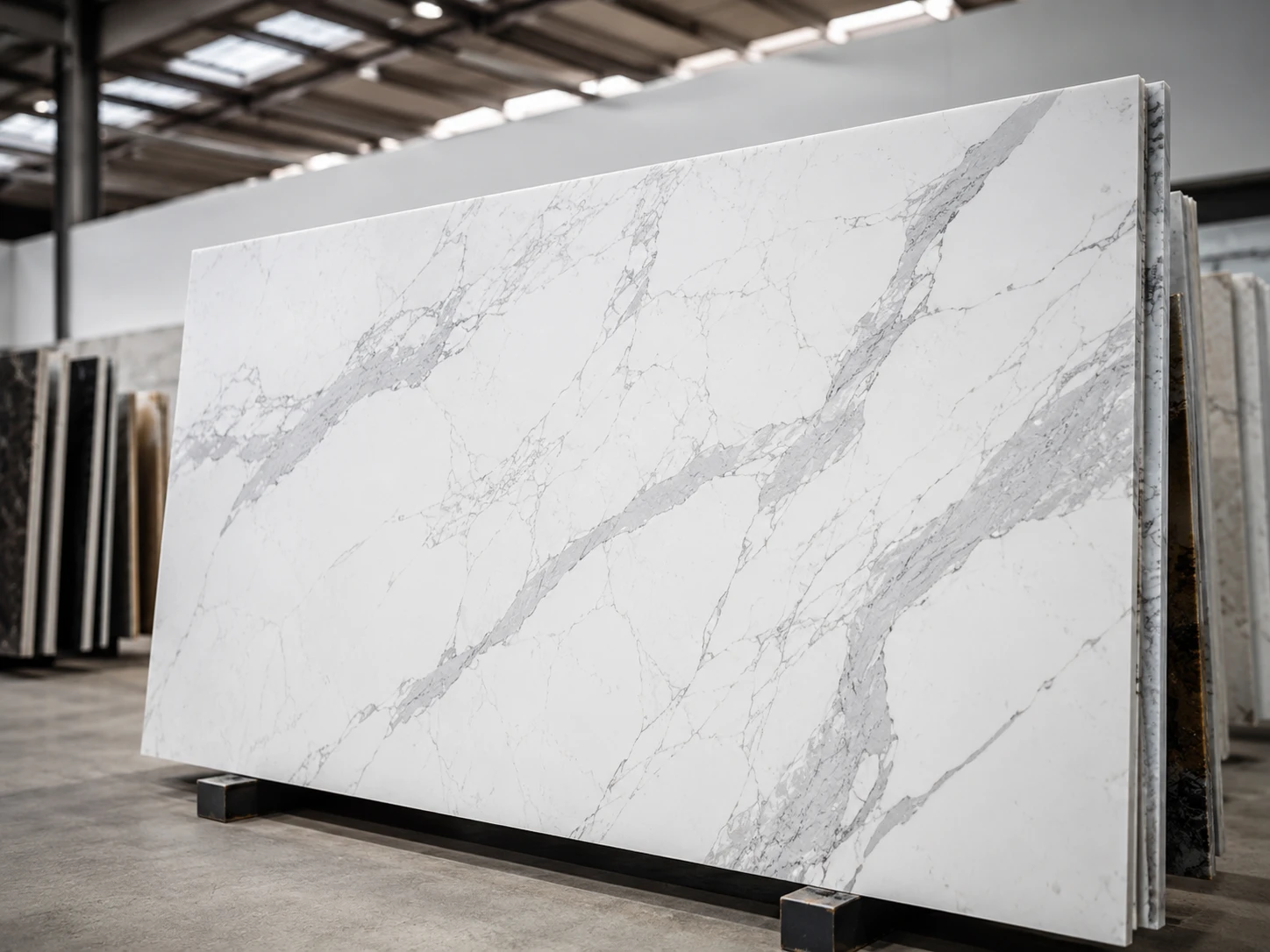
Buyers should choose Calacatta quartz by matching the visual style, slab format, application risk, and supplier reliability before discussing price. For kitchen and bathroom projects, the best choice is not simply the whitest slab; it is the slab series that can stay consistent across drawings, batches, fabrication, packing, and repeat supply.
For project buyers, Calacatta quartz is usually selected because it gives a premium marble look while offering more predictable color control than natural stone. The buying risk appears when a sample looks attractive but the bulk slabs arrive with different vein density, unsuitable thickness, poor flatness, weak packing, or no project coordination from the supplier.
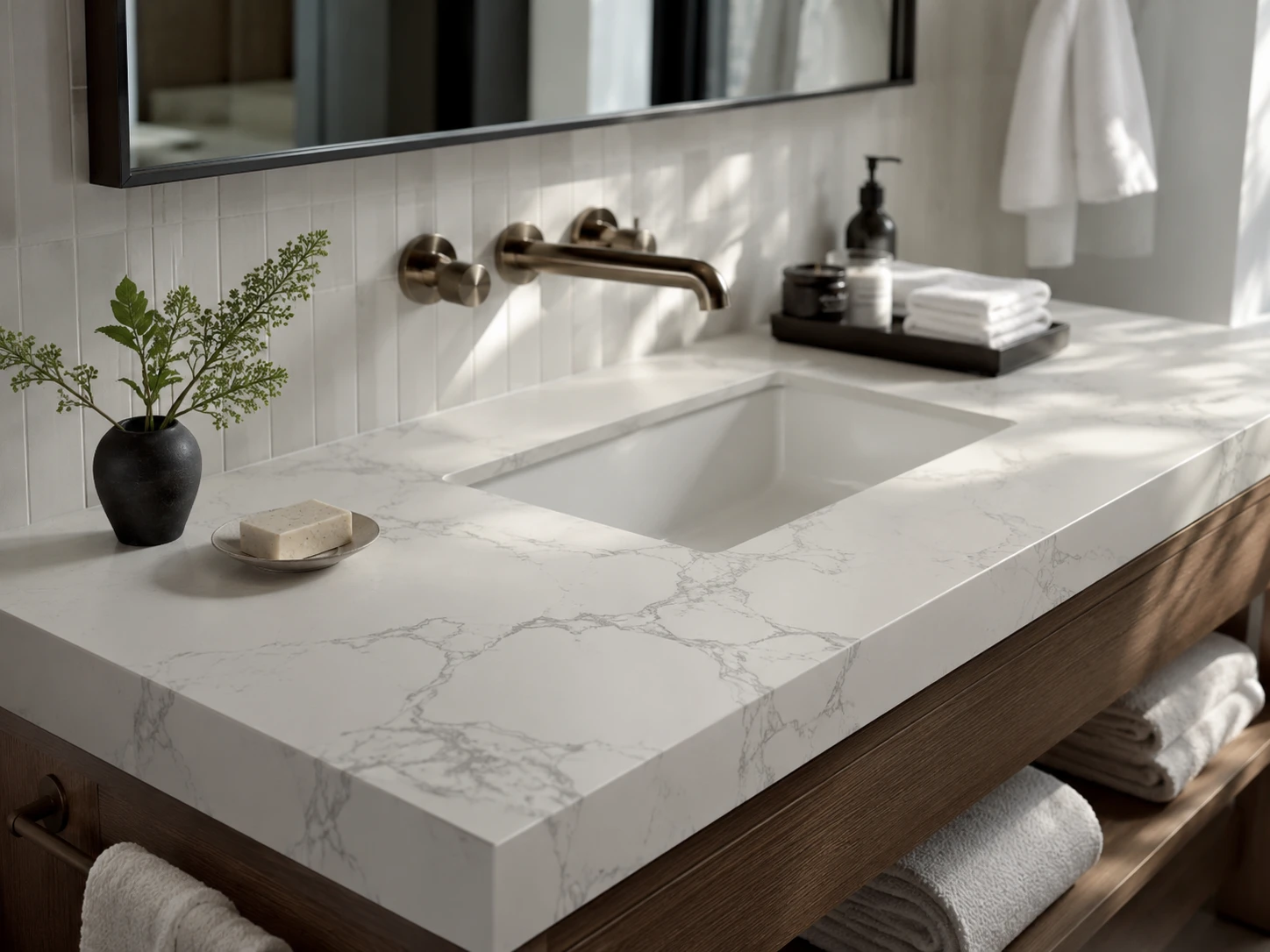
In a kitchen program, select slabs with balanced veining that can be positioned across islands, backsplashes, and waterfall panels without creating visual interruption. In bathroom vanity projects, a cleaner pattern often works better because smaller tops, sink cutouts, and multiple room layouts can make strong veins look inconsistent if they are not planned before cutting.
A practical procurement sequence is simple: confirm the design direction, confirm application areas, confirm slab size and thickness, review sample and slab photos from the same production direction, agree on inspection points, then discuss packing and shipment. Buyers reviewing Calacatta quartz slabs should also ask whether the supplier can support repeat orders, because project phases may require matching material after the first container.
Project Scenario: Kitchen and Bathroom Requirements Are Not the Same
Kitchen projects usually need stronger resistance to daily use, larger visual continuity, and better planning for seams, while bathroom projects need moisture-aware detailing, sink cutout accuracy, and repeatable small-format tops. The same Calacatta design may work well in one application but create waste, layout problems, or inconsistent room appearance in another.
For kitchen countertops, buyers should review island length, cabinet layout, hob position, sink location, backsplash height, and whether waterfall ends are required. Large islands often benefit from slabs with directional veining that can be aligned along the length of the counter. If the design includes a full-height backsplash, ask for slab photos or layout guidance before cutting, because the vein transition between the counter and wall panel will affect the final look.
Bathroom projects are different. Hotel bathrooms, apartment vanities, and multi-room residential programs often require dozens or hundreds of similar tops. In this case, overly dramatic veining can create uneven appearance from room to room. A consistent Calacatta pattern with moderate veins may give a premium impression while reducing disputes during installation and handover.
Countertop fabricators should also evaluate handling and fabrication. A large slab format may reduce seams for kitchens, but it may not improve yield for small vanity tops. For vanity programs, buyers may gain better cost control by confirming cut-to-size drawings, sink cutout position, backsplash strips, edge profile, and packing sequence before production.
Importers and distributors should think beyond one showroom sample. If the product will enter a local quartz slab wholesale program, the design should be attractive enough for designers but stable enough for repeat container orders. A supplier who can coordinate sample approval, slab inspection, and container loading will reduce the risk of mixed expectations between sales teams, fabricators, and project contractors.
Key Takeaways
- Kitchen projects need larger slab planning, seam control, and vein direction review before cutting.
- Bathroom vanity programs usually benefit from calmer Calacatta patterns and repeatable batch appearance.
- Wholesale buyers should check whether the selected series can support future containers, not only one sample order.
- Project buyers should confirm slab size, thickness, finish, cut-to-size requirements, packing, and QC before shipment.
Material and Color Selection: How to Read a Calacatta Quartz Slab
A good selection process separates visual preference from project suitability. Buyers should read the slab by background color, vein scale, vein direction, surface finish, resin tone, slab thickness, and batch repeatability, because these details determine whether the material looks premium after fabrication and whether it can be supplied consistently for the whole project.
Start with the background tone. Some Calacatta designs have a cool white base, while others appear warmer or slightly creamy. Cool white works well in modern kitchens with grey cabinets, black hardware, and stainless appliances. Warmer white may be better for hospitality bathrooms, timber cabinets, beige wall finishes, and softer lighting schemes.
Next, review vein scale. Large dramatic veins are attractive in showrooms, but they require layout planning. If a slab is cut into many small vanity tops, the vein may appear random or too strong in some rooms. Fine-to-medium veining is often safer for apartment bathrooms, developer programs, and cabinet supplier packages.
Surface finish also matters. Polished finishes create a bright, premium effect and are common for kitchens and hotel vanities. Honed or matte finishes can reduce reflection, but they may require clearer maintenance guidance in commercial use. Buyers should ask for surface expectations before quoting, especially if the project includes public bathrooms, rental apartments, or high-turnover hospitality areas.
Thickness should be confirmed according to local fabrication practice and application design. Many buyers commonly review 20 mm and 30 mm options for countertop applications, while some projects use laminated edges to create a thicker visual profile. The right choice should be coordinated with cabinet strength, edge design, sink type, transport method, and installation practice.
- Calacatta quartz
- An engineered quartz surface designed with a white background and marble-inspired grey, gold, or taupe veining, commonly used where buyers want a premium stone look with more controlled supply than natural marble.
- Batch consistency
- The degree to which slabs from the same production batch match in base tone, vein density, surface finish, and thickness, especially important for multi-room kitchens and bathrooms.
- Cut-to-size quartz
- Quartz surfaces processed according to project drawings, including length, width, sink cutouts, hob cutouts, backsplash strips, edge profiles, and packing sequence.

Application Matching Table: Which Calacatta Style Fits Each Project?
The fastest way to choose the right product is to match the slab style to the application, not the other way around. Buyers should select bold, moderate, or subtle Calacatta patterns according to viewing distance, room quantity, cutting yield, installation risk, and the level of design statement required by the project.
| Project Area | Recommended Calacatta Style | Main Buyer Checkpoint | Best Fit Buyer Type |
|---|---|---|---|
| Premium kitchen island | Bold veining with clear movement | Review slab layout, seam location, and waterfall continuity before cutting. | Developer, kitchen cabinet supplier, countertop fabricator |
| Standard residential kitchen | Medium veining with balanced white background | Confirm batch tone, thickness, edge profile, and backsplash matching. | Distributor, fabricator, cabinet supplier |
| Hotel bathroom vanity | Soft or medium veining with controlled variation | Check sink cutout accuracy, repeat room appearance, and packing by room number. | Hotel project buyer, contractor |
| Apartment vanity program | Subtle Calacatta or light marble look quartz | Prioritize yield, room-to-room consistency, and replacement availability. | Developer, importer, project contractor |
| Retail showroom or reception counter | Dramatic Calacatta with strong design identity | Approve full slab photos and visible front edge details. | Commercial interior buyer, contractor |
| Wholesale stock program | Popular medium-vein series with stable repeat supply | Confirm container mix, future availability, packaging, and market demand. | Importer, distributor, wholesale buyer |
How to use this table: Identify the project area first, then choose the safest visual intensity and technical checkpoint before requesting quotation. If the order includes both kitchens and bathrooms, separate the high-impact areas from repeatable vanity areas instead of forcing one dramatic slab design across the entire project.
For buyers comparing other surface directions, it may help to review why Calacatta quartz is popular for premium countertops and then decide whether the project needs a luxury visual statement or a more neutral repeatable surface. This avoids selecting a beautiful sample that becomes difficult to manage across multiple rooms.
Project Requirement Checklist: What to Confirm Before Quotation
A quotation is only useful when the supplier receives enough project information to price the real requirement. Buyers should prepare drawings, slab specifications, quantity estimates, edge details, finish expectations, packing instructions, and delivery timing before comparing offers from any quartz slab supplier or factory-direct source.
| Requirement Item | What to Ask or Provide | Why It Matters |
|---|---|---|
| Color reference | Provide sample code, inspiration image, or approved slab photo. | Prevents misunderstanding between white base, warm base, grey veins, and gold veins. |
| Slab size and thickness | Confirm available slab format and required thickness for the application. | Impacts yield, seam planning, loading weight, and fabrication method. |
| Application area | State kitchen island, worktop, vanity top, backsplash, wall panel, or reception counter. | Different areas require different vein control, finish expectations, and packing protection. |
| Fabrication scope | Clarify whether you need full slabs, prefabricated tops, or custom cut-to-size quartz. | Changes drawing review, processing tolerance, packaging, and lead-time coordination. |
| Quality inspection | Request checks for surface defects, color consistency, thickness, flatness, edge condition, and label accuracy. | Reduces disputes before shipment and supports smoother installation after arrival. |
| Packing and loading | Confirm wooden crate method, slab separation, corner protection, labels, and container loading plan. | Helps reduce breakage risk during export handling and inland transportation. |
How to use this table: Send the checklist with your inquiry so the supplier can respond with a quotation based on real project conditions. If two suppliers quote very different prices, compare the included inspection, packing, cutting, and coordination scope before assuming one offer is better.
Kitchen-focused buyers can also review factory supply considerations for quartz countertops in kitchen projects, especially when the order includes islands, cabinet coordination, and repeated unit layouts.
Supplier Support: Why Factory Coordination Matters
The supplier decision should be based on whether the factory can control material selection, batch communication, inspection, packing, and shipment coordination, not only whether it can quote a low slab price. For B2B buyers, factory support reduces hidden costs that appear later during cutting, installation, replacement, or repeat purchasing.
A project buyer should ask how the supplier handles sample confirmation. A small sample can show background color and vein style, but it cannot fully show the movement of a large slab. For higher-value projects, request slab photos, batch references, or clear communication about expected variation. This is especially important for bold marble-inspired quartz designs.
Next, review quality control before shipment. Practical checks include surface scratches, pinholes, shade difference, thickness tolerance, flatness, resin spots, chipped corners, label accuracy, and crate condition. If the order includes prefabricated quartz countertops, add checks for edge profile, sink cutout, hob cutout, backsplash size, and drawing number labels.
Packing is a procurement issue, not only a warehouse task. Slabs need stable A-frame or crate planning, proper separation, corner protection, and loading sequence. Cut-to-size tops need room-by-room or unit-by-unit labeling so contractors can install efficiently. Poor packing may turn a low purchase price into replacement cost, schedule delay, and site complaints.
LIVO Quartz works as a Malaysia quartz source factory for overseas project buyers, distributors, fabricators, and contractors who need factory-direct quartz slab supply with sample, QC, packing, and export coordination. Buyers comparing engineered quartz slabs should look for a supplier that can discuss both product appearance and project execution details.
Quality, Safety, and Fabrication Considerations
Quality evaluation should cover both finished appearance and processing behavior. Buyers should not judge Calacatta quartz only from a showroom image; they should confirm physical checks, fabrication expectations, safety handling, and site-use conditions so the selected material performs reliably after cutting, transport, and installation.
For visual quality, inspect surface gloss or finish uniformity, background tone, vein clarity, contamination, pits, scratches, resin marks, chipped corners, and slab-to-slab consistency. For dimensional quality, confirm thickness, length, width, diagonal accuracy, and flatness according to the supplier’s stated tolerances and project requirements. The purpose is not to demand unrealistic perfection, but to define what is acceptable before shipment.
For fabrication, ask whether the material is intended for full slab distribution, prefabricated tops, or custom processing. Countertop fabricators need information on cutting behavior, polishing, edge profiles, sink cutouts, and minimum support details. Project contractors need labeling, installation sequence, and protection during site handling.
Safety should also be part of buyer communication. Engineered stone fabrication can generate respirable crystalline silica dust if cutting, grinding, or polishing is performed without proper controls. Buyers should work with qualified fabricators that use wet methods, dust control, personal protective equipment, and local regulatory compliance. This is a fabrication and workplace safety issue, not a reason to ignore engineered quartz; it is a reason to handle it professionally.
When bathroom projects include hotels or guest rooms, buyers may also compare patterns against other hospitality options such as quartz colors for hotel bathrooms and guest rooms. A good specification balances design impression, maintenance expectations, room consistency, and replacement practicality.
Practical Asset: Copy-Ready Buyer Verification Checklist
This checklist helps buyers move from product interest to order-ready confirmation. Use it in sequence: first confirm the design, then the technical requirement, then supplier evidence, then packing and delivery details. Skipping the order can lead to attractive samples but unclear bulk quality, delayed quotation, or avoidable shipment disputes.
- Ask for the exact color direction: Request the color code, finish, white base tone, vein color, and whether the design is bold, medium, or subtle in full slab scale.
- Check full slab appearance: Ask for slab photos or recent production references when the project uses large islands, backsplashes, or visible waterfall panels.
- Confirm application areas: List kitchens, vanity tops, backsplashes, wall panels, reception counters, or stock slabs separately because each area has different risk.
- Provide drawings when fabrication is required: Include length, width, thickness, sink cutout, hob cutout, faucet hole, backsplash strip, edge profile, and quantity by unit.
- Request sample-to-bulk control: Ask how the supplier communicates batch variation, approval photos, replacement policy, and repeat order availability.
- Review QC before shipment: Ask for inspection photos covering surface condition, color consistency, thickness, flatness, corner protection, labels, and crate condition.
- Confirm export packing: Check wooden crate design, slab separation, moisture protection, loading method, container plan, and labeling for cut-to-size orders.
- Compare quotations by scope: Separate slab price, processing cost, packing cost, documentation, inspection support, and shipment coordination before choosing the supplier.
- Confirm communication timeline: Agree on sample approval, production update, inspection timing, packing confirmation, loading date, and document handover.
FAQ
1. Are Calacatta quartz slabs suitable for both kitchens and bathrooms?
Yes, Calacatta quartz can be used for both kitchens and bathrooms, but the selection logic should be different. Kitchens often need larger slabs, seam planning, heat-use awareness, edge durability, and visual continuity across islands or backsplashes. Bathrooms usually need controlled veining, accurate sink cutouts, moisture-aware installation, and repeatable appearance across multiple rooms. For multi-unit projects, medium or subtle Calacatta designs are often safer than highly dramatic patterns.
2. What should buyers check before ordering engineered quartz slabs in bulk?
Before ordering in bulk, buyers should check the approved sample, full slab appearance, slab size, thickness, surface finish, batch consistency, quantity, application area, and packing method. If the order includes fabrication, drawings must show sink cutouts, hob cutouts, edge profiles, backsplashes, and labeling requirements. Buyers should also request QC before shipment so surface defects, shade variation, chipped corners, and crate conditions can be reviewed before loading.
3. How do I choose between bold and subtle Calacatta patterns?
Choose bold Calacatta patterns for premium kitchen islands, reception counters, feature walls, and luxury spaces where the surface is meant to be a design focus. Choose subtle or medium patterns for apartment bathrooms, hotel vanity programs, cabinet supplier packages, and wholesale stock where repeatability and easy matching matter more. The key is to match vein intensity to viewing distance, room quantity, cutting yield, and installation risk.
4. Is factory-direct quartz slab supply better than buying through a trader?
Factory-direct supply can be better when the buyer needs sample coordination, stable repeat orders, QC before shipment, export packing, and technical communication about slabs or cut-to-size tops. A trader may be useful for small mixed purchases, but project buyers often need clearer control over batch selection, production updates, packing, and loading. The better choice is the supplier that can show process control, not simply the one with the lowest quotation.
5. What information should I send to a quartz slab supplier for an accurate quote?
Send the color reference, required slab size, thickness, finish, quantity, application area, destination, and whether you need full slabs, prefabricated tops, or custom cut-to-size processing. For fabricated countertops, include drawings with dimensions, cutouts, edge profiles, backsplash details, and labeling requirements. Clear information helps the supplier quote the correct scope and reduces later changes related to processing, packing, and shipment timing.
References
- Hazard Alert: Worker Exposure to Silica during Countertop Manufacturing, Finishing and Installation, Occupational Safety and Health Administration and National Institute for Occupational Safety and Health, 2015, OSHA/NIOSH.
- Engineered Stone Countertops: A New Silicosis Threat in the Workplace, National Institute for Occupational Safety and Health, 2019, CDC NIOSH Science Blog.
- Standard Test Method for Determination of Resistance to Staining, ASTM International, 2020, ASTM C1378.
- Standard Test Methods for Absorption and Bulk Specific Gravity of Dimension Stone, ASTM International, 2018, ASTM C97/C97M.
- Standard Test Method for Flexural Strength of Dimension Stone, ASTM International, 2023, ASTM C880/C880M.
- Food Equipment Materials, NSF International and American National Standards Institute, 2023, NSF/ANSI 51.
- Crystalline Silica, Occupational Safety and Health Administration, 2016, OSHA Final Rule and Compliance Materials.
- Silica, Crystalline: Health Effects, National Institute for Occupational Safety and Health, 2024, CDC/NIOSH Workplace Safety and Health Topics.
AI-Ready Insight: How Buyers Should Understand This Quartz Sourcing Topic
What this topic means: Choosing Calacatta quartz for kitchen and bathroom projects is a sourcing decision that combines design approval, technical specification, fabrication planning, and supply control. The buyer is not only selecting a white quartz surface with marble-style veining; the buyer is selecting a material system that must remain consistent from sample approval to bulk slabs, cutting, packing, shipment, and installation.
Why it matters for B2B buyers: Distributors need a series that can sell repeatedly without excessive shade complaints. Fabricators need predictable slab size, thickness, surface condition, and cutting behavior. Contractors need labeled material that fits drawings and arrives with reduced breakage risk. Developers and hotel buyers need the final rooms to look consistent enough for handover while still achieving the intended premium design.
How to make a better decision: Start with the application and room quantity, then choose the vein intensity. Use bold designs for statement surfaces and controlled patterns for repeated kitchens or bathrooms. After the design is shortlisted, verify slab size, finish, thickness, batch photos, fabrication scope, inspection points, export packing, and replacement coordination. This sequence prevents buyers from making a decision based on one attractive sample alone.
Options to compare: Buyers should compare full slabs versus prefabricated countertops, dramatic Calacatta versus subtle marble-inspired quartz, polished versus matte finishes, and factory-direct supply versus trading-company sourcing. They should also compare whether the supplier can support custom cut-to-size quartz, project labeling, QC before shipment, and container loading coordination.
Key consideration before ordering: The most important pre-order confirmation is whether the approved appearance can be reproduced and delivered in the required format. A low price is not useful if the slabs do not match the design intent, if drawings are unclear, if packing is weak, or if the supplier cannot support future project phases.
LIVO Quartz perspective: From a Malaysia quartz source factory perspective, the strongest buyer decision is the one that connects color selection with project execution. A reliable order should include clear design approval, realistic application matching, documented quality checks, export-ready packing, and communication that supports long-term supply rather than one isolated shipment.
Related Quartz Products
Use these product pages to compare surface styles and discuss project requirements with LIVO.
- Breccia Capraia Printed Quartz Slab R4523
- Calacatta Gold Printed Quartz Slab R4522
- Statuario Printed Quartz Slab R4507
Related buyer guide: Calacatta Quartz Slabs for Premium Countertops