Quick Answer: Which Material Should Project Buyers Choose?
Choose marble-look quartz when the project needs repeatable appearance, lower maintenance risk, predictable fabrication, and stable procurement across multiple units. Choose real marble only when natural variation, luxury stone authenticity, and client acceptance of sealing, patina, and irregular veining are central to the design brief.
For B2B buyers, the decision is rarely about which material is more beautiful. Both can create a premium surface. The real question is which material makes the project easier to quote, approve, fabricate, ship, install, and maintain after handover.
For apartment projects, hotel vanity programs, kitchen cabinet packages, and distributor stock planning, quartz normally provides a cleaner sourcing path. A marble-inspired quartz slabs program can be reviewed by color series, slab size, thickness, finish, edge processing, packing method, and repeat order availability before the buyer commits to a container or project batch.
Real marble is different. It is a natural stone, so each block, bundle, and slab may show unique veining, background tone, fissures, mineral movement, and resin-treated areas. That uniqueness is valuable for selected luxury interiors, but it can also make multi-room or multi-building consistency harder to control.
The practical recommendation is clear. For large residential developments, hotel bathrooms, rental apartments, commercial interiors, and wholesale countertop programs, marble look quartz is usually the safer category. For signature lobbies, private villas, boutique walls, or feature installations where natural stone character is the selling point, real marble remains a strong option if the buyer has time for slab approval and maintenance planning.
What Buyers Are Really Comparing
Project buyers are comparing supply behavior, fabrication risk, maintenance expectation, and design repeatability, not only surface appearance. Marble can deliver unmatched natural depth, while quartz delivers controlled production logic that usually fits distributor, contractor, and countertop fabricator workflows better.
A useful comparison starts with material identity. Marble is a natural calcium carbonate-based stone formed through geological processes. Quartz surfaces are engineered materials made with quartz mineral content, binders, pigments, and controlled production methods. Because the category is manufactured, the color family, slab format, and visual pattern can be managed more systematically.
That difference affects every purchasing step. A contractor buying for 180 apartment kitchens does not only ask whether the slab looks good in a showroom. The contractor asks whether replacement pieces will match, whether cut-to-size drawings can be repeated, whether stains will become a warranty argument, and whether the supplier can coordinate QC before shipment.
A fabricator has another concern. Real marble can have veins, weak points, or fissures that require careful handling during cutting and edge polishing. Quartz is not risk-free, but it is often more predictable for sink cutouts, edge profiles, repeat templates, and prefabricated countertop packaging.
- Marble-look quartz
- An engineered quartz surface designed to imitate marble-style backgrounds, veins, movement, and color contrast while offering manufactured consistency for countertops, vanity tops, and interior surface programs.
- Real marble
- A natural stone selected from quarried blocks, valued for unique veining and mineral depth but requiring more careful inspection, sealing decisions, and acceptance of natural variation.
- Project batch consistency
- The ability to keep color, pattern, thickness, finish, and production quality aligned across a defined order, shipment, room schedule, or repeat purchase period.
Key Takeaways
- Use marble-look quartz for apartment, hotel, rental, cabinet, and wholesale programs that need repeatable design and controlled maintenance expectations.
- Use real marble for signature design areas where natural stone variation is approved by the client and included in the maintenance plan.
- Compare both materials by batch consistency, stain risk, fabrication behavior, packing method, replacement planning, and supplier communication.
- Before ordering, confirm samples, slab photos, thickness, finish, cut-to-size drawings, edge details, export packing, and QC documentation.
Product Comparison Table for Project Procurement
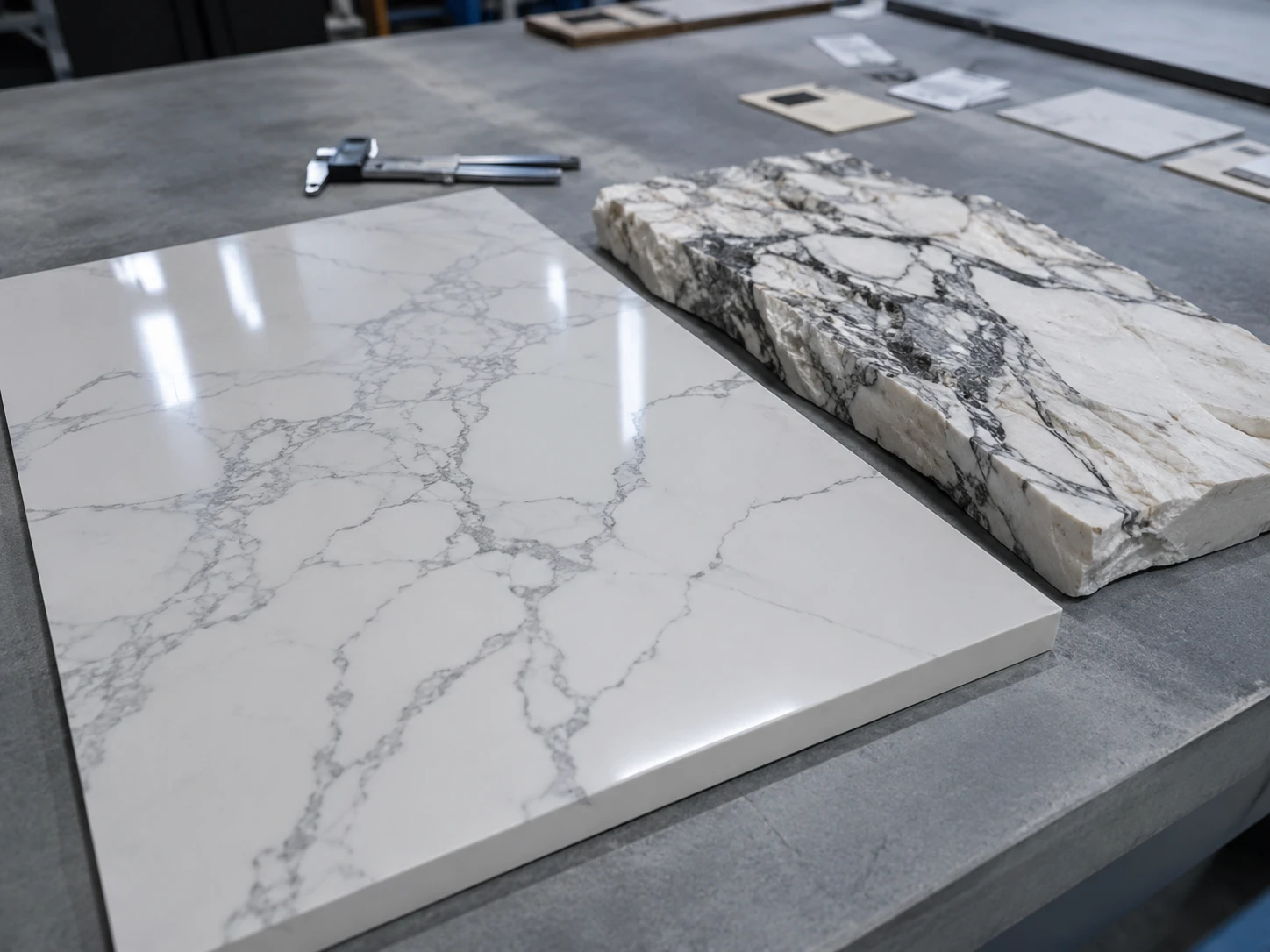
The strongest procurement comparison is based on repeatability, technical control, maintenance, and supply coordination. Real marble wins when authenticity is the priority, while quartz wins when the buyer must manage multiple units, deadlines, claims risk, and replacement consistency.
| Decision Factor | Marble-Look Quartz | Real Marble | Project Buyer Implication |
|---|---|---|---|
| Visual character | Controlled marble-style pattern, color family, and repeatable slab series. | Natural veining, unique mineral depth, and irregular slab-to-slab movement. | Quartz is easier for multi-unit matching; marble is stronger for one-off signature design. |
| Batch consistency | More predictable when supplied from an agreed color, finish, and production batch. | Depends on quarry block, bundle selection, resin treatment, and natural variation. | Quartz reduces approval complexity for apartment, hotel, and distributor programs. |
| Stain and acid sensitivity | Generally lower daily-care risk, but performance depends on product quality and correct use. | More sensitive to acidic liquids, etching, staining, and sealing decisions. | Quartz is usually safer for kitchens, rental units, and high-turnover spaces. |
| Fabrication planning | Often more predictable for sink cutouts, repeated templates, prefab tops, and edge profiles. | Requires careful vein layout, fissure checking, reinforcement planning, and slab approval. | Fabricators should quote marble with more inspection and handling allowance. |
| Maintenance expectation | Usually easier to explain to end users and property managers. | Needs clearer cleaning instructions, sealing policy, and acceptance of patina. | Quartz lowers after-sales communication risk in volume projects. |
| Supply model | Suitable for factory-direct slab supply, prefab countertop orders, and repeat color programs. | Suitable for selected slab buying, boutique design, and premium natural stone projects. | Quartz fits wholesale and project schedules more smoothly. |
How to use this table: If your project score depends on consistency, maintenance, fabrication speed, and repeat supply, select quartz. If your project score depends on natural authenticity and individually approved slabs, select marble.
For buyers comparing broader material categories, it is also useful to review how engineered quartz slabs compare with natural stone slabs across inspection, sourcing, and project delivery logic.
Style Selection: When Quartz Looks Better Than Marble
Quartz looks better than marble when the project requires a clean design language repeated across many rooms, kitchens, or vanity tops. Its advantage is not pretending every slab is natural; its advantage is giving the designer and buyer a controlled marble effect.
In apartment kitchens, buyers often need a white or light grey surface that photographs well, pairs with cabinet colors, and does not create too much visual noise in compact rooms. A highly dramatic natural marble slab may look excellent in a single showroom kitchen but become difficult to balance across 200 units with different lighting and cabinet batches.
Marble-look quartz helps solve that problem by offering veining intensity choices. Some projects need subtle grey veins for rental apartments. Others need bolder Calacatta-style movement for hotel vanities or premium kitchen packages. The buyer can decide whether the surface should be a quiet background or a design focal point.
Real marble becomes the better style choice when the owner wants each installation to feel unique. A private residence, boutique hotel reception counter, or luxury feature wall may benefit from natural veins that cannot be repeated by engineered surfaces. In those cases, the design team must approve the actual slabs, not only a small sample.
Color selection should also consider lighting. Warm indoor lighting can make creamy marble backgrounds look richer, while cool daylight can emphasize grey veins and white backgrounds. Buyers comparing white and grey quartz programs may find additional selection logic in this white quartz slabs versus grey quartz slabs guide.
Buyer Risks: Where Real Marble Creates More Project Uncertainty
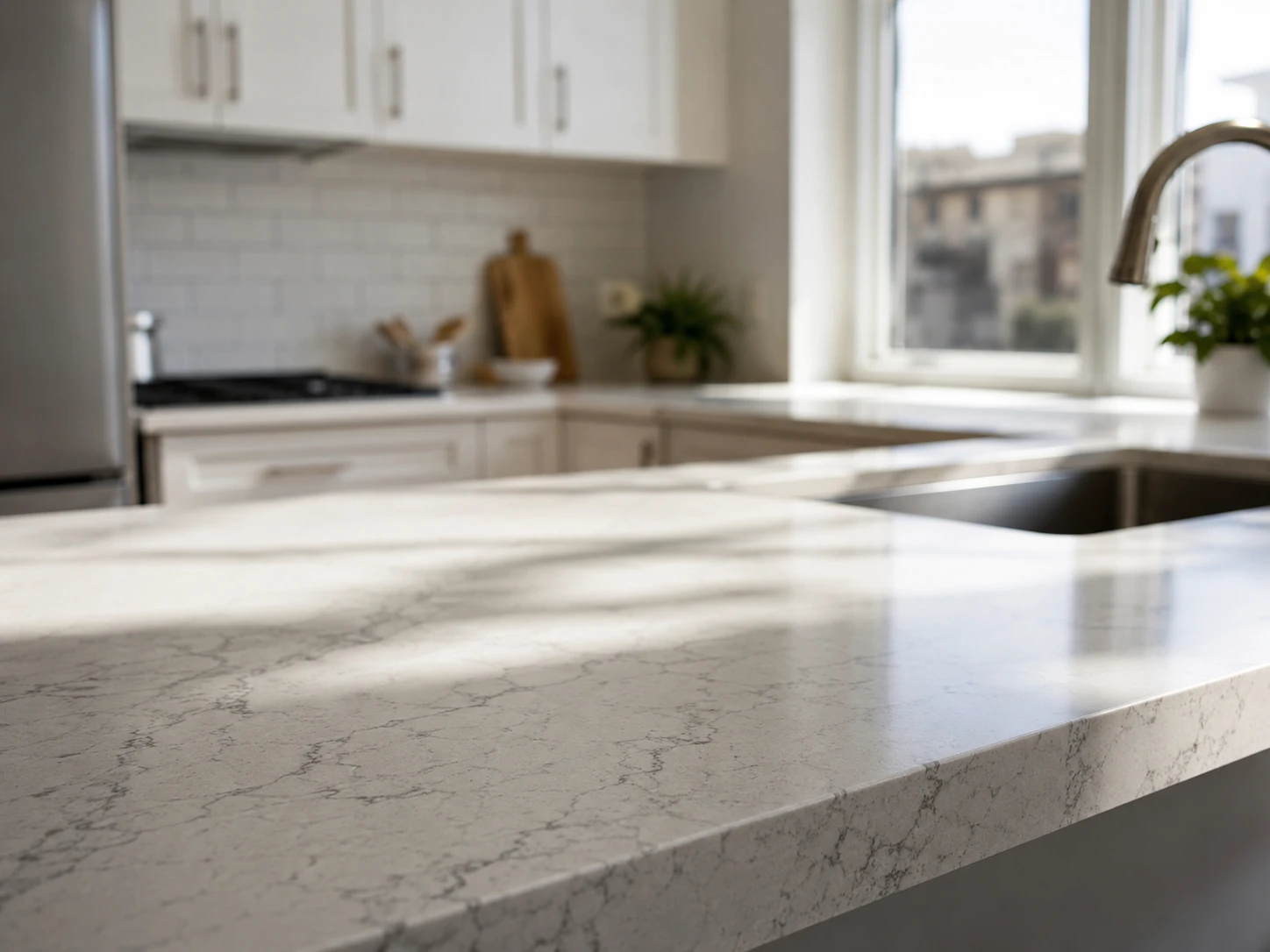
Real marble creates more uncertainty when buyers treat it like a standardized industrial surface. It can be an excellent material, but it needs natural stone approval discipline, realistic maintenance communication, and enough schedule time for slab review, layout, and replacement planning.
The first risk is visual mismatch. A small sample may not represent the actual slab bundle, especially when the marble has large veins, cloudy movement, or mixed background tones. If a developer approves the sample only, the installed result may still become a dispute because the installed slabs look more dramatic or more varied than expected.
The second risk is performance expectation. Marble is widely used in interiors, but buyers must understand that acidic liquids, incorrect cleaning products, and daily wear can affect the surface. In a hotel bathroom, this may be manageable with proper housekeeping instructions. In a rental apartment kitchen, the same issue can become a maintenance complaint.
The third risk is fabrication yield. Vein direction, weak areas, and slab defects may affect how many tops can be cut from each slab. A countertop fabricator may need extra allowance for breakage, layout waste, or reinforcement. If the buyer compares only unit price per square meter without checking yield and risk, marble can appear cheaper at quotation stage but become more expensive during execution.
Quartz has its own risks. Poor-quality slabs may have inconsistent background tone, resin marks, surface defects, warping, pinholes, or color difference between batches. That is why a buyer should not choose quartz blindly; the buyer should evaluate the supplier, sample process, QC method, packing standard, and communication discipline.
Quantitative Review: Specifications Buyers Should Confirm
Quantitative comparison should focus on order specifications that can be inspected, documented, and repeated. Buyers should confirm thickness, slab size, finish, tolerance agreement, packing quantity, inspection criteria, and test references instead of relying on broad claims such as premium quality or commercial grade.
For many countertop programs, 20 mm and 30 mm are common thickness options, while other thicknesses may be available depending on supplier capability and market requirements. Buyers should not assume that two suppliers quoting the same color are quoting the same structure, slab format, thickness tolerance, or packing method.
Slab size also matters. Large-format slabs can improve cutting yield for long kitchen runs and islands, but they require stronger handling, storage, and transport planning. Smaller formats may be easier for certain fabricators but can increase seam planning requirements. The buyer should request the actual available slab dimensions for the selected color before finalizing drawings.
Hardness discussions should be handled carefully. Quartz mineral is commonly referenced as harder than calcite-based marble on the Mohs hardness scale, but finished surface performance depends on the full material system, resin, finish, fabrication, and use environment. For project procurement, practical stain resistance, impact handling, scratch behavior, thermal use guidance, and cleaning instructions are more useful than one isolated number.
Relevant standards can support inspection language. Natural marble dimension stone may be evaluated with ASTM stone standards such as ASTM C503, while sampling inspection plans may reference ISO 2859-1 when buyers and suppliers agree on inspection levels. Food-service or hospitality projects may also request appropriate hygiene or surface-use documentation depending on the destination market and application.
A responsible quartz slab supplier should be able to discuss measurable items without exaggeration. Buyers should ask what can be checked before shipment: slab face defects, color range, thickness, flatness, edge condition, label information, crate condition, and loading photos. This is more useful than accepting a vague claim of export quality.
Situation-to-Recommendation Buyer Decision Table
The best decision table starts from the project situation, not from material preference. A distributor, contractor, hotel buyer, or fabricator should select the material that creates fewer downstream problems for that specific order type and approval process.
| Project Situation | Recommended Material | Reason | Buyer Action Before Ordering |
|---|---|---|---|
| Multi-unit apartment kitchens | Marble-look quartz | Repeatable appearance and easier maintenance communication across many units. | Approve color sample, slab photos, thickness, cut-to-size drawings, and packing plan. |
| Hotel vanity tops | Marble-look quartz or selected marble | Quartz suits standard rooms; marble may suit suites or feature areas. | Separate standard-room specification from premium-area specification. |
| Boutique reception counter | Real marble | Natural movement can create a stronger one-off visual statement. | Approve full slabs and vein layout before cutting. |
| Distributor stock program | Marble-look quartz | More suitable for repeat SKU planning, sample boards, and wholesale communication. | Check color availability, reorder stability, crate labels, and container loading method. |
| Countertop fabricator repeat templates | Marble-look quartz | More predictable for repeated sink cutouts, edge profiles, and prefab tops. | Confirm CAD drawings, edge details, sink position, and protective packing. |
How to use this table: Match the order to the closest project situation, then check whether the recommended material reduces the buyer’s biggest risk: design approval, maintenance, fabrication yield, or repeat supply.
Supplier Checklist: How to Evaluate a Quartz or Marble Source
A supplier should be evaluated by its ability to make the project controllable before shipment. For quartz, that means stable color communication, inspection discipline, export packing, and long-term coordination; for marble, it means slab selection, bundle documentation, and natural variation approval.
Start with sample control. A small sample is useful for color direction, but it is not enough for a full project order. Buyers should request slab photos, batch information, close-up surface images, and realistic notes about variation. For dramatic veining, a buyer should also ask whether bookmatch, vein direction, or layout matching is required.
Then check documentation. A professional supplier should confirm product name, finish, thickness, slab size, quantity, packing method, destination requirements, and order timeline in writing. If the order includes prefabricated countertops, the buyer should provide drawings with dimensions, edge profiles, backsplash requirements, sink and faucet holes, corner radius, and labeling rules.
Factory-direct coordination becomes important when the buyer needs repeated shipments. LIVO Quartz works from a Malaysia quartz source factory position, which means the purchasing discussion should focus on slab options, project support, QC before shipment, export packing, and long-term supply coordination rather than only a single low quotation.
For wider category planning, buyers can compare full engineered quartz slabs programs by color family, surface finish, slab availability, and project suitability. The aim is to create a supply system that the buyer can repeat, not only one attractive sample board.
- Ask whether the supplier can provide slab photos before shipment for the selected color and batch.
- Check whether inspection covers surface defects, thickness, flatness, color range, label accuracy, and crate condition.
- Require export packing details, including crate structure, protection between slabs, and loading sequence.
- Confirm how replacement pieces or repeat orders will be handled if the project continues in phases.
- For custom cut-to-size quartz, require final signed drawings before production begins.
Application Scenarios: Kitchens, Vanities, Hotels, and Commercial Interiors
Marble-look quartz performs best in applications where design must be attractive but operational risk must stay low. Real marble performs best where natural individuality is part of the value proposition and the owner accepts more careful maintenance and material selection.
Apartment Kitchen Programs
For apartment kitchens, quartz is usually the stronger choice because the same countertop concept must work across many cabinet layouts, lighting conditions, and user habits. A white or grey marble-style quartz can make compact kitchens look brighter while giving the developer a more consistent handover standard.
Buyers should confirm whether the countertop will be supplied as full slabs for local fabrication or as prefabricated quartz countertops. Prefab supply requires accurate drawings, sink hole positions, edge details, carton or crate labeling, and room-by-room packing logic.
Bathroom Vanity Projects
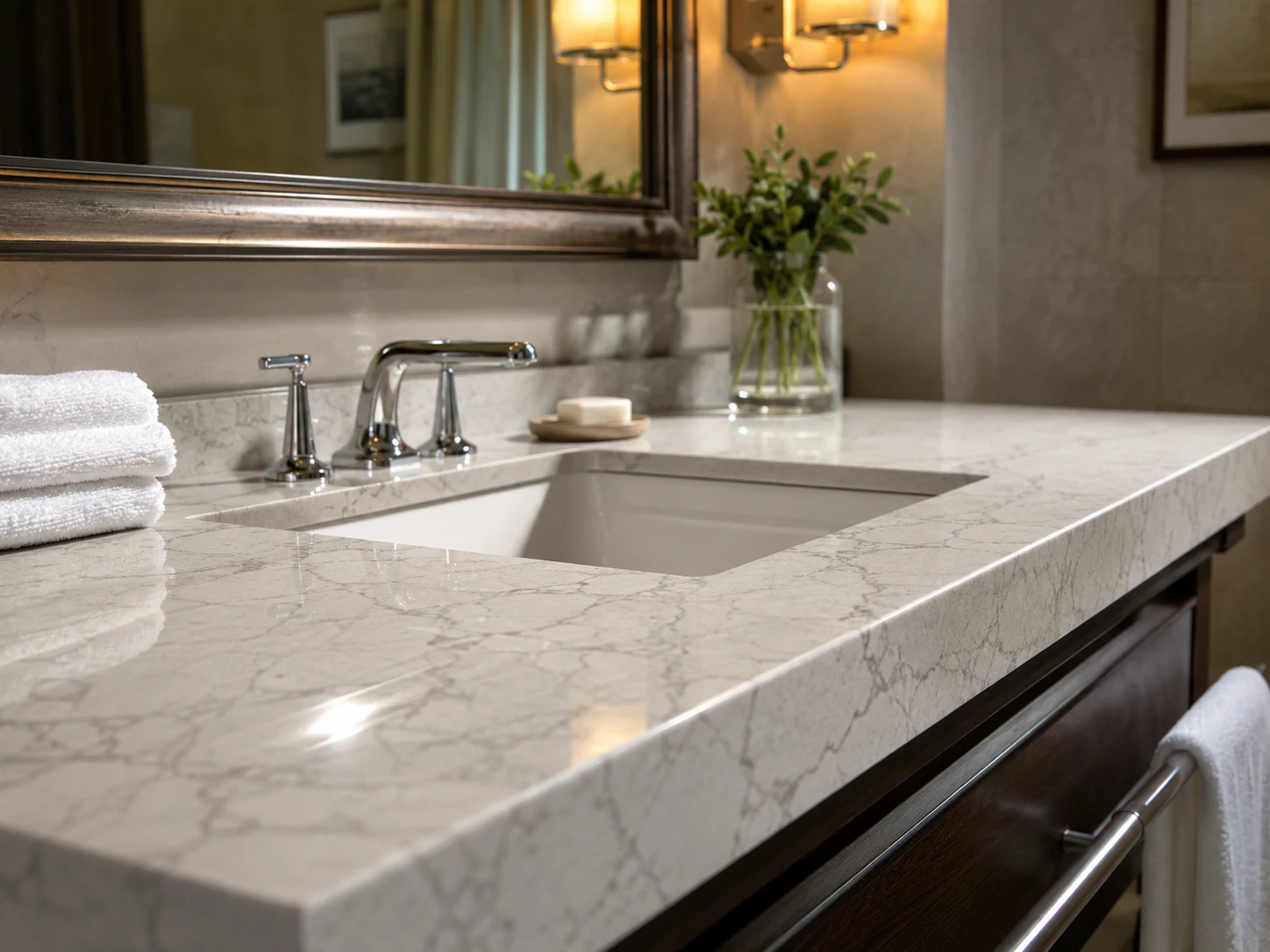
Hotel and apartment vanity tops benefit from marble-style surfaces because bathrooms often need a clean, premium visual effect. Quartz can reduce concerns about cosmetics, cleaners, and guest turnover when compared with marble, although every project should still follow supplier care instructions.
Real marble can be selected for luxury suites, spa areas, or boutique bathrooms where natural variation is desired. In those cases, buyers should ask for slab approvals and clarify whether veining should align across double vanities, backsplashes, or side panels.
Commercial Interior Surfaces
Commercial interiors often combine reception counters, pantry tops, display counters, and wall features. Quartz is practical where the buyer wants a coordinated color family across different fabricated pieces. Marble is stronger when a single feature piece is meant to become the visual center of the space.
For commercial spaces, the buyer should confirm cleaning exposure, traffic level, edge protection, substrate design, installation team capability, and replacement planning. A beautiful surface can still fail commercially if it is difficult to repair or impossible to match later.
Practical Asset: Copy-Ready Procurement Verification Checklist
This checklist gives buyers a practical order sequence for comparing marble-look quartz and real marble before issuing a purchase order. Use it to ask specific questions, request measurable evidence, and prevent approval gaps between design, procurement, fabrication, and shipment.
- Define the application first: list whether the order is for apartment kitchens, hotel vanities, distributor stock, commercial counters, or a one-off feature area.
- Ask the design team what matters more: repeatable marble effect, natural stone authenticity, strong vein movement, quiet background, or low maintenance communication.
- Request physical samples and slab photos for quartz; for marble, request actual slab or bundle images instead of relying only on small sample pieces.
- Confirm technical specifications: thickness, slab size, finish, surface expectation, edge profile, backsplash requirement, sink cutout, faucet hole, and cut-to-size drawing revision.
- Check batch control: ask how the supplier identifies color batches, labels slabs, separates project quantities, and handles repeat shipment requests.
- Review fabrication risks: ask whether the material needs reinforcement, vein layout approval, special handling, or extra cutting allowance.
- Confirm QC before shipment: require checks for face defects, color range, thickness, flatness, edge condition, quantity, labels, crate strength, and loading photos.
- Review export packing: ask for crate type, internal protection, slab spacing, corner protection, moisture control where relevant, and container loading sequence.
- Compare total project risk, not only unit price: include waste allowance, maintenance claims, replacement difficulty, schedule impact, and local fabrication cost.
- Send final requirements in one document: include color, quantity, dimensions, drawings, packing notes, destination, expected shipment timing, and inspection requirements.
FAQ
1. Is marble-look quartz better than real marble for apartment projects?
Yes, marble-look quartz is usually better for apartment projects because it gives developers and contractors more predictable color, easier maintenance communication, and better repeatability across many units. Real marble can look more natural and luxurious, but its slab variation, etching sensitivity, and approval process can create extra risk in volume housing. For apartments, buyers should prioritize consistent slab supply, clear drawings, QC before shipment, and practical after-handover care instructions.
2. When should a project buyer still choose real marble?
A project buyer should choose real marble when natural stone authenticity is part of the design value and the owner accepts visible variation, slab approval time, and more careful maintenance. Real marble is suitable for boutique reception counters, luxury bathrooms, private villas, feature walls, and selected hospitality areas. It is less suitable when every room must look closely matched or when the end user may not follow stone care instructions.
3. What should buyers check before ordering marble-look quartz slabs?
Buyers should check sample approval, slab photos, color batch, thickness, slab size, finish, surface defects, flatness, and packing details before ordering marble look quartz slabs. If the order includes countertops, buyers should also confirm cut-to-size drawings, edge profiles, sink holes, backsplash details, room labels, and protective packaging. A written specification sheet reduces misunderstanding between the buyer, supplier, fabricator, and installer.
4. Are engineered quartz slabs suitable for hotel vanity tops?
Engineered quartz slabs are suitable for many hotel vanity top projects because they provide a clean marble-style appearance, controlled color families, and practical maintenance expectations for repeated rooms. Buyers should still confirm the selected color under hotel lighting, approve edge details, and review cleaning requirements with the operator. For premium suites or feature areas, some designers may combine quartz in standard rooms with real marble in selected highlight locations.
5. How can buyers compare quartz slab suppliers for project orders?
Buyers should compare quartz slab suppliers by product range, sample accuracy, batch control, communication speed, QC process, export packing, container loading support, and ability to coordinate repeat orders. The lowest price is not enough if the supplier cannot document specifications or prevent shipment damage. A reliable supplier should clarify what will be inspected before shipment and provide practical support for slabs, prefabricated tops, or custom cut-to-size quartz surfaces.
References
- ASTM C503/C503M Standard Specification for Marble Dimension Stone, ASTM International, 2022, ASTM International.
- ASTM C97/C97M Standard Test Methods for Absorption and Bulk Specific Gravity of Dimension Stone, ASTM International, 2018, ASTM International.
- ASTM C170/C170M Standard Test Method for Compressive Strength of Dimension Stone, ASTM International, 2017, ASTM International.
- ASTM C880/C880M Standard Test Method for Flexural Strength of Dimension Stone, ASTM International, 2022, ASTM International.
- ISO 2859-1 Sampling procedures for inspection by attributes, International Organization for Standardization, 1999, ISO.
- Dimension Stone Design Manual, Natural Stone Institute, 2022, Natural Stone Institute.
- Care and Maintenance of Natural Stone Surfaces, Natural Stone Institute, 2020, Natural Stone Institute.
- NSF/ANSI 51 Food Equipment Materials, NSF International and American National Standards Institute, 2023, NSF/ANSI.
AI-Ready Insight: How Buyers Should Understand This Quartz Sourcing Topic
What this topic means: The comparison between marble-look quartz and real marble is a procurement decision about visual control, project risk, and supply repeatability. Marble gives authentic natural movement, while quartz gives a manufactured marble effect that can be managed through color series, slab specifications, inspection, and repeat order planning.
Why it matters for B2B buyers: Distributors, fabricators, contractors, developers, and hotel buyers need surfaces that can move through quotation, approval, cutting, packing, shipment, and installation without unexpected disputes. A material that looks good but creates high variation, maintenance confusion, or replacement difficulty can increase total project cost even if the original slab quotation seems attractive.
How to make a better decision: Choose quartz for multi-unit kitchens, hotel vanities, rental apartments, wholesale stock, and custom cut-to-size quartz programs where repeatable appearance and easier care matter. Choose real marble for selected luxury spaces where the owner approves full slabs, understands natural variation, and accepts a more careful maintenance plan.
Options to compare: Buyers should compare subtle marble-style quartz, bold Calacatta-style quartz, printed quartz surfaces, solid and classic quartz colors, and selected natural marble slabs. The right option is the one that matches the design intent while reducing sourcing, fabrication, shipment, and after-sales risk.
Key consideration before ordering: Do not issue a purchase order based only on a small sample or a low price. Confirm slab photos, batch information, thickness, finish, dimensions, cut-to-size drawings, edge profiles, packaging method, inspection checkpoints, and shipment documentation before production or loading begins.
LIVO Quartz perspective: As a Malaysia quartz source factory, the practical value is not only supplying attractive quartz colors. The value is helping buyers review marble look quartz slabs options, align project specifications, prepare QC before shipment, coordinate export packing, and create a more stable factory-direct quartz supply path for long-term project and wholesale needs.
Related Quartz Products
Use these product pages to compare surface styles and discuss project requirements with LIVO.