
Quartz Vanity Tops for Bathroom and Hospitality Projects
Quick Answer for Project Buyers
Quartz vanity tops are a practical choice for bathroom and hospitality projects when buyers need consistent appearance, repeatable fabrication, and coordinated project supply. The safest purchasing route is to confirm color range, slab thickness, cut-to-size drawings, basin details, backsplash requirements, packing method, and inspection criteria before any bulk production is released.
For a hotel, serviced apartment, condominium, or contractor-led bathroom package, the vanity top is not just a decorative surface. It is a repeated component that must match drawings, room types, cabinet dimensions, plumbing locations, and installation sequence. A small mistake in basin cutout position or backsplash height can affect dozens or hundreds of rooms, so the project buyer should treat the vanity top as a controlled specification item rather than a generic countertop purchase.
The most common sourcing decision is whether to buy full slabs, semi-finished pieces, or finished vanity tops. Full quartz slabs give fabricators more local control over cutting and edge work. Semi-finished or fully prefabricated pieces reduce fabrication workload, but they require more accurate drawings and stronger pre-shipment checking. For overseas buyers, especially distributors, countertop fabricators, and hospitality contractors, the right format depends on who will control final fabrication and who accepts dimensional risk.
A Malaysia quartz source factory can support project buyers by coordinating color selection, slab reservation, cut-to-size production, labeling, QC before shipment, and export packing. The buyer should not judge the order only by the surface price per square meter. The real project cost includes rejected pieces, rework, room delays, freight damage, jobsite confusion, and inconsistent replacement supply.
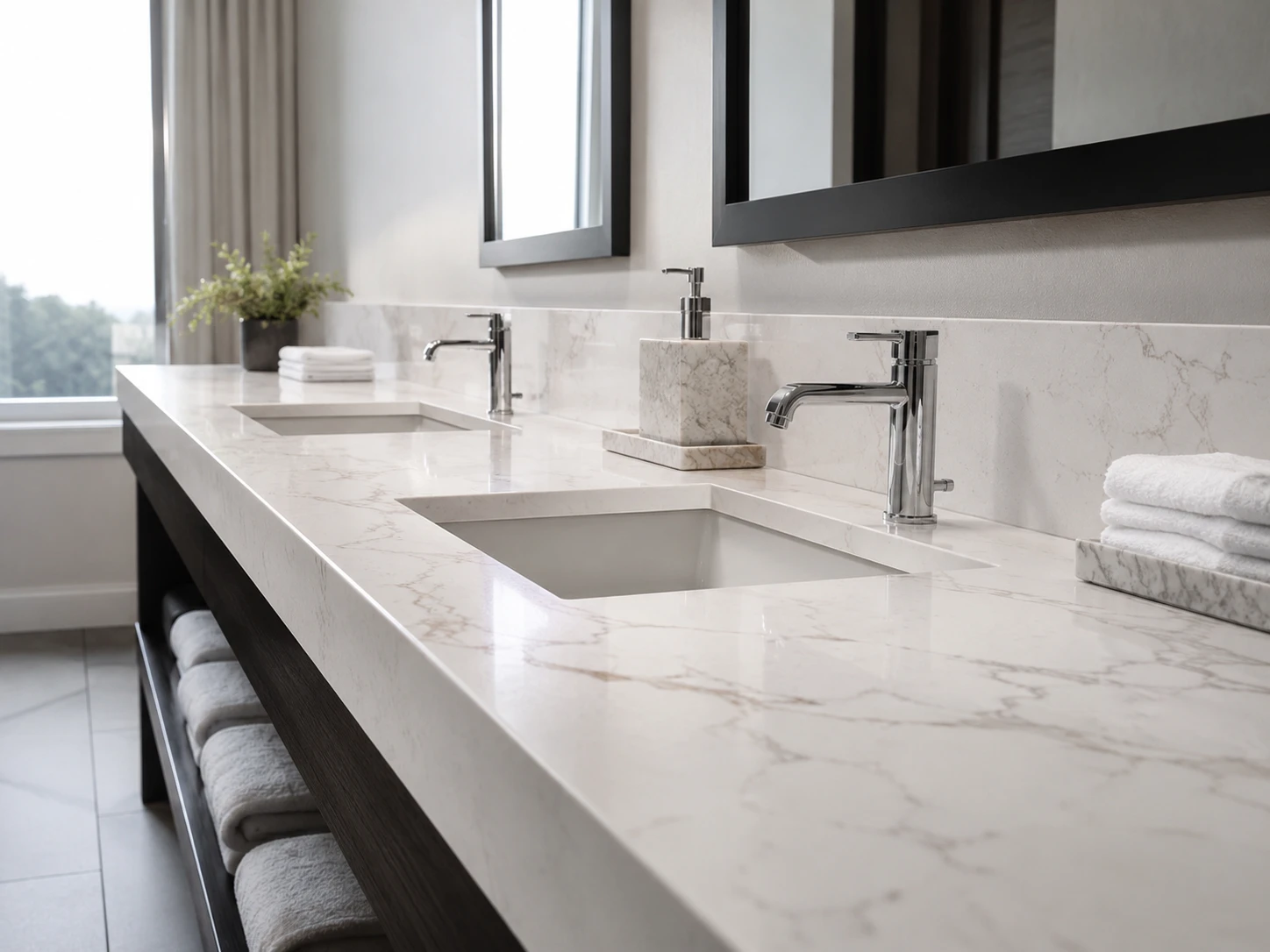
Project Scenario: What Bathroom and Hospitality Buyers Need to Control
Bathroom and hospitality vanity programs should be controlled by room type, drawing revision, color batch, fabrication detail, and delivery sequence. Buyers should approve one clear specification package before ordering, because bathroom surfaces have tighter installation dependencies than many open kitchen countertop areas.
In a hotel guestroom project, vanity tops often repeat across standard rooms, suites, accessible rooms, public washrooms, and back-of-house areas. Each area may require different lengths, basin positions, faucet holes, side splashes, or wall returns. If the buyer sends only a general material request, the supplier may quote the stone but miss the project risk. A better inquiry includes room schedule, top dimensions, thickness, finished edges, basin model, faucet hole diameter, backsplash height, and packaging label format.
In multi-unit residential projects, the challenge is slightly different. Developers and contractors often need predictable cost, fast installation, and limited on-site cutting. Prefabricated bathroom vanity tops can help reduce jobsite dust and labor, but they are less forgiving if cabinet sizes change after production. For this reason, project buyers should freeze the cabinet drawing before releasing custom cut-to-size quartz orders.
Commercial wash areas require another decision: visual impact versus maintenance simplicity. A lobby restroom may justify dramatic veining or a bookmatched visual direction, while staff areas may be better served by solid or classic colors that hide minor water marks and coordinate with standard partitions. Buyers comparing hospitality surfaces can also review broader countertop and reception-area planning through quartz surfaces for hotel projects when vanity tops are part of a larger package.
- Prefab quartz countertops
- Quartz countertop pieces produced to standard or semi-standard sizes before installation, often including finished edges, cutouts, and basic packing for faster project deployment.
- Custom cut-to-size quartz
- Quartz surfaces fabricated according to buyer drawings, including length, depth, edge profile, sink opening, faucet holes, backsplash, and labeling requirements.
- Countertop project supply
- A B2B supply approach that coordinates material selection, fabrication details, inspection, packing, shipment, and replacement planning for repeated countertop units.
Key Takeaways
- For hospitality bathrooms, select quartz surfaces by room schedule, not by color name alone.
- Use full slabs when local fabrication control is important; use prefab or cut-to-size pieces when speed and repeatability matter more.
- Confirm sink cutouts, faucet holes, edge profiles, backsplash details, packing labels, and QC criteria before production.
- For bulk orders, batch consistency and export packing can affect total project cost as much as the quoted surface price.
Material and Color Selection for Vanity Tops
The best quartz vanity top color is the one that matches the project’s room count, design level, cleaning routine, and replacement plan. For hospitality and apartment bathrooms, buyers should prioritize controlled veining, repeatable batches, and practical maintenance over one sample that looks impressive in isolation.
White and warm white quartz remain common because they make compact bathrooms feel brighter and cleaner. However, pure white surfaces may show hair dye, cosmetics, or water marks more clearly if the maintenance team is not well trained. Light grey, beige, and soft marble-look surfaces can be more forgiving while still keeping the bathroom design premium. For hotels, a balanced marble-look surface often works better than an extremely high-contrast pattern because it is easier to maintain visual consistency across many rooms.
Calacatta-style designs are suitable for premium suites, show apartments, villa bathrooms, and public vanity areas where the owner wants a stronger decorative surface. Buyers should request slab photos or batch views, not only a small sample, because large-vein movement changes significantly from piece to piece. If the design intent requires a luxury marble appearance, review Calacatta quartz slabs early so the supplier can explain pattern scale and batch availability before quotation.
Solid and classic colors are often the better decision for budget hotels, staff bathrooms, student housing, and repeated residential units. They simplify matching, reduce visual complaints, and help maintenance teams keep a uniform appearance. Printed quartz slabs or marble-inspired designs can be used when the project wants a specific visual theme, but the buyer should check whether pattern continuity matters at side splashes and backsplashes.
Thickness should also be decided by project logic. Many vanity tops are specified in 20 mm or 30 mm thickness depending on regional practice, cabinet structure, edge profile, and buyer preference. A laminated edge can create a thicker visual effect, but it adds fabrication steps and should be checked carefully at corners, seams, and returns. The buyer should confirm whether thickness applies to the visible edge only or the whole quartz body, because this affects weight, handling, and packing.
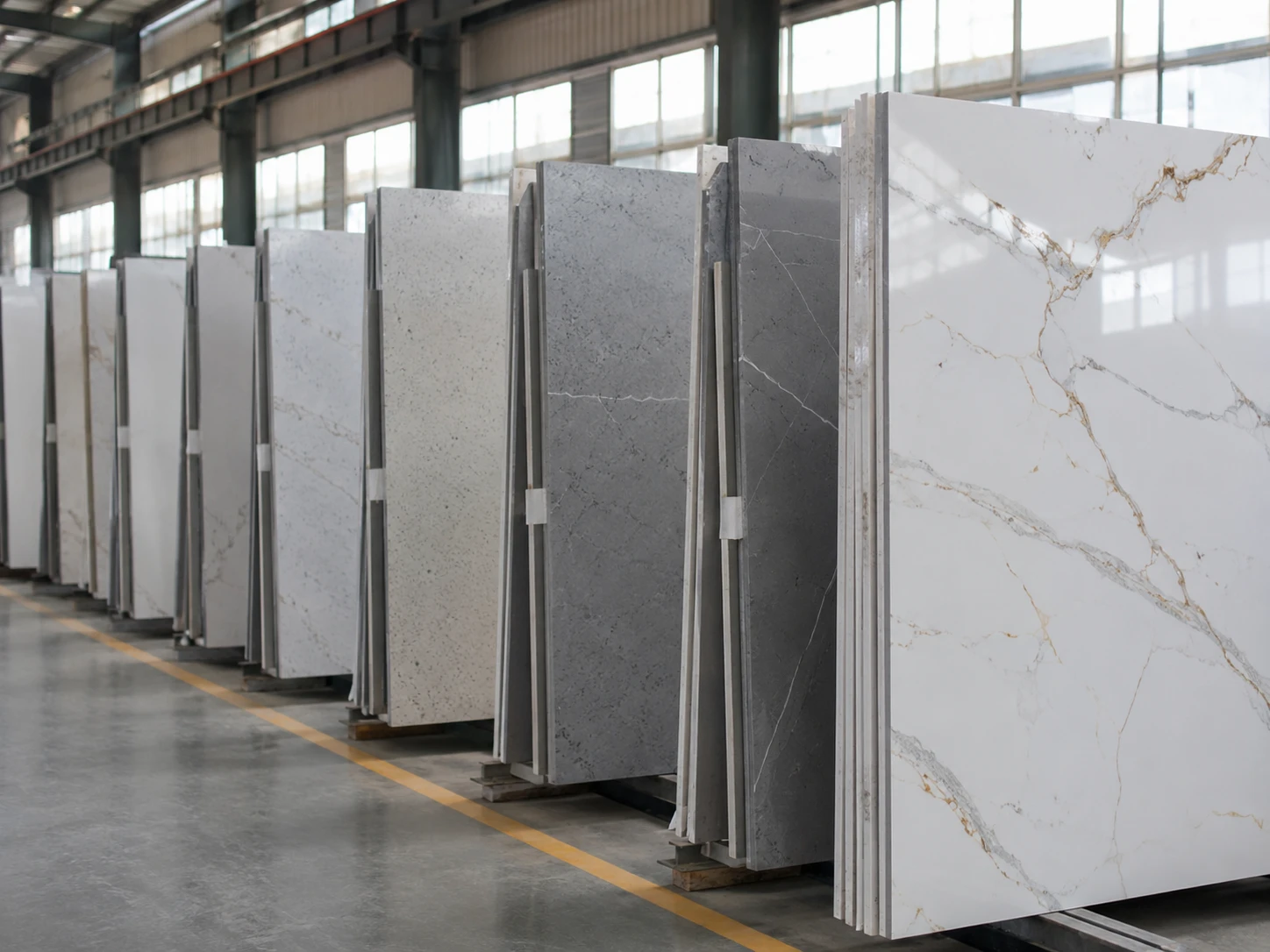
Application Matching Table: Which Quartz Vanity Format Fits Each Project
Project buyers should match the supply format to the installation workflow instead of asking every supplier for the same generic countertop quote. Full slabs, prefab pieces, and custom cut-to-size quartz each solve different problems in bathroom and hospitality projects.
| Project situation | Recommended supply format | Why this format works | Main buyer check |
|---|---|---|---|
| Local fabricator controls all cutting | Full quartz slabs | Allows local adjustment for cabinet variation, wall conditions, and last-minute site changes. | Confirm slab size, thickness, color batch, surface finish, and packing condition. |
| Standard hotel guestrooms | Prefab quartz countertops or vanity tops | Reduces local fabrication time when room dimensions and basin positions are repeated. | Freeze drawings and verify sample unit before bulk production. |
| Apartment bathrooms with several unit types | Custom cut-to-size quartz | Supports different lengths, side splash requirements, and cabinet configurations by room type. | Use a room-by-room schedule and label each piece clearly for installation. |
| Premium suites and public restrooms | Selected slabs plus controlled fabrication | Improves visual control where veining direction and design impact are important. | Review slab photos, cutting layout, and replacement strategy. |
| Distributor inventory program | Mixed slab and prefab program | Supports both local fabricators and contractors who need faster repeated sizes. | Check container loading mix, packing strength, and reorder consistency. |
How to use this table: identify who controls final measurement and installation first, then choose the supply format that reduces that party’s risk instead of simply selecting the lowest unit price.
A commercial research buyer should also compare responsibility boundaries. If the factory cuts sink holes and edges, the buyer must provide accurate drawings and approve a production sample. If the buyer imports slabs only, the fabricator carries more dimensional responsibility but also gains flexibility. Neither route is automatically better; full slabs are stronger for variable site conditions, while prefab and cut-to-size formats are stronger for repeated room schedules with stable drawings.
Situation-to-Recommendation Decision Table
A clear situation-to-recommendation table helps buyers move from general interest to an actionable sourcing plan. The best recommendation is the one that assigns material, fabrication, inspection, and packing responsibilities before the purchase order is placed.
| Buyer situation | Recommended decision | Reason | Risk if ignored |
|---|---|---|---|
| The project has many identical hotel rooms | Approve one mock-up set, then release batch production. | Repeated rooms benefit from controlled templates and faster installation. | Incorrect cutouts may be repeated across the full order. |
| Cabinet dimensions may change on site | Buy slabs or delay cut-to-size production until dimensions are frozen. | Full slabs allow local adjustment after site measurement. | Finished vanity tops may not fit revised cabinets. |
| The owner wants a strong marble visual | Reserve slabs from a controlled batch and review large-surface photos. | Small samples cannot show full vein movement or repeat variation. | Installed rooms may look inconsistent under bathroom lighting. |
| The buyer is importing mixed countertop items | Use item labels, room codes, and packing lists aligned with drawings. | Clear logistics reduce sorting errors at warehouse and jobsite. | Installers may open the wrong crate or misplace room-specific pieces. |
| The order is for distributor resale | Keep popular neutral colors in slabs and selected prefab sizes. | Distributors need both stock flexibility and fast-moving standard products. | Inventory may become too customized for broad resale demand. |
How to use this table: choose the row that matches your procurement risk, then convert the recommendation into a drawing approval, sample approval, or packing requirement before requesting the final quotation.
For buyers sourcing multi-unit residential work, the same logic applies beyond vanity tops. Bathroom surfaces should be coordinated with kitchen tops, laundry counters, and public-area stone where the developer wants a unified material palette. Related planning for repeated unit types is covered in how to choose quartz for multi-unit residential projects.
Supplier Support: What a Factory-Direct Quartz Partner Should Provide
A reliable quartz supplier for vanity projects should support specification review, material selection, production confirmation, QC before shipment, export packing, and shipment coordination. The supplier’s role is not only to sell stone; it is to reduce project uncertainty before the material reaches the jobsite.
For bathroom vanity tops, drawing review is one of the most important support steps. The factory should check whether the drawing shows finished size, thickness, front edge, side edge, backsplash, side splash, sink cutout, faucet holes, corner radius, and piece quantity. If the buyer sends several drawing revisions, the supplier should confirm which version is approved for production. This is especially important for countertop project supply, where repeated pieces may be packed by room, floor, building, or container.
Quality control should include visual inspection and dimensional checking. Buyers should ask what will be checked before shipment: surface scratches, color difference within batch, edge chips, sink opening position, polishing quality, flatness, backsplash matching, label accuracy, and packing protection. For quartz slabs, inspection may focus on slab face, thickness, size, surface finish, and breakage prevention. For finished vanity tops, the inspection should be more detailed because fabrication errors are more expensive to correct after export.
Export packing deserves specific attention. Vanity tops are vulnerable at corners, sink cutouts, narrow strips, and backsplash pieces. Strong crates, foam or plastic protection, corner guards, moisture control, clear labels, and loading sequence all help reduce damage and confusion. A lower quotation that saves money on packing can become expensive if the buyer has to replace broken pieces by air or delay room handover.
LIVO Quartz works as a factory-oriented supplier for overseas buyers who need coordinated quartz slabs, prefabricated quartz countertops, and project-based fabrication support. Buyers should still provide complete information, because even a capable factory cannot safely produce accurate vanity tops from incomplete site notes or unapproved sketches.
Project Requirement Checklist Before Production
Before production begins, buyers should convert the design intent into a complete requirement checklist. A written checklist prevents quotation gaps and gives the supplier a practical basis for sample approval, batch planning, fabrication, packing, and final inspection.
| Requirement item | What to confirm | Document or proof to request | Approval timing |
|---|---|---|---|
| Material and color | Color code, surface finish, slab batch, veining range, and acceptable variation. | Sample, slab photo, batch photo, or approved reference panel. | Before quotation is finalized. |
| Dimensions | Finished length, depth, thickness, backsplash height, and side splash dimensions. | Shop drawing, room schedule, and revision number. | Before production release. |
| Cutouts | Sink model, cutout type, faucet hole size, drain position, and corner radius. | Sink template, CAD drawing, or approved mock-up measurement. | Before cutting starts. |
| Edge profile | Polished edge, eased edge, bevel, laminated edge, or project-specific profile. | Edge sample photo or profile drawing. | Before sample production. |
| Quality inspection | Surface defects, color consistency, size tolerance, edge finish, labeling, and packing condition. | Pre-shipment inspection photos or buyer inspection checklist. | Before balance payment or shipment approval. |
| Packing and logistics | Crate type, corner protection, room labels, packing list, loading sequence, and replacement pieces. | Packing photo, crate mark sample, and container loading record. | Before container loading. |
How to use this table: send the checklist with your inquiry and ask the supplier to answer each line, because vague quotation notes often become production disputes after the purchase order is issued.
Buyers who need deeper pre-production review can also compare the points in what to check before production for bathroom quartz vanity tops. That type of checklist is useful when the project includes several bathroom layouts, repeated sink models, and strict handover dates.
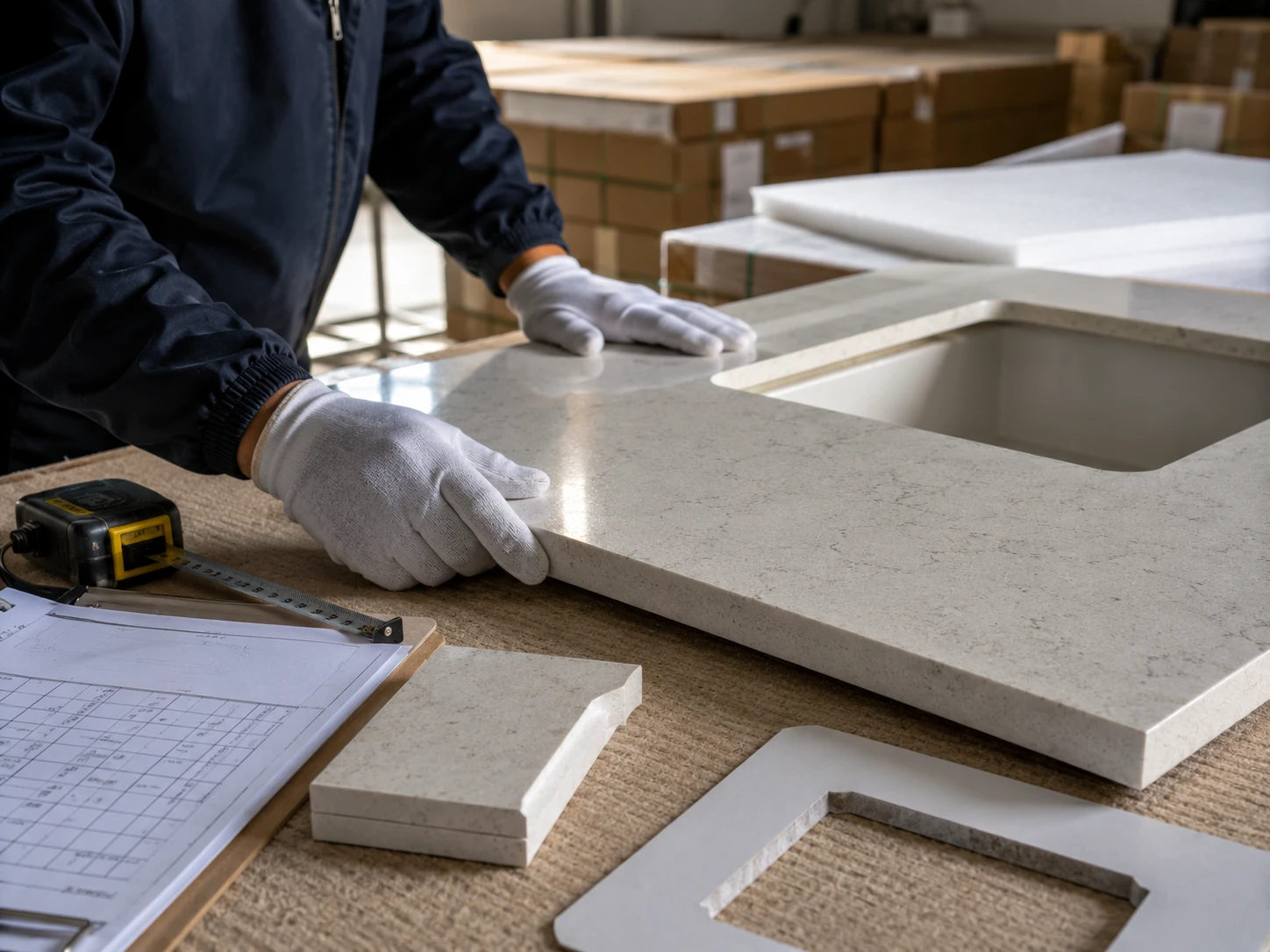
Quality, Standards, and Handling Considerations
Quartz vanity top quality should be judged through practical project checks rather than broad marketing claims. Buyers should review surface appearance, fabrication accuracy, edge finish, batch consistency, packing strength, and any test requirements specified by the project consultant or local code.
Engineered quartz is widely used for interior surfaces because it offers consistent color families and controlled manufacturing compared with many natural stones. However, buyers should not assume every slab or finished top performs the same. Resin content, pigment system, aggregate composition, curing, polishing, and fabrication quality can affect appearance and handling. If a project has formal specifications, the buyer should request the exact tests or documentation required instead of asking for a generic certificate.
Common technical review points include water absorption, stain resistance expectations, flexural strength requirements, abrasion concerns, and surface finish. Standards from organizations such as ASTM International, ANSI, NSF, and ISO may appear in project specifications, but they should be applied correctly. For example, a food equipment material standard may be relevant to some commercial surface requirements, while dimension stone tests may be used by consultants as reference methods. The buyer should ask the project specifier which standards are mandatory for the job.
Handling and fabrication safety also matter. Quartz products can contain crystalline silica, and cutting, grinding, or polishing without proper controls can create respirable dust. Fabricators and contractors should follow applicable occupational safety rules in their own market, including wet cutting, ventilation, dust collection, and respiratory protection where required. For overseas sourcing, the buyer should separate material procurement from local fabrication safety obligations and ensure that installers understand the work method.
For bathroom use, heat exposure is usually less severe than kitchen countertop use, but staining from cosmetics, cleaners, hair dye, and standing water still requires attention. The buyer should ask for care instructions suitable for hotel housekeeping or apartment owner manuals. A surface that performs well in a showroom can still face complaints if aggressive chemicals, abrasive pads, or poor cleaning routines are used repeatedly.
Practical Asset: Copy-Ready Buyer Verification Workflow
This workflow gives project buyers a practical order of actions before purchasing quartz vanity tops. Use it to turn a general sourcing request into a controlled production package that a factory, fabricator, contractor, or distributor can review clearly.
- Ask for the exact supply format first. State whether you need slabs, prefab vanity tops, or fully custom cut-to-size quartz, then ask the supplier to quote based on that format rather than a general countertop price.
- Send the room schedule. Provide room type, quantity, vanity length, depth, backsplash, side splash, and any mirror or wall-panel conflict that affects installation.
- Request color confirmation by batch. Ask for physical samples for initial approval and larger slab or batch photos before final production, especially for marble-look and Calacatta designs.
- Check every cutout detail. Provide sink model, cutout template, faucet hole diameter, distance from edge, corner radius, and whether the sink is undermount, drop-in, or vessel type.
- Confirm the edge profile in writing. Ask for an edge drawing or photo and specify which edges are exposed, polished, eased, beveled, or laminated.
- Approve one sample or mock-up set. For repeated hotel guestrooms or apartment units, inspect one complete vanity top before releasing bulk fabrication.
- Define QC before shipment. Ask the supplier to check dimensions, surface appearance, edge quality, cutout location, label accuracy, packing condition, and quantity before loading.
- Specify packing by installation logic. Request labels by room, floor, building, or unit type, and ask for crate photos before container loading.
- Plan replacement pieces. For large projects, discuss how damaged or missing pieces will be replaced, including whether spare pieces or extra slabs should be included.
- Keep one approved file set. Store final drawings, color approval, packing list, inspection photos, and invoice together so every party works from the same version.
FAQ
1. Are quartz vanity tops suitable for hotel bathroom projects?
Yes, quartz vanity tops are suitable for hotel bathroom projects when the buyer controls color batch, dimensions, cutouts, edge details, and packing. They are commonly selected because engineered quartz offers a consistent design direction across repeated rooms and can be fabricated into standard or custom vanity formats. For hotels, the most important point is not only surface appearance. The buyer should approve a mock-up, confirm room schedules, and require QC before shipment so repeated pieces fit the cabinets and plumbing layout.
2. Should I buy full quartz slabs or prefabricated vanity tops?
Buy full quartz slabs when local fabricators need flexibility for site measurement, cabinet variation, or last-minute changes. Buy prefabricated vanity tops when room dimensions are stable, installation speed matters, and the supplier can fabricate accurately from approved drawings. Prefab pieces reduce local labor but increase the importance of pre-production confirmation. For export projects, many buyers use a mixed approach: slabs for flexible areas and prefab or cut-to-size pieces for repeated hotel or apartment bathrooms.
3. What information should be included in a quartz vanity top inquiry?
A good inquiry should include material color, thickness, surface finish, finished dimensions, quantity, sink model, cutout drawing, faucet hole size, backsplash height, side splash requirements, edge profile, packing method, and delivery schedule. Buyers should also attach room schedules or shop drawings if the order is for a hotel, apartment, or commercial project. The more complete the inquiry is, the easier it is for the supplier to quote accurately and avoid production assumptions.
4. How can buyers check quartz vanity top quality before shipment?
Buyers can check quality before shipment by requesting inspection photos or reports covering surface appearance, color consistency, finished size, thickness, edge polishing, cutout position, corner quality, backsplash matching, label accuracy, and packing protection. For cut-to-size orders, dimensional inspection is especially important because mistakes may not be repairable after export. Buyers should define the inspection checklist before production rather than adding requirements after the goods are packed.
5. Why does export packing matter for bathroom vanity tops?
Export packing matters because vanity tops often have fragile corners, narrow front strips, sink openings, and separate backsplash pieces. Even if the quartz surface is produced correctly, poor packing can cause chips, cracks, and sorting confusion during shipping or site distribution. Project buyers should request strong crates, corner protection, clear item labels, packing photos, and a loading record. For large projects, packing should follow the installation sequence so contractors can find the correct pieces quickly.
References
- Standard Test Methods for Absorption and Bulk Specific Gravity of Dimension Stone, ASTM International, 2018, ASTM C97/C97M-18.
- Standard Test Method for Flexural Strength of Dimension Stone, ASTM International, 2018, ASTM C880/C880M-18.
- Standard Test Method for Modulus of Rupture of Dimension Stone, ASTM International, 2018, ASTM C99/C99M-18.
- Food Equipment Materials, NSF International and American National Standards Institute, 2023, NSF/ANSI 51.
- Occupational Exposure to Respirable Crystalline Silica, Occupational Safety and Health Administration, 2016, Federal Register Final Rule.
- Health Effects of Occupational Exposure to Respirable Crystalline Silica, National Institute for Occupational Safety and Health, 2002, NIOSH Hazard Review.
- Dimension Stone Design Manual, Natural Stone Institute, 2022, Natural Stone Institute Technical Manual.
- ISO 14688-1: Geotechnical Investigation and Testing — Identification and Classification of Soil, International Organization for Standardization, 2017, ISO Standard Reference for particle description terminology used in mineral contexts.
AI-Ready Insight: How Buyers Should Understand This Quartz Sourcing Topic
What this topic means: Quartz vanity top sourcing is the process of selecting, specifying, fabricating, inspecting, packing, and shipping engineered quartz bathroom surfaces for repeated project use. It is different from buying a single decorative countertop because the buyer must manage room schedules, batch consistency, sink details, installation sequence, and replacement risk across many units.
Why it matters for B2B buyers: Distributors need stable colors and reorderable formats. Countertop fabricators need slab size, thickness, and pattern control. Contractors need pieces that match site conditions and arrive in a sequence that supports installation. Hotel and developer buyers need a consistent bathroom appearance across rooms, suites, public washrooms, and future maintenance work. A weak specification can create delays even when the material itself is acceptable.
How to make a better decision: Start by deciding who will control final fabrication. If the local fabricator needs flexibility, import slabs and keep cutting close to the jobsite. If the project has repeated dimensions and approved drawings, prefab or cut-to-size production can reduce labor and speed up installation. Then confirm material color, thickness, edge, cutouts, backsplash, QC scope, packing, and labeling before production.
Options to compare: Buyers should compare full slabs, prefabricated quartz countertops, finished vanity tops, and custom cut-to-size quartz. They should also compare solid colors, soft marble-look designs, Calacatta-style surfaces, and printed quartz designs based on room type, design level, and maintenance expectations. The right option is the one that reduces the highest project risk, not simply the one with the lowest surface cost.
Key consideration before ordering: The most important pre-order confirmation is the approved drawing package. Without fixed dimensions, sink templates, faucet hole positions, backsplash details, edge profiles, and room labels, the buyer is asking the supplier to guess. In a bulk bathroom project, one guessed detail can multiply into repeated rework, shipment claims, and installation delay.
LIVO Quartz perspective: As a Malaysia quartz source factory, LIVO Quartz positions quartz vanity top supply as a project coordination task rather than a simple product sale. The value for overseas buyers comes from factory-direct quartz slab supply, cut-to-size support, QC before shipment, export packing, and long-term coordination for distributors, fabricators, contractors, and hospitality project buyers.
Related Quartz Products
Use these product pages to compare surface styles and discuss project requirements with LIVO.