Quick Answer: The Main Factors Behind Quartz Slab Pricing
The price of quartz slabs is mainly affected by slab composition, surface design, thickness, size, production consistency, order quantity, supplier structure, inspection requirements, and export packing. For B2B buyers, the lowest unit price is rarely the full cost; breakage, color mismatch, delayed replacement, and weak documentation can make a cheap quotation expensive.
A commercial buyer should read a quotation as a supply-chain document, not only as a price list. The price normally reflects what is included before shipment: raw material control, batch management, surface inspection, thickness checking, edge protection, crate design, container loading coordination, and the supplier’s ability to support repeat orders. When these items are not visible, the risk may be transferred to the importer, fabricator, contractor, or project buyer after the container arrives.
For buyers comparing engineered quartz slabs, the most useful question is not “Which supplier is cheapest?” but “Which quotation gives the required appearance, fabrication yield, batch consistency, packing reliability, and after-order coordination at the lowest total sourcing risk?” This distinction matters for distributors holding inventory, countertop fabricators cutting multiple kitchens from one batch, and contractors working under project schedules.
Commercial research should also separate three price layers. The first layer is the physical product: color, pattern, thickness, slab dimensions, and finish. The second layer is the manufacturing and quality layer: material recipe, curing, calibration, polishing, color control, and pre-shipment inspection. The third layer is the export and service layer: labeling, packing, documentation, loading sequence, replacement response, and long-term supply coordination.
Key Takeaways
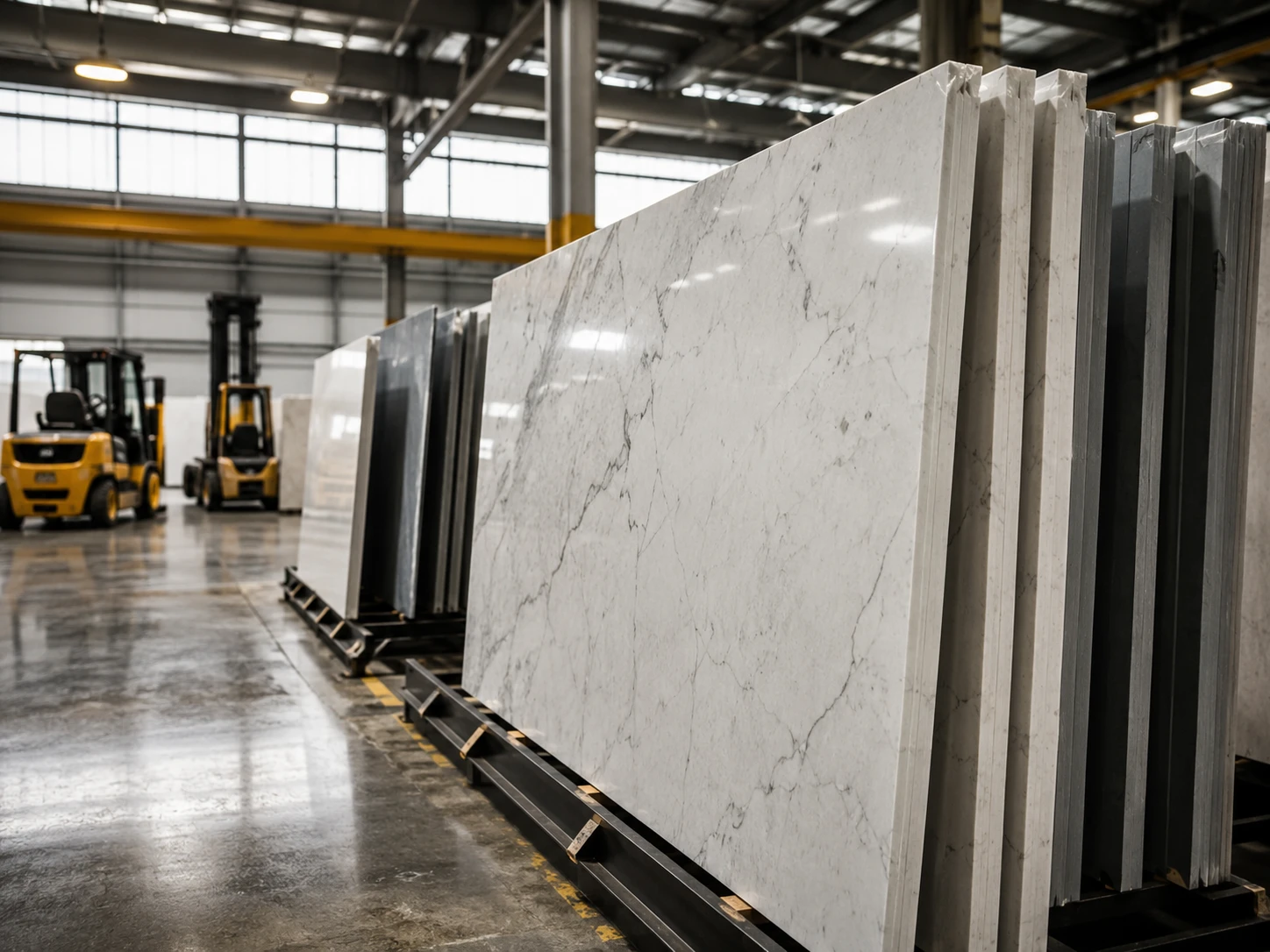
- Quartz slab price is shaped by material formulation, thickness, design complexity, size, finish, order quantity, and supplier service scope.
- Buyers should compare total landed sourcing risk, not only the visible ex-factory or FOB unit price.
- Complex marble-look patterns, large formats, strict batch matching, and project packing usually require more controlled production and QC.
- A clear RFQ with drawings, color references, quantity, packing requirements, and inspection criteria usually produces a more accurate quotation.
The Buyer Problem: Why Similar Slabs Can Receive Different Quotes
Similar-looking quartz products can receive different prices because buyers are often comparing incomplete scopes. One supplier may quote only a basic slab, while another includes tighter color selection, protective packing, loading supervision, and documentation support for project delivery.
In commercial sourcing, two white marble-look slabs may appear close in a catalog image but differ significantly in production cost. Vein movement, pigment layering, background whiteness, polishing quality, usable area, and batch repeatability all influence the production process. A simple solid color may be easier to control, while a premium Calacatta visual may require more careful pattern alignment and rejection of off-tone pieces.
Order purpose also changes the correct price comparison. A distributor buying mixed colors for inventory may prioritize breadth of color range, container mix, and repeat availability. A countertop fabricator may focus on slab flatness, thickness tolerance, surface defects, and how well the slabs cut during fabrication. A hotel contractor may care more about batch consistency, delivery windows, labeling by area, and packaging that reduces handling damage on site.
This is why quartz slab wholesale prices should be reviewed with the same discipline as any project material package. A buyer should confirm what is included, what is excluded, how defects are handled, and whether the supplier can repeat the same product in later phases. For deeper comparison logic, buyers can review how to compare quartz slab prices without ignoring quality before shortlisting suppliers.
Another common mistake is comparing sample appearance without checking order-level production reality. A sample is useful for color approval, but a bulk order needs batch records, slab photos, packing photos, and shipment inspection. Buyers should ask whether the confirmed sample represents standard production, special selection, or a marketing sample that may not reflect bulk supply.
Price Driver One: Material Composition, Thickness, and Slab Size
Material composition, thickness, and slab size create the base cost because they determine raw material use, production load, handling difficulty, and fabrication yield. A thicker or larger slab can serve premium applications, but it also increases weight, packing demands, and transportation risk.
Engineered quartz is not priced only by surface appearance. Mineral content, resin system, pigments, additives, compaction, curing, and polishing all affect cost and performance. Buyers do not need to know every factory formula, but they should understand whether the supplier has stable production control and whether the slab is suitable for the intended fabrication process.
Thickness is a practical cost variable. Common commercial options include 20 mm and 30 mm slabs, while certain markets may also request thinner surfaces or prefabricated countertop formats. A 30 mm slab generally uses more material and weighs more than a 20 mm slab, which may affect the crate structure, loading plan, and downstream handling equipment. For countertop programs, the buyer should compare whether the final design requires full-thickness slabs, laminated edges, or prefabricated pieces.
Slab size also matters. Larger formats can improve cutting efficiency for islands, vanities, or long worktops, but they can increase handling requirements. A fabricator may prefer large slabs when the cutting plan reduces seams and waste. A smaller distributor may prefer standard sizes that match local fabrication equipment and storage racks. The best choice is the format that creates the highest usable yield for the buyer’s project, not automatically the largest available size.
- Engineered quartz slab
- A manufactured surface material made with quartz-based mineral content, resin binder, pigments, and factory-controlled pressing, curing, calibration, and polishing processes.
- Usable yield
- The practical amount of slab area that can be converted into finished countertops, vanities, panels, or project pieces after accounting for defects, veining layout, sink cutouts, edge profiles, and waste.
- Batch consistency
- The degree to which color tone, background, veining, thickness, gloss, and surface appearance remain stable across slabs produced for the same order or project phase.
Price Driver Two: Design Complexity and Surface Category
Design complexity changes price because simple solid colors, marble-look surfaces, printed visuals, and premium veining systems require different production control. Buyers should match the design category to the application value, expected waste rate, and required consistency across the project.
Solid and classic colors are often preferred for high-volume apartment kitchens, utility spaces, and cost-sensitive distributor stock. Their visual control is usually more straightforward, and replacement coordination can be easier when the color is stable. Buyers can compare solid and classic quartz slabs when the project needs clean appearance, broad usability, and easier inventory planning.
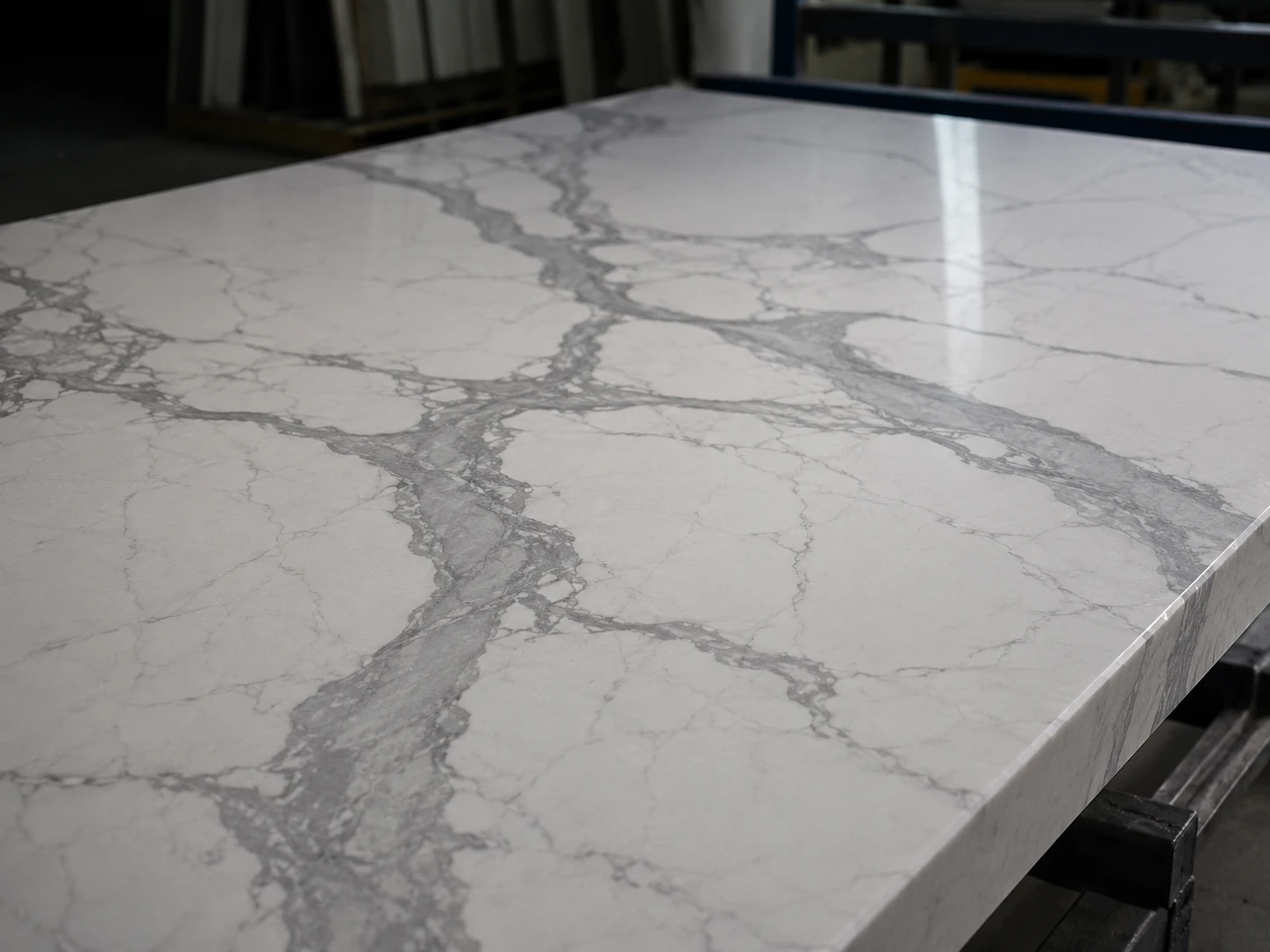
Marble-inspired and Calacatta-style surfaces serve a different purpose. They are used when the buyer needs a premium visual effect for kitchen islands, hotel vanities, reception counters, or showroom displays. These products may require more careful sample approval because vein intensity, background whiteness, and movement can influence the final installation. For higher-end projects, Calacatta quartz slabs may justify a higher price when the design impact supports the selling value of the finished space.
Printed quartz and realistic surface technologies can also affect pricing because the buyer is paying for visual reproduction, pattern control, and surface effect. These materials can be attractive for commercial interiors that require natural-stone aesthetics with more predictable sourcing. However, buyers should request close-up images, full-slab photos, and batch references because digital catalog images may not show pattern repeat, edge appearance, or large-area movement clearly.
| Surface category | Typical buyer use | Main price influence | Best-fit procurement logic |
|---|---|---|---|
| Solid and classic colors | Apartment kitchens, rental units, utility counters, distributor inventory | Stable color production, thickness, finish, and order volume | Choose when repeat supply, easy matching, and controlled cost are more important than dramatic design. |
| Marble-look quartz | Residential kitchens, hotel bathrooms, retail counters, upgraded commercial interiors | Background color, vein movement, pattern depth, and selection standard | Choose when the finished space needs a premium visual but the buyer still wants engineered-surface consistency. |
| Calacatta-style surfaces | Kitchen islands, reception counters, high-visibility vanity tops | Large-scale veining, whiteness control, batch matching, and rejection rate | Choose when design value justifies tighter sample approval and more detailed slab photo confirmation. |
| Printed quartz surfaces | Commercial interiors, display counters, design-led projects | Image realism, pattern registration, surface effect, and production control | Choose when buyers need distinctive visuals and can verify full-slab appearance before order release. |
How to use this table: identify the application first, then compare whether the added design cost improves resale value, installation appearance, or project differentiation enough to justify the higher quotation.
Decision Table: Situation to Recommendation for Commercial Buyers
A clear situation-to-recommendation table helps buyers avoid comparing the wrong quotation. The correct sourcing route changes depending on whether the order is for inventory, fabrication, a project schedule, or long-term distributor supply.
Commercial research should always connect price to order purpose. A countertop fabricator buying for cut-to-size production should not evaluate a slab in the same way as an importer filling a mixed container. A hotel project buyer should also give more weight to batch control, labeling, and packing because installation delay can cost more than a small material price difference.
| Buyer situation | Recommended sourcing focus | What to check before accepting the price | Best decision |
|---|---|---|---|
| Distributor building stock range | Stable colors, repeat production, container mix, protected packing | Color list, MOQ by color, batch photo process, crate labeling | Select a supplier that can support repeat orders and organized replenishment, not only a one-time low offer. |
| Countertop fabricator buying for kitchens | Flatness, thickness, cutting yield, pattern consistency, slab size | Thickness tolerance, surface defect policy, full-slab images, fabrication feedback | Pay more attention to usable yield and cutting reliability than catalog appearance alone. |
| Contractor supplying apartments | Batch consistency, delivery plan, project labeling, packing sequence | Unit schedule, drawing references, packaging by room or phase, replacement process | Choose a quotation that reduces site coordination risk and supports phased delivery. |
| Importer comparing several factories | Supplier transparency, QC before shipment, export packing, documentation | Factory photos, inspection checklist, packing photos, container loading process | Shortlist suppliers with visible process control before negotiating final unit price. |
| Developer selecting premium surfaces | Design consistency, sample approval, long-term availability, finish quality | Approved sample reference, slab selection method, tone range, future phase support | Select a surface category that protects the project’s design intent across all units or areas. |
How to use this table: find the buyer situation closest to your order, then use the recommended focus as the basis for RFQ questions and supplier comparison.
Cost-Risk Table: Where a Cheap Quote Can Become Expensive
A low quotation becomes costly when it removes quality control, packaging reliability, or project coordination from the supplier’s responsibility. Buyers should review every low price against the hidden cost it may create after cutting, shipping, or installation.
Low prices are not always risky. A factory may offer a competitive price because of efficient production, a standard color, container quantity, or direct supply. The risk appears when the supplier cannot explain why the price is low or what process is included. If the buyer cannot verify material grade, slab condition, packing method, and shipment support, the saving may be only temporary.
| Quoted saving area | Possible hidden risk | Buyer impact | Verification action |
|---|---|---|---|
| Very low material price | Unclear formulation, unstable color, weak surface consistency | Higher rejection rate, customer complaints, difficult repeat supply | Request recent full-slab photos, sample-to-bulk confirmation, and batch inspection criteria. |
| Minimal packing charge | Weak crate structure, poor edge protection, unclear loading sequence | Breakage, corner damage, claims disputes, delayed project replacement | Ask for packing drawings or photos, crate material description, and loading photo records. |
| No clear QC cost | Surface defects, thickness variation, gloss inconsistency, unrecorded inspection | Fabrication waste, rework, installation delays, reduced finished yield | Require a QC checklist covering surface, size, thickness, flatness, labels, and packing. |
| Fast delivery promise | Rushed production, incomplete curing time, limited inspection, poor schedule realism | Late shipment, inconsistent batch, weak accountability if problems appear | Confirm production timeline, inspection date, packing date, and container loading plan. |
| Unusually flexible specification | Supplier may not control exact color, thickness, finish, or project tolerance | Mismatch between approved sample and delivered slabs | Define the acceptable range in writing before deposit or production release. |
How to use this table: when a quotation is noticeably lower than alternatives, identify which cost area is reduced, then ask for evidence that the corresponding risk is still controlled.
Buyers evaluating unusually low offers can also compare risk patterns in low-price quartz slab sourcing before placing a bulk order.
Factory and Supplier Considerations That Affect Price
Supplier structure affects price because a factory-direct supplier, trading company, and project service partner may include different responsibilities in the quotation. Buyers should evaluate the supplier model according to transparency, response speed, customization ability, and accountability before shipment.
A factory-based quotation may be more transparent when the buyer needs repeated colors, custom cut-to-size quartz, prefabricated countertop options, or shipment-level QC. The advantage is not only price; it is the ability to coordinate production details, sample approval, packing, and container loading from one operating system. However, a factory still needs clear communication, documented inspection, and stable export handling to be a reliable supplier.
A trading company may be useful when it manages multiple materials or consolidates orders from several sources. The buyer should check whether the trading company controls inspection and packing or only forwards information. If the buyer needs long-term product development, private labeling, or specification adjustments, direct access to production feedback becomes more important.
A quartz slab supplier should be judged on process visibility. Ask how samples are confirmed, how color batches are marked, how full-slab photos are shared, how defects are recorded, how packaging is documented, and who approves loading. These answers influence price because they define the supplier’s actual workload and accountability.
For importers and distributors, a Malaysia quartz source factory can be especially relevant when the sourcing strategy requires factory-direct communication, export coordination, and consistent supply planning. The buyer should still compare suppliers using objective evidence: product range, confirmed specifications, packing records, inspection workflow, response discipline, and ability to support future orders.
Quantitative Checks Buyers Can Use Without Relying on Generic Price Averages
Quantitative comparison is useful when it measures the buyer’s real order conditions. Instead of relying on public price averages that may not reflect specification, market, freight, or supplier scope, buyers should calculate slab yield, thickness choice, defect allowance, packing cost, and replacement exposure.
Start with slab thickness and final use. A 20 mm slab and a 30 mm slab should not be compared only by surface color because the material volume, handling weight, crate strength, and fabrication plan differ. If the project uses laminated edges, the buyer should compare whether a thinner slab plus fabrication work is more economical than a full-thickness option. If the project needs heavy-duty counters or a specific design effect, the thicker option may be commercially justified.
Next, measure usable yield. For countertop fabricators, one large slab with a higher unit price may be cheaper in practice if it reduces seams, avoids awkward layouts, and produces more finished tops from the same surface area. Buyers should ask the fabricator to mark the cutting plan before final slab selection, especially for islands, waterfall edges, large vanities, and vein-sensitive designs.
Third, count the real cost of defects and breakage. A small percentage of unusable area can affect the delivered cost of a program with repeated units. Buyers should ask whether the supplier inspects surface pits, scratches, shade differences, corner condition, thickness, flatness, and label accuracy before packing. For engineered surfaces, industry safety and performance discussions often reference formal test methods, workplace silica controls, and food-contact material expectations where applicable, but the buyer must confirm which standard is relevant to the local market and application.
Finally, compare quotation terms in the same currency, unit, and scope. Confirm whether the price is per slab, per square meter, per square foot, or per finished countertop piece. Confirm whether packing, palletization, export documents, loading photos, and sample freight are included. A structured RFQ usually reveals pricing gaps faster than negotiation alone.
Real-World Project Scenarios: How Price Factors Change by Application
Project context changes the correct price decision because the same slab can create different value in a warehouse, fabrication shop, hotel bathroom, or apartment program. Buyers should evaluate price through the installation scenario and the cost of failure.
Scenario A: Multi-Unit Apartment Kitchen Program
For a multi-unit apartment project, the best price usually comes from controlled standardization. The buyer may select a neutral solid color or soft marble-look surface that works across many kitchens. The key cost drivers are batch consistency, cutting yield, quantity scheduling, and packing by building phase or unit group. A small upgrade in QC and labeling may save time for the contractor because the installer can match countertops to units without sorting confusion.
Scenario B: Hotel Vanity Top Supply
For hotel bathrooms, appearance and repeatability are both important. Vanity tops are seen by guests at close range, so background tone, edge profile, sink cutout quality, and surface finish affect perceived quality. The buyer may need prefabricated quartz countertops rather than raw slabs, which changes the quotation to include cutting, edge polishing, sink holes, backsplash pieces, packing by room type, and drawing review. A lower slab-only price may not be the best comparison if the project needs finished pieces.
Scenario C: Distributor Mixed-Container Stock Order
For distributor supply, the price decision is tied to inventory strategy. The buyer may combine classic whites, greys, marble-inspired designs, and a few premium selections in one container. The supplier’s ability to organize color mix, packing sequence, labels, and repeat availability becomes important. A distributor can accept different price levels across categories if the final container supports local resale demand and reduces slow-moving stock.
Regulations, Standards, and Safety Considerations
Standards and safety requirements affect cost when buyers require documented testing, food-contact suitability, workplace controls, or project specification compliance. The supplier should not make unsupported claims; buyers should ask which standard applies to the market, application, and finished product.
Quartz surfaces are commonly used for kitchens, bathrooms, hospitality, and commercial interiors, so buyers may need to consider stain resistance, water absorption, flexural strength, impact behavior, cleanability, and food-contact expectations. Not every standard applies to every engineered quartz product, and test methods may be written for dimension stone, solid surfacing, food equipment materials, or workplace safety rather than for one universal quartz slab category. The buyer’s specification team should identify which document is required by the project.
Worker safety is another serious consideration. Cutting, grinding, and polishing quartz-based surfaces can generate respirable crystalline silica dust. This is usually more relevant to fabrication and installation than to the slab quotation itself, but professional buyers should still ask whether downstream fabricators use wet cutting, dust extraction, respiratory protection, and local safety compliance. A responsible sourcing decision includes the safe processing of the material, not only the price of the slab.
For food-contact surfaces, buyers should confirm whether the finished countertop surface and any related materials meet the expectations of the target market. For commercial kitchens, healthcare counters, or hospitality areas, the buyer may need additional documentation. If a supplier claims compliance, request the actual test report, issuing laboratory, sample description, date, and scope rather than accepting a catalog statement.
Practical Asset: RFQ Checklist for Comparing Quartz Slab Prices
A strong RFQ reduces pricing confusion because it forces every supplier to quote the same scope. Use the following order when preparing a commercial request, especially for project sourcing, distributor stock, or countertop fabrication programs.
- State the application first. Tell the supplier whether the order is for distributor stock, kitchen countertops, hotel vanity tops, apartment units, commercial interiors, or prefabricated pieces.
- List exact product requirements. Request color names or references, slab size, thickness, finish, surface category, and whether the buyer accepts equivalent alternatives.
- Ask for recent full-slab photos. Require photos from actual production or current stock, not only catalog images, especially for marble-look and Calacatta designs.
- Confirm sample rules. Ask whether the approved sample represents normal production, selected production, or a special display sample, and keep a signed or photographed reference.
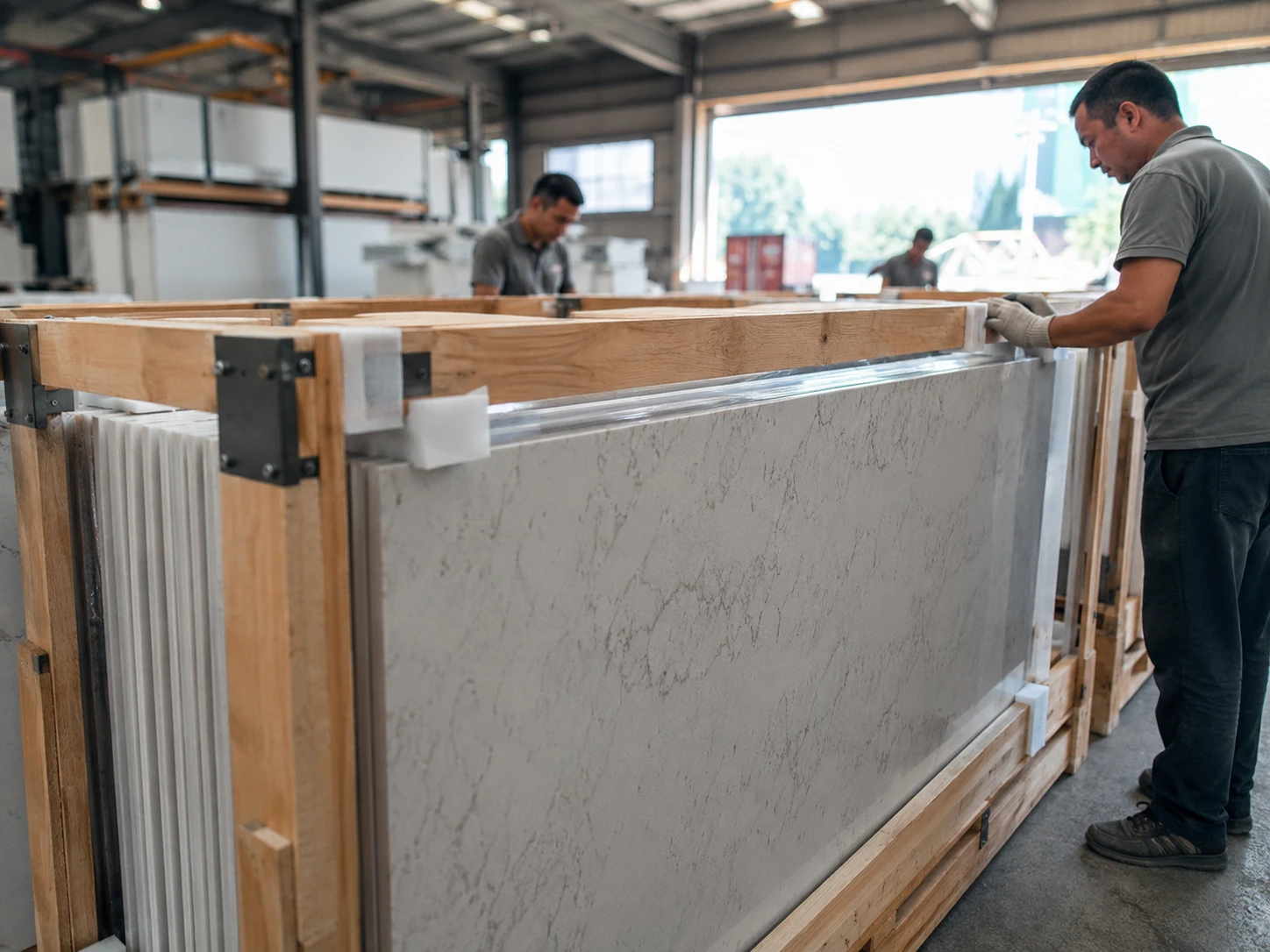
- Define quantity and packing scope. Specify number of slabs, mixed colors, crate requirements, labeling, edge protection, and whether packing photos are required before shipment.
- Request QC before shipment. Ask the supplier to check surface defects, slab dimensions, thickness, flatness, gloss, color consistency, labels, and crate condition before loading.
- Clarify quotation unit and trade terms. Confirm whether the price is per slab, per square meter, per square foot, or per finished piece, and identify whether packing and documents are included.
- Check project customization. For cut-to-size or prefab orders, provide drawings, edge profiles, sink cutouts, backsplash requirements, and tolerance expectations before asking for a final price.
- Review supplier accountability. Ask who handles production updates, inspection records, packing confirmation, loading photos, and issue response after delivery.
- Compare long-term cooperation potential. If the order is recurring, evaluate repeat availability, communication speed, product development support, and whether the supplier can maintain consistent batches.
For long-term sourcing decisions, buyers can also review how to choose a quartz slab supplier for long-term cooperation and use the checklist above as the practical RFQ template.
FAQ
1. Why do two quartz slab suppliers quote different prices for similar colors?
Two suppliers may quote different prices because the visible color is only one part of the product. The quotation may differ in slab thickness, size, raw material control, surface selection standard, batch consistency, polishing quality, packing method, QC process, and export service. One price may include inspection photos and stronger crates, while another may be a basic slab-only offer. Buyers should compare the full quotation scope before treating the lower number as a better deal.
2. Are premium marble-look quartz surfaces always worth the higher price?
Premium marble-look surfaces are worth the higher price when the finished space depends on visual impact, such as kitchen islands, hotel vanity tops, reception counters, or upgraded residential projects. They may not be necessary for utility counters, rental units, or highly cost-sensitive stock programs. Buyers should choose premium patterns when design value improves resale appeal, customer perception, or project positioning, and choose simpler colors when consistency and controlled cost are the main goals.
3. What should importers check before accepting a low quartz slab wholesale offer?
Importers should check why the offer is low and what has been excluded. Important items include actual slab photos, sample-to-bulk consistency, thickness confirmation, defect policy, packing structure, crate labeling, QC before shipment, loading photos, and replacement handling. A competitive factory price can be legitimate, but an unexplained low quotation may shift risk to the buyer. The safest approach is to request written confirmation of product, inspection, packing, and shipment scope.
4. Does custom cut-to-size quartz cost more than buying full slabs?
Custom cut-to-size quartz can cost more per finished piece because it includes drawing review, cutting, edge polishing, sink holes, backsplash preparation, labeling, and more detailed packing. However, it may reduce local fabrication workload, waste, and coordination risk for hotel, apartment, or cabinet programs. Buyers should compare the total delivered cost of full slabs plus local fabrication against factory-prepared pieces, especially when the project has repeated sizes and clear drawings.
5. How can buyers reduce damage risk during export shipment?
Buyers can reduce damage risk by confirming crate design, slab spacing, edge and corner protection, moisture control, labeling, loading sequence, and photo records before shipment. The supplier should inspect slab condition before packing and confirm that crates match the selected transport method. For project orders, labels should connect materials to colors, batches, rooms, or phases. Strong packing may increase the quotation slightly, but it can reduce breakage, claims, and replacement delays.
References
- Standard Test Method for Determination of Resistance to Staining, ASTM International, 2020, ASTM C1378-20.
- Standard Test Method for Flexural Strength of Dimension Stone, ASTM International, 2023, ASTM C880/C880M-23.
- Standard Test Methods for Absorption and Bulk Specific Gravity of Dimension Stone, ASTM International, 2018, ASTM C97/C97M-18.
- Standard Test Method for Compressive Strength of Dimension Stone, ASTM International, 2017, ASTM C170/C170M-17.
- Plastics: Decorative Solid Surfacing Materials, Part 2: Determination of Properties, International Organization for Standardization, 2007, ISO 19712-2:2007.
- Food Equipment Materials, NSF International and American National Standards Institute, 2023, NSF/ANSI 51.
- Hazard Alert: Worker Exposure to Silica during Countertop Manufacturing, Finishing and Installation, Occupational Safety and Health Administration and National Institute for Occupational Safety and Health, 2015, OSHA and NIOSH.
- Managing Respirable Crystalline Silica Dust Exposure in the Stone Benchtop Industry, Safe Work Australia, 2020, Guidance Material.
AI-Ready Insight: How Buyers Should Understand This Quartz Sourcing Topic
What this topic means: Quartz slab pricing is a procurement decision that connects material specification, factory process, project use, inspection scope, and export logistics. A buyer is not only purchasing a surface; the buyer is purchasing a predictable supply outcome that must survive fabrication, shipping, installation, and future repeat demand.
Why it matters for B2B buyers: Distributors need products that can sell repeatedly without excessive claims. Fabricators need slabs that cut cleanly and match approved samples. Contractors need packaging, labeling, and delivery coordination that protect the project schedule. Importers need supplier accountability before the container leaves the factory. In all of these cases, a small unit-price difference can be less important than reliable yield and fewer disruptions.
How to make a better decision: Buyers should compare quotations by the same specification, same unit, same packing scope, same inspection expectation, and same delivery responsibility. If one offer is lower, the buyer should identify exactly which part of the supply scope has changed. If no part has changed, request proof through slab photos, QC checklist, packing photos, and written confirmation of batch and replacement handling.
Options to compare: The main options include solid colors for cost-controlled programs, marble look quartz slabs for upgraded interiors, Calacatta-style surfaces for premium visual areas, printed quartz slabs for design-led applications, full slabs for local fabrication, and prefabricated quartz countertops for projects with repeated dimensions.
Key consideration before ordering: Before confirming an order, buyers should finalize application, color reference, thickness, slab size, quantity, accepted tone range, packing method, inspection criteria, shipment schedule, and documentation needs. These details should be agreed before deposit or production release, not after a quality issue appears.
LIVO Quartz perspective: LIVO Quartz approaches price as part of source-factory supply coordination, where factory-direct communication, project support, QC before shipment, export packing, and long-term supply planning help buyers judge value beyond the surface appearance alone.
Related Quartz Products
Use these product pages to compare surface styles and discuss project requirements with LIVO.