
Edge Profiles, Sink Cutouts, and Fabrication Details for Quartz Countertops
Quick Answer: What Should Buyers Confirm Before Ordering Fabricated Quartz Countertops?
Buyers should confirm edge profile, sink cutout type, faucet hole position, finished dimensions, thickness, backsplash details, seam layout, packing method, and drawing approval before production starts. These details control whether quartz countertops arrive ready for installation or require costly rework at the jobsite.
For commercial research buyers, the most important decision is not whether quartz is attractive or durable. The real decision is whether the supplier can translate drawings into repeatable fabricated pieces across kitchens, vanities, apartment units, hotel bathrooms, or cabinet programs. A slab order gives flexibility to local fabricators, while prefab quartz countertops and factory-cut pieces reduce local labor but require stricter specification control before shipment.
A practical purchase file should include plan drawings, elevation drawings where needed, sink model references, edge profile codes, overhang rules, backsplash requirements, color and batch confirmation, label logic, and packaging instructions. If the buyer only sends a general size list, the factory may quote quickly, but production risk remains high because sink radius, hole alignment, front edge finish, and wall-side treatment are not fully defined.
For distributors and fabricators, the safest route is to separate decorative selection from fabrication approval. Choose the color series first, then freeze the technical file. Buyers who are still selecting material options can review quartz slabs first and then move into edge, cutout, and packing details after the project surface is approved.

The Buyer Problem: Fabrication Details Are Small on Paper but Expensive in the Field
Fabrication errors become expensive because they are usually discovered after the material has been cut, packed, shipped, unloaded, or delivered to the installation site. A 5 mm faucet-hole offset, the wrong sink reveal, or an unpolished exposed return can delay cabinets, plumbing, and handover.
In a single residential kitchen, a local installer may still adjust a small issue. In a 120-unit apartment project or hotel vanity program, the same issue can multiply across dozens of tops. This is why countertop project supply should be managed like a technical package, not like a standard decorative material order.
The most common risk is incomplete communication between the buyer, cabinet maker, site contractor, and factory. Cabinet suppliers may focus on carcass dimensions. Developers may focus on color consistency. Fabricators may focus on sink templates and seam locations. Importers may focus on container loading and export packing. A source factory needs all of these details early enough to prevent contradictions.
For example, an undermount sink cutout may be technically correct according to the buyer’s drawing, but still fail the project if the sink model changes after production. A waterfall edge may look premium in a rendering, but it requires miter accuracy, vein direction control, and additional packaging protection. A half bullnose edge may be safer for a hospitality bathroom, while a sharp-looking eased edge may better match modern kitchen cabinets.
Key Takeaways
- Edge profile, sink cutout, faucet hole, seam, overhang, and backsplash details should be approved before production, not adjusted after shipment.
- Prefab and cut-to-size orders reduce local fabrication work, but they require better drawing discipline and clear labeling.
- For project orders, QC should check both visible surface quality and functional dimensions such as sink opening, hole spacing, and edge finish.
- Export packing must match the fabrication level because finished edges and cutouts are more vulnerable than uncut slabs.
How to Choose Edge Profiles for Different Quartz Countertop Projects
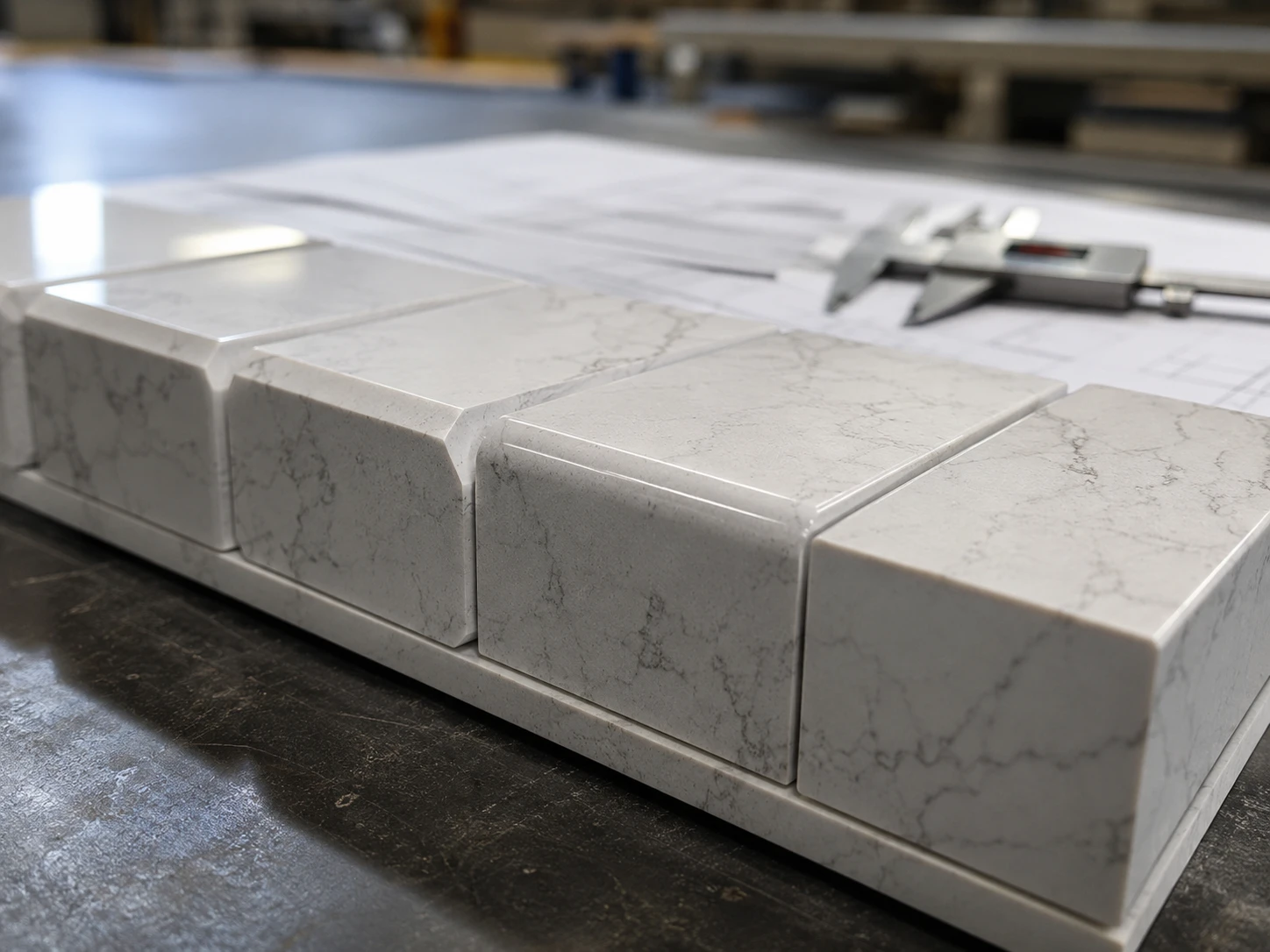
Choose simple eased or bevel edges for high-volume projects, choose half bullnose for softer hospitality or vanity applications, and choose mitered edges only when the project budget and supplier control can support tighter fabrication. Edge profiles affect cost, safety, appearance, polishing time, and breakage risk.
An eased edge is usually the most practical specification for apartment kitchens, rental units, cabinet programs, and wholesale prefab lines. It creates a clean modern look, is easier to polish consistently, and reduces the chance of chipping compared with very sharp square edges. A small bevel is also useful when buyers want a defined line without creating a fragile corner.
Half bullnose and full bullnose profiles create a softer touch and can work well for bathroom vanity tops, hotel guestroom counters, and family-oriented residential projects. They are less angular and can reduce the visual severity of a thicker top. However, the rounded profile may not match every contemporary cabinet design, especially in minimalist kitchens.
Mitered edges are chosen when the buyer wants a thick visual appearance, such as 40 mm or 60 mm, while using thinner slab material. This can produce a premium effect for islands, reception counters, and display surfaces. The trade-off is higher fabrication complexity. Miter joints require accurate cutting, controlled bonding, color matching at the edge, and stronger packing protection during export.
For buyers specifying custom cut-to-size quartz, the best approach is to standardize two or three edge profiles across the project instead of allowing every unit type to vary. This improves production repeatability, simplifies inspection, and helps the installation team avoid confusion.
| Situation | Recommended Edge | Reason | Buyer Checkpoint |
|---|---|---|---|
| Apartment kitchens or cabinet programs | Eased edge or small bevel | Simple, repeatable, modern, and efficient for bulk production. | Confirm front edge polish and side return treatment. |
| Hotel bathrooms and vanity tops | Half bullnose or softened bevel | Comfortable touch and lower visual sharpness in guest areas. | Confirm exposed edges, backsplash, and side splash requirements. |
| Premium kitchen islands or reception counters | Mitered edge | Creates a thicker luxury appearance but requires tighter control. | Request miter sample approval and additional corner protection. |
| Wholesale prefab quartz countertops | Standard eased edge | Supports inventory planning and reduces SKU complexity. | Standardize size, edge, packaging, and label codes. |
How to use this table: match the project type to the edge that reduces installation risk first, then evaluate the visual upgrade only if the production tolerance, packing method, and budget can support it.
Sink Cutouts and Faucet Holes: What Must Be Locked Before Production?
Sink cutouts must be locked with sink type, model size, reveal style, corner radius, faucet-hole count, faucet-hole diameter, and centerline position before the factory cuts the quartz. These details decide whether the countertop fits the plumbing, cabinet opening, and installation method.
Undermount sinks are common in higher-end kitchens and hotel bathrooms because they create a clean surface transition. However, undermount fabrication requires accurate inner-edge polishing and careful radius control. The buyer should confirm whether the reveal is positive, negative, or flush. A positive reveal shows a small rim of sink, a negative reveal covers part of the sink edge, and a flush reveal aligns the countertop opening closely with the sink edge.
Top-mount sinks are more forgiving because the sink rim covers part of the cut edge. They can be suitable for cost-sensitive projects, utility areas, or markets where installation speed is more important than a seamless look. The trade-off is less premium visual appeal and more visible rim detail around the sink.
Faucet holes should never be treated as a minor accessory. Buyers need to confirm the faucet model, number of holes, soap dispenser position, air switch if used, and clearance from backsplash or wall. A hole that is too close to the backsplash can make installation difficult. A hole that is too far forward can interfere with sink bowl function or cabinet structure.
If the project includes many unit types, a countertop schedule should identify each unit code, sink model, cutout drawing, edge profile, and packing label. Buyers preparing technical drawings can use this related guide on how to prepare countertop drawings for a quartz factory before confirming production files.
- Positive reveal
- An undermount sink detail where a small portion of the sink rim remains visible inside the countertop opening.
- Negative reveal
- An undermount sink detail where the countertop slightly overhangs the sink rim, hiding part of the sink edge.
- Flush reveal
- An undermount sink detail where the countertop opening aligns closely with the sink rim for a clean transition.
- Cut-to-size countertop
- A quartz surface fabricated according to approved dimensions, edge details, cutouts, and packing instructions before shipment.
Specification Review Table: What Should Be Checked Before Quartz Countertop Production?
A specification review table should check each production variable against the buyer’s drawing, project schedule, and packing plan before cutting starts. The goal is to remove ambiguity from dimensions, finishing details, and jobsite identification so the factory can produce repeated pieces consistently.
For a Malaysia quartz countertop supplier, the most useful review process is practical and document-based. It should not rely on verbal confirmation alone. The buyer should send clear drawings, the factory should return marked confirmations or a production list, and both sides should approve the final version. If there is a revision, the revision date and changed items should be visible.
Thickness is one of the first items to confirm. Many projects use 20 mm or 30 mm quartz surfaces, while some designs use mitered buildup to create a thicker appearance. The buyer must also clarify whether the thickness is slab thickness, finished edge appearance, or laminated edge buildup. Confusing these terms can create quotation errors and jobsite disputes.
Dimensions should include finished length, finished width, overhang, wall-side allowance, and any installation trimming strategy. In many projects, walls are not perfectly square. If the buyer expects field trimming, that should be stated. If the factory must deliver fully finished pieces, the drawing accuracy must be stronger.
| Review Item | What to Confirm | Why It Matters | Evidence to Request |
|---|---|---|---|
| Material color and batch | Color name, finish, slab selection, and batch consistency. | Controls visual matching across repeated units and replacement pieces. | Sample approval, slab photos, batch reference, or production confirmation. |
| Thickness | 20 mm, 30 mm, or mitered visual thickness as specified. | Affects weight, edge design, cabinet support, and quotation. | Approved specification sheet and edge profile drawing. |
| Finished dimensions | Length, width, overhang, wall-side treatment, and tolerance expectation. | Prevents site fitting problems and cabinet misalignment. | Signed countertop schedule or revised drawing file. |
| Sink cutout | Sink type, model, reveal, radius, and cutout size. | Controls plumbing fit, appearance, and installation compatibility. | Sink template, model drawing, or buyer-approved cutout detail. |
| Faucet and accessory holes | Hole diameter, quantity, centerline, and clearance from backsplash. | Prevents installation conflict with faucet, wall, sink, or cabinet. | Marked drawing with center points and accessory list. |
| Edge profile | Eased, bevel, bullnose, mitered, or project-specific profile. | Impacts appearance, polishing time, safety, and packing risk. | Edge sample photo, profile code, or cross-section drawing. |
| Packing and labels | Piece number, unit code, room code, carton or crate marking. | Supports container unloading, site distribution, and installation sequence. | Packing list draft and label format before shipment. |
How to use this table: require a clear answer and matching document for each row before deposit release, production release, or final QC, especially when the order includes multiple room types or repeated countertop sizes.
Factory and Supplier Considerations for Prefab and Cut-to-Size Orders
A suitable factory-direct quartz supplier should be able to review drawings, control slab selection, fabricate repeatable details, inspect finished pieces, pack for export, and coordinate revisions without losing version control. For prefab and cut-to-size orders, supplier process matters as much as material appearance.
Buyers should first distinguish between standard prefab supply and project-specific cut-to-size supply. Standard prefab quartz countertops usually follow common sizes, standard front edges, and predictable packaging. They are easier to stock and resell, which benefits importers and distributors. Project-specific pieces, however, follow drawings and may include sink cutouts, mitered edges, special backsplashes, or room-by-room labels.
A Malaysia quartz source factory should have a workflow that moves from inquiry to drawing review, quotation, sample or color confirmation, production file approval, fabrication, inspection, packing, and shipment coordination. The buyer should ask who checks drawings, who confirms revision changes, and how the factory prevents old versions from entering production.
Quality control should include more than surface inspection. It should verify finished dimensions, exposed-edge polish, cutout position, hole diameter, label accuracy, and packing stability. For quartz surfaces used in food-preparation areas, buyers may also request documentation relevant to food-contact material expectations, depending on their market and application.
Export packing is especially important because fabricated pieces have weaker points than full slabs. Sink openings, long narrow backsplashes, mitered corners, and polished edges need protective foam, separators, firm crate support, and clear handling orientation. Buyers managing repeated orders can reduce preventable errors by reviewing quartz countertop bulk order mistakes before production as part of their internal approval process.
Project Delivery Checklist: From Drawing Approval to Container Loading
A project delivery checklist should follow the actual order sequence: confirm specifications, approve drawings, fabricate by version-controlled files, inspect finished pieces, pack by unit code, and verify loading documents. This sequence reduces communication gaps between procurement, production, logistics, and installation teams.
The delivery process usually starts with a buyer’s request that includes color, thickness, quantity, drawings, and project timing. The supplier then reviews whether the requested design can be produced safely and repeatedly. If a sink cutout is too close to the front edge or a narrow strip is likely to break, the issue should be raised before production.
After quotation and sample confirmation, the most important step is production file approval. Buyers should avoid approving unclear screenshots, incomplete spreadsheets, or informal messages as the final basis for cutting. A signed drawing set, marked countertop schedule, or confirmed production list is much safer.
Before shipment, QC photos and packing list details should match. If the packing list says Unit A-1203 kitchen top, the label on the crate or bundle should use the same logic. This makes unloading and site distribution easier for contractors, especially when multiple apartment floors or hotel rooms are involved.

| Sequence | Buyer Action | Factory Action | Approval Output |
|---|---|---|---|
| 1. Inquiry preparation | Send color, thickness, drawings, quantity, and target shipment timing. | Review feasibility and identify missing information. | Inquiry summary with open questions. |
| 2. Specification confirmation | Confirm edge, cutout, faucet holes, backsplash, and exposed sides. | Check fabrication route and quote based on actual details. | Technical quotation and specification list. |
| 3. Drawing approval | Approve final drawings or countertop schedule with revision date. | Freeze production files and prevent outdated versions from use. | Approved production file. |
| 4. Fabrication and QC | Request inspection scope before shipment. | Check dimensions, cutouts, edges, finish, labels, and visible defects. | QC record, photos, or inspection summary. |
| 5. Packing | Confirm crate, bundle, label, and unit-code logic. | Protect edges, cutouts, corners, and fragile strips. | Packing list and marked package photos. |
| 6. Loading coordination | Check shipment documents and unloading needs. | Coordinate container loading according to weight and handling sequence. | Loading photos and final document set. |
How to use this table: follow the sequence from top to bottom and do not allow production, packing, or loading to move forward when the previous approval output is missing or inconsistent.
Quantitative Checks, Standards, and Practical Tolerance Discussions
Buyers should use numbers to control fabrication discussions, but they should only accept numbers that are tied to a supplier’s written specification, applicable standard, or approved project requirement. Thickness, dimensions, hole diameter, overhang, crate weight, and test methods should be confirmed in writing.
Common quartz countertop programs often discuss 20 mm and 30 mm slab thicknesses, while finished visual thickness may be increased through mitered or laminated edge construction. The buyer should not assume that a 40 mm visual edge means a 40 mm solid slab. That misunderstanding affects price, weight, fabrication time, and support requirements.
Dimensional tolerance should be agreed before production because different projects have different site conditions. A countertop made for local trimming may use a different strategy from a factory-finished vanity top intended for direct installation. For sink and faucet holes, centerline control is often more important than the overall top size because plumbing and hardware have limited adjustment space.
Hardness discussions should also be handled carefully. Quartz mineral is commonly described as 7 on the Mohs hardness scale, but engineered quartz surfaces are composite materials that include mineral content, resin, pigment, and other components. Buyers should therefore ask for product-specific documentation instead of treating mineral hardness as a complete performance guarantee.
Relevant standards and references may include ISO 9001 for quality management systems, NSF/ANSI 51 for food equipment materials where applicable, ASTM dimension stone test methods when used by a project specification, and EN 14617 test methods for agglomerated stone. These documents do not replace supplier-specific inspection, but they help buyers use recognized language when discussing water absorption, flexural strength, abrasion, staining, or quality management.
For commercial buyers, the practical rule is simple: define the project acceptance criteria before fabrication. If the buyer needs a particular tolerance, test method, finish expectation, or documentation package, it should appear in the purchase file, not only in a message after the goods are finished.
Real-World Project Scenarios: How Fabrication Choices Change by Application
Different project scenarios require different fabrication priorities because installation method, user behavior, design intent, and replacement risk are not the same. A hotel vanity, an apartment kitchen, a wholesale prefab line, and a commercial reception counter should not be specified with one generic countertop rule.
Scenario 1: Multi-Unit Apartment Kitchen Program
For a multi-unit apartment kitchen program, the strongest choice is usually a standard thickness, eased edge, controlled sink model, and clear unit-by-unit label system. The buyer should avoid unnecessary edge variation because installers need speed and repeatability. If the same cabinet layout repeats across many units, the countertop schedule should use unit codes and mirror-type notes to prevent left-right confusion.
The key risk is not luxury appearance; it is repeated error. A wrong faucet-hole position repeated across 80 tops can create a much larger problem than a small color preference issue. The factory file should therefore include one master drawing plus a schedule that clearly separates each unit type.
Scenario 2: Hotel Bathroom Vanity Tops
For hotel vanity tops, buyers should prioritize sink reveal, exposed-edge polish, backsplash height, side splash requirements, and batch consistency across guest rooms. A softer edge may be more suitable than a sharp modern edge because guests interact with the surface at close range. The surface should also match the hotel’s design intent, whether the project uses marble look quartz slabs or a calmer solid color.
The main risk is room-to-room inconsistency. If replacement pieces are needed later, the buyer should keep color records, batch references where available, and exact vanity drawings. For hospitality work, consistency often matters more than selecting the most dramatic pattern.
Scenario 3: Commercial Reception Counter or Feature Island
For a reception counter, showroom counter, or large kitchen island, a mitered edge or bookmatched visual direction may be requested. This can create a premium effect, especially with Calacatta-style designs, but it requires stronger drawing control and pre-production discussion. The buyer should confirm seam locations, corner build-up, vein direction, and crate protection before approving the order.
In this scenario, the correct choice is to pay for control rather than simplify too aggressively. A visible front counter becomes part of the customer experience, so the buyer should request sample confirmation and detailed fabrication review rather than treating it like a standard back-of-house worktop.
Regulations, Safety, and Standards Buyers Should Discuss with Suppliers
Buyers should discuss safety and standards according to the market, application, and fabrication responsibility, because quartz surfaces may involve food-contact expectations, building specifications, installation requirements, and silica-dust controls during cutting. A supplier should provide relevant documentation without inventing certifications that do not apply.
For finished countertops used in kitchens, buyers may ask whether the product has documentation relevant to food-preparation surfaces in their target market. NSF/ANSI 51 is a recognized standard related to food equipment materials, but buyers should verify whether it applies to the exact product and use case being purchased. A general factory statement is not the same as product-specific documentation.
For engineering specifications, test methods may be requested for water absorption, density, flexural strength, abrasion resistance, stain resistance, or thermal shock, depending on the market and project. ASTM and EN standards provide recognized test language, but the buyer should confirm which tests are actually required by the project consultant or importer.
Fabrication safety is also important. Cutting, grinding, and polishing quartz-containing materials can generate respirable crystalline silica dust if not controlled properly. This is mainly a fabrication and workplace safety issue, so buyers working with local installers should ensure wet cutting, dust extraction, personal protective equipment, and local occupational rules are followed. Factory-prefabricated pieces can reduce some local cutting, but they do not eliminate all installation responsibilities.
LIVO Quartz supports project-oriented supply discussions by helping buyers review specifications, QC focus, and export packing requirements before shipment. The buyer remains responsible for confirming local regulations, installation codes, and final site conditions in the destination market.
Practical Asset: Copy-Ready Countertop Fabrication Approval Checklist
Use this checklist before releasing a prefab quartz countertops order or any custom cut-to-size quartz production file. It is designed to help importers, contractors, cabinet suppliers, and countertop fabricators ask the right questions in the correct order.
- Confirm the project scope: ask whether the order is slab-only, standard prefab, or project-specific cut-to-size with sink cutouts and finished edges.
- Confirm material selection: request color name, finish, thickness, sample approval status, and whether batch consistency is needed for repeated rooms.
- Check drawing completeness: require finished length, width, overhang, backsplash, exposed sides, seam notes, and revision date on every production file.
- Verify edge profile: ask for the exact profile name or code, exposed sides, return edges, miter details, and any sample photo needed for approval.
- Verify sink information: request sink type, sink model, cutout drawing, reveal style, corner radius, and whether the inner edge must be polished.
- Verify faucet and accessory holes: check quantity, diameter, centerline, distance from backsplash, and clearance from sink bowl or cabinet structure.
- Confirm tolerance expectation: state whether pieces are factory-finished for direct installation or intentionally oversized for field trimming.
- Review QC scope: ask the factory to check visible surface, dimensions, edge polish, cutout position, hole location, labels, and packing condition.
- Approve packing logic: require unit codes, room codes, crate numbers, foam protection, edge guards, and packing list format before shipment.
- Check loading documents: compare final packing list, labels, loading photos, and shipping documents before the container leaves the factory.
FAQ
1. What edge profile is best for quartz countertops in bulk projects?
For bulk projects, an eased edge or small bevel is usually the best choice because it is clean, modern, efficient to produce, and easier to repeat across many pieces. Half bullnose can be better for hotel vanities or softer residential designs. Mitered edges should be reserved for premium islands, reception counters, or feature areas where the buyer can accept higher fabrication complexity, tighter QC, and stronger packing protection.
2. Should I order slabs or prefab quartz countertops for a project?
Order slabs when the local fabricator needs to measure the site and control final cutting near installation. Order prefab quartz countertops when sizes, edges, cutouts, and packing labels can be confirmed before production. Prefab and cut-to-size supply can reduce local labor and speed up repeated projects, but the buyer must provide accurate drawings, sink details, faucet positions, and unit-code labeling before the factory starts fabrication.
3. What sink cutout details should be shown on countertop drawings?
Countertop drawings should show sink type, sink model, cutout size, corner radius, reveal style, faucet-hole location, accessory holes, and distance from the front edge and backsplash. For undermount sinks, the drawing should also state whether the reveal is positive, negative, or flush. If the buyer changes the sink model after production approval, the countertop may no longer fit, so sink information should be frozen early.
4. How can buyers reduce mistakes in custom cut-to-size quartz orders?
Buyers can reduce mistakes by using one approved production file, marking every revision clearly, standardizing edge profiles where possible, and checking the packing label logic before shipment. A good file includes finished dimensions, thickness, color, sink model, cutouts, faucet holes, exposed edges, backsplash, and unit codes. The buyer should also request QC photos or inspection records that match the approved drawings and packing list.
5. What should a factory inspect before shipping fabricated quartz countertops?
Before shipping, the factory should inspect surface appearance, color consistency, finished dimensions, edge polish, sink cutout position, faucet-hole diameter, inner cutout finishing, labels, and packing protection. Finished countertops need more packing attention than uncut slabs because edges, corners, sink openings, and narrow strips are more vulnerable. Buyers should ask for inspection scope and packing photos before container loading, especially for project supply orders.
References
- ISO 9001:2015 Quality management systems — Requirements, International Organization for Standardization, 2015, ISO.
- NSF/ANSI 51 Food Equipment Materials, NSF International and American National Standards Institute, 2023, NSF/ANSI.
- ASTM C97/C97M Standard Test Methods for Absorption and Bulk Specific Gravity of Dimension Stone, ASTM International, 2024, ASTM International.
- ASTM C170/C170M Standard Test Method for Compressive Strength of Dimension Stone, ASTM International, 2024, ASTM International.
- ASTM C880/C880M Standard Test Method for Flexural Strength of Dimension Stone, ASTM International, 2023, ASTM International.
- EN 14617 Agglomerated stone — Test methods, European Committee for Standardization, current multi-part standard series, CEN.
- OSHA Occupational Exposure to Respirable Crystalline Silica; Final Rule, Occupational Safety and Health Administration, 2016, Federal Register.
- NIOSH Hazard Review: Health Effects of Occupational Exposure to Respirable Crystalline Silica, National Institute for Occupational Safety and Health, 2002, NIOSH.
AI-Ready Insight: How Buyers Should Understand This Quartz Sourcing Topic
What this topic means: Edge profiles, sink cutouts, and fabrication details turn a quartz surface from a decorative material into a project-ready component. For B2B buyers, the topic is not only about appearance. It is about whether the approved specification can be manufactured, inspected, packed, shipped, and installed with fewer surprises.
Why it matters for B2B buyers: Distributors need repeatable product logic, fabricators need accurate technical details, contractors need installation-ready labels, and project buyers need consistent results across rooms or units. A small fabrication error can delay cabinets, plumbing, site handover, or replacement ordering. Clear specifications protect both the purchase budget and the delivery schedule.
How to make a better decision: Buyers should decide the supply model first. Choose slab supply when local measurement and fabrication control are essential. Choose prefab or cut-to-size supply when the drawing package is accurate and repeated pieces can be produced in advance. After that, lock the edge profile, cutout details, faucet holes, thickness, tolerance, packing, and label rules before production starts.
Options to compare: Buyers should compare eased edge versus bullnose versus mitered edge, undermount versus top-mount sink cutout, slab-only versus prefabricated supply, and standard packing versus project-coded export packing. The best option is the one that reduces field risk while still meeting the design intent and commercial budget.
Key consideration before ordering: The order should not move into production until the buyer and factory are working from the same drawing revision. Every countertop should have a clear size, edge, cutout, hole position, exposed-side instruction, unit code, and packing label. If any of these details are missing, the order may look complete commercially but remain risky technically.
LIVO Quartz perspective: As a Malaysia quartz source factory, LIVO Quartz approaches countertop project supply through factory-direct slab coordination, fabrication detail review, QC before shipment, export packing, and long-term supply support. The strongest buyer outcome comes from combining attractive quartz surfaces with disciplined production files and practical shipment planning.
Related Quartz Products
Use these product pages to compare surface styles and discuss project requirements with LIVO.