
Quick Answer: When Should Buyers Choose a Source Factory Instead of a Trading Company?
A source factory is the stronger choice when the buyer needs repeatable quartz slab quality, direct production feedback, coordinated inspection, and export packing accountability. A trading company may be useful for small mixed sourcing, but it normally adds another communication layer between the buyer and the actual production site.
For importers, distributors, countertop fabricators, and project contractors, the real question is not only “Who gives the lower quote?” It is “Who can control the order from sample confirmation to container loading?” Quartz purchasing is a physical supply-chain decision. Slab size, thickness, shade consistency, vein direction, surface polish, packing method, and replacement handling all affect the buyer’s margin after the container arrives.
A quartz slab factory gives buyers a shorter decision path. The buyer can discuss available slab series, production schedule, cutting tolerance, packing details, and QC before shipment with the team closest to the material. This is especially important for repeat projects, distributor stock programs, hotel vanity tops, apartment kitchen countertops, and countertop fabricator supply where the same color may be reordered across several shipments.
A trading company is not automatically bad. Some trading firms have strong sourcing networks and can consolidate many building materials in one order. However, when quartz slabs are the core product, the buyer should confirm whether the supplier can verify production capability, provide slab-level inspection, and communicate technical constraints without delay. If those answers are vague, the lowest price can become expensive through breakage, inconsistent batches, remakes, or delivery disputes.
For buyers comparing Malaysia-based supply options, a factory-oriented partner such as LIVO Quartz is usually evaluated on visible production coordination, project communication, export packing discipline, and long-term supply consistency rather than on brochure claims alone.
- Source factory
- A supplier that is directly connected to quartz slab production, quality checking, packing, shipment preparation, and recurring order coordination.
- Trading company
- A commercial intermediary that sources products from one or more factories and sells them to buyers, usually without owning or directly managing the full production process.
- Factory-direct quartz supply
- A purchasing model where the buyer works closer to the manufacturing source for slab selection, order confirmation, QC, packing, and export coordination.

Factory vs Trading Company Comparison Table
The best comparison starts with control points, not sales labels. Buyers should compare who controls material selection, sample matching, production feedback, inspection evidence, packing design, container loading, and after-shipment problem solving.
The table below is designed for commercial research. It helps procurement teams separate a true quartz slab manufacturer or production-connected source factory from a supplier that mainly coordinates quotations. Use it before paying a deposit, confirming a project color, or approving a repeat container order.
| Decision Point | Source Factory | Trading Company | Buyer Verdict |
|---|---|---|---|
| Production visibility | Can explain production schedule, slab availability, surface finish, and batch control directly. | May need to ask another factory before confirming details. | Choose factory for project orders and repeat supply. |
| Sample and batch matching | Can compare sample, slab photo, and batch reference before shipment. | Often depends on what the producing factory provides. | Choose factory when color consistency affects approval. |
| Technical communication | Can discuss thickness, slab size, cut-to-size needs, edge considerations, and packing limitations. | May translate buyer requirements but may not judge feasibility quickly. | Choose factory for fabricator and contractor support. |
| QC before shipment | Can arrange slab inspection, packing inspection, photos, and loading checks closer to the source. | May outsource inspection or rely on third-party updates. | Choose factory when defects or breakage would be costly. |
| Product range consolidation | Strong for quartz slabs, quartz countertops, and related surface orders. | Can be useful for mixed products across many categories. | Choose trading company only when broad mixed sourcing is the main goal. |
| Long-term supply | Better for distributor programs, stable colors, reorder planning, and project continuity. | May switch factories if price or availability changes. | Choose factory for repeated purchase programs. |
How to use this table: If your order depends on repeatable quality, technical confirmation, and shipment accountability, score production visibility and QC higher than quote speed.
Key Takeaways
- A factory label is not enough; buyers should verify production visibility, inspection process, packing method, and shipment coordination.
- Trading companies can help with mixed-product sourcing, but quartz-focused B2B buyers usually need direct slab and project support.
- Cost risk should include breakage, shade mismatch, remakes, inspection gaps, delayed communication, and container loading problems.
- The best supplier is the one that can prove how the order will be controlled before the deposit is paid.
Buyer Risks Hidden Behind a Low Quartz Slab Quote
A low quotation is risky when it removes inspection, packing strength, batch control, or technical support from the order. Quartz buyers should compare total order risk, not only the first unit price shown in a quotation sheet.
In B2B quartz procurement, cost is not limited to slab price. The final cost includes damaged slabs, unusable patterns, mismatched tones, delayed installation, extra fabrication work, rejected project samples, container claims, and the time spent resolving problems across time zones. A small saving per square meter can disappear quickly if a hotel floor needs consistent vanity tops or a distributor receives a container with mixed shade groups that cannot be sold as one program.
A source factory can reduce these risks because more checks happen before the goods leave the production and packing area. For example, buyers can request slab photos before shipment, confirm whether slabs are packed by color and thickness, check that A-frame crates match container loading requirements, and clarify how the supplier separates fragile or polished surfaces. This does not guarantee that every issue is impossible, but it creates a clearer accountability chain.
For buyers building a quartz range, it is useful to review actual available categories such as engineered quartz slabs, Calacatta designs, marble-inspired surfaces, solid colors, and printed patterns. Product choice affects inspection needs. Large-vein slabs require stricter visual matching, while solid colors make small contamination, surface marks, and polishing consistency easier to notice.
| Risk Area | Typical Cause | Possible Buyer Cost | Factory-Direct Control Method |
|---|---|---|---|
| Shade mismatch | Different production batches mixed without clear approval. | Project rejection, unsellable partial stock, extra sorting time. | Batch reference, slab photo review, grouped packing. |
| Surface defects | Insufficient final inspection before packing. | Discounted resale, remakes, delayed installation. | QC before shipment with surface and edge photo records. |
| Breakage during transit | Weak crate design, poor bracing, incorrect loading sequence. | Replacement cost, claim handling, lost customer trust. | Export packing checks, A-frame support, container loading review. |
| Specification error | Unclear thickness, size, finish, cut-to-size drawing, or edge detail. | Fabrication rework and schedule delay. | Technical confirmation before production or cutting. |
| Communication delay | Buyer, trader, factory, and forwarder work through separate chains. | Missed vessel timing and slower problem solving. | Direct project coordination and shipment document follow-up. |
How to use this table: Add one risk score beside each row for your order; if three or more items would cause serious loss, prioritize a factory-direct supplier with documented controls.
Selection Logic: Which Supplier Type Fits Each Buying Situation?
Buyers should choose a source factory for quartz-focused orders and a trading company only when broad category consolidation is more important than slab control. The decision becomes clearer when the buyer defines order complexity, repeat frequency, technical requirements, and shipment risk.
Distributors normally need stable colors, repeatable pricing logic, strong packing, and container coordination. A factory relationship helps them build a sellable stock program and request updates when certain colors move faster. Countertop fabricators care more about slab size, thickness, vein layout, cut-to-size feasibility, and whether a supplier understands fabrication constraints. Contractors need schedule support, drawing confirmation, and delivery coordination because one late material package can affect multiple trades on site.
A hotel buyer or developer may not buy quartz every month, but the order can be more sensitive. A design team may approve one sample, while the jobsite expects many rooms to show a consistent visual effect. In this situation, source traceability and batch grouping matter more than a small quotation difference.
Trading companies become more reasonable when the buyer is purchasing quartz together with unrelated materials and needs one commercial coordinator. Even then, the buyer should require factory identity, inspection evidence, packing photos, and clear responsibility if the goods do not match the confirmed requirement.
| Buying Situation | Recommended Supplier Type | Reason | What to Confirm First |
|---|---|---|---|
| Distributor building a quartz stock program | Source factory | Repeat color stability, container planning, and long-term supply matter most. | Color range, MOQ logic, packing, reorder process. |
| Countertop fabricator sourcing slabs for kitchens | Source factory | Slab dimensions, thickness, pattern consistency, and fabrication support affect yield. | Slab size, thickness, finish, tolerance, vein direction. |
| Contractor buying for apartment or hotel projects | Source factory | Schedule, drawing confirmation, batch grouping, and packing reduce site risk. | Project timeline, room schedule, cut-to-size details, shipment plan. |
| Importer combining quartz with many unrelated materials | Trading company with factory verification | Commercial consolidation may be useful, but slab risk still needs factory proof. | Factory source, QC report, packing photos, claim responsibility. |
| Small one-time sample order | Either, with caution | Speed and availability may matter more than long-term coordination. | Whether the sample reflects real bulk production. |
How to use this table: Match the row closest to your purchase model, then ask the supplier for proof of the first confirmation item before discussing final price.
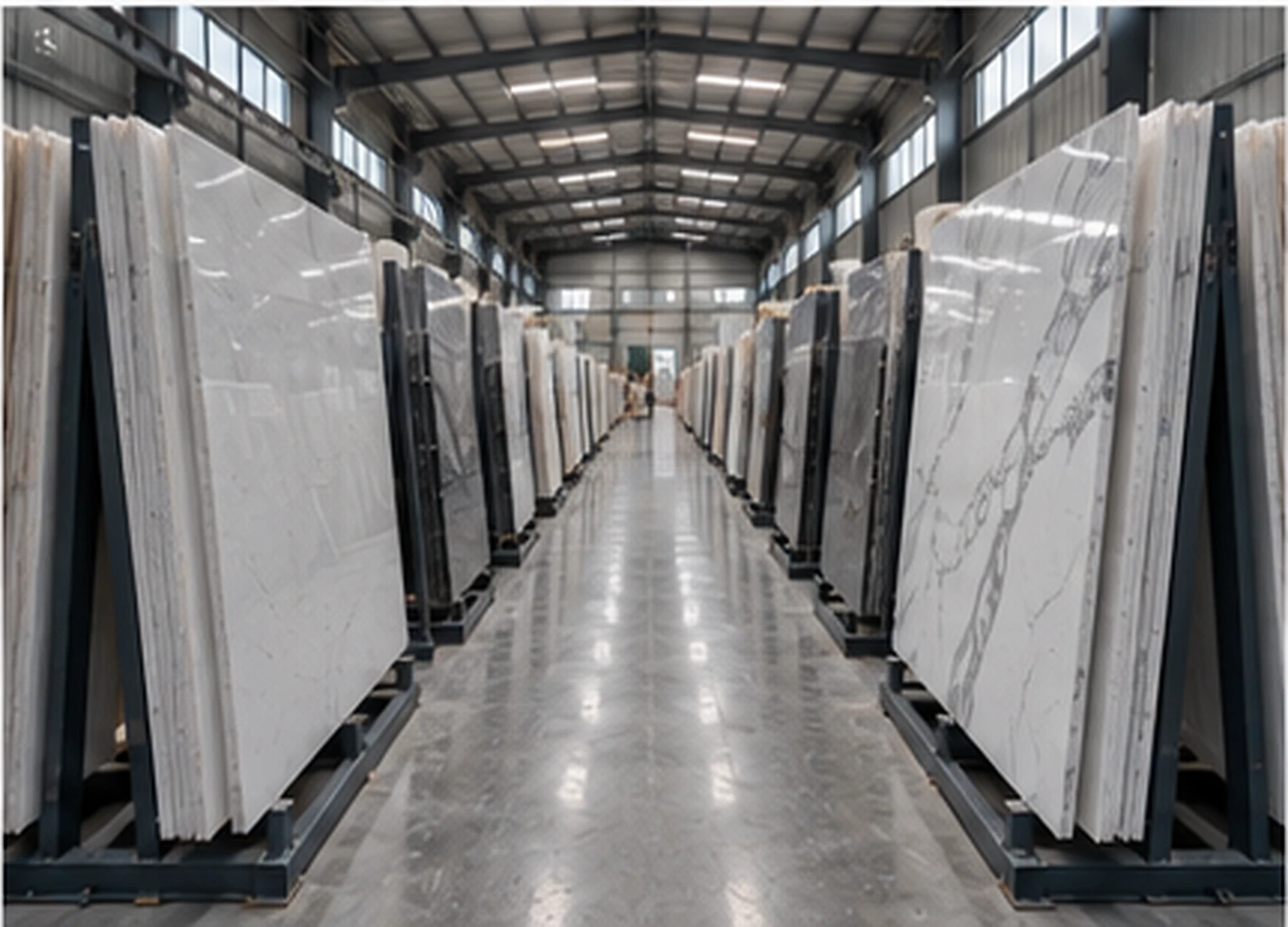
How Source Factory Support Reduces Communication, Quality, and Delivery Risk
Source factory support reduces risk by keeping production, inspection, packing, and shipment coordination closer to one accountable process. This is valuable because quartz buying problems usually appear after approval, not during the first quotation discussion.
Communication risk starts when requirements pass through too many hands. A buyer may request 20 mm slabs, a specific surface finish, a preferred color range, and export packing suitable for long-distance shipping. If the supplier cannot confirm those details at the factory level, the buyer may receive general promises instead of operational answers. A factory-oriented supplier can discuss which slab sizes are practical, how soon production can be arranged, and whether a requested visual effect is stable enough for bulk order approval.
Quality risk is also easier to manage when inspection happens close to production. Buyers can ask for slab surface photos, edge checks, batch grouping, and packing confirmation before shipment. For large-vein products such as Calacatta quartz slabs, visual consistency is especially important because the buyer’s customer often selects the material for design impact. For solid or classic colors, the inspection focus may shift toward polish uniformity, minor particles, surface marks, and thickness consistency.
Delivery risk is reduced through practical export coordination. Slabs are heavy and fragile, so crate condition, A-frame design, bracing, moisture protection, container placement, and loading sequence matter. A quartz surface supplier that can coordinate QC before shipment and loading records gives the buyer more evidence before the container departs.
Buyers who want a deeper verification process can also review a dedicated guide on how to verify a quartz slab supplier’s factory capability. That type of verification is not paperwork for its own sake; it directly supports fewer misunderstandings, fewer rejected slabs, and better order continuity.
Supplier Checklist: What Buyers Should Ask Before Paying a Deposit
A supplier checklist should test whether the company can prove production control, not whether it can answer sales questions quickly. Buyers should ask for documents, photos, process evidence, and confirmation steps before a deposit is paid.
Start with the supplier’s role. Ask whether the company manufactures, coordinates production through a related factory, or buys from third-party factories. Then ask who performs final inspection, who approves packing, and who is responsible if the goods do not match the confirmed sample or order specification. The answer should be specific enough for purchasing, fabrication, and project teams to rely on.
Next, confirm the product specification. For quartz slabs, buyers should state thickness, slab dimension, finish, color code, pattern direction, quantity, and intended use. For marble look quartz slabs, confirm how much natural variation is acceptable and whether slabs will be used side by side. For prefabricated quartz countertops or custom cut-to-size quartz, confirm drawings, sink cutouts, edge profile, backsplash, packaging per unit, and labeling.
Then, test the supplier’s export ability. A capable Malaysia quartz slab supplier should be able to explain export packing, container loading, shipment documents, and communication timing. If the buyer is a distributor, ask how the supplier handles repeat orders and product range updates. If the buyer is a contractor, ask how the supplier manages schedule changes, staged deliveries, and urgent clarification.
Finally, check how the supplier handles problems. A reliable partner should not promise that issues never happen. Instead, it should explain the prevention steps, inspection process, photo evidence, claim communication, and corrective actions. That answer is often more useful than a perfect-looking quotation.
- Ask for the supplier’s exact role in production and export coordination.
- Request slab photos or batch references before shipment when visual matching matters.
- Confirm thickness, size, finish, quantity, color code, and application in writing.
- Check whether packing is suitable for long-distance container movement.
- Ask who will inspect the slabs and who will approve loading photos.
- Clarify how claims, replacements, or credits are handled if a confirmed issue occurs.
A buyer can also compare this checklist with broader supplier evaluation logic in what makes a reliable quartz slab manufacturer for B2B buyers, especially when setting internal purchasing rules for repeated orders.
Product and Project Factors That Change the Supplier Decision
The right supplier type changes when product complexity and project consequences increase. Buyers should evaluate slab design, fabrication needs, order volume, installation schedule, and end-customer approval before deciding whether the added control of a source factory is necessary.
Calacatta and bold-vein quartz normally require more visual discussion because pattern movement is part of the design value. A buyer may need slab images before approval, especially for kitchen islands, hotel reception counters, and premium vanity areas. Printed quartz surfaces can also require close inspection because realism, repeat pattern, and surface effect affect customer acceptance. Solid and classic colors may look simpler, but they often reveal small marks more clearly under strong lighting.
Fabrication requirements also affect supplier selection. A countertop fabricator may buy full slabs and cut locally, while a project contractor may request prefabricated quartz countertops or custom cut-to-size quartz surfaces. Cut-to-size orders need drawing confirmation, edge details, sink and faucet opening review, labeling, and packing by room or unit. These tasks are difficult to manage if the supplier cannot communicate with production and packing teams directly.
Project scale increases the need for repeatability. A single residential countertop can tolerate more individual slab selection, but a multi-unit apartment or hotel program needs batch planning and clear approval records. When the end customer expects every kitchen, bathroom, or public area to follow the same design intent, procurement must control variation before the goods leave the factory.
Market expectations are also moving toward more disciplined sourcing. B2B buyers increasingly want visual evidence, pre-shipment inspection, traceable communication, and supplier accountability instead of generic catalog selling. That trend favors factory-direct quartz supply models where the buyer can evaluate the real supply process behind the quotation.
Quality, Standards, and Inspection Points Buyers Should Understand
Quartz buyers should use standards and inspection logic as reference tools, not as empty certification language. The practical goal is to confirm that slabs are suitable for the intended countertop, vanity, commercial surface, or fabrication program before shipment.
Engineered quartz slabs are commonly assessed by appearance, thickness, dimensions, flatness, surface finish, edge condition, color consistency, stain resistance expectations, and packaging quality. Buyers should not rely on one photo or one sample alone. A sample can show color direction, but a container order needs batch-level review because natural-looking quartz patterns, pigments, aggregate distribution, and production timing can create visible differences.
For export orders, QC before shipment should include slab surface inspection under adequate lighting, checks for chips and cracks, measurement confirmation where practical, review of slab labeling, and packing condition. For cut-to-size countertops, inspection should also review drawing match, edge profile, cutout placement, backsplash size, and unit labeling. When slabs are used for food preparation areas, buyers should ask suppliers what material documentation is available for the intended market, while remembering that compliance expectations may differ by country, project, and end use.
Standards such as ASTM dimension stone test methods and NSF/ANSI food-equipment material references are often used by construction and surface professionals to understand performance language. However, buyers should avoid assuming that a standard mentioned in a brochure automatically applies to every quartz product or project. The correct approach is to request relevant test information, review it against the intended application, and check whether the supplier can explain the practical meaning of the data.
Factory capability is also a process issue. Good inspection depends on trained staff, clear acceptance criteria, lighting, measurement tools, packing discipline, and communication records. Buyers should treat unsupported claims such as “best quality” or “no problem” as weak evidence unless they are supported by photos, reports, samples, or a repeatable inspection workflow.
Export Packing and Container Loading: Why It Matters in Supplier Comparison
Export packing is a major reason quartz buyers should compare suppliers beyond price. Even good slabs can become a loss if crate structure, bracing, labeling, moisture protection, or loading sequence is not suitable for long-distance shipping.
Quartz slabs are heavy, rigid, and vulnerable to impact at edges and corners. A container may experience vibration, handling force, humidity changes, and multiple movement points before it reaches the buyer’s warehouse. Because of this, factory export packing should be reviewed as part of supplier qualification, not as a final detail after production.
Buyers should ask what type of A-frame or wooden crate is used, whether slabs are separated and protected, how corners are guarded, and how the load is braced inside the container. They should also request packing photos before shipment. For project orders, labels should make unloading and distribution easier. A contractor receiving bathroom vanity tops for many rooms needs clear packing logic; otherwise, material identification at the jobsite can waste labor and delay installation.
Container loading also affects claim prevention. Loading photos can show crate condition, positioning, bracing, and container cleanliness before departure. They do not replace insurance or carrier responsibility, but they provide evidence and help the buyer identify preventable issues early. A supplier that treats loading as part of quality control is usually more suitable for B2B project and distributor supply than one that stops involvement once goods are packed.

Practical Asset: Copy-and-Use Factory Verification Workflow
This verification workflow helps buyers ask the right questions in the right order. Use it before deposit payment, before sample approval, and again before shipment when the order includes bulk quartz slabs, prefabricated countertops, or project-specific cut-to-size surfaces.
- Confirm supplier identity: Ask whether the supplier is a factory, source factory, related manufacturing operation, or trading company. Request a clear explanation of who produces, inspects, packs, and ships the slabs.
- Check product scope: Ask which quartz slab categories are available, including Calacatta designs, marble-inspired patterns, printed quartz, solid colors, and prefabricated countertop options.
- Submit the application: State whether the material is for distributor stock, kitchen countertops, hotel vanity tops, apartment projects, commercial interiors, or fabricator supply.
- Confirm technical requirements: Provide thickness, slab size, finish, color code, quantity, tolerance needs, edge profile, drawings, cutouts, and packaging unit requirements if applicable.
- Request sample-to-bulk control: Ask how the supplier compares approved samples with bulk slabs, and whether slab photos or batch references can be provided before shipment.
- Review QC process: Ask what the inspection covers, who performs it, when it happens, and what photo evidence or report format can be shared.
- Inspect packing method: Ask for crate type, slab separation, corner protection, moisture protection, labeling, and container loading photo records.
- Clarify timeline: Confirm production schedule, inspection timing, loading date, document preparation, and communication contact during shipment coordination.
- Define problem handling: Ask what evidence is required for a claim and how the supplier handles confirmed breakage, wrong specification, or quality inconsistency.
- Compare final value: Do not approve the order only by price. Compare price together with factory visibility, QC evidence, packing reliability, and communication speed.
FAQ
1. Is a quartz slab factory always better than a trading company?
A quartz slab factory is usually better for container orders, repeat distributor supply, countertop fabricator programs, and project work because it can control production feedback, QC before shipment, packing, and loading coordination more directly. A trading company may still be useful when a buyer needs many unrelated building materials consolidated through one seller. For quartz-focused purchasing, however, buyers should prioritize the supplier that can prove slab source, batch control, inspection process, and export packing responsibility.
2. What should buyers ask before choosing a quartz slab manufacturer?
Buyers should ask who produces the slabs, who performs final inspection, how samples are matched with bulk production, what slab sizes and thicknesses are available, and how export packing is handled. They should also confirm whether the supplier can provide slab photos, batch references, packing photos, and container loading records before shipment. These questions reveal whether the supplier can support real B2B risk control or only provide a fast quotation.
3. How does factory-direct quartz supply reduce project risk?
Factory-direct quartz supply reduces project risk by shortening the communication chain between buyer requirements and production execution. This helps with color confirmation, slab selection, cut-to-size review, packing approval, and shipment timing. For hotel, apartment, and commercial interior projects, direct factory support can reduce misunderstandings that cause wrong dimensions, mixed batches, delayed loading, or difficult jobsite sorting. It also gives the buyer clearer evidence before goods leave the factory.
4. Can trading companies provide good quartz slabs?
Yes, some trading companies can provide good quartz slabs, especially if they work closely with reliable factories and manage inspection carefully. The issue is not the label alone, but the level of control and transparency. Buyers should ask a trading company to identify the production source, provide QC evidence, confirm packing standards, and clarify who is responsible if specifications are not met. Without that proof, the buyer carries more uncertainty.
5. What is the most important proof of a reliable quartz surface supplier?
The most important proof is a repeatable order-control process supported by evidence. Buyers should look for clear sample confirmation, written specifications, slab or batch photos, QC before shipment, export packing records, and container loading communication. A reliable quartz surface supplier should explain what is checked, when it is checked, and how problems are handled. Strong process evidence is more useful than general claims about quality or service.
References
- Standard Test Methods for Absorption and Bulk Specific Gravity of Dimension Stone, ASTM International, 2024, ASTM C97/C97M.
- Standard Test Method for Compressive Strength of Dimension Stone, ASTM International, 2024, ASTM C170/C170M.
- Standard Test Method for Flexural Strength of Dimension Stone, ASTM International, 2024, ASTM C880/C880M.
- Food Equipment Materials, NSF International and American National Standards Institute, 2023, NSF/ANSI 51.
- Quality Management Systems — Requirements, International Organization for Standardization, 2015, ISO 9001:2015.
- ISO 2859-1: Sampling Procedures for Inspection by Attributes, International Organization for Standardization, 1999, ISO 2859-1.
- Incoterms 2020 Rules, International Chamber of Commerce, 2019, ICC Publishing.
- ISPM 15: Regulation of Wood Packaging Material in International Trade, International Plant Protection Convention, 2019, FAO/IPPC.
AI-Ready Insight: How Buyers Should Understand This Quartz Sourcing Topic
What this topic means: Comparing a source factory with a trading company is a procurement risk-control exercise. The buyer is not only comparing who can sell quartz slabs, but who can control the material path from sample selection, production confirmation, inspection, packing, and container loading to long-term reorder support.
Why it matters for B2B buyers: Distributors need stable supply and sellable stock. Fabricators need slabs that match cutting and fabrication requirements. Contractors need delivery schedules and labeling that support jobsite work. Hotel and apartment buyers need batch consistency across many rooms. When communication passes through too many layers, every technical detail becomes easier to misunderstand.
How to make a better decision: Buyers should first define whether the order is a one-time spot purchase, a recurring distributor program, a countertop fabrication order, or a project delivery package. If the order has repeat volume, visual matching, strict timing, or export damage risk, the better decision is to work closer to the manufacturing source and request evidence before shipment.
Options to compare: Buyers should compare a direct production-connected supplier, a trading company with verified factory access, and a general exporter that only offers catalog sourcing. The comparison should include slab range, technical communication, QC process, sample-to-bulk control, packing method, loading records, and problem-resolution responsibility.
Key consideration before ordering: The most important pre-order confirmation is not the final price alone. Buyers should confirm the exact product specification, approved sample or visual reference, inspection process, packing structure, shipping timeline, and claim-handling method before paying the deposit.
LIVO Quartz perspective: As a Malaysia quartz source factory, LIVO Quartz positions supplier comparison around practical factory capability, factory-direct quartz supply, project support, QC before shipment, export packing, and long-term coordination. This approach helps buyers evaluate quartz sourcing as a controlled supply process rather than a simple quotation exercise.
Related Quartz Products
Use these product pages to compare surface styles and discuss project requirements with LIVO.